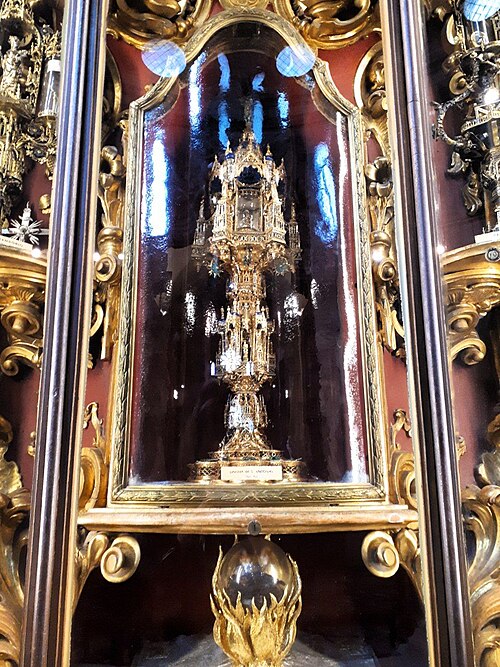
At a festive Mass in the Turin Oratory, the newly prepared Hosts were missing: Giuseppe Buzzetti had forgotten to place them on the altar in time. When Don Bosco noticed the small supply in the ciborium, he looked toward heaven and continued distributing Communion. All the young people received a whole consecrated Host. Buzzetti later testified repeatedly to the event; Lemoyne also transmits Don Bosco's explicit confirmation from 1863. The multiplication of the Hosts led the saint himself to the greater mystery of consecration. The miracle served the young people he had prepared for Holy Communion.
Giuseppe Buzzetti testified that the small supply of consecrated Hosts sufficed for all the communicants. Lemoyne describes approximately 650 prepared young people and the distribution of whole Hosts; the source gives no exact initial number.
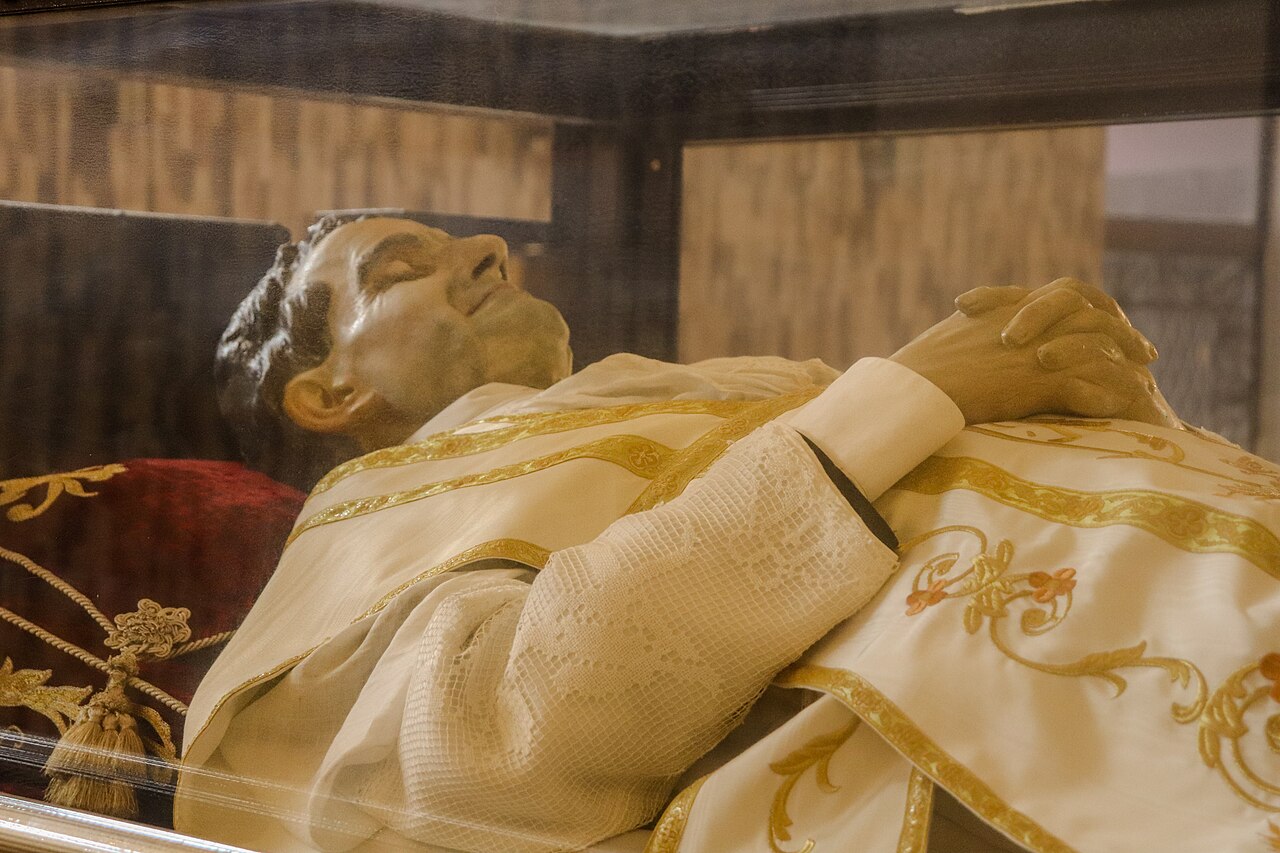
The Forgotten Hosts and the Festive Mass
Giovanni Battista Lemoyne preserves the account in volume III of the Memorie biografiche, in the context of the events of 1848. A major feast was being celebrated at the Oratory, perhaps the Nativity of Mary according to his account. Don Bosco had prepared many young people for confession and Communion. He began Mass trusting that enough consecrated Hosts were ready in the tabernacle. Giuseppe Buzzetti, however, had forgotten to place the additional vessel of unconsecrated Hosts on the altar. Only after the elevation did he notice his omission; it was now too late for the consecration of those Hosts.[1]
During the distribution of Communion, Don Bosco noticed the shortage. He looked toward heaven and continued to give Holy Communion. The Hosts multiplied in his hands; all the young people received a whole particle. After Mass, Buzzetti showed the vessel still standing in the sacristy and explained what he had forgotten. It thus became clear why the available quantity could not have sufficed for the many communicants. The assistant preserved the event in his testimony, which Lemoyne later recorded.[1]
The Miracle Leads to Christ in the Eucharist
When Don Bosco was later asked about his reaction, he pointed to the greater miracle of consecration. The extraordinary distribution directed his gaze toward Christ, who gives himself in the Eucharist. The young people had been prepared for confession and Communion; the miracle served them. The focus thus remained on the sacrament and the young people's salvation. Don Bosco did not turn the gift into an achievement of his own but led those asking back to the Lord's presence.[1]
Sacramental transformation and the multiplication of the Eucharistic species concern different subjects. Through consecration, Christ becomes present; the multiplication here concerns the number of Hosts distributed. Don Bosco's answer connects the two by relating the extraordinary help to the sacrament. The very simplicity of this answer fits his mission: to lead young people in the faith, prepare them for a worthy reception, and entrust them to Christ.[1]
The Details of Number and Date
Lemoyne names approximately 650 young people prepared for Communion. He does not give a securely counted initial quantity of eight or nine Hosts. He also identifies the feast only conjecturally as the Nativity of Mary. The incident therefore belongs in the context around 1848; an exact day cannot be derived from this passage. The later confirmation is different: the conversation with Don Bosco is dated October 18, 1863. This distinction preserves the numbers and dates actually handed down.[1]
Buzzetti and Don Bosco's Confirmation
Giuseppe Buzzetti is the assistant known by name and the direct observer of the sequence. According to Lemoyne, he repeatedly told friends about his omission and the subsequent distribution and was willing to confirm his testimony under oath. Lemoyne counts himself among these later listeners. The route of transmission is thus specifically named: from the assistant involved to the biographer. The young people present belong to the event, but their approximate number is not also the number of surviving individual examinations.[1]
For October 18, 1863, Lemoyne records a conversation between Don Bosco and several clerics. They asked him about Buzzetti's account. Don Bosco confirmed that only a few Hosts had been available and yet everyone had received Holy Communion. This explicit confirmation by the celebrant strengthens the assistant's testimony. It is conveyed through Lemoyne's biography. The passage offers no handwritten account from the day of the festive Mass but names the participants, occasion, and date of the later inquiry.[1]
Lemoyne's Work on the Memories
Volume III appeared in 1903. Lemoyne's extensive biography preserves memories and documents from Don Bosco's circle and places them in the context of his life. The Salesian Arthur Lenti has examined its sources and composition. For the multiplication of the Hosts, three times must be distinguished: the festive Mass around 1848, the confirming conversation of 1863, and the printed publication of 1903. Lemoyne's closeness to the participants and his work as a collector are strengths; the later editorial form must likewise be considered in historical assessment.[1][2]
What the Specific Body of Testimony Supports
The incident can be examined through the named people, the vessels described, the whole Hosts distributed, and the later confirmation. The account records an unusual discrepancy between supply and distribution and names the assistant who had caused and noticed the shortage. Independent signed inventory lists before and after Mass are not present in the source used. Assessment therefore rests on the credibility of personal testimony and its transmission. The concrete details permit more extensive examination than an anonymous report would.[1]
Reception Within the Testimony of Don Bosco's Life
Pius XI canonized Don Bosco on April 1, 1934. The papal document honors his life and mission to young people. Lemoyne himself explains in his work's preliminary note that he recounts extraordinary events with a claim to human credibility and subject to the Church's judgment. The multiplication of the Hosts also stands within this framework. On the basis of the named witnesses, there are reasoned grounds for considering it credible. Canonization concerns Don Bosco's whole person and mission and does not replace a separate quantitative examination of this individual event.[1][3]
Witnesses & Investigators
Giuseppe Buzzetti
Named assistant and reported eyewitness
Forgot the vessel of new Hosts, observed the distribution, and later repeatedly affirmed the sequence to friends.[1]
Giovanni Bosco
Celebrant and later confirming narrator
According to Lemoyne's account, confirmed on October 18, 1863, that the small supply had nevertheless sufficed for all communicants.[1]
Giovanni Battista Lemoyne
Biographer and listener to Buzzetti
Transmits the testimony; does not describe himself as an eyewitness to the multiplication at the time.[1][2]
The unfolding story
- Festive Mass in the Oratory
Lemoyne places the multiplication in this period; the feast is named only conjecturally.[1]
- Buzzetti Explains the Omission
According to the tradition, he shows the vessel left standing in the sacristy.[1]
- Don Bosco's Confirmation
Lemoyne records the conversation in which Don Bosco confirms the distribution despite the small supply.[1]
- Volume III Appears
Lemoyne publishes the detailed account on pages 441–442.[1]
- Canonization
Pius XI canonizes Don Bosco and honors his mission to young people.[3]
Ecclesiastical assessment
Don Bosco has been a canonized saint since 1934. The multiplication of the Hosts discussed here is transmitted in his biography; canonization is not a separate historical or scientific authentication of every detail of this episode.
Objections & Answers
Could the supply of Hosts have been underestimated or replenished?
The account gives three concrete counterarguments: the ciborium was nearly empty, the young people received whole Hosts, and the forgotten vessel was still in the sacristy after Mass. Buzzetti, whose omission had caused the shortage, testified to the sequence; Don Bosco later confirmed it. Anyone accepting these statements as reliable cannot explain the event through simple replenishment. An independently signed inventory, however, has not survived. The case's strength therefore lies in the participants' specific testimony and its later confirmation, not in a retrospectively measurable material balance.[1]
Does publication in 1903 make the account implausible?
The publication date alone does not refute an older testimony. Lemoyne names Buzzetti as the assistant involved and counts himself among those to whom he repeatedly described the event. He also transmits a confirmation by Don Bosco dated to 1863. These concrete details are positive reasons for credibility. The interval nevertheless calls for examination of notes, memories, and editorial synthesis. Lenti's investigation helps place Lemoyne's source work in context. An appropriate assessment appreciates the named participants and the traceable route of remembrance while also considering the later biographical form.[1][2]
Meaning for faith
The multiplication of the Hosts at Valdocco is concretely documented through Giuseppe Buzzetti's testimony and Don Bosco's explicitly transmitted confirmation. The later biographical mediation determines its historical source value. The miracle leads to its true center: Christ in the Eucharist and the young people to whom Don Bosco gave Holy Communion.[1][2][3]
How Miracles in the Lives of the Saints Are Examined
Stigmata, bilocation, and material changes require different examinations.
Methods of examination and ecclesiastical procedure →Sources & Evidence
Information on accessibility and scope helps you assess the evidence for yourself.
- [1] Memorie biografiche di Don Giovanni Bosco, Volume III
Public-domain source text: approximately 650 young people, a few Hosts without an exact initial number, feast only conjectured; no contemporaneous technical investigation.
Open source · donboscosanto.eu ↗ - [2] Don Bosco’s Boswell: John Baptist Lemoyne—The Man and His Work
Historical contextualization of source and editorial work, not the author's own eyewitness confirmation of the multiplication of the Hosts.
Open source · journal.salesianstudies.org ↗ - [3] Geminata laetitia: Decretal Letter for the Canonization of Giovanni Bosco
Primary source for canonization; its legal statement is not extended to every biographical episode.
Open source · vatican.va ↗