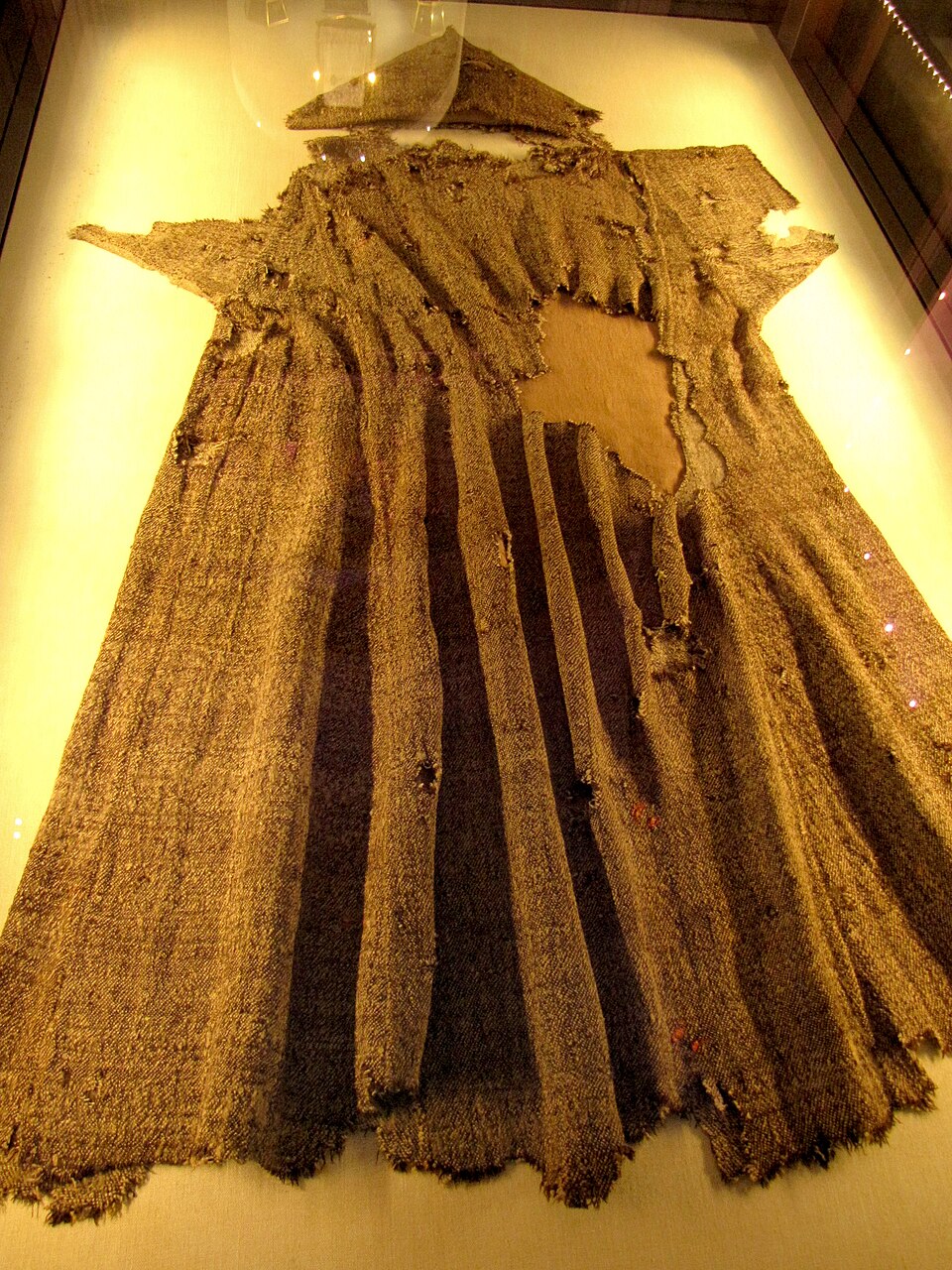
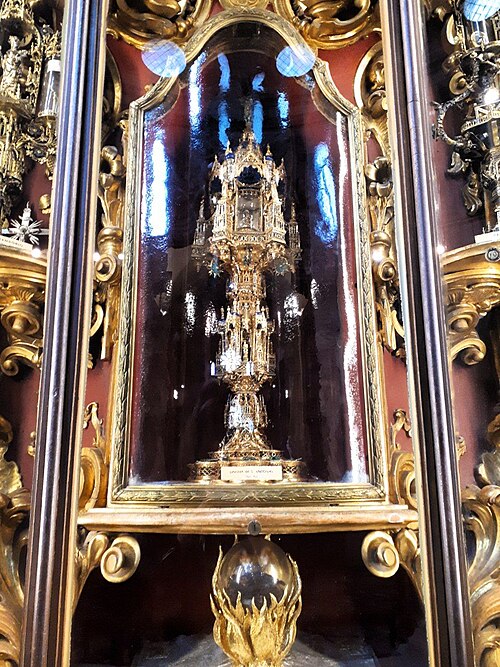
Saint Helena ordered a search for Christ's cross in Jerusalem. The ecclesiastical historian Socrates records the discovery of three crosses and the healing of a dying woman: when she touched the Lord's cross, she immediately became well. Bishop Macarius recognized in this the answer to the question of which cross Christ had carried. Already in the fourth century, Cyril of Jerusalem attests to the distribution of wood of the cross; the pilgrim Egeria describes its public veneration. These early testimonies anchor devotion to the cross in the ancient Church. Veneration is directed toward the Redeemer who died for humanity on this wood.
Socrates of Constantinople records that Helena found three crosses in Jerusalem and that Christ's cross was recognized through the immediate healing of a dying woman. Earlier sources already attest in the fourth century to the preservation, distribution, and public veneration of wood of the cross.
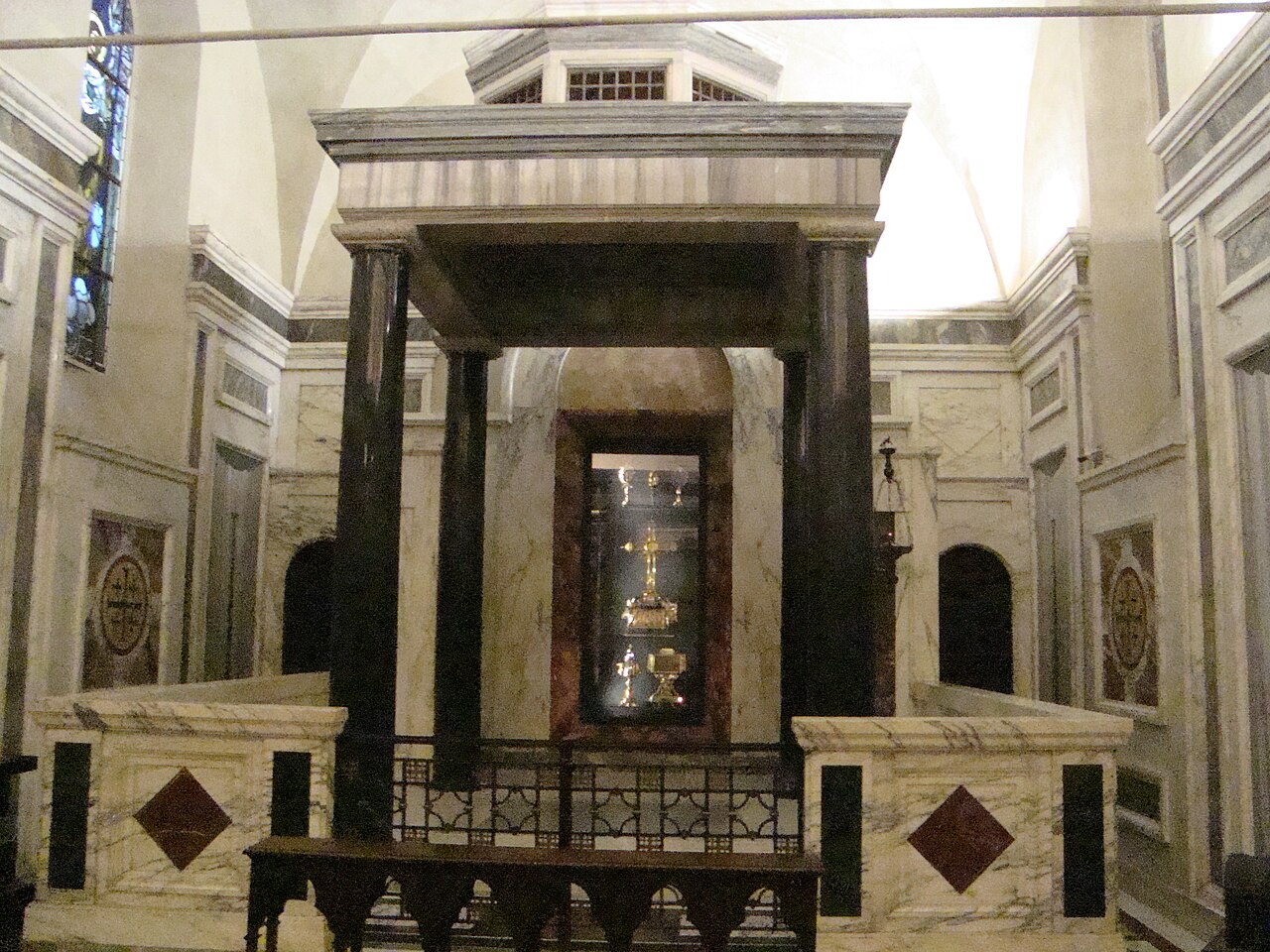
Three Crosses and the Healing of the Dying Woman
Socrates of Constantinople describes the sequence in his Ecclesiastical History. Helena had the buried site of the tomb uncovered. Three crosses and Pilate's inscription were found. Since the Lord's cross could not yet be securely identified, Bishop Macarius arranged a test on a seriously ill woman close to death. The first two crosses produced no change. When the third touched her, she immediately became well. The healing gave the answer: this was Christ's cross. Thus Socrates transmits the discovery and the miracle that confirmed its identification.[4]
Socrates wrote in the fifth century. His account preserves the detailed sequence with Macarius and the healed woman. An earlier version in Ambrose places the inscription at the center of identification. Both belong to the ancient ecclesiastical tradition of Helena's search but do not transmit the same details. The healing miracle is therefore presented according to Socrates's version with its own source reference; the woman's name and medical diagnosis are not preserved in it.[3][4]
Helena Recognizes the King on the Cross
In his funeral oration for Theodosius in 395, Ambrose speaks of Helena's search. She finds three instruments of execution and recognizes the King's cross through the inscription. The Doctor of the Church also explains the direction of her veneration: she adores the one who hung on the cross, not the wood as a god. This early Western account connects the discovery with a clear profession of Christ. The visible object leads to the Redeemer. His earthly Passion and the hope of faith stand at the center of remembrance of Helena's discovery.[3]
The Cross as the Sign of Salvation
Cyril proclaims the cross together with the Resurrection. Christ's suffering is the Redeemer's real self-giving for humanity. Christians therefore preserved the places and objects of his Passion: salvation occurred in history, at particular places and in the Lord's body. Ambrose makes clear to whom veneration is directed. The wood leads to the Crucified and Risen One. Helena's search and the early veneration of the cross stand within this movement of faith: recognizing the Redeemer, thanking him, and entrusting oneself to his saving love.[2][3]
The Holy Places and the Early Testimony to the Cross
In the Vita Constantini, Eusebius describes the uncovering of the tomb, Constantine's church construction, and Helena's journey. He reports her charity and foundations in Bethlehem and on the Mount of Olives. He thus offers an early historical framework for the opening up of the holy places in the Constantinian period. He does not recount Helena's discovery of the cross in these passages. His silence must be considered in reconstructing the precise sequence of discovery; his positive details also establish important circumstances of her journey and the building activity of the time.[1]
In his thirteenth catechesis, Cyril of Jerusalem explicitly attests to the wood of the cross and the distribution of portions throughout the world. Already in the fourth century, he speaks at the place of the Passion about a current practice. This early testimony shows that veneration of the wood of the cross did not originate only in medieval accounts. Cyril knows the object and its distribution. His statement establishes the devotion to the cross at that time, while the history of individual particles and the detailed discovery scene require additional sources.[2]
Egeria Sees the Veneration of the Cross in Jerusalem
The pilgrim Egeria describes Jerusalem's late fourth-century Good Friday liturgy from personal observation. A silver-gilt container was opened, and the wood of the cross and inscription were placed on a table. The bishop held the wood, deacons guarded it, and the faithful approached one by one to venerate it. Egeria explains the guard through an incident told to her in which a visitor had bitten off a piece. Her account thus distinguishes the observed rite from supplementary information she received locally.[5]
This concrete description carries particular weight. It shows a preserved object under ecclesiastical supervision and its publicly ordered veneration. Egeria attests to the observance she herself saw; she did not experience the discovery, placed around half a century earlier. Her text complements Cyril's earlier testimony with the precise course of the liturgy. For early veneration of the cross, there is thus a combination of local proclamation and a pilgrim's personal account.[5]
Helena and the Veneration of the Holy Cross
Helena is venerated as a saint in Catholic tradition; her Western memorial is August 18. Ecclesiastical accounts preserve her connection with the finding of the cross. Veneration leads to Christ's redemptive death as attested in the Gospel. The differing details of the ancient authors can be identified with their respective sources. Through Helena and the relics, the Church remembers the Lord himself. Examination of an individual detail of the discovery or a particular fragment of wood concerns the historical access to this memory.[7][3]
The Sources and the Provenance of Individual Relics
The texts can be compared according to date and content. Cyril and Egeria provide the early evidence for devotion to the cross; Ambrose and Socrates reveal different versions of the discovery. Jan Willem Drijvers examines these late antique branches of tradition and their further development. Such textual history determines which detail appears in which source. It does not scientifically refute a miracle but limits or strengthens specific historical statements through the actual body of texts.[6]
For an individual particle of the cross, transfers, containers, and provenance documents must also be examined. Great material age alone does not identify a piece as Jesus's cross; conversely, the absence of modern analysis does not prove inauthenticity. Early general veneration and the provenance of each fragment existing today are different subjects of investigation. For the healing in Socrates, an ecclesiastical historical account is available. A retrospective clinical examination of the woman it mentions is not possible from it.[1][2][4][5]
Witnesses & Investigators
Eusebius of Caesarea
Early ecclesiastical historian
Attests to the uncovering of the tomb, the imperial church buildings, and Helena's journey; the discovery itself is not narrated there.[1]
Cyril of Jerusalem
Witness to early devotion to the cross
Attests to wood of the cross at the place of the Passion and its distribution already in the fourth century.[2]
Egeria
Pilgrim and observer of the liturgy
Describes veneration of the cross in Jerusalem from personal observation, not the original discovery.[5]
Macarius of Jerusalem
Bishop within the later narrative
According to Socrates, arranges the testing of the three crosses on the dying woman.[4]
The unfolding story
- The Holy Places Are Opened Up
Eusebius describes the uncovering of the tomb and the imperial church buildings.[1]
- Helena's Journey
Eusebius describes her journey to the eastern provinces and Palestine; the precise chronology is a subject of historical research.[1][6]
- Cyril's Catecheses
The Jerusalem teacher refers to distributed portions of the wood of the cross.[2]
- Egeria's Observations
The pilgrim describes public veneration of the cross on Good Friday.[5]
- Ambrose on Helena
The funeral oration for Theodosius connects the finding of the cross with the inscription.[3]
- Detailed Miracle Account
Socrates recounts Macarius, the three crosses, and the dying woman healed immediately.[4]
Ecclesiastical assessment
Veneration of the Holy Cross and Saint Helena is established in the Church. The individual variants of the discovery narrative and the authenticity of every wooden relic later so designated are not thereby equally authenticated historically or scientifically.
Objections & Answers
Does Eusebius's silence refute the finding of the cross?
Eusebius does not recount the finding of the cross in the passages used, although he extensively honors Helena's journey and the imperial buildings. This is a serious historical question. Silence, however, is not an explicit counteraccount. The early positive evidence of veneration of the cross comes from Cyril and Egeria: they attest to the wood of the cross and its concrete public veneration already in the fourth century. In 395, Ambrose explicitly connects Helena with the discovery. The tradition is thus rooted early. The precise sequence of the healing test in Socrates is attested later and must be assessed with this source situation in view.[1][2][5]
Is veneration of the cross the worship of wood?
Ambrose explicitly answers this objection: veneration is directed toward Christ, who hung on the cross. The wood is not worshiped as an independent deity. Through the object, the bodily gesture is directed toward the Redeemer and his historical sacrifice. Egeria describes the corresponding ordered liturgy. The healing in Socrates likewise appears as God's answer, not as an independently available power of arbitrary pieces of wood. Veneration of the cross and examination of an individual relic's provenance can therefore go together. The center is the crucified and risen Lord.[2][3][4][5]
Meaning for faith
The early veneration of the wood of the cross is powerfully attested by Cyril and Egeria. Ambrose and Socrates preserve the ancient tradition of Helena's discovery; Socrates describes the immediate healing through which the cross was recognized. The sources have differing proximity and details, but together they lead to the center of veneration: Jesus Christ, who accomplished humanity's salvation on the cross.[1][2][3][4][5]
How Miracles in the Lives of the Saints Are Examined
Stigmata, bilocation, and material changes require different examinations.
Methods of examination and ecclesiastical procedure →Sources & Evidence
Information on accessibility and scope helps you assess the evidence for yourself.
- [1] Vita Constantini, Book III
Public-domain primary text in historical translation: uncovering of the tomb, buildings, and Helena, without an account of the finding of the cross.
Open source · newadvent.org ↗ - [2] Thirteenth Baptismal Catechesis
Early testimony to veneration of the wood of the cross and its theological interpretation.
Open source · newadvent.org ↗ - [3] De obitu Theodosii oratio
Latin primary text; identification through the inscription, veneration of Christ rather than deification of the wood.
Open source · monumenta.ch ↗ - [4] Ecclesiastical History, Book I
Later detailed version: three crosses, Macarius, and the healing of an unnamed woman.
Open source · newadvent.org ↗ - [5] The Pilgrimage of Etheria
Public-domain travel account: observed Good Friday veneration in Jerusalem, not eyewitness testimony to the discovery.
Open source · ccel.org ↗ - [6] Helena Augusta
Modern historical distinction between branches of tradition; not a material examination.
Open source · roman-emperors.sites.luc.edu ↗ - [7] Sant’Elena, imperatrice
Current ecclesiastical reception of the Helena tradition, not a retrospective scientific assessment.
Open source · vaticannews.va ↗