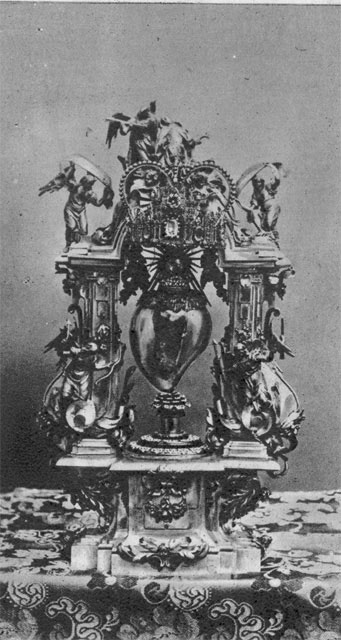
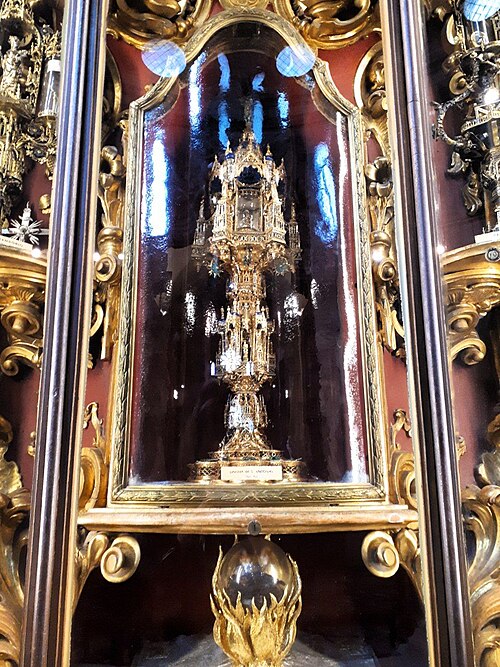
Joseph of Copertino was repeatedly raised from the ground during prayer. People from his circle testified to this in ecclesiastical proceedings. The elevations were associated with profound ecstatic states that could be triggered by religious words, music, or Holy Mass. The Franciscan did not seek public attention; the events also led to investigations, transfers, and restrictions. His humility and obedience shaped his response. The surviving body of testimony makes the levitations a historical case open to concrete investigation.
Witnesses from Joseph's circle describe repeated elevations from the ground and movements through the air without visible support during ecstatic states. Their statements were collected in ecclesiastical proceedings and form the case's historical foundation.
Joseph's Path into the Order
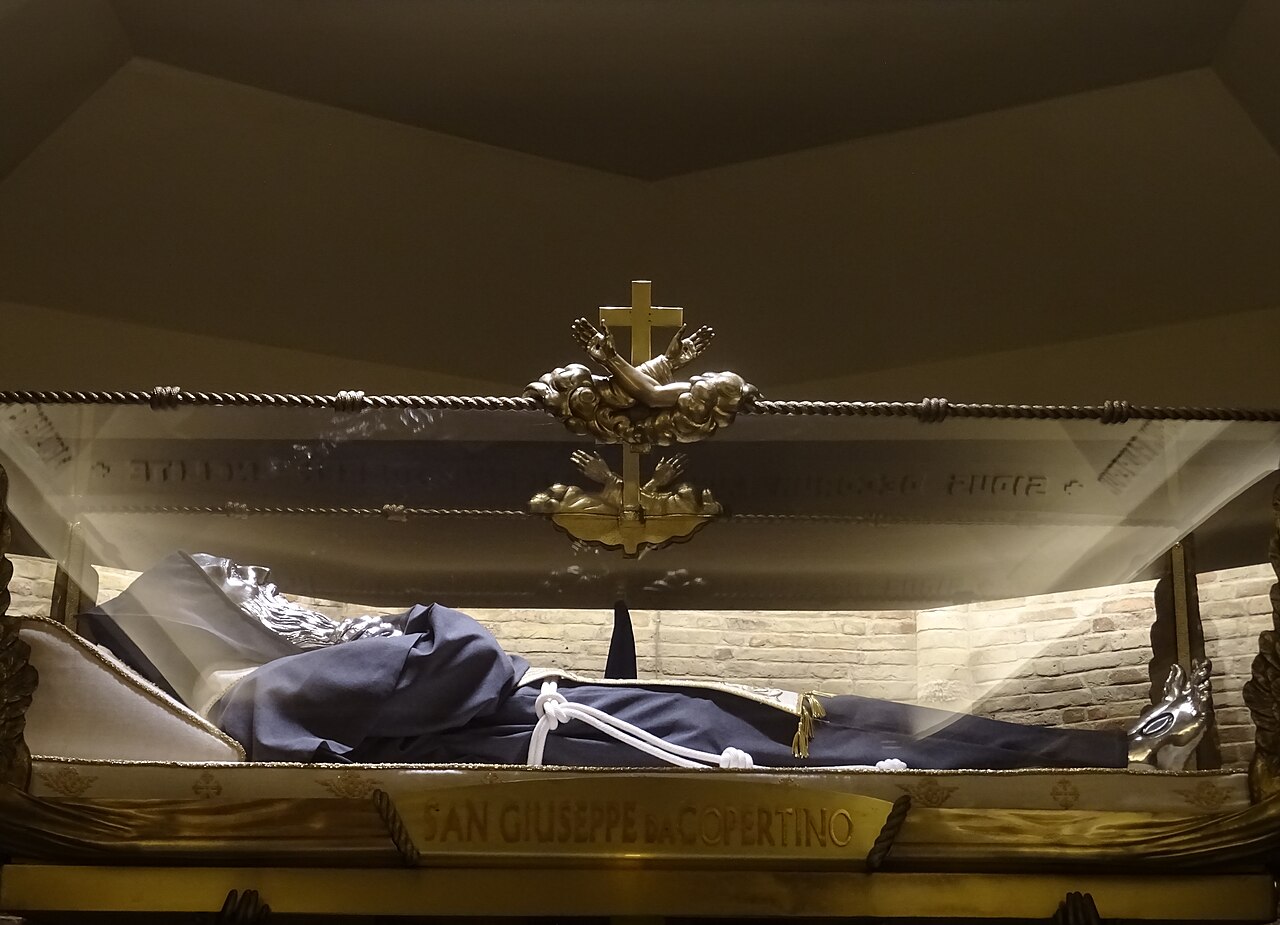
Joseph Desa was born in Copertino in 1603. His path into religious life was arduous. After an unsuccessful attempt with the Capuchins, he was accepted by the Conventual Franciscans. The early biography describes his limited schooling and practical clumsiness as well as his devotion to God. He was ordained a priest in 1628. The extraordinary states appeared within this unassuming religious life. The Church's tradition of his life sets them alongside his humility, patience, and willingness to entrust himself to his superiors' guidance. These qualities also shape his response to the later elevations.[1]
Raised During Prayer and Holy Mass
The early accounts describe how religious words, music, or the celebration of Mass led Joseph into profound absorption. He then scarcely responded to his surroundings. In such states, witnesses saw him raised from the ground or cover unusual distances through the air. The statement concerns an external bodily movement observed by those present. Ecstasy and elevation belong together in the account but designate different occurrences: the saint's deep recollection on the one hand and his visible movement on the other. These concrete observations were later recorded in ecclesiastical proceedings.[1]
Examination, Transfers, and Hiddenness
The events attracted attention and made Joseph's ordinary religious life difficult. Ecclesiastical investigations and concern for orderly worship led to restricted public appearances and transfers. Joseph lived in Assisi, among other places, and finally in Osimo. He accepted these restrictions in obedience. The transmitted course shows that those responsible approached the extraordinary accounts with scrutiny. For Joseph, they became a burden he bore patiently. His witness of life therefore connects the graces received with a long testing in humility and self-effacement.[1][2]
Devotion and Faithfulness in Religious Life
The Church venerates Joseph for his holy life. Within it, the elevations stand as extraordinary graces connected with prayer and self-giving. He did not treat them as an ability to be demonstrated. His patience under restrictions and fidelity to his superiors show the direction of his discipleship. Here also lies the spiritual meaning of the miracles handed down: God acts upon a person who entrusts himself to him. Those who venerate Joseph find an example of prayer, humility, and steadfastness. The historical testimonies provide access to the external events, while the whole life makes their religious context visible.[1][2]
Sworn Statements About the Events Observed
The old ecclesiastical proceedings collected statements from people who had known Joseph. A study published in 2026 by Daniel Costa and Stefano Chiozza evaluated 103 sworn eyewitness statements from a published selection of these sources. It considered descriptions both with and without movements through the air. The number denotes historical statements, not controlled experiments. It nevertheless makes clear the extent of a concrete body of testimony. The modern work returns the discussion to the described sequences and their common features and permits a closer comparison of individual observations.[3]
Witnesses & Investigators
Brigida Preite and Matteo Macchia
Witnesses named in the modern source analysis
Their statements are presented in tables with occupation, age, and the scene reported; their recollections were retrospective.[3]
Ecclesiastical investigators and religious superiors
Examination and oversight
Assessed the person, conduct, and public effects; their work was not a modern program of physical experiments.[1]
The unfolding story
- Birth
Joseph Desa is born in Copertino.[1]
- Ordination to the Priesthood
He is ordained a priest in the Franciscan order.[1]
- Ecstasies and Elevations
Witnesses observe extraordinary states and elevations; the Church investigates the events.[1]
- Death in Osimo
Joseph dies on September 18.[1]
- Beatification and Canonization
The Church confirms his veneration.[2]
- New Historical Assessment
A study examines the descriptions in old witness statements.[3]
Ecclesiastical assessment
Joseph was beatified in 1753 and canonized in 1767. Accounts of elevations belong to the Church's tradition of his life and to the collected witness statements. No present-day experimental confirmation of every claimed height or distance traveled is inferred from this here.
Are Jumps or Hidden Supports Sufficient Explanations?
Joe Nickell considers jumps, concealed foot positions, holding onto objects, and later changes in memory. A long habit can make a bodily posture difficult to assess. These possibilities, however, must be applied to each specific scene. The word jump does not readily explain a statement about a prolonged unsupported elevation; a proposed support must fit the surroundings described. The hypotheses must therefore be tested for their actual explanatory power. Without such demonstration, they are possible objections, not an already proven refutation of the entire body of testimony.[4]
What a Neurological Assessment Can Achieve
Costa and Chiozza found recurring descriptions that may be compatible with known neurological seizure features. They expressly made no retrospective diagnosis. Their investigation also found a particular deception model inadequate. The questions thus remain properly distinct: an explanation of the ecstatic state is not yet an explanation of an actually observed unsupported elevation. Nor does an inadequate deception hypothesis prove supernatural origin by itself. Above all, the study strengthens precise work on the sources and examination of which explanation actually accounts for which statement.[3]
Objections & Answers
Could several witnesses have been mistaken?
Several people can misjudge the same event. Visibility, duration, distance, and the time of the statement therefore matter. The general possibility of error, however, is not evidence that all the specific statements are false. For Joseph, there is an extensive body of named testimonies, some given under oath. These must be compared individually: what movement was actually seen, under what circumstances, and for how long? Well-described cases carry more weight than later vague summaries. A positive historical assessment can rest on this quality without indiscriminately confirming every reported height or distance.[1][4]
Does a neurological condition explain the levitations?
A possible natural explanation for the absorption initially answers the question of Joseph's state. It does not yet explain whether an external elevation was correctly observed or what caused it. That must be examined separately through each testimony. The earlier biography connects the events with prayer, conduct of life, and ecclesiastical oversight. A diagnosis from afar cannot replace this source work. Conversely, an unexplained state alone is not complete proof of a miracle. Assessment must bring together the described inner state, external movement, and overall religious context with their respective grounds.[1]
Meaning for faith
Joseph's levitations are accessible through an extensive, specifically identified historical body of testimony. General references to jumps or neurological states do not replace explanations of individual observations. The Church's tradition of his life connects the elevations with prayer, humility, and obedience; their credibility and spiritual significance lie within this context.[1][2]
How Miracles in the Lives of the Saints Are Examined
Stigmata, bilocation, and material changes require different examinations.
Methods of examination and ecclesiastical procedure →Sources & Evidence
Information on accessibility and scope helps you assess the evidence for yourself.
- [1] St. Joseph of Cupertino
Public-domain historical biography; individual miracle accounts are identified as tradition.
Open source · newadvent.org ↗ - [2] S. José de Cupertino, sacerdote franciscano
Institutional account of his veneration.
Open source · vaticannews.va ↗ - [3] Surprising epileptic semiology in seventeenth-century beatification testimonies: A neuropsychiatric analysis of St. Joseph of Copertino
Original study of published historical statements; not a clinical diagnosis or a present-day levitation test.
Open source · pmc.ncbi.nlm.nih.gov ↗ - [4] Secrets of “The Flying Friar”: Did St. Joseph of Copertino Really Levitate?
Skeptical historical argument; not an experimental repetition of all individual cases.
Open source · skepticalinquirer.org ↗