On April 1, 1375, after Holy Communion in Santa Cristina in Pisa, Catherine of Siena received the wounds of Christ. Her confessor Raymond of Capua was present and recorded the sequence. Catherine saw the Crucified One in great light; five rays struck her hands, feet, and heart. At her request, the wounds remained hidden. She continued to bear their pain while her life belonged to prayer, the sick, and service to the Church. Raymond's account preserves both his observations and the subsequent conversation in which Catherine explained the grace she had received.
Catherine testified to her confessor that five rays from Christ's wounds struck her hands, feet, and heart. She asked for outwardly invisible wounds. Raymond of Capua observed the event after Communion and transmitted her subsequent explanation.
After Communion in Santa Cristina
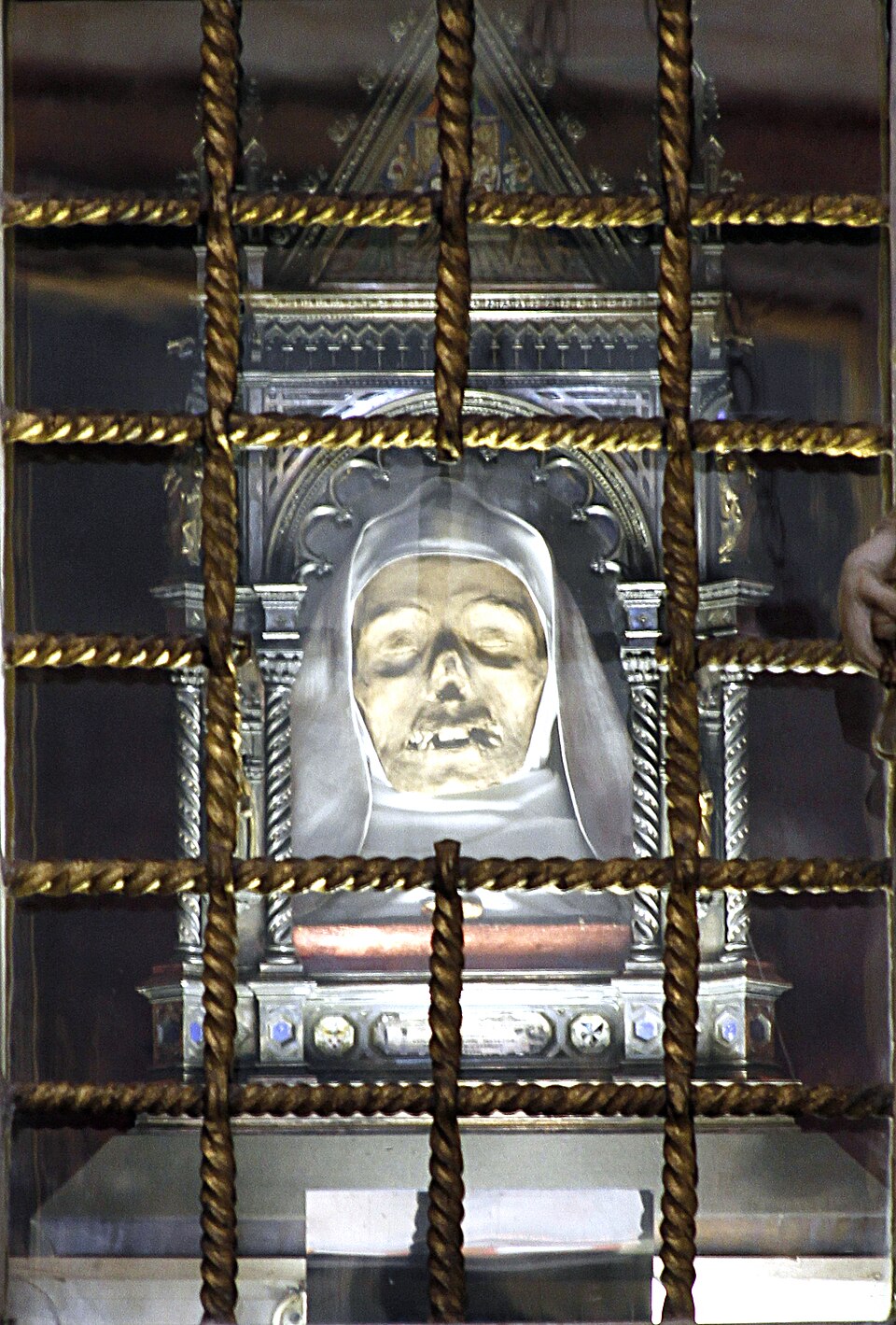
Raymond of Capua describes the event in his life of Catherine. He was staying with her and other companions in Pisa. At her request, he celebrated Holy Mass in Santa Cristina and gave her Communion. Afterward, she remained in deep recollection for a long time. Those waiting saw her rise onto her knees, spread her arms, and remain with closed eyes. Finally, she collapsed. Raymond was present and recorded these observations. Catherine received the stigmata during this time of prayer; afterward, she confided to him what had happened to her.[1]
The Five Rays from Christ's Wounds
Catherine had Raymond called to her and spoke softly of the wounds she had received. In response to his question, she described Christ on the cross in great light. Five rays, initially blood-red, proceeded from his wounds and were directed toward her. Catherine asked that the wounds remain outwardly hidden. Before the rays touched her, they became bright light. They struck her hands, feet, and heart. Raymond asked about the side of the body affected; Catherine named the left side of the heart and explained her orientation toward the cross. The transmitted dialogue records these details.[1]
The Hidden Wounds and Her Companions' Concern
Catherine was weakened after the event and fainted again at their lodging. Her companions feared losing her and asked her to pray for a longer life among them. Catherine replied that she wished to accept God's will. The following Sunday, Raymond saw her markedly stronger. She explained that the wounds remained but would no longer exhaust her in the same way. The grace connected her participation in Christ's suffering with further service to the people entrusted to her.[1]
Suffering with Christ and Serving the Church
Catherine was canonized in 1461. Her care for the sick, her letters, her prayer, and her commitment to the Church show the direction of her life. The hidden stigmata belong to this self-giving. Sharing in Christ's suffering led her to love and concern for the salvation of others. Her desire for hiddenness fits precisely with this service. The grace's significance lies in union with Christ, whose fruits become visible in life. The Church's veneration of Catherine remembers the wounds within this whole portrait of the saint.[1][2]
Raymond of Capua as a Close Witness
Raymond was Catherine's confessor and companion. He completed the Legenda maior around 1395, after her death, and could draw on his own presence and conversations for many events. In the Pisa episode, he distinguishes what he saw from what Catherine explained to him afterward. This precise attribution gives the account its particular weight. Thomas Caffarini collected further early traditions; witnesses were later examined in the Castello process. These sources deepen knowledge of Catherine's life. For the inner vision of the rays, her own testimony preserved by Raymond remains the immediate foundation.[1][2]
The Crucifix and the Memory of Pisa
The shrine in Siena preserves the connection with the crucifix before which Catherine prayed in Pisa. The shrine's account associates it with the stigmatization and records its transfer to Siena in 1565. A concrete object from her world of prayer thus survives. The relationship between cross, place, and life account roots the veneration historically. Through this provenance, the crucifix complements the written tradition; it is not an instrument for measuring the rays of light. In accordance with Catherine's request, the wounds were hidden and are therefore known above all through her testimony and Raymond's account.[3]
Witnesses & Investigators
Raymond of Capua
Confessor and narrator present at the event
Attests to the posture observed and the subsequent dialogue; he knows of the rays of light from Catherine's own statement.[1]
Catherine of Siena
Person healed
Reports the vision, the invisible wounds, and the pain.[1]
Catherine's companions
Community present
Observed Catherine's weakness, were concerned for her, and together asked for her continued service.[1]
The unfolding story
- Birth in Siena
Catherine grows up in the Benincasa family.[2]
- Stay in Pisa
The stigmatization is dated to April 1.[3]
- Death in Rome
Catherine dies on April 29.[2]
- Legenda maior
Raymond completes his extensive biography.[2]
- Canonization
Pius II canonizes Catherine.[2]
- The Crucifix in Siena
The cross associated with the stigmatization reaches Siena.[3]
Ecclesiastical assessment
The stigmatization is handed down in the Church's veneration of Catherine. According to the account, it specifically does not concern visible wounds publicly examined during her lifetime. Canonization and the Church's recognition of her teaching must be distinguished from a medical finding.
Objections & Answers
How can invisible wounds be attested?
Catherine herself reported the vision, the pain, and her request for hiddenness. Raymond saw her posture and weakness and recorded the subsequent conversation with follow-up questions. There are thus two precisely attributed approaches: his external observation and her personal testimony. Inner pain is not otherwise immediately visible to other people's eyes either. For its supernatural origin, the person's credibility must be assessed within the overall spiritual context. The source offers no medically measured open wounds and makes no such claim. Its strength lies in the close witness and the specifically preserved conversation.[1]
Was Catherine merely portrayed after the model of Francis?
Francis's stigmata belonged to the religious world of her time. This may shape language and comparisons, but it does not prove an invented adaptation. Catherine's account has its own form: the request for invisibility, the rays' transformation into bright light, and Raymond's precise follow-up questions about the side of the heart. These details do not fit a mere transfer of publicly visible wounds. Historical assessment considers the interval before the account was written and Raymond's personal attachment, as well as his closeness to the event. The decisive common theme is discipleship of Christ, which proved itself distinctly in Catherine's service.[1][2]
Meaning for faith
Catherine's hidden stigmata are accessible through her personal testimony and the detailed account of her confessor, who was present. Raymond preserves observation and conversation with precise attribution. The grace leads to participation in Christ's suffering and finds expression in Catherine's love and her service to the Church.[1][2]
How Miracles in the Lives of the Saints Are Examined
Stigmata, bilocation, and material changes require different examinations.
Methods of examination and ecclesiastical procedure →Sources & Evidence
Information on accessibility and scope helps you assess the evidence for yourself.
- [1] La Vie de sainte Catherine de Sienne
Primary testimony of the confessor present; account of Catherine's own explanation.
Open source · bibliotheque-monastique.ch ↗ - [2] St. Catherine of Siena
Public-domain historical overview, not a modern medical judgment.
Open source · newadvent.org ↗ - [3] The Shrine of the House of Saint Catherine
Current institutional account of the place, crucifix, and veneration.
Open source · santacaterina.siena.it ↗