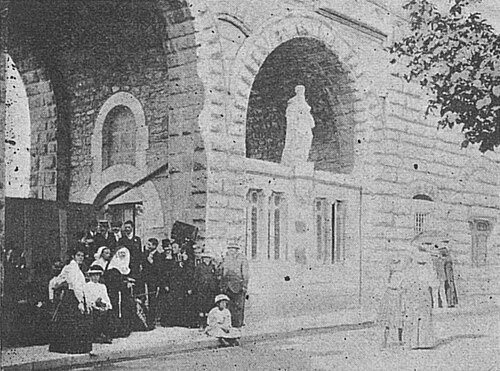
After a fall, Catherine Latapie could use her right hand only to a limited extent. In the early morning of March 1, 1858, the pregnant mother from Loubajac went to the grotto at Lourdes. When she dipped her hand into the spring water, mobility returned. Later that same day, she gave birth to a child at home. Her healing was among the first seven cases recognized by Bishop Laurence in 1862.
Her right hand, impaired since an injury, suddenly became mobile again when immersed in the spring water and remained usable.
Further original photographs from the publisher
The Consequences of the Fall in 1856
Henri Lasserre's early account and the shrine's history describe Latapie's daily life after a fall in 1856. Fingers of her right hand remained immobile. Caring for her family and performing daily manual work were greatly hampered as a result. The impairment was still present when she heard about the events at the grotto in 1858.[1][2]
The accident occurred in October 1856 when she fell from an oak tree. The injury was treated surgically at once; nevertheless, weakness and a fixed deformity of several fingers remained. Repeated treatments brought no change. Lasserre names the tasks she could no longer perform: sewing, spinning, and knitting. These very activities formed part of her ordinary contribution to earning a living and caring for the household.[1]
The Early Morning at the Spring
On March 1, 1858, Latapie set out with her children from the neighboring village of Loubajac for Lourdes. She was heavily pregnant. At the grotto, she prayed and immersed the impaired hand in the spring water. Mobility returned; she could use her fingers again. Afterward, she went home and gave birth to her child that same day.[1][2]
She had risen around three in the morning and taken two of her children with her. At the grotto, they knelt to pray. After immersion, her fingers straightened and could be bent and extended again. Latapie knelt once more and, for the first time since the injury, could join both hands in thanksgiving. She returned with her children to Loubajac, where the birth took place later that day.[1][2]
Caring for Her Family with Both Hands Again
The healing restored an ability essential to Latapie's daily life. She could once again use her right hand for her responsibilities as a mother. This also expresses the human meaning of this early Lourdes case: the recovery concerned a woman's independence and her family's life.[1][2]
Her Testimony and the Commission Record
Lasserre referred to a personal conversation with Latapie. The English publication of 1871 also contains an extract from the commission's fifteenth record. Alongside her personal testimony, information from the early ecclesiastical investigation has thus also been preserved.[1]
What the Investigation at the Time Recorded
The examination concerned the longstanding functional impairment following the injury and the sudden restoration of use. The medical description and statements about Latapie's condition before and after her visit to the spring were assessed in the diocesan proceedings of the time.[1][3]
The reproduced commission extract emphasizes the roughly eighteen-month duration of the impairment and the failure of previous treatments. It then describes the rapid opening and closing of the hand and its continued usability. The examiners also considered that the spring contained ordinary water. Their judgment rested on this comparison between the longstanding condition, previous treatments, and immediate return of function.[1]
One of the First Seven Recognitions
On January 18, 1862, Bishop Bertrand-Sévère Laurence of Tarbes recognized the first seven healings of Lourdes. Catherine Latapie was among them. Her case thus stood at the beginning of the pilgrimage site's history of healings examined by the Church, more than two decades before the permanent Medical Bureau was established in 1883.[3]
Witnesses & Investigators
The unfolding story
- Injury
Previous history given in the early account.[1]
- Journey to the Grotto
Date according to the institutional chronology.[2]
- Diocesan Investigation
Early investigation in connection with Lourdes.[3]
- Recognition
One of the first seven recognized healings.[3]
- English Publication
Lasserre's account appears in The Catholic World.[1]
- Later Institutionalization
Establishment of the permanent Medical Bureau.[3]
Ecclesiastical assessment
The case is among the seven healings recognized by Bishop Bertrand-Sévère Laurence in 1862.
Objections & Answers
How precisely can the anatomy of the hand injury be determined today?
The early texts describe longstanding functional impairment and restored mobility. They provide no modern imaging or measurement of completely severed nerves. Such anatomical details are therefore not added retrospectively. Today's CMIL structure also did not yet exist in 1858; recognition rested on the diocesan proceedings of the time.[1][3]
What source value does Lasserre's religiously committed account have?
Lasserre names a conversation with Latapie and preserves an extract from the commission record. These specific details can be assessed historically. His account connects the healed woman's report with the printed commission extract. The personal testimony, printed record, and official recognition are therefore identified with their respective origins.[1][3]
Meaning for faith
Latapie regained an ability important to her family and daily life. Her healing is preserved in early testimony and a commission extract and belongs to the first seven ecclesiastical recognitions of Lourdes.[1][2][3]
Examining Healings: From Findings to the Church's Judgment
Diagnosis, treatment, the course of healing, and ecclesiastical recognition are examined separately.
Methods of examination and ecclesiastical procedure →Sources & Evidence
Information on accessibility and scope helps you assess the evidence for yourself.
- [1] Our Lady of Lourdes, Part Sixth, V; note 12
Early account reproducing a commission extract and a conversation with Catherine Latapie.
Open source · gutenberg.org ↗ - [2] 25 mars 1858: la Dame dit son nomOpen source · lourdes-france.org ↗
- [3] Le Bureau des Constatations Médicales – histoireOpen source · lourdes-france.com ↗