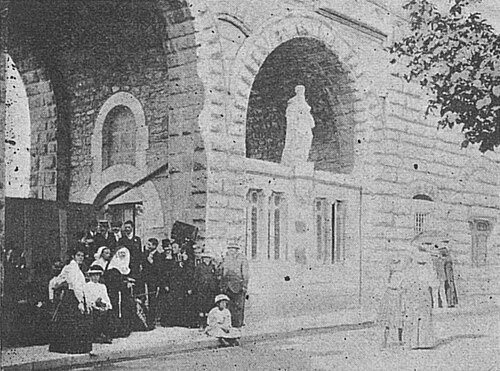
Danila Castelli suffered for years from severe, recurring hypertensive crises. Several operations did not end her symptoms. After bathing in Lourdes on May 4, 1989, she experienced a lasting recovery. Its course was examined over more than two decades; the CMIL assessed it as medically unexplained in 2011. Bishop Giovanni Giudici of Pavia recognized the healing as a miracle in 2013.
The recognized case concerns the complete and lasting end of severe recurring hypertensive crises after a long history of illness and treatment.
Further original photographs from the publisher
Hypertensive Crises despite Repeated Operations
AMIL's medical account describes a wife and mother who had suffered severe hypertensive crises since middle adulthood. From 1982 onward, gynecological findings and later a diagnosis of a catecholamine-producing tumor led to several operations. The procedures performed through 1988 did not eliminate the crises.[1]
Castelli had led an ordinary family life until the age of 34. In 1982, X-rays and ultrasound examinations showed a mass beside the uterus and a uterus with fibroids. Removal of the uterus and its appendages followed, along with partial removal of the pancreas. The following year, scintigraphy led to a diagnosis of a pheochromocytoma in the pelvic region, a tumor producing catecholamines. Further operations sought to remove the lesions held responsible for the hypertensive crises.[1]
Bathing on May 4, 1989
During the Lourdes pilgrimage, Castelli experienced an extraordinary sense of well-being after bathing. The improvement lasted: the previous crises did not return, and she resumed her ordinary life. She soon reported the change to the Medical Bureau.[1]
The medical account places the new sense of well-being after bathing at the beginning of a sustained return to daily life. Despite the previous operations, severe crises had repeatedly occurred up to that point. After the pilgrimage, however, Castelli could again lead her ordinary life as a wife and mother. This lasting change was the subject of her report and the later consultations in Lourdes.[1]
Five Consultations and Many Years of Follow-up
The Bureau considered the case five times between 1989 and 2010. It eventually unanimously found a complete and lasting recovery and saw no sufficient connection with the previous operations and treatments. On November 19, 2011, the CMIL confirmed that the nature of the healing remained unexplained in light of the scientific knowledge available at the time.[1]
The Bureau's individual meetings took place in 1989, 1992, 1994, 1997, and 2010. At the final vote, the physicians looked back on 21 years since the pilgrimage. Their unanimous conclusion concerned recovery from the entire syndrome described and the absence of an adequate explanation through earlier treatments. The CMIL subsequently met in Paris on November 19, 2011.[1]
The Decision of the Bishop of Pavia
Giovanni Giudici declared the healing a miracle and a religious sign on June 20, 2013. The Diocese of Pavia also recorded this event in its tribute to the bishop. Castelli was thus listed as the 69th recognized healing of Lourdes.[2]
Remembrance in the Pilgrimage Community
The UNITALSI community of Pavia also remembers Castelli and her healing. Her story belongs to the local pilgrimage tradition in which volunteers accompany sick people to Lourdes. The lasting reason for gratitude is the return of a previously seriously ill mother to her family life.[1][3]
Witnesses & Investigators
The unfolding story
Ecclesiastical assessment
Bishop Giovanni Giudici of Pavia recognized the healing as a miracle in 2013. In 2011, the CMIL had assessed the nature of the recovery as unexplained in light of the scientific knowledge available at the time.
Objections & Answers
Could the previous operations explain the recovery?
This question was explicitly part of the medical assessment. The earlier operations had not ended the recurring crises; the specialist assessment also found no sufficient connection between treatment and the later lasting change. The public medical summary states this conclusion but does not contain all the surgical reports, hormone findings, and follow-up data. The case concerns healing from the syndrome described, not documented regrowth of organs previously removed.[1]
Why did so many years pass before the judgment?
The consultations from 1989 to 2010 allowed a long observation of her subsequent health. The CMIL's medical opinion of 2011 was followed by the bishop's decision in 2013. The durability of the recovery was thus assessed over a substantial period; the medical assessment and the Church's recognition remained separate steps.[1][2]
Meaning for faith
Years of crises were followed by a lasting recovery in 1989. The physicians also examined the previous treatments. The Bishop of Pavia recognized a miracle and a reason for gratitude in this course of events.[1][2]
Examining Healings: From Findings to the Church's Judgment
Diagnosis, treatment, the course of healing, and ecclesiastical recognition are examined separately.
Methods of examination and ecclesiastical procedure →Sources & Evidence
Information on accessibility and scope helps you assess the evidence for yourself.
- [1] 69. Danila Castelli
Medical and ecclesiastical outline; complete findings not published.
Open source · amilourdes.com ↗ - [2] Mons. Giovanni Giudici: la diretta dal canale YouTubeOpen source · diocesi.pavia.it ↗
- [3] Sabato 7 dicembre l’Unitalsi di Pavia celebra i 100 anni dal primo pellegrinaggio a Lourdes
The organization's own history; the historical total given at the time must not be used as the current figure.
Open source · unitalsi.it ↗