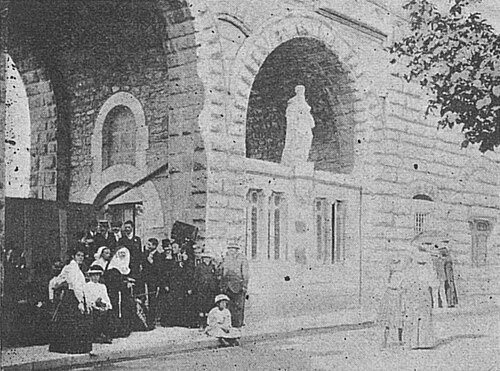
Jean-Pierre Bély was 51 years old and severely disabled by advanced multiple sclerosis when he came to Lourdes for the Rosary Pilgrimage in 1987. There he received the sacraments and regained his mobility. The recovery remained complete and lasting. After many years of medical examinations, Bishop Claude Dagens confirmed the authentic nature of the healing in 1999 and honored it as a gift of God and a sign of Christ.
On October 9, 1987, Bély suddenly, completely, and permanently recovered from the severe disability his treating physicians had attributed to advanced multiple sclerosis.
Further original photographs from the publisher
The Rosary Pilgrimage of 1987
Bishop Claude Dagens's declaration and the shrine's biography describe Bély's path from progressive illness to recovery. He lived with his wife Geneviève and their two children near Angoulême and worked as a nurse. Symptoms of multiple sclerosis began in 1972. His condition worsened year by year; he was assessed as having complete, permanent disability with entitlement to care. In October 1987, he traveled bedridden to Lourdes for the Rosary Pilgrimage.[1][4]
During the pilgrimage, Bély received the Sacrament of Reconciliation and the Anointing of the Sick. After the anointing, he experienced deep inner peace. Then his sense of touch and ability to move suddenly returned. At first, he still did not dare stand up. The following night, he inwardly heard the call to rise and walk, and acted on it. The ecclesiastical chronology gives October 9, 1987, as the day of healing.[1][4]
His restored health endured, while his social benefits classification initially continued to list him as completely disabled. Bély described the event as a healing of his heart followed by physical recovery. The visible change was that the previously bedridden man could move again and be on his feet.[4]
Physicians Followed the Sustained Recovery
The later examinations confirmed the sudden and lasting change. Neurological and psychiatric expert reports were submitted to the Lourdes Bureau and the CMIL over almost ten years. The focus was the striking difference between his advanced disability before the pilgrimage and his complete recovery afterward.[1]
Patrick Theillier and the Case Review
Patrick Theillier, who became head of the Medical Bureau in 1998, presented Bély's case to the CMIL. In an article of his own in 2010, he recalled this involvement and the subsequent recognition in 1999. A physician involved in the later phase of the proceedings can thus also be identified by name.[3]
Theillier thus belonged to the medical phase immediately preceding the ecclesiastical decision. Dagens, for his part, referred to the neurological and psychiatric expert reports submitted over the years and to the commission's consultation in January 1999. This chronological connection explains how the medical dossier entered the published episcopal judgment.[1][3]
Claude Dagens's Judgment
A canonical commission met in Angoulême on January 4, 1999. Dagens publicly recognized the healing on February 9. Celebrations of thanksgiving followed in Lourdes and Angoulême on February 11; Bély attended with family and friends. The bishop interpreted the recovery as a personal gift of God and an effective sign of Christ through the intercession of Our Lady of Lourdes.[1][2]
Sacraments, Prayer, and New Life
Dagens emphasized the connection with the sacraments received and the prayer of the Rosary. For Bély, being physically raised up thus also took on spiritual meaning: he experienced himself as accepted and gifted by God. The public recognition invited his family, his parish, and especially other sick people to share in thanksgiving.[1]
Witnesses & Investigators
The unfolding story
Ecclesiastical assessment
On February 9, 1999, Bishop Claude Dagens publicly recognized the healing as authentic, as a personal gift of God, and as an effective sign of Christ. Lourdes lists Bély as the 66th recognized case.
Objections & Answers
What particular limit does Dagens name in his declaration?
He explicitly writes that the CMIL had not presented absolute medical proof and had requested a separate ecclesiastical judgment. At the same time, the text attests to the sudden, complete, and lasting recovery and states that it falls outside the usual course of the diagnosed illness. The AMIL editorial of 2024 discusses the particular wording of recognition. Classification as the 66th Lourdes case must not obscure this nuance of the original judgment.[1][2]
Can multiple sclerosis not follow a fluctuating course?
Precisely for that reason, the earlier diagnosis, neurological findings, and long-term condition after the pilgrimage were examined. The ecclesiastical document records a complete and lasting recovery, while also naming the limit of absolute proof. The published texts do not contain the entire clinical file; an independent specialist reassessment would need to draw on it.[1]
Meaning for faith
After severe disability, Bély returned to an independent life. Dagens publicly recognized this lasting recovery and placed it in the context of the sacraments, Marian intercession, and thanksgiving.[1][2]
Examining Healings: From Findings to the Church's Judgment
Diagnosis, treatment, the course of healing, and ecclesiastical recognition are examined separately.
Methods of examination and ecclesiastical procedure →Sources & Evidence
Information on accessibility and scope helps you assess the evidence for yourself.
- [1] Miracle à Lourdes – Déclaration au sujet de la guérison de M. Jean-Pierre BélyOpen source · eglise.catholique.fr ↗
- [2] Édito n° 361
Explicitly discusses the nuanced wording of recognition in Bély's case.
Open source · amilourdes.com ↗ - [3] Lourdes 2010, par le Dr Theillier, ancien président du Bureau médicalOpen source · fr.zenit.org ↗
- [4] Guarigioni miracolose – Jean Pierre Bély
Institutional biography on family, profession, medical history, and course of recovery; wording of recognition follows Dagens's original declaration.
Open source · lourdes-france.com ↗