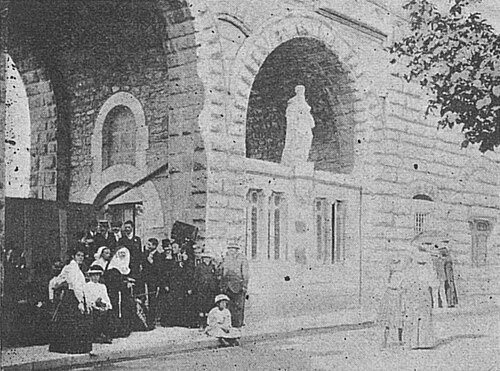
Jeanne Frétel came to Lourdes seriously ill in October 1948. She could barely retain food and could no longer walk. After receiving Communion on October 8, she tolerated milk and later full meals; her severely swollen abdomen returned to normal, and she walked independently again. Cardinal Clément Roques of Rennes recognized the healing as a miracle on November 20, 1950. Frétel later helped sick pilgrims herself.
After an illness diagnosed as tuberculous peritonitis, Frétel permanently regained the ability to retain food, walk independently, and resume daily life during the pilgrimage.
Further original photographs from the publisher
Years of Illness and Unsuccessful Treatments
The contemporary publication from Rennes describes deterioration after an operation in 1938. Dr. Pelé diagnosed tuberculous peritonitis in 1940. Further operations, stays in sanatoriums, and a prolonged trial of streptomycin did not bring recovery. When Frétel set out for Lourdes on October 4, 1948, she was very weak, could no longer walk, and could take only small amounts of fluid.[1]
The illness had caused a severely distended, painful abdomen and persistent vomiting. Frétel could take only small amounts of fluid. The contemporary report mentions three morphine injections a day. The prolonged treatment with streptomycin relieved pain but did not restore her strength. In this serious condition, she depended on others for care and transport.[1]
Communion, First Nourishment, and the Walk to the Grotto
At Mass for the sick on October 8, she received only a small piece of the Host because of her vomiting. Afterward, she could sit up and drink milk without vomiting it back up. Later at the grotto, she noticed that her previously severely distended abdomen was normal again. She ate ordinary meals and walked independently to the baths. She began the journey home in good condition and without her previous painkillers.[1]
The early publication records the day's course step by step: the first milk she could tolerate was followed by a larger meal at noon. In the evening, Frétel could eat normally again. During the night, she woke hungry, ate, and went back to sleep. As her abdomen returned to normal, appetite, food intake, and the strength to walk thus returned together.[1]
Examination of the Sustained Recovery
Back in Rennes, Frétel resumed demanding work. The National Medical Commission considered her healing on March 12, 1950. The later decree took medical statements and the canonical investigation into account. It emphasized the sudden transition from serious illness to lasting health.[1]
The medical notice from the spring of 1950 reports that a physician established her complete recovery after her return to Rennes. Frétel had previously received care as an incurably ill patient. Her subsequent return to physically demanding work was therefore a particularly clear part of the course observed over time.[1]
The Decree of November 20, 1950
Cardinal Clément Émile Roques, Archbishop of Rennes, recognized the miraculous nature of the healing and interpreted it as divine help through the intercession of Our Lady of Lourdes. The decree was printed in full in the ecclesiastical press. Lourdes lists Frétel as the 52nd recognized healing.[1][2]
The Healed Woman Helps a Sick Woman
Pilgrimage helper Bernard Mellerio later recalled his wife Hélène's serious illness. For the pilgrimages of the late 1960s, he expressly thanked Jeanne Frétel and another helper. Her restored strength now benefited people who continued to depend on support.[3]
The Connection with Communion
The beginning of recovery coincided with receiving Communion. The Church's interpretation sees in this a sign of Christ's closeness to the sick woman. Frétel's later service carries this connection forward: the woman who had experienced help herself accompanied people who were suffering.[1][3]
Witnesses & Investigators
The unfolding story
- Beginning of the Medical History
Operation and later diagnosis in the contemporary account.[1]
- Pilgrimage to Lourdes
Journey as a seriously ill patient.[1]
- Healing
Beginning after receiving Communion.[2]
- Medical Consultation
According to the contemporary notice, the National Medical Commission considered the case.[1]
- Episcopal Decree
Recognition in Rennes.[1]
- Service to Others
Mellerio names Frétel as a helper to his wife.[3]
Ecclesiastical assessment
Cardinal Clément Roques's surviving decree is explicitly dated November 20, 1950. It recognizes the miraculous nature of the healing.
Objections & Answers
Was an effect of the earlier treatment considered?
The early source expressly mentions operations and streptomycin. The examination at the time judged that they did not adequately explain the particular, lasting course. A present-day specialist reassessment would require the precise diagnostic, dosage, and follow-up records; the published decree does not contain every individual finding.[1]
Why is this case mentioned in connection with the Eucharist?
Frétel received Communion immediately before the beginning of recovery. The physical event examined concerns her herself. The case contains no investigation of a material change in the Host. Its Eucharistic significance lies in the connection between sacrament, healing, and later service.[1][3]
Meaning for faith
After serious illness, Frétel could eat, walk, and work again. Her healing was examined medically and ecclesiastically and recognized in 1950. Her later service to sick pilgrims shows how help received became new help for others.[1][3]
Examining Healings: From Findings to the Church's Judgment
Diagnosis, treatment, the course of healing, and ecclesiastical recognition are examined separately.
Methods of examination and ecclesiastical procedure →Sources & Evidence
Information on accessibility and scope helps you assess the evidence for yourself.
- [1] Guérisons de Lourdes; Guérison miraculeuse de Mademoiselle Jeanne Frétel
Contemporary reports and complete decree of 20.11.1950; digitized copy, including the date, visually checked.
Open source · diocese-quimper.fr ↗ - [2] Les miracles de Lourdes – Jeanne FrételOpen source · lourdes-france.com ↗
- [3] Souvenirs d’un brancardier
Personal account of later help; editorial biographical footnotes are not adopted as a medical source.
Open source · abiif.com ↗