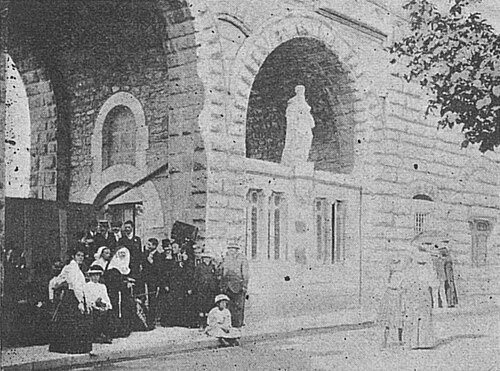
After severe wounds in the First World War, John “Jack” Traynor had lost the use of his right arm and suffered from epileptic seizures and limited mobility in his legs. On July 25, 1923, he was healed during the first Liverpool pilgrimage to Lourdes. Later, he carried sick pilgrims himself. The Church's recognition followed in 2024 after historical medical documents had been brought together again and examined.
The case concerns recovery from severe effects of wartime injuries: regained mobility, a right arm usable again, and the end of previously severe epileptic seizures.
Further original photographs from the publisher
Wounded at Antwerp and Gallipoli
AMIL's medical summary describes Traynor's wounds at Antwerp in 1914 and Gallipoli in 1915. Operations did not help sufficiently. He lost the use of his right arm and suffered severe epileptic seizures. A further operation in 1920 did not end the seizures; afterward, both legs were also partly paralyzed. In this condition, he joined the Archdiocese of Liverpool's first pilgrimage to Lourdes in 1923.[2]
July 25, 1923
After bathing and the Eucharistic procession with the blessing of the sick, Traynor regained his mobility. The pilgrimage group's physicians established the change while still in Lourdes. The following day, he began his journey home. The man who had arrived as a severely disabled patient could walk again and use his right arm.[1][2]
From Patient to Stretcher-Bearer
Traynor returned regularly to Lourdes as a stretcher-bearer until 1939 and belonged to the Liverpool association of helpers. His recovery thus also changed his role within the pilgrimage: he now supported others on a journey during which he himself had previously needed help.[2]
The Physicians and the Report of 1926
In 1926, the Medical Bureau explicitly considered the case. The surviving documents include the report led by Dr. Auguste Vallet and the statements of physicians Azurdia, Finn, and Marley. These documents recorded observations from the time of the pilgrimage and his later state of health. Their rediscovery became decisive for concluding the ecclesiastical proceedings.[1][3]
The three accompanying physicians had examined Traynor both before and after his recovery in 1923. They were involved again in Vallet's examination in July 1926. His French-language report appeared in the Journal de la Grotte in December 1926. According to the archbishop's statement, this report apparently did not reach Liverpool. Between 1913 and 1946, no possible miraculous healings from Lourdes were forwarded to the responsible diocesan bishops at all.[3]
Why Recognition Came Only in 2024
It had long been assumed that the records were insufficient for formal recognition. In 2023 and 2024, Liverpool physician Kieran Moriarty brought together historical evidence. In November 2024, the canonical commission heard him and the head of the Lourdes Bureau, Alessandro de Franciscis. On December 8, Archbishop Malcolm McMahon declared the healing a miracle.[3]
An attempt in 1993 had failed because the contemporary documentation was considered inadequate. The new starting point was Liverpool's anniversary pilgrimage in 2023: de Franciscis asked Moriarty to review the Lourdes file again. The reference to Vallet's publication led to further research, including in the archdiocesan archive. The compiled dossier was forwarded in 2024 through the Bishop of Tarbes and Lourdes. The decisive meeting of the Liverpool commission took place on November 29.[3]
The Basis of the Later Judgment
The judgment of 2024 rested on early medical findings and their present-day archival evaluation. Moriarty examined the historical documentation; the physicians on the original pilgrimage had encountered Traynor personally. This connection gave the proceedings a basis beyond the veneration that had already existed in Liverpool for many years.[3]
Witnesses & Investigators
John Traynor
Person healed
Experienced the change and subsequently continued his public life.[1]
Dr. Auguste Vallet; Drs. Azurdia, Finn, and Marley
Medical examiners
Expert witnesses named in the recognition document.[3]
Dr. Kieran Moriarty
Later reviewer of the records
Reconstructed the historical documentation; not an eyewitness from 1923.[3]
The unfolding story
- Wartime Injuries
Severe wounds in the published medical history.[1]
- Recovery in Lourdes
Observation during the Liverpool pilgrimage.[1]
- Medical Report
Follow-up examination and publication of the medical assessment.[3]
- Archival Review
Moriarty brings contemporary evidence to light.[3]
- Recognition
Archbishop's declaration in Liverpool.[3]
Ecclesiastical assessment
In 2024, Archbishop Malcolm McMahon declared Traynor's healing from several severe conditions a miracle through the intercession of Our Lady of Lourdes.
Objections & Answers
Can a case still be recognized after more than a hundred years?
What mattered here was that medical documents close to the event became available again. The proceedings of 2024 were a renewed historical and ecclesiastical assessment; they were not a clinical investigation running continuously for a hundred years. The public declaration names the underlying reports and the later experts. Some summaries give different July dates for Traynor's presentation in 1926; this discrepancy does not affect the consistently recorded healing date of July 25, 1923.[1][2][3]
Had the healing already been recognized by the Church before 2024?
In Liverpool, Traynor's recovery had long been venerated as a miracle. The formal declaration by the responsible archbishop, however, came only on December 8, 2024. The early public remembrance and the date of official recognition must therefore be distinguished.[3]
Meaning for faith
Traynor's path led from severe consequences of war to a life in which he could help others again. The early medical reports and their rediscovery made formal recognition as the 71st miracle of Lourdes possible in 2024.[2][3]
Examining Healings: From Findings to the Church's Judgment
Diagnosis, treatment, the course of healing, and ecclesiastical recognition are examined separately.
Methods of examination and ecclesiastical procedure →Sources & Evidence
Information on accessibility and scope helps you assess the evidence for yourself.
- [1] John Traynor, 71e miraculé de LourdesOpen source · lourdes-france.com ↗
- [2] 71. Jack/John Traynor
The day given for July 1926 differs from the Sanctuaire page; only the year is deliberately used here.
Open source · amilourdes.com ↗ - [3] Statement on the Case of John TraynorOpen source · lourdes-france.org ↗