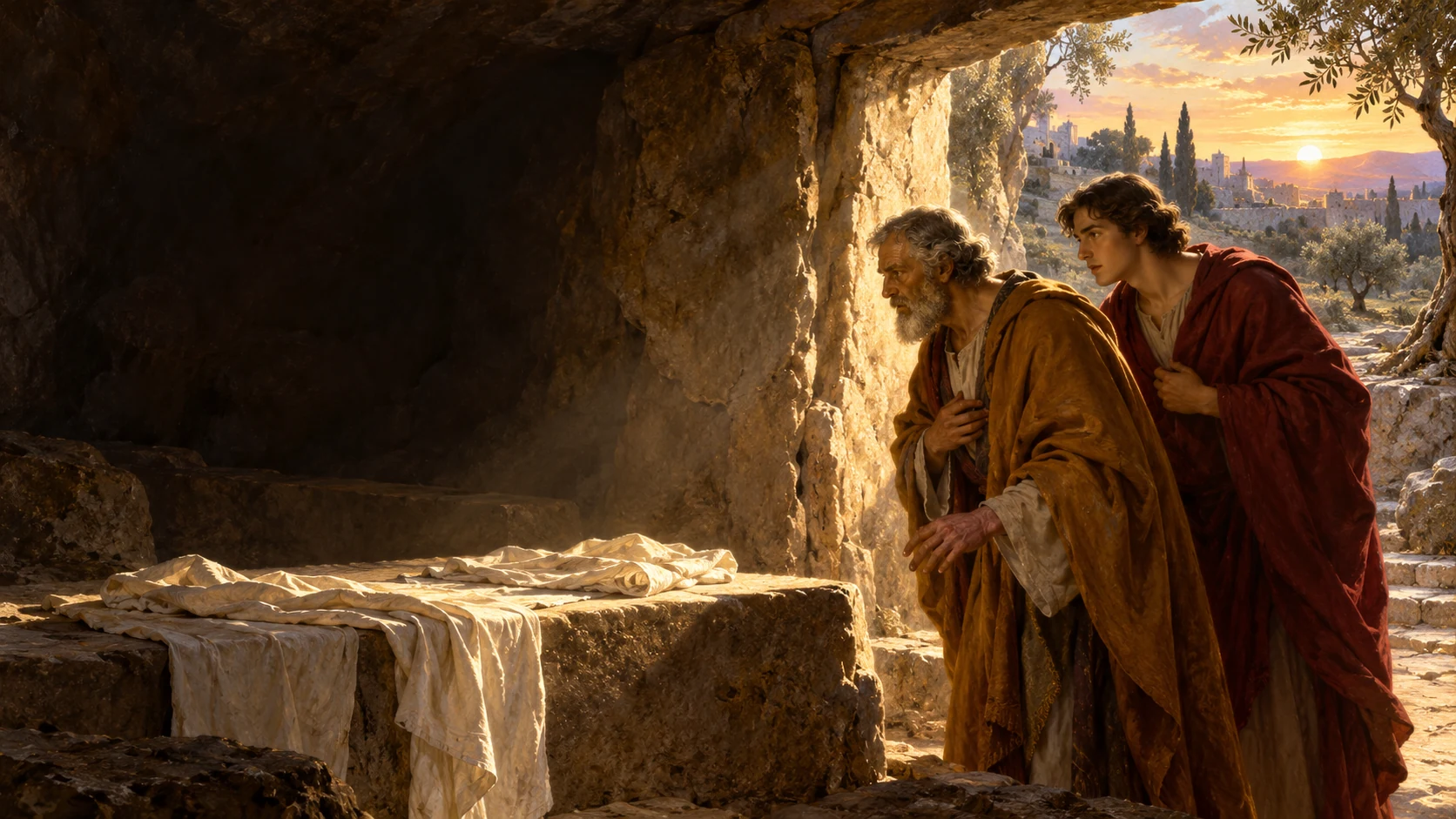
Peter and John at the empty tomb – artistic depiction
Signs of the Coming Kingdom

The Miracles of Jesus

Healings, miracles of nature, raisings from the dead, and the Resurrection of Christ: the complete Gospel accounts and their witnesses.

Understanding the subject

The deeds of Jesus Christ and the testimony of the Apostles.

Jesus heals the blind and the paralyzed, cleanses lepers, stills the storm, feeds the multitude, and calls the dead back to life. His miracles show his divine power and his mercy. In his Resurrection, he conquers death and establishes the hope of his Church.

The Gospels transmit specific people, places, words, and actions. The dossiers present these events as connected accounts and lead directly to the passages of Scripture. The apostolic witnesses and the interpretation of the Church Fathers show how the Church understood these events from the beginning.

Historical and textual questions are then addressed: the transmission of the Gospels, their parallel accounts, and their place in Jesus' ministry. The biblical miracles belong to the foundational testimony of Revelation and are explained from that position.

The investigation in detail
Discover · compare · read further

The dossiers in this category.

Choose a place, period, or subject. Explore the same selection as dossiers, on the map, or in the timeline.

Investigative approach and ecclesiastical judgment →

Dossiers: 13

The Miracles of Jesus

Jesus Stills the Storm

Sea of Galilee · Jesus' public ministry in the 1st century

In the evening, Jesus and his disciples cross the Sea of Galilee. A fierce storm arises; waves strike into the boat while Jesus sleeps in the stern. The disciples wake him and call for rescue. He stands, commands the wind and sea, and a great calm follows. Filled with awe, those rescued ask who this is, whom even wind and water obey. Matthew, Mark, and Luke attest to the miracle. It reveals Christ's power over creation and shows how he leads people in their fear to recognition of his person and trust in him.

Synoptic Gospel testimonyRead →
The Miracles of Jesus

Jesus Walks on Water

Sea of Galilee · After the feeding of the five thousand

After the feeding of the five thousand, the disciples cross the lake while Jesus stays behind to pray. A headwind makes the crossing difficult. In the night, he comes to them across the water. The disciples are frightened, but he encourages them. Matthew also attests to Peter's step: at Jesus' call, he walks toward him, begins to sink when he sees the wind, and is immediately grasped by his hand. When they enter the boat, the wind subsides. The disciples worship Jesus as God's Son. Attested in three Gospels, the miracle reveals Christ's dominion over creation and his saving nearness to his own.

Attested in three GospelsRead →
The Miracles of Jesus

The Centurion of Capernaum

Capernaum on the Sea of Galilee · Jesus' public ministry · 1st century

In Capernaum, a centurion's servant lies seriously ill. The officer intercedes for him and asks Jesus for help. He trusts his authority so deeply that he does not request a visit to the sickbed: one word from Christ is enough. Jesus praises this extraordinary faith, and the servant recovers. Matthew attests to healing in that very hour; Luke reports that the returning messengers find him well. Care for the sick man, the intercession of Jewish elders, and the centurion's humble confidence shape this miracle. His plea lives on in the Church's prayer before Holy Communion.

Biblical miracle in the testimony of the GospelsRead →
The Miracles of Jesus

The Daughter of Jairus

By the Sea of Galilee; the passages do not precisely locate Jairus's house · Jesus' public ministry · 1st century

Jairus, a synagogue leader, falls at Jesus' feet and pleads for the life of his dying daughter. Jesus goes with him. When news of her death arrives along the way, he urges the father to keep believing. In the house, he takes the twelve-year-old girl by the hand and calls her to life: Talitha kum. Immediately she gets up and walks about. Her parents and Peter, James, and John are present. Christ, who commands death, then sees to it that the child is given food. Mark, Matthew, and Luke attest to this miracle; their accounts and the interpretation of the Church Fathers reveal its course and meaning.

Biblical miracle in the testimony of the GospelsRead →
The Miracles of Jesus

The Feeding of the Five Thousand

By the Sea of Galilee; the exact place is not unambiguously established · Jesus' public ministry in the 1st century

A large crowd gathers around Jesus by the Sea of Galilee. As it grows late, the available provisions fall far short: five loaves and two fish. Jesus has the people sit down, blesses the food, and gives it to be distributed. Everyone eats and is satisfied. Afterwards, the disciples gather twelve baskets of leftovers. All four Gospels attest to this miracle. John names the boy with the barley loaves, as well as Philip and Andrew, and connects the event with the ensuing discourse on the Bread of Life. Christ satisfies real hunger and reveals himself as the generous Lord who, beyond food, will give himself.

Attested in all four GospelsRead →
The Miracles of Jesus

The Healing of the Leper

Galilee; the exact place is not named in the passages · Jesus' public ministry · 1st century

A man with leprosy prostrates himself before Jesus and asks to be cleansed. He trusts in his power: if Christ wills it, he can heal him. Jesus stretches out his hand, touches him, and speaks his effective word. Immediately the leprosy leaves him. Afterwards, he sends the healed man to present himself to the priest and offer the gift prescribed by Moses. The man makes the miracle widely known; more and more people seek Jesus out. Mark, Matthew, and Luke attest to this encounter, in which the Lord touches the man in his severe suffering, heals his body, and opens the way for his full return to Israel's communal life.

Biblical miracle in the testimony of the GospelsRead →
The Miracles of Jesus

The Healing of the Man Born Blind

Jerusalem; Pool of Siloam · Jesus' public ministry · Joh 9

In Jerusalem, Jesus encounters a man who has been blind from birth. He anoints his eyes with clay and sends him to the Pool of Siloam. The man washes and returns able to see. Neighbors recognize the change, his parents confirm his identity and congenital blindness, and the religious questioners repeatedly investigate the event. Despite pressure, the healed man holds to what he knows: he was blind and now sees. When he has been cast out, Jesus seeks him out. The healing leads to confession and worship of Christ. John 9 preserves the miracle together with the detailed questioning of its witnesses.

Canonical healing accountRead →
The Miracles of Jesus

The Healing of the Woman with a Hemorrhage

By the Sea of Galilee, on the way to Jairus's house · Jesus' public ministry · 1st century

A woman has suffered from bleeding for twelve years. Many treatments have failed to help her; her resources are exhausted and her condition has worsened. As Jesus walks through the crowd on his way to Jairus's house, she approaches from behind and touches his garment. Immediately her affliction ends. Jesus stops, calls her out of concealment, and has her tell those present what has happened. He calls her daughter, honors her faith, and sends her away in peace. The three Synoptic Gospels attest to a healing that restores the body and leads the previously timid woman into a personal encounter with Christ.

Biblical miracle in the testimony of the GospelsRead →
The Miracles of Jesus

The Paralytic of Capernaum

Capernaum on the Sea of Galilee · Jesus' public ministry in the 1st century

In Capernaum, four men bring a paralytic to Jesus. The house is overcrowded, so they open the roof and lower the sick man on his stretcher. Jesus sees their faith and pronounces forgiveness of sins over him. When scribes take offense at his authority, he answers with a visible miracle: he commands the paralytic to rise, take his bed, and go home. Immediately, the man stands before everyone, carries his stretcher, and goes home praising God. The people marvel and glorify God. Mark, Matthew, and Luke attest to the healing as a revelation of the Son of Man's authority.

Canonical testimony to healingRead →
The Miracles of Jesus

The Raising of Lazarus

Bethany near Jerusalem · Before Jesus' final Passover · Joh 11–12

Lazarus has died and has lain in the tomb for four days when Jesus reaches Bethany. Martha confesses her faith in him as the Christ and Son of God; Mary falls before him in grief. At the tomb, Jesus weeps. Then he has the stone removed, thanks the Father, and calls his friend out. Lazarus comes alive from the tomb, still bound in the burial linens. Those present are to unbind him. Many witnesses now believe in Jesus; others report the event to his opponents. John connects this powerful miracle with the approaching Cross: the Lord gives his friend life and himself advances toward his Passion.

Canonical account of a raising from the deadRead →
The Miracles of Jesus

The Resurrection of Jesus Christ

Jerusalem; further encounters in Galilee · On the third day after the Crucifixion · New Testament Easter testimonies

Jesus Christ, who died on the Cross and was buried, rises bodily from the dead on the third day. The women find the tomb open; Peter and the other disciple see the cloths left behind. Mary Magdalene encounters the Lord. He appears to the disciples, speaks with them, makes his wounds recognizable, and leads Thomas to confess his divinity. The Gospels preserve these encounters in Jerusalem and Galilee. Paul passes on the Easter testimony he has received and names individual witnesses, the apostolic circle, and more than five hundred brothers at once. Easter is Christ's real victory over death and the foundation of Christian hope.

Central truth of the Christian faithRead →
The Miracles of Jesus

The Wedding at Cana

Cana in Galilee; precise identification of the site disputed · At the beginning of Jesus' public ministry · Joh 2,1–11

At a wedding in Cana, the wine runs out. Mary notices the need and brings it to her Son. Jesus has six stone jars filled to the brim with water. When the servants take some to the steward, he tastes excellent wine. The servants know they poured in water; the steward attests to the wine's quality without knowing its source. Christ thus performs his first public miracle and reveals his glory. His disciples believe in him. John preserves the precise sequence of this gift, in which Mary's intercession, the servants' obedience, and their Lord's creative authority work together.

Canonical miracle accountRead →
The Miracles of Jesus

The Young Man of Nain

Nain in Galilee · Jesus' public ministry · 1st century

Outside the gate of Nain, Jesus encounters a widow's funeral procession: her only son is being carried out for burial. Jesus sees the mother, takes pity on her, and stops the procession. He touches the bier and commands the dead man to arise. The young man sits up, begins to speak, and is returned to his mother. The disciples and many people witness the miracle; they praise God, who has visited his people. Luke preserves the account of this public raising from the dead. It reveals Christ's divine authority and his compassion for a mother who has already lost her husband and now her only son.

Biblical miracle in the testimony of the GospelsRead →
Miracles · Catholon · EnglishUnderstand the relevant investigative approach · Image credits