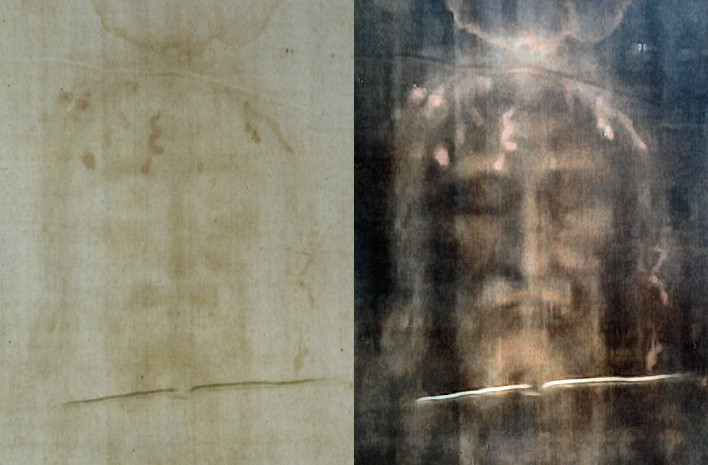
Jesus Christ, who died on the Cross and was buried, rises bodily from the dead on the third day. The women find the tomb open; Peter and the other disciple see the cloths left behind. Mary Magdalene encounters the Lord. He appears to the disciples, speaks with them, makes his wounds recognizable, and leads Thomas to confess his divinity. The Gospels preserve these encounters in Jerusalem and Galilee. Paul passes on the Easter testimony he has received and names individual witnesses, the apostolic circle, and more than five hundred brothers at once. Easter is Christ's real victory over death and the foundation of Christian hope.
Jesus Christ, crucified and buried, rose bodily on the third day and appeared alive to his disciples. He does not return to mortal life for a further period, but lives imperishably in God's glory.
The Crucified One Has Risen on the Third Day
Jesus died on the Cross and was buried. On the third day, he rises bodily from the dead. Paul connects these facts in the tradition he himself received and passed on to the communities: Christ died for our sins, was buried, was raised on the third day, and appeared to his witnesses. The same Lord whose death shattered the disciples meets them alive. The Easter message therefore proclaims God's real deed in the crucified one. Paul makes its full significance clear: without this Resurrection, Christian preaching would be empty. From the beginning, the event itself stands at the center of apostolic faith.[3]
The risen Christ lives in imperishable glory. He has not merely returned, like Lazarus, to a life still subject to death. Thomas Aquinas explains this distinction and the signs by which the Lord makes himself known. The Gospels attest to his bodily identity with the crucified one: he speaks, shows his wounds, and eats with the disciples. At the same time, he appears to them in a new mode of existence. The unity of real body and perfected life belongs to the miracle of Easter. Death, to which Christ freely submitted, no longer has power over him.[7]
The Women and the Disciples at the Empty Tomb
On the first day of the week, the women come to the tomb. The Gospels preserve their encounter with the open tomb and the Easter message. John particularly emphasizes Mary Magdalene. When she sees the stone removed, she initially thinks the body has been taken away and reports this to Peter and the other disciple. Both run to the tomb. They see the linen cloths left behind; the cloth that had covered Jesus' head lies separately. The other disciple enters, sees, and believes. The individual observations lead the witnesses step by step to recognize what has happened.[1][4][5]
The women and disciples encounter a real, changed place. Jesus no longer lies where he was buried. The meaning of this finding is revealed to them through encounters with the risen one. Mary initially still seeks the missing body; soon she will recognize the living Lord. The Gospels thus preserve the path from grief and incomprehension to certainty of the Resurrection. Together with the appearances and apostolic confession, the tomb belongs to the Easter testimony. Its details are described in the Gospel itself and have their source value independently of the later veneration of particular burial-cloth relics.[1][3]
The Living Lord Speaks, Shows His Wounds, and Sends
Mary Magdalene stands weeping at the tomb. Only when Jesus addresses her by name does she recognize him. She goes to the disciples and recounts her encounter. In the evening, the Lord comes among the gathered disciples, greets them with peace, and shows them his hands and side. They rejoice to see the Lord. Thomas is absent from this first encounter and later demands certainty for himself. Eight days afterwards, Jesus appears again and invites him to see and touch the wounds. Thomas responds by confessing him as his Lord and God. John thus preserves both the initial hesitation and its overcoming through the encounter with Christ.[1]
Luke recounts Cleopas and his companion on the road to Emmaus. Jesus opens the Scriptures to them; they recognize him in the breaking of bread. They return to Jerusalem. There the Lord appears to the gathered community and makes clear that he is not a mere spirit. John 21 preserves a further encounter by the lake with a shared meal. Matthew recounts the sending of the disciples in Galilee. These testimonies lead to the same living Lord, who makes himself known in different situations and commissions his disciples to proclaim. The encounters transform grieving and frightened people into his witnesses.[2][4][6]
Paul Passes On the Testimony He Received
In the First Letter to the Corinthians, Paul recalls the Gospel he has already proclaimed. He emphasizes that he passes on what he himself received. In the sequence of appearances, he names Cephas, the apostolic circle, more than five hundred brothers at once, James, all the Apostles, and finally himself. He says most of the five hundred are still alive. He thus points to a generation of witnesses living in his time. The Easter confession appears as an already shared content of apostolic preaching. Death, burial, Resurrection, and appearances belong inseparably together in this early tradition.[3]
Paul also confesses that he previously persecuted the Church. His encounter with Christ therefore does not come at the end of an uninterrupted desire to confirm the Christian message. It leads him to conversion and apostolic service. Nevertheless, he does not set his experience against the testimony of the others: he places it within the same proclamation. In interpreting this passage, Benedict XVI particularly emphasizes the connection between received tradition and personal testimony. This carries important historical weight: the Resurrection is proclaimed jointly from the beginning and attested as an experienced reality by a former opponent.[3][9]
The Testimonies Point to a Connected Event
The Christian case encompasses the whole body of sources: Jesus' real death, burial, the empty tomb, encounters with various individuals and groups, and the Apostles' early preaching. Paul is added to this, his former opposition turning into testimony for Christ. The Gospels also preserve the obstacles on the path to faith: grief, fear, mistaken identity, and doubt. The witnesses reach certainty because the Lord meets them. The Resurrection explains this shared core and the bodily reality to which the accounts hold. An alternative explanation must take the same whole body of evidence seriously.[1][3][6]
Catholic faith recognizes God's saving power within the historically attested event. The Catechism holds both sides together: the Resurrection has historical testimony and, as entry into glorified life, transcends the ordinary course of events within history. Historical reasons therefore lead neither to a mere mood nor to an arbitrary religious idea. They concern Christ, who had died and lives. Faith accepts this attested reality and confesses its divine author. Precisely the event's distinctive nature requires reading testimonies according to their evidential value, without reducing the mystery to a technical account of the process.[8]
The Testimony Also Sustains the Faith of Later Generations
After the encounter with Thomas, Jesus blesses those who do not see for themselves and yet believe. Immediately afterwards, John explains the purpose of his Gospel: he has written down the signs so that readers may believe. Later faith is therefore grounded in transmitted testimony. Thomas Aquinas distinguishes the visible signs from what Thomas confesses. He sees the risen Lord's wounds and recognizes his divinity. Perception leads to recognition of the person. For later generations, the Apostles preserve this encounter in their testimony; through them, people who did not stand in the room in Jerusalem can also trust the living Christ.[1][7]
His Victory Grounds Our Hope
Paul unfolds Christ's Resurrection as the beginning of our own resurrection. The Lord's victory is not confined to him: it opens to humanity the fulfillment for which God created us. This hope encompasses the body that suffers, ages, and dies. For Paul, it also leads to a concrete attitude in present life. He closes his great chapter on resurrection with the call to stand firm and remain faithful in the Lord's work. Love, sacrifice, and toil are not in vain because Christ has overcome death. Easter therefore gives more than memory and consolation; it grounds the expectation of enduring life in communion with the risen Lord.[3]
Witnesses & Investigators
Mary Magdalene
Easter witness in the Gospel of John
Initially seeks the missing body and then encounters the Lord, who addresses her by name.[1]
Peter and the Other Disciple
Witnesses to the tomb according to John
See the cloths left behind; Cephas is also named in Paul's sequence of appearances.[1][3]
Thomas
Initially doubting Apostle
The later encounter leads to his explicit confession; the text reports the invitation to touch, not explicitly that he actually did so.[1]
Cleopas and His Companion
Emmaus disciples according to Luke
Encounter Christ on the road, hear the interpretation of Scripture, and recognize him in the breaking of bread.[6]
Paul
Apostolic transmitter of tradition and witness in his own right
Names the received tradition, further witnesses, and his own encounter as a former persecutor.[3]
The unfolding story
- The Lord Truly Died
The apostolic confession connects death, burial, and the ensuing Resurrection.[3]
- The Women at the Tomb
The Gospels transmit the open or empty tomb and the Easter message.[1][4][5][6]
- Encounters with the Living Lord
John and Luke recount different encounters and the passage from incomprehension to recognition.[1][6]
- Thomas Confesses His Lord
The encounter connects the visible wounds with faith in Christ's divinity.[1]
- Mission and Communion
Matthew recounts the commission in Galilee; John 21 an encounter by the lake.[2][4]
- Paul Passes On the Tradition He Received
1 Corinthians 15 names various witnesses and the shared Easter message.[3]
Ecclesiastical assessment
Jesus' bodily Resurrection belongs to the binding Christian confession. Its apostolic attestation is independent of questions about the authenticity of individual relics venerated later.
How the Different Easter Accounts Belong Together
The Gospels do not name the same people, places, and encounters in every passage. Matthew emphasizes the commission in Galilee; Luke unfolds the encounters in connection with Jerusalem; John attests to both areas. Different selections do not mean mutual exclusion. When an Evangelist does not name a particular encounter, he does not thereby deny it. Questions of exact order and chronological compression nevertheless require careful reading of each version. An unbroken chronology cannot be established unambiguously for every step. The shared core remains clear: Jesus, who died and was buried, has risen bodily and meets his witnesses. This agreement is neither strengthened by an invented unified record nor negated by differing emphases.[1][2][4][6]
Objections & Answers
Can the Easter Testimony Be Fully Explained by Grief and Inner Visions?
Merely naming such a hypothesis does not explain the whole body of sources. The accounts describe different encounters, individuals and groups, the crucified one's wounds, the meal with the disciples, and certainty of his bodily presence. Paul is added to this, having previously opposed Christ as a persecutor of the Church. Initial reactions also differ: Mary suspects removal of the body, the disciples are frightened, Thomas demands certainty of his own. The Christian explanation takes these details together: the living Lord meets people and leads them to faith. This does not rule out every psychological counterhypothesis by logic alone; such a hypothesis must, however, provide concrete reasons and explain more than a single experience of grief. Asserting an inner vision alone replaces neither that work nor a historically reasoned assessment of apostolic testimony.[1][3][6]
Could the Empty Tomb Be Explained by Theft?
The tomb is not viewed in isolation within Christian testimony. Mary Magdalene herself initially thinks of removal; Matthew recounts the theft allegation circulated against the Resurrection. The subsequent encounters and early shared proclamation are also decisive, however. A removed body does not by itself explain why different witnesses encounter and proclaim the bodily living Lord. A theft hypothesis would additionally have to explain this connection. Conversely, merely mentioning an opposing allegation is not proof of every detail of the Christian account. The weight lies in the total testimony of tomb, encounters, and confession. Interpretation as a real Resurrection takes these transmitted facts together, whereas removal alone concerns only part of the findings.[1][3][4]
Do Differences Between the Gospels Undermine the Resurrection?
A difference must first be identified precisely. An additional person or encounter does not already contradict a shorter presentation that omits it. Questions of order and chronological compression, however, must be answered through the respective text. A complete overall chronology filled in to the minute is not required. The Gospels agree on the central reality: the one who died was buried and subsequently shows himself alive. Their different emphases make them neither automatically wholly independent records nor a coordinated invention. The five hundred named by Paul are likewise attested through his statement; we do not possess five hundred individually preserved records. This precise identification of the source pathway leaves intact the Easter testimony's actual breadth and early roots.[1][2][3][4][6]
Why Does No Witness Observe the Moment of Resurrection Itself?
The witnesses encounter the risen one and recognize his identity with the one who previously died. Thomas Aquinas explains that they can thus truthfully attest to the reality of the Resurrection without having seen the divine act of transition itself. In other settings too, changes can be recognized from the initial situation, result, and reliable testimony. Easter's distinctive character does not negate such knowledge. It does mean, however, that the Gospels supply no physical record of the transition into glorified life. Neither radiation values nor energy formulas may be derived from this silence. Nor are the burial cloths in John 20 described there as examined image-bearing objects. Apostolic testimony stands on its own foundation and does not depend on the authenticity of a relic venerated later.[1][7][8]
Meaning for faith
Christ has truly risen. The empty tomb, encounters with the living Lord, and the Apostles' early shared proclamation form the historical Easter testimony. The Church recognizes in this God's definitive victory over sin and death. The risen one is the same one who was crucified; his new life grounds the hope of our own resurrection and gives faithfulness, love, and sacrifice enduring meaning.[1][3][7]
How the Miracles of Jesus Are Examined
Apostolic testimony, historical transmission, and the deeds of Christ.
Methods of examination and ecclesiastical procedure →Sources & Evidence
Information on accessibility and scope helps you assess the evidence for yourself.
- [1] Gospel According to John, Chapter 20
Ancient Greek text and historical Vulgate; independent German presentation, without adopting the modern Knox translation.
Open source · newadvent.org ↗ - [2] Gospel According to John, Chapter 21
Encounter by the lake and the Gospel's claim to testimony.
Open source · newadvent.org ↗ - [3] First Letter to the Corinthians, Chapter 15
Apostolic primary text; the listed witnesses are attested through Paul, not as individually preserved records.
Open source · newadvent.org ↗ - [4] Gospel According to Matthew, Chapter 28
Women at the tomb, competing allegation of theft, commission in Galilee.
Open source · newadvent.org ↗ - [5] Gospel According to Mark, Chapter 16
The account through verse 8 is used here; the separate question of the textual transmission of Mark's longer ending is not a prerequisite of the argument.
Open source · newadvent.org ↗ - [6] Gospel According to Luke, Chapter 24
Emmaus and the encounter in Jerusalem; ancient text in an independent German presentation.
Open source · newadvent.org ↗ - [7] Summa theologiae III, quaestio 55
Public-domain primary text on the manifestation of the Resurrection and the significance of its signs.
Open source · newadvent.org ↗ - [8] Catechism: On the Third Day He Rose from the Dead
The Church's teaching on the simultaneously historical and transcendent reality of the Resurrection.
Open source · vatican.va ↗ - [9] Saint Paul the Apostle: The Importance of Christology – The Resurrection
Primary source for the Church's interpretation of received tradition and apostolic testimony.
Open source · vatican.va ↗