Cathedral of Saint John the Baptist, Turin · ItalyRelic of the Passion · securely documented since the 14th centuryApproximate reading time (minutes): 34
View the cloth itself
One cloth. Two views of the body.
Front and back, positive and negative. All photographs can be enlarged.
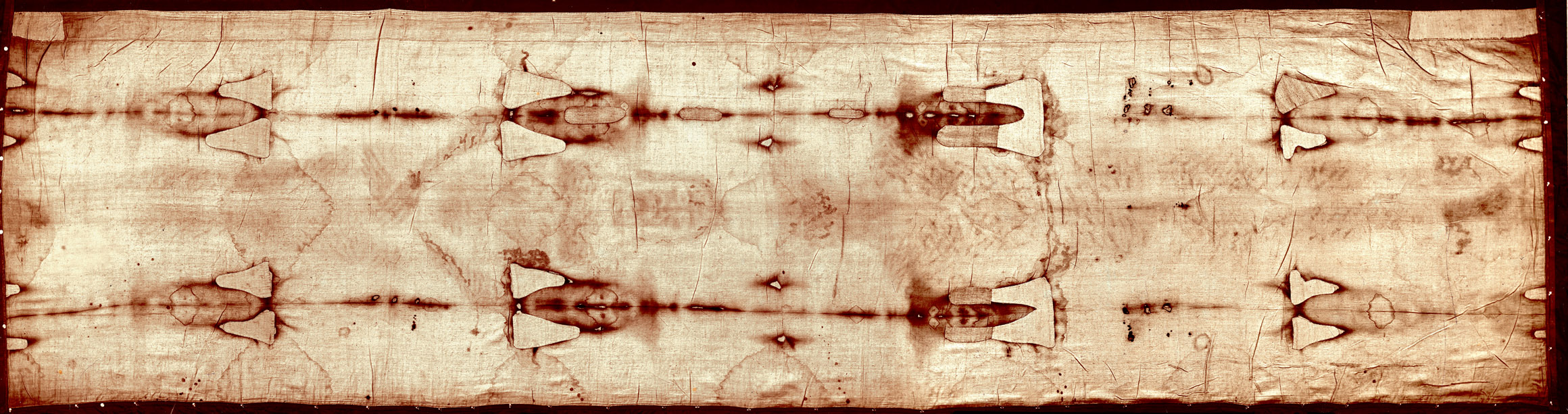
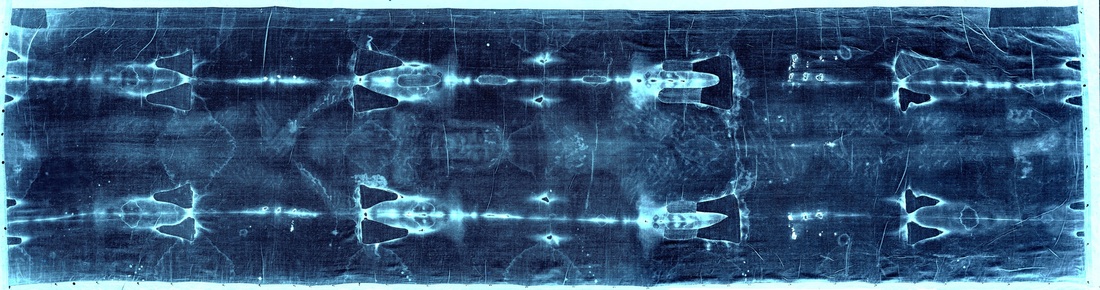
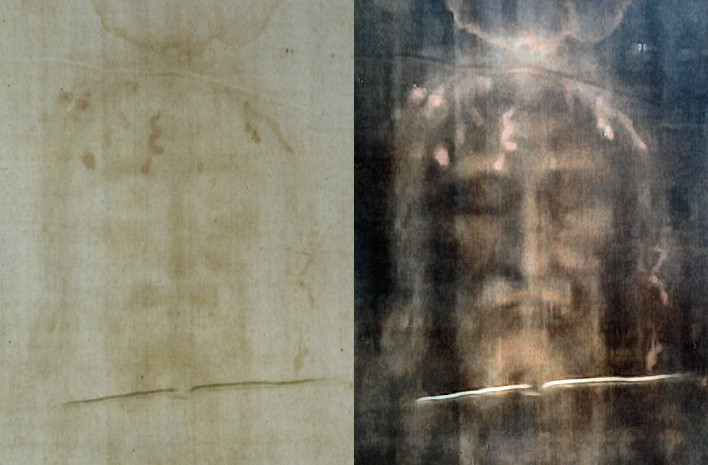
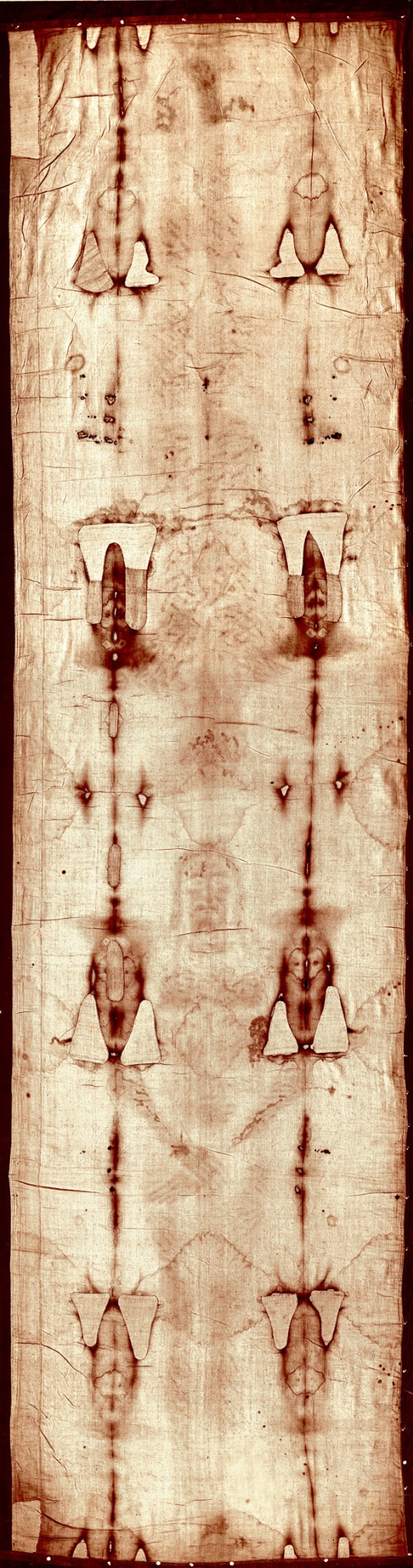
Full view before the restoration of 2002. The front of the body image is on the left, the back on the right. The pale sewn-on patches are still present here. Image credit · Enlarge ↗Negative reproduction of the entire cloth. Brightness values are reversed; the body image, blood areas, and fire damage remain distinct image components. Image credit · Enlarge ↗The face shown side by side in positive and negative reproductions. The negative contrast makes the facial features easier to recognize. Image credit · Enlarge ↗Complete photograph in its original portrait format, uncropped. Image credit · Enlarge ↗
Image and Passion
What can be seen where?
Select a marker. The detail view shows the same image area enlarged.
Enlarged detail of the same photograph. Markers provide orientation.
Image guide · 01
Face and forehead
The forehead shows a distinctive downward-running trace; further traces are present on the head. The Passion accounts name the crowning with thorns and blows to the head. The association consists of comparing the visible findings with the Gospel.
Numerous small, paired, and elongated injury marks can be seen on the back and legs. John, Matthew, and Mark explicitly recount the scourging of Jesus. Examination of the cloth addresses the form and distribution of these traces.
The hands lie one over the other in front of the body. A distinctive blood trace is visible in the wrist area. John records Thomas's demand to see the nail marks in Jesus' hands.
A larger blood area lies at the side of the chest. John recounts the spear thrust after Jesus' death and the flow of blood and water. The finding and its medical description are explained in the dossier.
The foot regions and associated darker traces are visible at the lower ends of the body image. Comparison with Scripture leads to the wounds of the risen Lord; the Gospels do not describe every technical detail of the nailing.
The large symmetrical dark burn areas with pale patches belong to the cloth's later history. The Chambéry fire of 1532 damaged the folded linen. These areas are not wounds of Christ; the earlier patches were removed in 2002.
The Shroud of Turin shows a scourged and crucified body from the front and back: blood on the head, wounds at the hands and feet, an opened side, and traces of burial. These features lead directly to the Passion of Jesus Christ. Chemical evidence of blood, optical measurements, microscopic findings, and the image's distinctive spatial ordering give the surviving cloth extraordinary weight. For decades, specialists from various disciplines have examined its fibers, traces, and history. Views of the whole cloth and the corresponding Gospel passages unfold this connection step by step.
What this case concerns
In Turin, the Church venerates the linen cloth of Christ's burial. The combined pattern of the Passion wounds, the examined bloodstains, and the distinctive properties of the body image support its identification with Jesus' cloth. This surviving testimony is considered here in the context of its history and the published investigations.
The Whole Cloth: A Body from the Front and Back
Anyone seeking to understand the Shroud begins with its complete form. The long linen shows a human body from the front and from the back; the two heads lie close to one another in the middle of the cloth. This arrangement can be explained by a corpse lying on one part of the linen while the remaining part was laid over the head and onto the front. The arms lie in front of the body, and the hands cross in the pelvic area. The back, legs, and feet can be traced in the dorsal view. The view of the whole cloth makes this relationship visible in a way that a photograph of the face alone cannot convey.[2]
The fabric is approximately 4.4 meters long and a little over one meter wide. Its herringbone weave, faint yellowish-brown body image, reddish-brown bloodstains, and much more prominent damage form different layers of the same object. They should be followed separately when viewing it: first the outlines of the body, then the blood areas, and finally the recurring burn holes with their edges. The large areas of damage along the sides belong to the cloth's later history. Anyone mistaking them for bodily wounds would overlook the actual Passion image.[2][23]
The color photograph shows the appearance of the surviving linen. A photographic or digital reversal of tonal values makes the bodily features much clearer: light becomes dark and dark becomes light. The two views therefore belong side by side. The negative image adds no wounds or facial features; it changes the brightness relationships of the existing image. Enlargements then help locate individual traces within the whole image. The cloth itself remains the reference point, not an ideal figure drawn afterward.[26]
Why This Image Leads So Directly to the Passion
The Gospels attest to Jesus' suffering as events affecting a real human body. He is beaten, scourged, crowned with thorns, crucified, and pierced in the side after his death. Friends take down the body and bury it. The Shroud combines corresponding features in a single figure. The combination of crucifixion with numerous scourge marks, blood on the head, and a wound in the side of the chest gives the comparison its weight. It directs contemplation toward the particular Passion of Jesus, not merely the general theme of human suffering.[14][31][32]
The corresponding passages of Holy Scripture stand alongside the visible traces. Scourging, crowning with thorns, crucifixion, the opening of the side, and burial form a connected sequence. The correspondence thus concerns the particular Passion of Jesus and the burial that followed. This connection can be followed directly in the photographs.[14][31][32]
The Son of God assumed human nature and gave his life for sinners. Contemplating the wounds leads into the reality of his sacrifice. They speak of Christ's love, the gravity of sin, and the hope of redemption. The material testimony and the words of the Gospels together direct our gaze to the Redeemer.[14][33]
Real Blood: What Heller and Adler Demonstrated
The statement about blood rests on investigations of material samples. In 1980, John H. Heller and Alan D. Adler published spectroscopic and chemical tests on material from the blood areas. Among other things, they examined the light-dependent properties of hemoglobin and chemically converted the heme component into a fluorescent porphyrin. Their conclusion was that blood is present in the areas examined. This is thus a biochemical finding, not merely the impression that a reddish stain might represent blood.[17]
The more detailed investigation of 1981 supplemented the findings with reactions for proteins, albumin, and bile pigments, as well as enzymatic tests, among other methods. The authors brought these results together as evidence of whole blood. In their work, they distinguish blood deposits from the yellowish body image and from inorganic particles. Particularly clear is the difference between fabric whose fibers are discolored at the surface and an area in which blood components are detected. The two must not simply be treated as the same brown color.[16]
Alongside Heller and Adler's chemical work, an optical finding supports interpreting the reddish stains as blood: Samuel Pellicori reported in 1980 that the stains examined exhibit spectral properties compatible with hemoglobin. He measured how strongly different areas reflect light of different wavelengths. The body image showed a different curve from the blood areas. The blood finding thus rests on more than the mere impression of a red color: chemical reactions and light measurements lead to mutually compatible observations.[39][17]
For the case for authenticity, this means that anyone seeking to explain how the Shroud was made must also explain the blood findings. The claim that the whole thing is merely a painted face with arbitrary red spots fails to account for these findings. What stands before us is an examined material testimony. The evidence is attributable to the scientists and their published methods; this precise attribution makes it verifiable. Whether a particular blood group can also be reliably determined is a different question from the basic detection of blood and is addressed separately below.[16]
The Scourging: The Wounded Back
In the dorsal view, numerous small, recurring injury marks stand out. Their pattern extends across the back into the leg region. Unlike the large, approximately symmetrical burn damage, these traces relate to the bodily figure. The UV photographs published by Miller and Pellicori made the fine scourge marks particularly clear. The researchers saw in them an indication of close contact between the cloth and a wounded body.[28]
Matthew 27:26 and Mark 15:15 attest that Pilate had Jesus scourged before handing him over for crucifixion. John 19:1 mentions the same mistreatment. The traces distributed over the back and legs give these brief words a harrowing visual force: when carrying the cross, Jesus' body was already severely wounded.[14][31][32]
Contemplation of the Passion sees in this the Savior's voluntary self-giving. The view of the whole back shows the extent of the mistreatment; enlargements of individual areas reveal their form. Each individual trace thus remains related to the connected findings of the wounded body.[14]
Face and Head: Blows and a Crown of Thorns
Photographs of the face show closed eyes, the beard, and areas of hair. More distinct bloodstains lie on the head, including the striking curved mark on the forehead. The back of the head also belongs in the comparison. The Turin image guide connects the marks distributed across the head with puncture injuries caused by thorns. Their distribution is more informative for contemplation than an attempt to reconstruct an entire crown of thorns from a single stain.[23]
John reports that the soldiers wove a crown of thorns and placed it on Jesus. Matthew and Mark add mockery and blows to the head. The crown of thorns combines physical torment with the mockery of his kingship. This provides a particularly specific correspondence between the Passion account and the blood on the head: not every crucifixion included such a crowning. The comparison thus shows more than the general possibility of a head injury.[14][31][32]
In the face, the traces of suffering stand beside the stillness of a person who has died. Christian contemplation recognizes in this the royal dignity of Christ in his utmost humiliation. The Gospels attest to both together: the King mocked by the soldiers is the Lord who gives his life.[14][31]
Hands and Feet: The Signs of Crucifixion
At the crossed hands, a pronounced bloodstain lies in the area of one wrist. Blood traces also run along the forearms. In the dorsal view, the foot region is visible with clearly defined traces. Such areas must be related to one another in the whole image: crucifixion concerns not just an individual point but the fastening and position of the entire body.[17][38]
According to John 20:25, Thomas mentions the nail marks in Jesus' hands and the wound in his side. On the Shroud, the injury areas at the hands or wrists and at the chest correspond to these details. The blood traces on the forearms and in the foot region fit into the overall image of the crucified and subsequently buried body.[14]
The hands lying together before the lower abdomen show the body in its burial position, while the blood traces point to the preceding execution. This depth in time matters. We are looking not at an image of a living man hanging on the cross, but at the buried body bearing the traces of what was done to it. In the sequence of the Gospels, crucifixion is followed by the taking down of the body and burial. The image leads back to precisely this sequence.[14][31]
For devotion, the wounds remain signs of self-giving. In the Easter encounter, they are not erased but belong to the recognition of the Lord. The Risen One is the same one who suffered on the cross. The connection between the crucifixion and Easter accounts prevents the Shroud from being understood merely as an image of defeat. It stands within the horizon of Christian hope in the resurrection.[14]
The Opened Side: Blood and Water
A larger bloodstain can be seen on the side of the chest. Shroud research relates it to a transverse blood area on the back. In the full view, location and extent should be considered first; the question of the precise path of the fluid is a subsequent investigative step. The blood mark on the side differs clearly from the regular series of later burn damage.[19]
John 19:33–37 attests that the soldiers found Jesus already dead and did not break his legs. One soldier opened his side with a lance; blood and water came forth. The Evangelist emphasizes the testimonial character of this event. In the cloth's image, the side wound receives particular attention because, together with scourging, thorn injuries, and crucifixion, it completes the Passion pattern. The Scripture passage says more than a description of fluids: it points to the Crucified One upon whom people are to look.[14]
In the Gospel, the opened side attests to Christ's love given to the very end. The Church's interpretation also connects blood and water with the sacraments. The bloodstain on the cloth leads material contemplation back to this event at the cross and its spiritual meaning.[14][33]
Wrapped in Linen: The Burial and Easter Morning
Joseph of Arimathea asks for Jesus' body and, according to the Synoptic Gospels, wraps it in linen. John also names Nicodemus and the aromatic substances brought for burial. The Shroud's two connected views of the body can be understood within such a wrapping. Its long shape offers a tangible way of covering a body below and above with the same cloth. The image concerns burial after the taking down from the cross; the linen is not a garment Jesus wore during crucifixion.[31][32][14]
On Easter morning, the disciples find the tomb empty. John distinguishes the linen cloths left behind from the head cloth lying separately. The other disciple sees and believes. Contemplation of the Shroud therefore leads beyond the traces of death to the resurrection of the Lord and the testimony of the Apostles.[14]
The term “shroud” also preserves an important order. A tomb is the place where those left behind expect a dead person. Christian faith, however, proclaims the Living One who has overcome death. The linen is not the endpoint of the story. It directs attention to the body that lay within it and to the Easter message that the Lord lives. In this, the moving depiction of death finds its Christian perspective.[14]
Before Turin: The Trail to Constantinople
The question of the early history leads to the Christian world of the eastern Mediterranean. The account of crusader Robert de Clari is especially significant for an older image on a shroud. In the context of the conquest of Constantinople in 1204, he describes a cloth venerated as Christ's shroud in the Church of Saint Mary of Blachernae, on which Christ's figure was said to be visible. He also reports its regular display and that, after the conquest, no one knew where it had gone. This is a specific medieval report of a cloth bearing Christ's figure before the securely documented tradition in Lirey.[30]
Robert de Clari's report expressly connects a shroud of Christ with a visible bodily figure and regular display in Constantinople. It thus provides a specific indication of such an image before the securely documented history in Lirey. The account is a major point of reference for research into the route from the Christian East to France.[30]
For further identification, the objects described, their places of preservation, and their chronological contexts are compared. The very form of a burial cloth bearing a body image makes Clari's report significant. The question of its route after 1204 is addressed below together with the other objections concerning provenance.[1]
The Pray Codex: A Pictorial Witness from the 12th Century
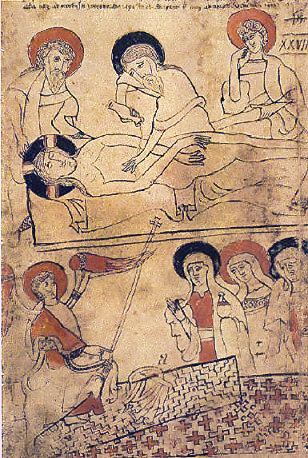
Pray Codex, around 1192–1195. The miniature itself is medieval testimony; its relationship to the Turin cloth is explained in the text below. Image credit
The Hungarian Pray Codex is an actual surviving medieval manuscript in the National Széchényi Library in Budapest. The library dates the relevant manuscript material to 1192–1195. Its miniature shows the preparation of the dead Christ above and the women at the tomb below. These scenes belong to medieval visual representations of the Passion and the Easter message. The dating of the book is therefore an important starting point for asking whether the artist could have known a model corresponding to the Shroud of Turin.[24][36]
Advocates of authenticity chiefly compare the naked body, the hands lying before the lower abdomen, the thumbs that are not emphasized, geometric patterns, and a small angular group of circles in the lower scene. The smaller groups of holes already present on the Shroud before the fire of 1532 are cited as a possible correspondence. The strength of this argument lies in the combination of several distinctive features. A single schematic line would be much less informative.[25]
The miniature is accessible in the large image beside the description. The comparison of body posture, hand position, and groups of holes can thus be followed directly. Together, these features form historical evidence that an image corresponding to the Turin cloth was known before the medieval interval of the C14 measurement.[25]
The dating of the manuscript and the details observed form the basis of this argument. Its weight still depends on which features of the miniature actually depict the cloth and which belong to the artistic composition. This question is taken up below with the objections to the historical comparison.[24][25]
From Lirey through Savoy to Turin
The cloth now kept in Turin can be securely traced from the middle of the 14th century. Its history first leads to Geoffroy de Charny and the church of Lirey in Champagne. In 1453, it passed to the House of Savoy. Its veneration received a permanent home in Chambéry; a special liturgical celebration was permitted in 1506. It was brought to Turin in 1578. The pilgrimage of Saint Charles Borromeo provided a particular occasion for this move. Turin has remained the center of its public veneration ever since.[1]
These stages give the history names, places, and dates. Through them, one can trace its religious significance, the protection of the object, and its depiction in images. For Catholic tradition, it matters that the Shroud was venerated with reference to Christ across generations. For historical investigation, it also matters where the reliable record of the physical object begins. The search for early traces and the later documented history of ownership complement one another but serve different purposes.[1][33]
1532: Reading Burn Holes and Water Stains Correctly
The large, recurring holes and dark burned edges formed on the folded cloth during the chapel fire in Chambéry in 1532. The multiple layers of fabric explain the repetition of damage. In 1534, Poor Clare sisters repaired the linen. The patches later sewn on were removed during conservation work in 2002, and the backing was replaced. Older and newer photographs of the whole cloth therefore differ especially in the damaged areas.[37]
Careful viewing distinguishes these burn traces from the wounds of the body depicted. The damage does not run like a series of human injuries but follows the storage and folding of a textile. The water stains also belong to the object's history. They must not be attributed to the lance thrust or scourging. This makes the Passion traces more clearly recognizable: the cloth's later damage lies on a different chronological level from the depiction of the crucified body.[37][23]
Using UV fluorescence photography, Miller and Pellicori found a measurable difference between the burn discolorations and the body image. This matters for explaining the image. A fabric can look similarly brownish in different places yet have been altered through different processes. The burned areas thus even provide comparison material on the same object. They are not an explanation that can be extended to the entire body image without examination.[28]
In 1997, a fire in Turin also threatened the Shroud's surroundings; the cloth was rescued. This more recent event must be distinguished from the fire of the 16th century. In a connected history of the relic, each belongs in its respective place: 1532 explains the large surviving burn damage, and 1997 the rescue from a new danger.[35]
1898: Secondo Pia and the Discovery in the Negative
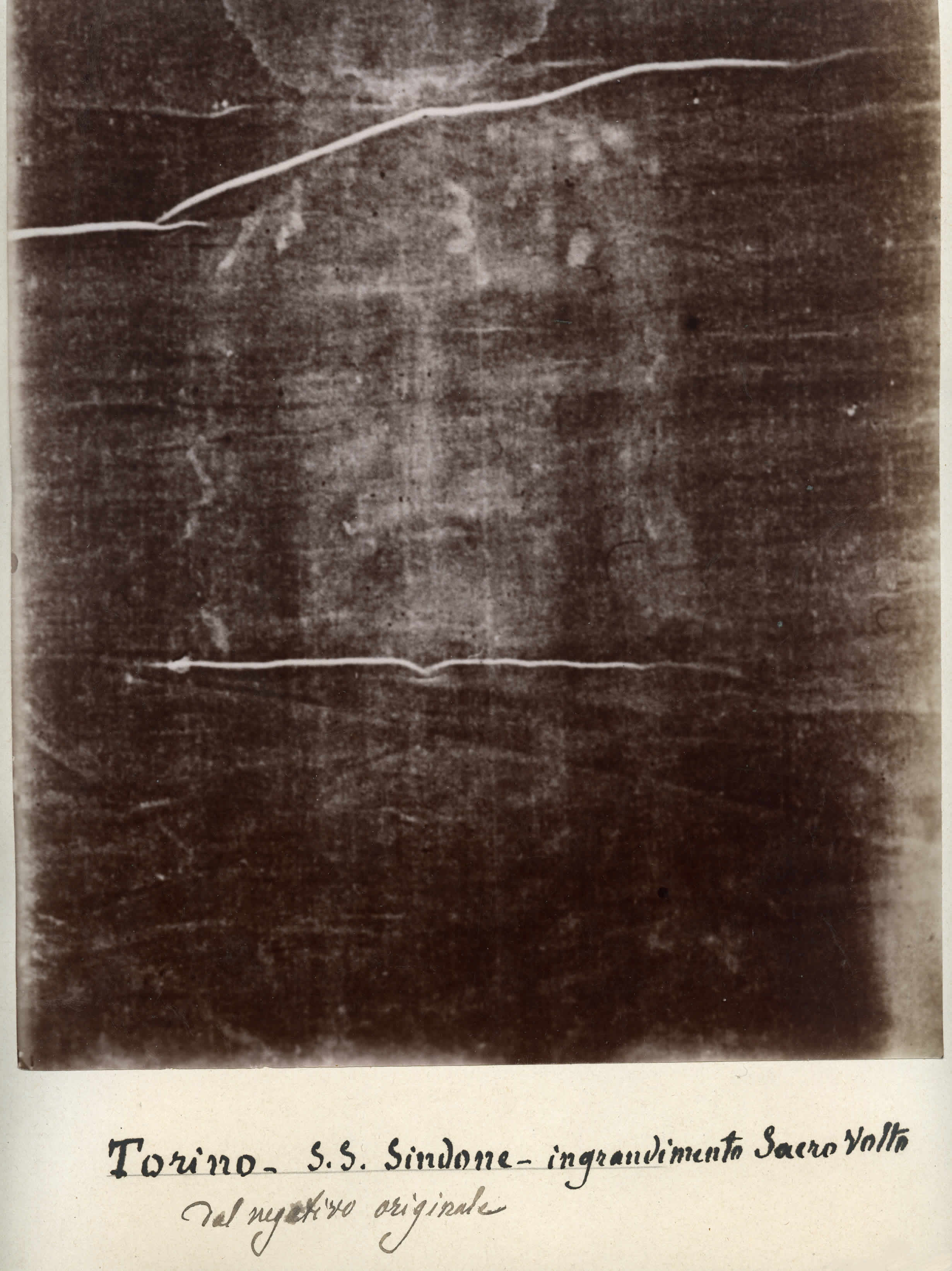
The face on the Shroud of Turin in Secondo Pia's photographic negative (1898). · Image credit · Click to enlarge
In 1898, Secondo Pia was permitted to photograph the Shroud. Developing the photographs revealed a surprisingly clear human figure: the photographic negative showed the face in a distribution of light and dark more familiar to the eye. What appears only faintly on the pale linen gained clarity on the plate. This event is a major part of the history of research and explains why the negative view is still shown alongside the direct photograph today.[26]
This historical photography must not be confused with a new claim that the linen was made with a camera. “Negative” here initially means the reversal of tonal values. The immediate transition between the two views shows how the same image features become legible in different ways. The body image responds differently from the dark burned areas, which appear light in the negative. This is another reason why every illustration needs clear identification.[26]
Giuseppe Enrie photographed the cloth again in 1931. The official Turin account records the photographs taken during that exhibition. The photographic history thus does not depend on a single development experiment by Pia. Repeated photographic documentation opened the object to a much larger circle of viewers and researchers. A faintly visible linen image became an object of comparable detailed photographs. The photograph remains testimony to the cloth; an artistic replica or digital reconstruction should not take its place.[27]
1978: The Body Image under the Microscope
In 1978, the Shroud of Turin Research Project, or STURP, examined the original using various methods. Later publications address microscopy, spectra, X-ray fluorescence, and UV photography, among other subjects. The research was thus conducted on a surviving object and on material taken from it. The results concern not merely whether an image looks aesthetically convincing, but the fabric on which its visibility depends.[5]
Pellicori and Evans described a faint yellowish coloration in the outermost fiber regions. They found no corresponding layer of applied artificial color for the body image. Blood areas could behave differently and penetrate deeper into the weave. This is an important positive finding: according to this investigation, the visible body is not an ordinary accumulation of brown paint but becomes visible through linen fibers altered at the surface.[29]
Jackson, Jumper, and Ercoline investigated whether the differing brightness values of the frontal image relate to a human body shape. Their work, published in 1984, found a correlation with the distances between the body and the cloth lying above it. This explains why a corresponding image analysis can produce a body-like relief. For a case for authenticity, this is a remarkable indication: what must be explained is not only a recognizable figure but also the spatial ordering of its brightness values.[15]
In 1981, STURP summarized its result in favor of a real scourged and crucified human figure and rejected ordinary artistic production as an explanation of its findings. At the same time, the team stated that the specific mechanism of formation of the body image remained unresolved. Both statements are valuable for the case for authenticity: the positive material description and the open question of its complete formation. The first need not be weakened in order to state the second honestly.[5]
In their detailed overall assessment, Schwalbe and Rogers described the body image as an alteration of linen fibers near the surface. Jumper, Adler, Jackson, Pellicori, Heller, and Druzik brought these observations together in 1984: the yellowish body image and the blood areas possess different properties; the collected investigations could not demonstrate a sufficient image-bearing layer of paint. This very combination of a recognizable human image and an extremely fine alteration of the fabric makes the Shroud a demanding subject of materials research.[42][43]
Light and X-ray Measurements on the Original
Scientific investigation of the Shroud extends far beyond the familiar names John Heller and Alan Adler. Samuel Pellicori, as well as Roger and Marion Gilbert, examined its optical properties; R. A. Morris, L. A. Schwalbe, and J. R. London analyzed the distribution of elements using X-rays. Raymond Rogers studied fiber chemistry, and John Jackson and Eric Jumper the spatial information of the body image. The 1978 investigation thus produced a series of specialist publications in which observations from different measurement methods can be compared.[39][40][41][42][15]
Roger Gilbert and Marion Gilbert took nondestructive measurements in ultraviolet and visible light. They examined how the body image, burned areas, and blood areas reflect light or exhibit fluorescence. These measurement series document different regions of the same cloth under comparable conditions and supplement the photographic and chemical investigations.[40]
Morris, Schwalbe, and London examined the distribution of chemical elements on the cloth. Their measurements revealed no corresponding difference in heavy metals between the body image and background that would explain the figure as an applied layer of mineral pigment. More iron, however, was found in the wound areas examined. This elemental analysis gains its value in conjunction with the chemical and microscopic investigations: it examines another property of the material and helps distinguish the body image from the reddish deposits.[41][42]
How Modern Experiments Examine the Distinctive Fibers
The investigation does not end with the work of 1978. Paolo Di Lazzaro and his colleagues used very short vacuum-UV laser pulses to produce superficial discolorations on comparison linen. Within a narrow experimental range, properties emerged that the researchers considered relevant to the Shroud image; some discolorations became visible only later. Such experiments make a specific materials question testable: how can an extremely fine color change be produced on linen? The experiments provide individual building blocks for this, not a complete historical explanation of the image.[44]
A Materials Finding Compatible with Great Age
In 2022, Liberato De Caro, Teresa Sibillano, Rocco Lassandro, Cinzia Giannini, and Giulio Fanti examined a small linen sample using wide-angle X-ray scattering, or WAXS. This measures the structural degradation of cellulose. In comparison with dated linen samples, the authors found a result compatible with an age of approximately two thousand years under their assumptions about long-term temperature and humidity. This is a positive indication for the possibility of an ancient cloth. The age statement remains tied to the model used and to the incompletely known history of storage.[10]
The Blood Question Remains under Investigation
More recent work also addresses the red stains. In 2018, Di Lascio, Di Lazzaro, Iacomussi, Missori, and Murra experimentally examined how unusual blood composition and UV light can affect the color of blood on linen. In 2017, Fanti and Zagotto investigated the possible coexistence of blood and pigments added later. In 2024, Giulio Fanti presented further interpretations of particles from older Shroud samples. These contributions show how the question develops from mere color toward testable material properties; their differing claims must each be assessed against the samples and methods used.[50][49][51]
The Features Speak Together
Scourging, thorn injuries, crucifixion, a side wound, and burial are encountered on a single cloth. Added to these are chemically examined bloodstains, the superficial body image, and its brightness differences that can be analyzed spatially. The correspondence with the particular Passion of Jesus gives its identification as his burial cloth a strong historical and material foundation.[14][31][32][16][17][15]
An explanation must account for these findings together. An arbitrary imprint on linen is not enough. A production hypothesis must also explain the image fibers, blood areas, bodily figure, and historical transmission. The strength of the argument for authenticity lies in the interplay of these distinguishable properties.[42][43]
The historical context and material peculiarities support a confident contemplation of the cloth as testimony to Christ's suffering. The examination of the dating and objections that follows returns to precisely these findings.[1][5][16]
A Sign That Leads to Christ
Thomas Aquinas explains the veneration of images of Christ and of the cross through their relation to Christ. The honor does not stop at the wood, paint, or fabric. It is directed to the one to whom the sign points. This classical Catholic ordering also helps with the Shroud: reverence for the relic does not mean divinizing a material object. Contemplation of the suffering body should lead to love for the Redeemer.[33]
In 1998, John Paul II honored the Shroud as a compelling pointer to the Gospel and encouraged scientific research. At the same time, he explained that historical identification is not a question of faith that the Church decides through scientific competence of its own. In 2010, Benedict XVI contemplated it in the light of Holy Saturday: the real death of Jesus and the hope that leads beyond death. Veneration and honest investigation can thus do justice to the same object in different ways.[3][13]
Viewing the whole cloth, following the bloodstains, reading the Passion account, and becoming still before the Crucified One: contemplation can thus lead to repentance, gratitude, and discipleship. The wounds lead to a response to Christ's love. In this, the material testimony receives its spiritual depth.[14][33]
“He saw and believed” leads in John's Gospel to Easter morning. The subsequent beatitude for those who have not seen and yet believe does not exclude reverent seeing. It places it in the proper order. The Shroud can be a powerful sign on the path to faith. Its Christian meaning is fulfilled when it directs our gaze beyond itself to Jesus Christ, crucified and risen.[14]
Witnesses & Investigators
The Evangelists
Apostolic testimony to the Passion
The Gospels attest to Jesus' suffering, death, burial, and resurrection. Their details are explored alongside the cloth's visible features.[14][31][32]
Robert de Clari
Medieval chronicler
Reports on the shroud venerated and publicly displayed in Constantinople, bearing a visible figure of Christ, before the conquest of 1204.[30]
Secondo Pia and Giuseppe Enrie
Photographic documentation
Their photographs of 1898 and 1931 made the body image in the negative view widely accessible.[26][27]
John H. Heller and Alan D. Adler
Chemical investigation
They published the spectroscopic and chemical findings concerning blood. Their result rests on examined sample material.[16][17]
STURP
Interdisciplinary investigation in 1978
The interdisciplinary team examined the original in 1978 using optical, chemical, microscopic, and other physical methods. Several specialist publications document its results.[5]
Samuel Pellicori; Roger and Marion Gilbert
Optical spectra and fluorescence
Examined reflection and fluorescence in different areas of the cloth and distinguished the body image, blood areas, and burned areas.[39][40]
R. A. Morris, L. A. Schwalbe, and J. R. London
X-ray fluorescence
Compared the distribution of chemical elements on the original and contributed to distinguishing the image and blood areas.[41]
L. A. Schwalbe and Raymond N. Rogers
Physics, chemistry, and overall findings
Brought together the material results of the 1978 investigation in a detailed specialist paper in 1982.[42]
John Jackson, Eric Jumper, and William Ercoline
Spatial image analysis
Examined the relationship between image brightness and a human body shape.[15]
Paolo Di Lazzaro and colleagues
Light–material experiments
Produced superficial coloration on comparison linen using short vacuum-UV pulses.[44]
Liberato De Caro, Teresa Sibillano, Rocco Lassandro, Cinzia Giannini, and Giulio Fanti
X-ray scattering and cellulose aging
Published a comparison of a linen sample with dated textiles under stated climate assumptions in 2022.[10]
Marco Riani, Anthony Atkinson, Aldo Corbellini, and Paolo Di Lazzaro
Statistical analysis of C14 raw data
Reexamined subsample assignment and the existing radiocarbon data in 2026.[48]
The unfolding story
Jesus' Passion and Burial
The Gospels recount scourging, crowning with thorns, crucifixion, the opening of the side, and burial in linen.[14][31][32]
Pray Codex
The manuscript contains the miniature compared with features of the Shroud.[24][25]
Robert de Clari
The chronicler reports a venerated shroud bearing a visible figure of Christ in Constantinople.[30]
Lirey
Beginning of the secure record of the physical cloth now kept in Turin.[1]
Damage in Chambéry; subsequent repair by Poor Clare sisters.[37]
Turin
The transfer makes Turin the permanent center of its veneration.[1]
Secondo Pia
The first photograph reveals the expressive negative view.[26]
Giuseppe Enrie
New photographic documentation during the exhibition.[27]
STURP and Blood Investigations
Examination of the original; Heller and Adler publish their chemical evidence of blood.[5][16][17]
Radiocarbon
Three laboratories date portions of a shared edge sample to the Middle Ages.[4]
Rescue and Conservation
Rescue during the Turin fire; later removal of the old patches and replacement of the backing.[37]
Further Material Investigations
The suitability of the C14 sample region and alternative aging methods are scientifically investigated.[7][9][10][11]
Ecclesiastical assessment
Relic of the Passion Venerated by the Church
The Shroud has been venerated as a relic of the Passion for centuries. The Church's appreciation directs attention to Christ's suffering and death and supports research on the cloth. Its historical identification is assessed on the basis of historical and scientific evidence; it has not been declared a binding article of faith.
The C14 Objection and the Question of the Sample Examined
The most important scientific counterevidence to an origin in Jesus' time remains radiocarbon dating. In 1988, three laboratories examined material from the same strip removed from the edge; the paper published in 1989 gives the calibrated range AD 1260–1390 at 95 percent confidence. A scientifically sound account must take the strength of this result seriously. Advocates of an older origin therefore pose a precise question: was the strip examined representative of the whole cloth, and was the uncertainty of the measurement series adequately accounted for?[4][9]
In 2013, Riani, Atkinson, Fanti, and Crosilla examined the spatial distribution of the published measurements. In 2019, Casabianca and colleagues additionally evaluated released raw data. In 2020, Walsh and Schwalbe, as well as Di Lazzaro and colleagues, addressed differences between the laboratory series and possible causes. These studies give specific reasons to examine sampling, homogeneity, and error calculations more closely. They do not, however, determine the linen's correct age by themselves: an irregularity in a measurement series proves neither a repair nor a date in the first century.[45][9][46][47]
In June 2026, Riani, Atkinson, Corbellini, and Di Lazzaro published a further statistical investigation of the old raw data. It addresses incompletely known subsample locations, numerous possible assignments, and robust outlier analyses. This is a new specialist paper on existing data. No new sampling or radiocarbon measurement of the cloth took place as part of this publication.[48]
In 2005, Raymond Rogers reported chemical differences in material from the dating region and therefore considered the original sample unrepresentative. This argument is a specific starting point for criticism of the C14 result. It is countered, however, by the investigation of Freer-Waters and Jull: in 2010 and again in 2026, they found no textile evidence of the alleged later addition in preserved Arizona material. The fragments examined in 2026 match the main cloth in fiber type and weave structure; no cotton fibers were observed. The repair hypothesis therefore remains disputed.[7][8][11]
The 2026 investigation also has a limited scope. The area examined by electron microscopy was small; it does not constitute a complete chemical examination of every fiber consumed in 1988. Conversely, this limitation must not be reinterpreted as evidence of substantial contamination. Clarification would require new, well-documented investigations suitable for the cloth as a whole.[11][47]
The substantive answer to the dating objection thus lies in examining representativeness and the measurement series. These objections are developed in specialist papers; they have so far produced no generally accepted new dating of the whole cloth. There is currently no scientific consensus on an origin in Jesus' time. The question remains a subject of research and must be assessed together with the other findings.[4][9][48][11]
Painting, Blood Patterns, and Explaining the Image
After microscopic examination of adhesive-tape material, Walter McCrone argued that pigments and a binding medium explained the image. This is a genuine specialist counterposition. The STURP investigators' response concerns the distribution and quantity of particles and the properties of the fibers: a detected pigment particle does not automatically explain an entire visible body image. What matters is whether the proposed material is present in the locations and form needed to produce the observed image.[6][29]
The shape of individual blood traces has also been studied in model experiments. Such experiments are useful when their body posture, fabric position, blood quantity, and sequence of events are disclosed. They do not retrospectively observe the historical crucifixion. A different pattern in an experiment can refute a particular reconstruction without overturning the chemical detection of blood. Conversely, a similar trace does not yet prove the entire sequence. The appropriate response is to compare the experimental conditions with the explanation being proposed.[18][19]
In 2023 and 2024, forensic specialists in Düsseldorf were able, under certain conditions, to produce similar patterns for traces on the head, side, and wrists. The branching forearm traces remained harder to explain; movement and skin conditions influenced the result. This provides a specific response to the blanket objection that such traces could not arise naturally at all. At the same time, these remain experiments on possible sequences. They replace neither examination of the original nor historical evidence of a particular handling of the corpse.[19][38]
ENEA research groups produced superficial Shroud-like coloration on linen using short laser pulses. This shows that the material properties can be investigated experimentally. It does not demonstrate a measured flash of light from the resurrection. Nor is such a commitment necessary from a Catholic perspective: Christ's resurrection is confessed in faith, while the scientific question of image formation can be investigated openly. Someone who considers the cloth authentic need not also commit to every proposed theory of its image mechanism.[12][14]
The investigations impose demanding conditions on simple models of image formation. It does not follow, however, that every natural or human-caused process has been excluded. A brightness pattern that can be analyzed spatially does not date the cloth; a UV laboratory experiment does not show a historical resurrection event. The appropriate strength of the argument lies in requiring an explanation to account for the various material findings together. The Christian interpretation of the cloth goes beyond these measurable properties.[15][44]
Why WAXS and C14 Cannot Simply Be Counted against One Another
WAXS and radiocarbon dating examine different properties. The work of De Caro and colleagues allows for great age under its climate assumptions; applying it to the whole cloth, however, requires a sound identification of the sample and better knowledge of storage. It therefore does not simply replace the C14 finding. Likewise, renewed media attention to the work in 2024 should not be counted as a second study: the underlying publication dates from 2022.[10][4]
What the Blood Findings Do Not Prove
The combination of blood chemistry and spectral measurements carries more weight than a mere impression of color. Nevertheless, different claims must be distinguished: identifying material as blood, determining its human origin, establishing a blood group, and identifying a particular person are each separate evidentiary steps. The STURP overview of 1984 already described human origin as probable rather than absolutely proven. The findings cited here therefore do not justify a secure claim of blood group AB or an identification of Jesus through blood or DNA.[43][17]
A nanoparticle study published in 2017, from which particularly far-reaching claims about severe trauma were drawn, was retracted by PLOS ONE in 2018. Reasons included inadequate controls and insufficiently supported biological conclusions. This work should therefore not be used as established evidence. The retraction concerns that individual study; it does not generally overturn the older chemical and optical findings.[52]
Objections & Answers
Is the evidence of blood merely an assumption based on color?
No. Heller and Adler conducted spectroscopic and chemical investigations on sample material and reported the detection of blood. The finding can therefore be specifically described as evidence of blood in their investigation. A digital photograph alone could not achieve this. Attributing a research statement to a particular team and its published methods does not turn it into a mere visual assumption; it makes clear what it rests on.[17]
Does this also prove human blood of group AB or Jesus' DNA?
These claims go further. In 1981, Heller and Adler left precise species identification open for later immunological investigations. Detection of blood is therefore not automatically reliable evidence of AB or proof of personal identity. Mixed DNA traces from a textile stored and handled over a long period likewise provide no genetic identification of Jesus. The positive case for authenticity does not need such broader claims of certainty: it rests on the connected findings of body image, bloodstains, Passion, and history.[16][20]
Has the C14 measurement settled authenticity once and for all?
It provided a medieval date for the material examined and remains a substantial objection. The reasoned counterposition asks whether the jointly sampled edge strip reliably represents the whole cloth. Published analyses of material and data address this with differing results. This dossier therefore treats the dating in detail without turning it into an explanation of the bloodstains or image formation. A new examination of samples from a wider area would be more informative than repeating the same slogans.[4][7][9][11]
Do paint, fire, or contamination make every investigation worthless?
No. Different areas can be compared systematically. The burn damage can be historically identified and shows different properties from the body image in investigations. With contamination, too, one must ask specifically which substance was detected where and which finding it can explain. The general possibility of an admixture does not automatically imply either a forgery or the refutation of an unwelcome date. The case for authenticity is strongest when it starts from the actual differences in the material.[23][28]
Must a Catholic believe in the authenticity of the Shroud of Turin?
No. The Church venerates the Shroud with reference to Christ but has not made its historical identification a binding article of faith. A Catholic may be convinced of its authenticity and defend that conviction with good reasons. At the same time, the Catholic can acknowledge that faith in the Redeemer and his resurrection rests on God's revelation and apostolic testimony. This freedom protects veneration from false dependence on a single future laboratory decision.[3][14]
Do Clari's account and the Pray Codex already prove an unbroken provenance?
Clari attests in Constantinople to a cloth displayed as Christ's shroud with a visible figure. The Pray Codex offers an image dated before the C14 interval with remarkable comparable features. Both are specific historical indications of an older image tradition. Further identification, however, requires comparison of the objects described: Clari names no subsequent transport route to Lirey, and individual forms in the miniature remain open to iconographic interpretation. This objection limits the completeness of the chain of provenance; it removes neither the early testimonies nor their significance for the question of authenticity.[30][24][25]
Meaning for faith
The Shroud presents the Passion in an extraordinary combination: a scourged and crucified body, examined bloodstains, a side wound, and the form of burial. The different measurement methods reveal real properties of this surviving object. In conjunction with the Gospels and historical tradition, they provide substantial reasons for its authenticity. Contemplation leads to the Redeemer himself, his sacrifice on the cross, and the hope of his resurrection.[14][5][17][3]
Explore the investigation further
How Miraculous Images Are Examined
Investigating image formation and determining what the findings establish.
[19] Some experiments and remarks regarding the possible formation of blood stains on the Turin Shroud: stains attributed to the crown of thorns, the lance wound and the belt of blood
Lisa König; Ronja Schmölders; Marcel Jühling; Alexandra Reckert; Anna Heger; Stefanie Ritz-Timme · 2023 online; 2024 journal issue · International Journal of Legal Medicine 138, pp. 229–238; DOI 10.1007/s00414-023-02959-6
Full text; experiments on models and comparison material, not identification of the historical person.
[21] New Historical Evidence Explaining the Invisible Patch in the 1988 C-14 Sample Area of the Turin Shroud
M. Sue Benford and Joseph Marino · 2005 · Introduction and conclusion; pp. 1–3, 13
Original contribution presenting the repair hypothesis. The historical reconstruction is a proposal; the preliminary note about review is not equated with publication in the journals named.
Robert de Clari · Beginning of the 13th century · Chapter 92: Church of Blachernae
Medieval account of a cloth venerated as Christ's shroud in Constantinople, bearing a visible figure; identity with Turin is not established by the text.
[38] Further experiments and remarks regarding the possible formation of blood stains on the Turin Shroud: stains attributed to the nailing of the hands
Anna Heger; Lisa König; Alexandra Reckert; Melanie Schröder; Ferhat Kiliç; Farahs Emami; Stefanie Ritz-Timme · 2024 · International Journal of Legal Medicine 138, pp. 1573–1581; DOI 10.1007/s00414-024-03166-7
Original model experiments on the shape of wrist and forearm traces; no new chemical detection of blood.
[43] A Comprehensive Examination of the Various Stains and Images on the Shroud of Turin
Eric J. Jumper, Alan D. Adler, John P. Jackson, Samuel F. Pellicori, John H. Heller, James R. Druzik · 1984 · Archaeological Chemistry III, Advances in Chemistry 205, chapter 22, 447–476
Full text read as an original scan; bibliographic details confirmed with publisher ACS
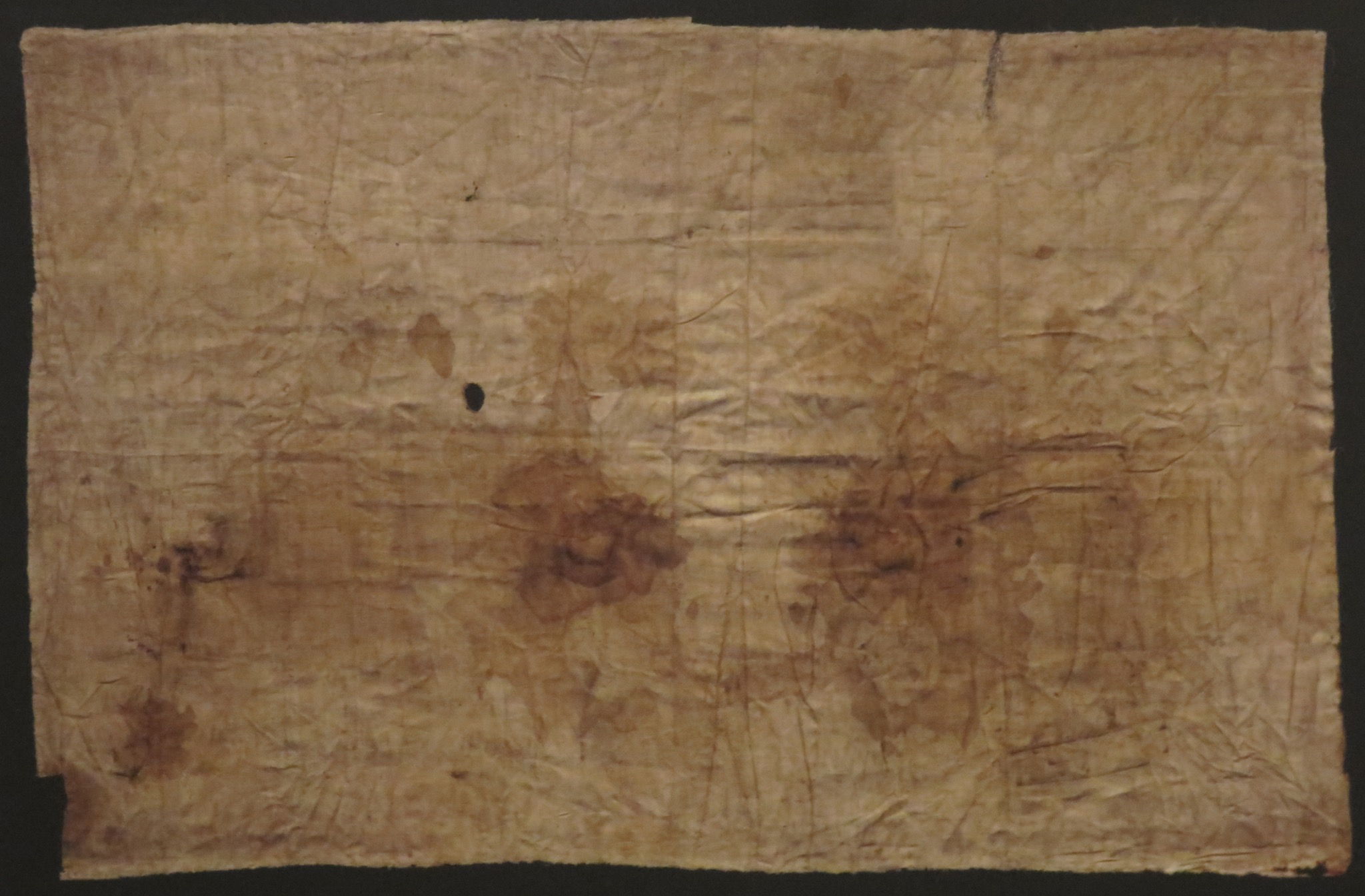
Cámara Santa, Cathedral of Oviedo · Medieval veneration; modern studies since 1965
A small linen cloth is venerated as Christ's head cloth in the Cámara Santa of Oviedo. Its folds and stains allow a vivid reconstruction of care for a deceased person. Giulio Ricci, the Spanish EDICES team, and other researchers examined the fabric, bloodstains, and connections to the Shroud of Turin. Comparisons at the nose, mouth, and back of the head, and the possible sequence in which the two cloths were used, are particularly revealing. Its history leads from the Arca Santa and medieval pilgrims to present-day forensic and microscopic investigations.
Relic of the Passion Venerated in the CathedralRead →
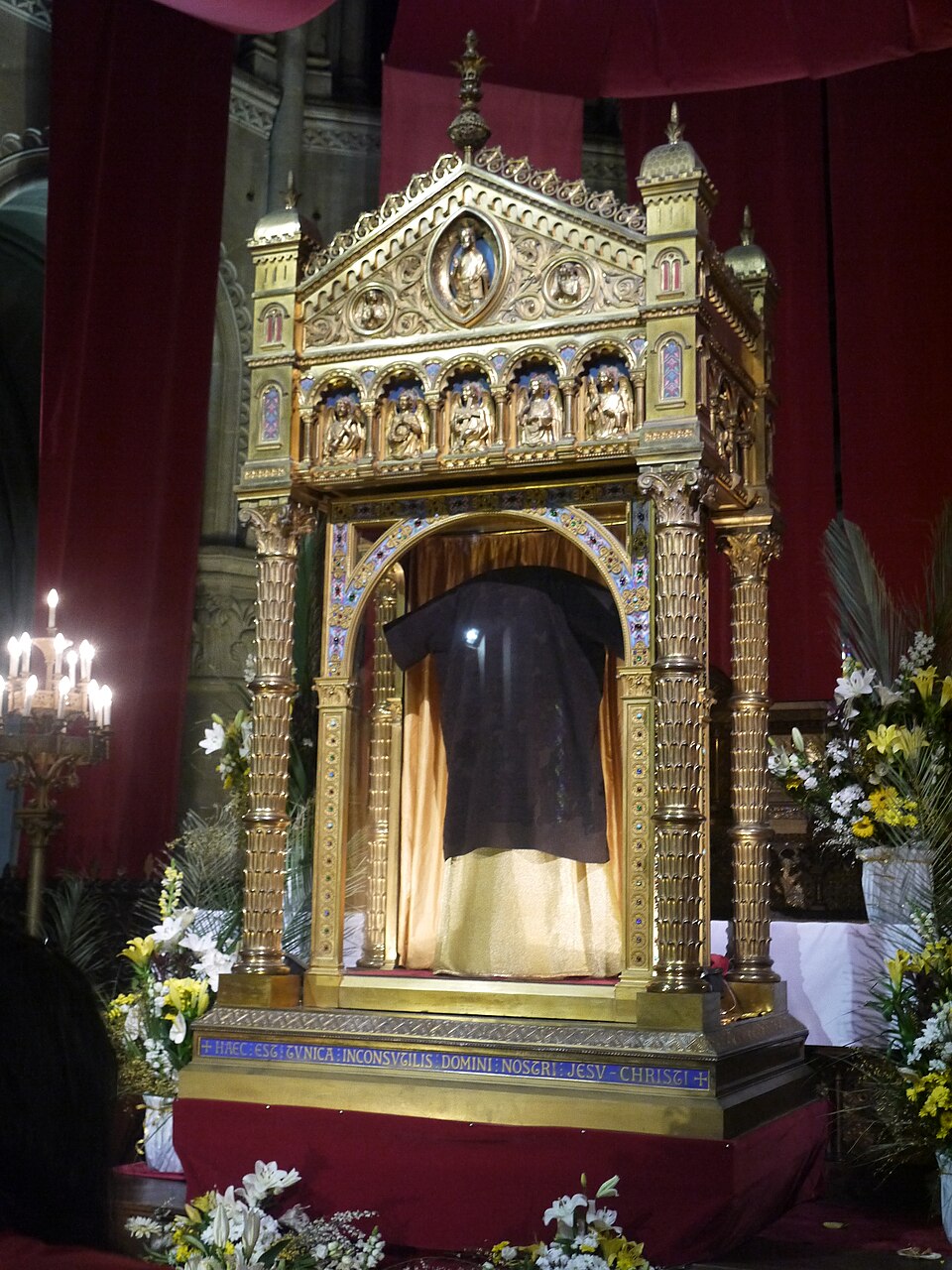
Basilica of Saint-Denys, Argenteuil · Public veneration since the Middle Ages; public display in 2025
In Argenteuil near Paris, an old woolen garment is venerated as Christ's tunic. Its fragments bear traces of an eventful history: hidden storage, medieval pilgrimage, rescue during the French Revolution, and careful restoration. The shrine connects the tradition with examinations of fabric, bloodstains, and pollen. Solemn public displays continue into the present; the tunic was shown publicly again in 2025. At the center stands remembrance of Christ's bodily self-giving and the undivided garment beneath the cross.
Relic of the Passion Venerated by the ChurchRead →
Jerusalem; further encounters in Galilee · On the third day after the Crucifixion · New Testament Easter testimonies
Jesus Christ, who died on the Cross and was buried, rises bodily from the dead on the third day. The women find the tomb open; Peter and the other disciple see the cloths left behind. Mary Magdalene encounters the Lord. He appears to the disciples, speaks with them, makes his wounds recognizable, and leads Thomas to confess his divinity. The Gospels preserve these encounters in Jerusalem and Galilee. Paul passes on the Easter testimony he has received and names individual witnesses, the apostolic circle, and more than five hundred brothers at once. Easter is Christ's real victory over death and the foundation of Christian hope.