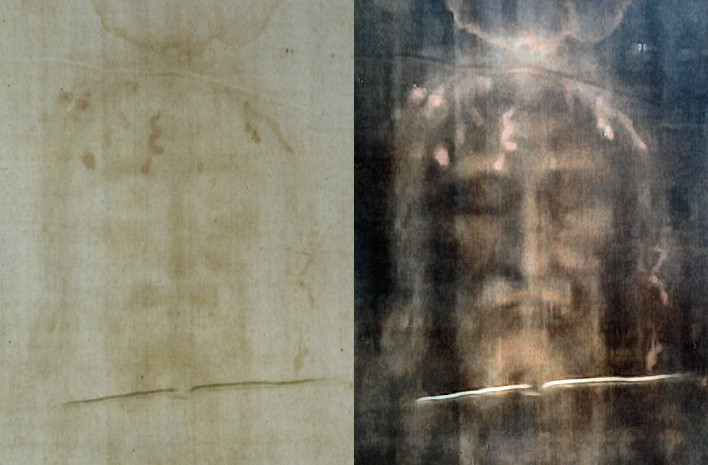
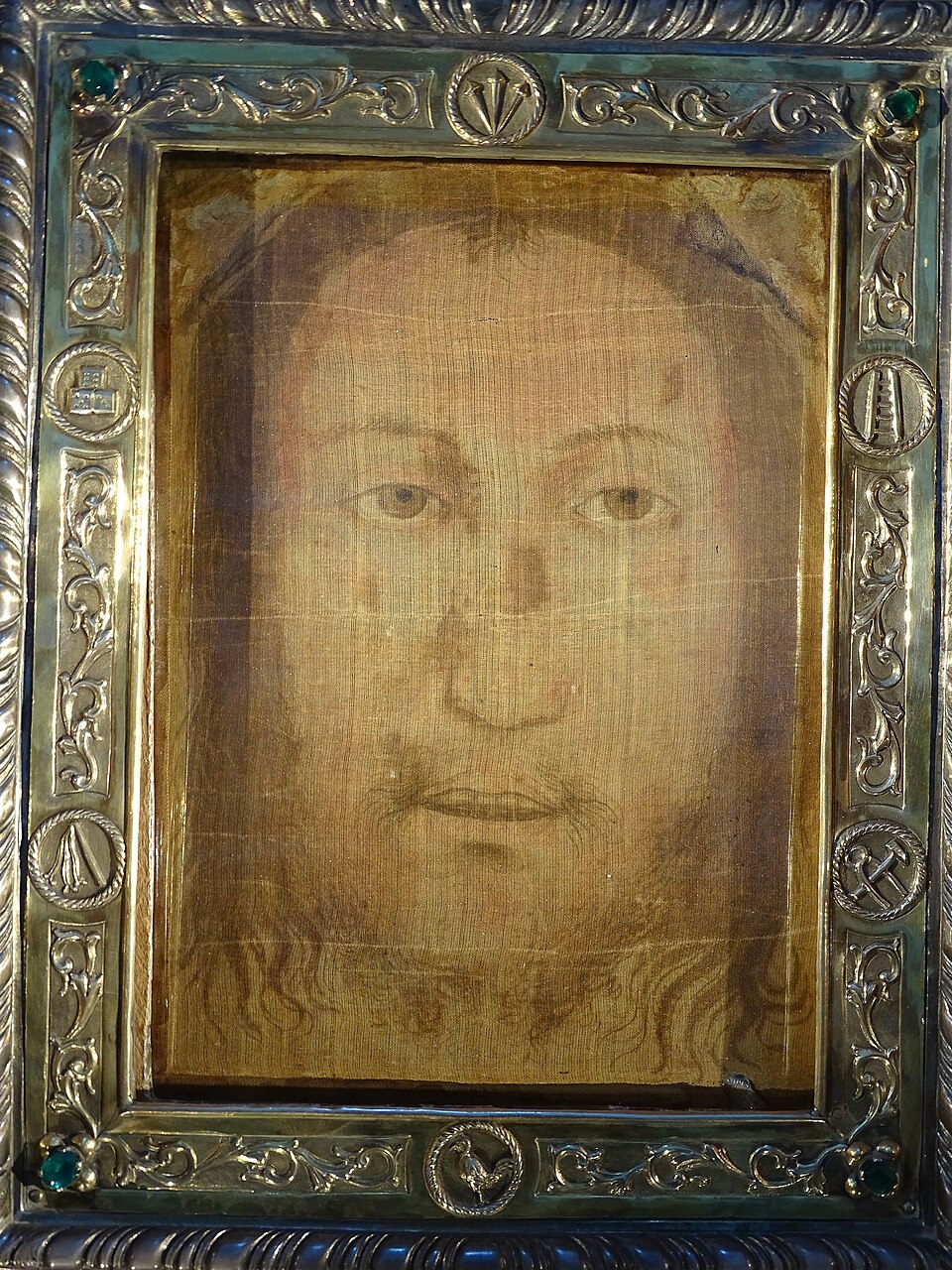
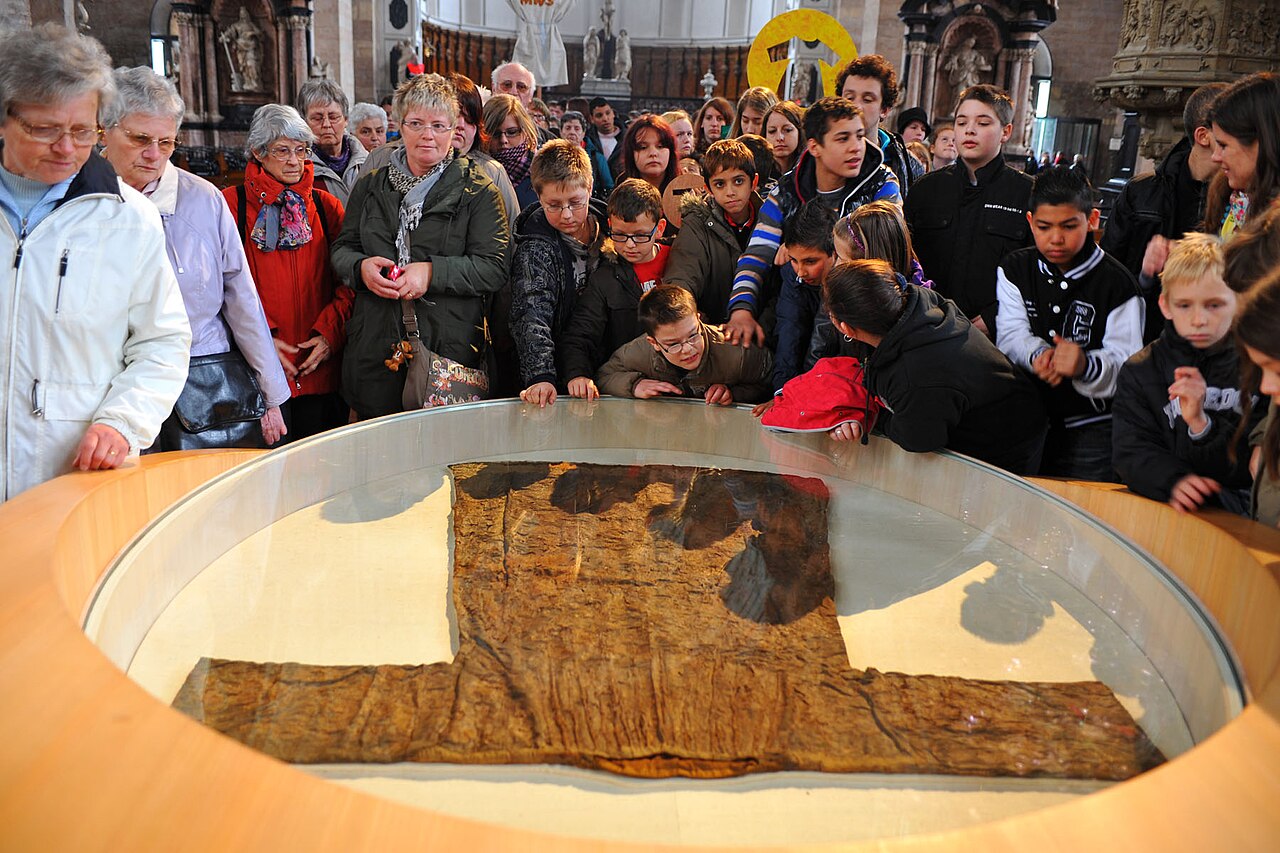
A small linen cloth is venerated as Christ's head cloth in the Cámara Santa of Oviedo. Its folds and stains allow a vivid reconstruction of care for a deceased person. Giulio Ricci, the Spanish EDICES team, and other researchers examined the fabric, bloodstains, and connections to the Shroud of Turin. Comparisons at the nose, mouth, and back of the head, and the possible sequence in which the two cloths were used, are particularly revealing. Its history leads from the Arca Santa and medieval pilgrims to present-day forensic and microscopic investigations.
Tradition connects the Sudarium with Jesus' head during the taking down from the cross and before burial. The examined stains and folds form the basis for comparison with the Shroud of Turin.
The Cloth and Its Traditional Use
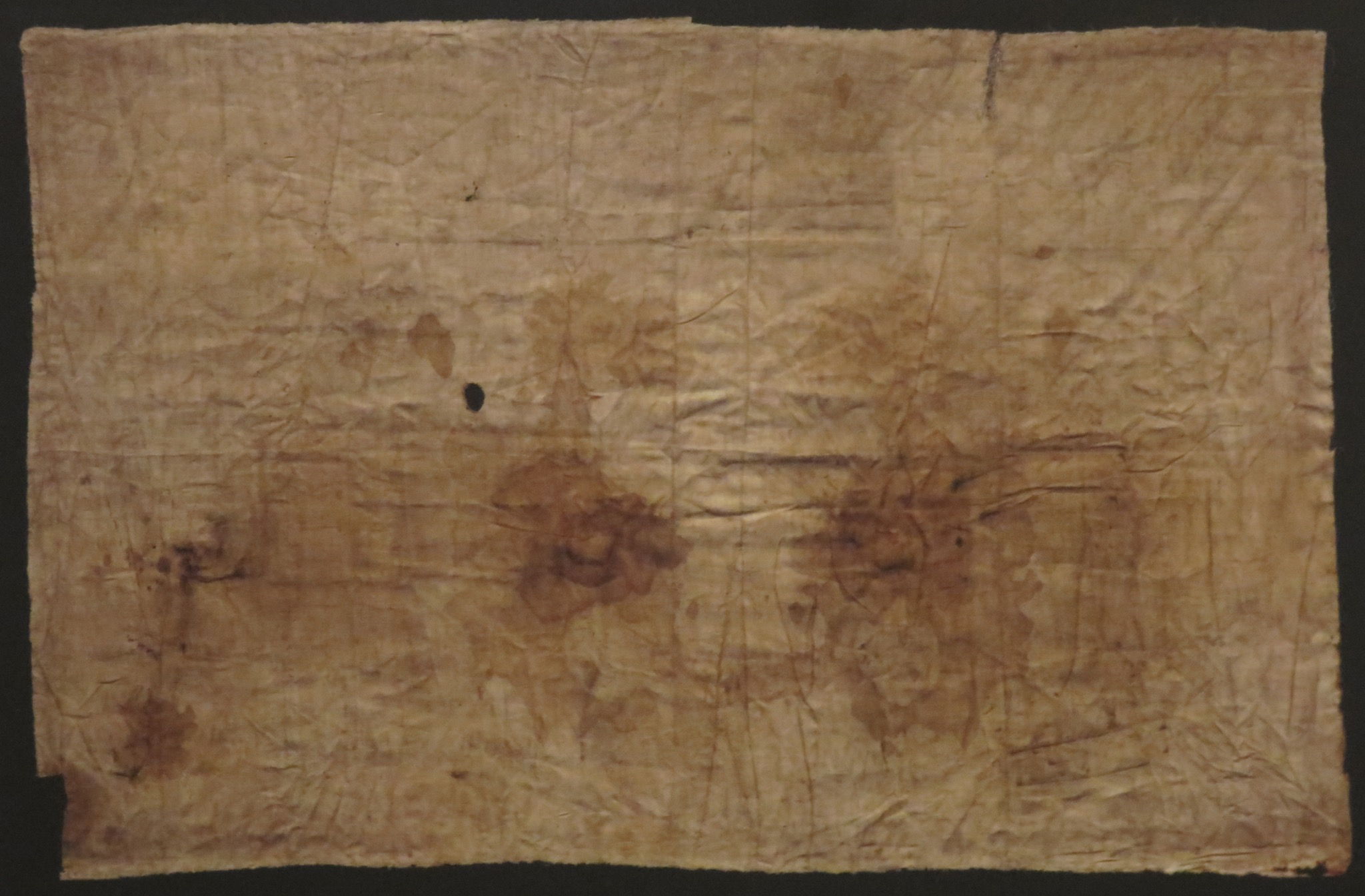
The Sudarium is a linen cloth measuring approximately 85 × 53 centimeters. It is kept in the Cámara Santa of the Cathedral of Oviedo together with the treasures of the Arca Santa. Stains, folds, and other signs of use can be seen across its surface. Unlike Turin, the impression of a face here arises from examining these contact traces; the Sudarium bears no image of a body or face.[10][11]
Its traditional use follows an understandable sequence: a cloth was first placed around the head and face of the deceased to absorb escaping fluid. It was removed before the actual burial, and the body was then wrapped in a larger cloth. John 20:6–7 explicitly distinguishes the linen cloths and a separate head cloth. In this biblical context, the Oviedo researchers examine whether the two surviving textiles fit successive actions performed on the same deceased person.[11][7]
The Arca Santa and Medieval Veneration
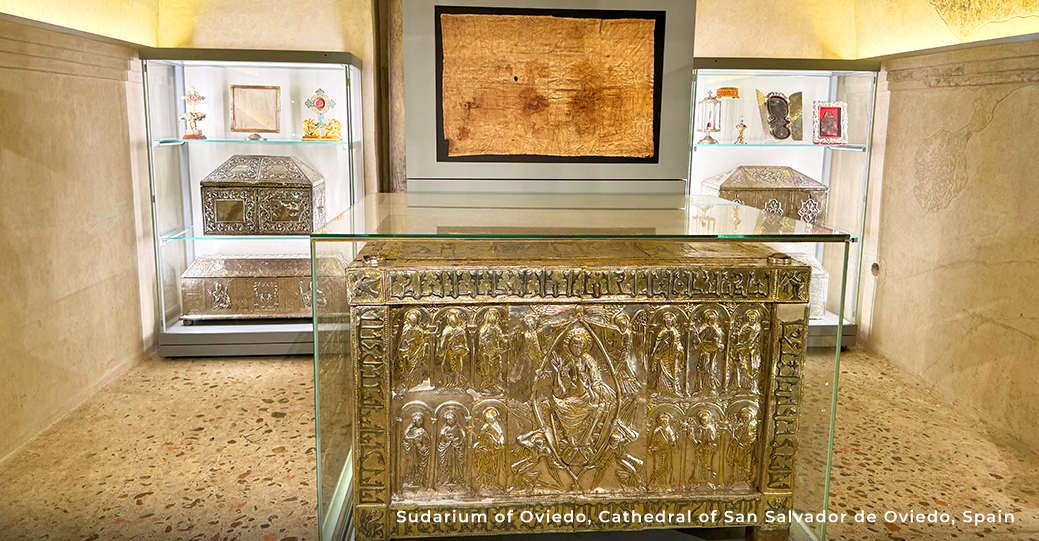
Local tradition begins with the rescue of a reliquary chest from Jerusalem ahead of the Persians. It leads through locations around the Mediterranean to Spain and finally to the Asturian north. A central medieval point of reference is the solemn opening of the Arca Santa in 1075 under King Alfonso VI. The surviving account of this event names a Sudarium of the Lord among the relics. The cloth's history is thus closely linked with an important shrine of medieval Spain.[2][10]
Oviedo became an important destination for pilgrims on the way to Santiago de Compostela. The Sudarium remains part of the cathedral's living tradition; the Spanish Center for Sindonology describes its veneration and the blessings on Good Friday and in September. Public display places the relic in the context of prayer, Passion, and resurrection.[3]
Ricci, Heras, and the EDICES Team
Giulio Ricci began comparing the Sudarium with the Shroud of Turin in the 1960s. From 1989 onward, the EDICES team worked with the support of the cathedral chapter and the Centro Español de Sindonología. Guillermo Heras led the early collaboration; results were presented at an international congress in Oviedo in 1994. Heras Moreno, forensic physician José Delfín Villalaín Blanco, and Jorge Manuel Rodríguez Almenar are particularly prominent in the comparative work. Their investigations combine photography, fabric, stain shapes, and attempts at reconstruction.[2][12]
Bloodstains and Folding around the Head
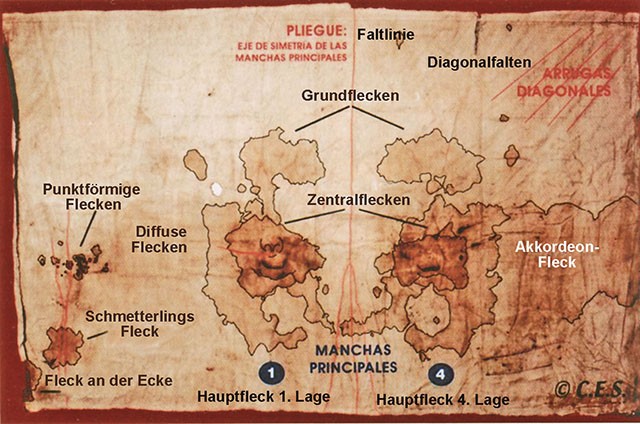
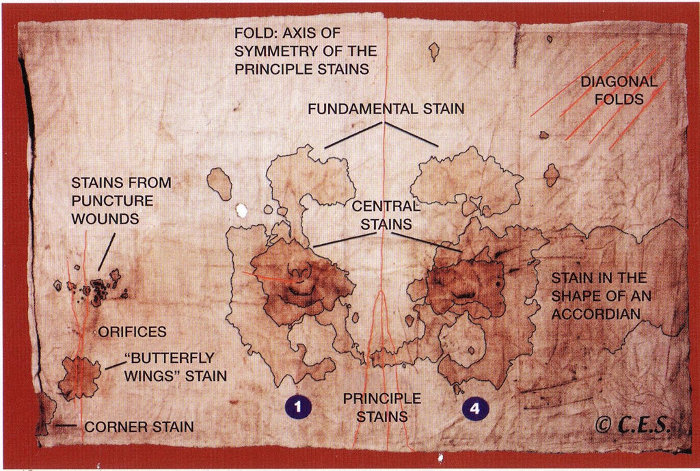
The Centro Español de Sindonología describes photographic, textile, and hematological investigations of the cloth. It also reports on Pierluigi Baima Bollone's blood studies and the assignment to group AB. The arrangement of the stains and their penetration through the fabric are central to the hypothesis of use: a folded cloth can receive corresponding traces on several layers. Different fabrics and stain patterns can fit different tasks in handling the same body.[4]
Reconstruction of the cloth folded around the head makes the approximately mirror-image stains understandable. The researchers trace where fluid emerges at a particular head position, how it reaches the fabric, and which traces are added after a change in position. A mere similarity thus becomes a testable sequence of contact, folding, and fluid deposition.[4][5]
The Main Comparative Findings
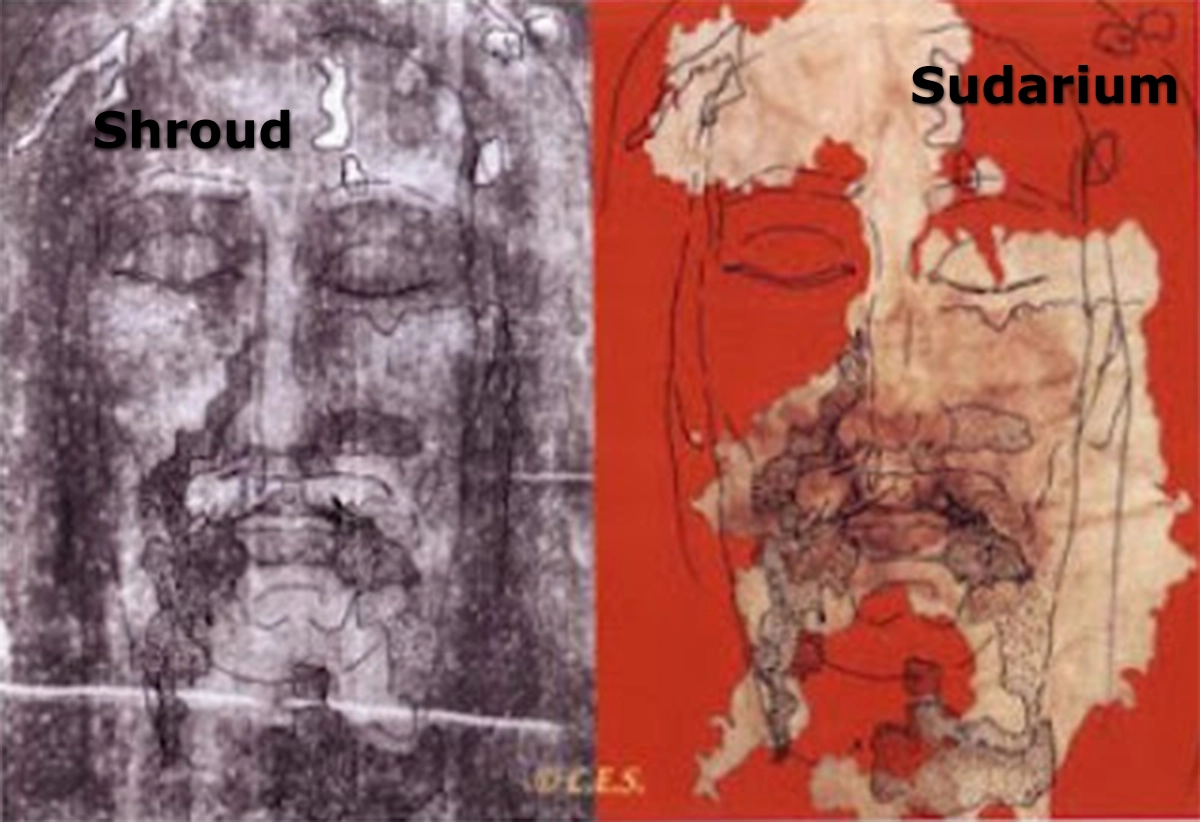
The textiles: both cloths are described as linen with Z-twist threads. Their weave differs markedly: the Shroud of Turin has a herringbone pattern, while the Sudarium has a simple right-angle plain weave. This combination permits comparison of two distinct textiles with different functions.[11]
Nose, mouth, and cheek: Heras Moreno, Villalaín Blanco, and Rodríguez Almenar compare reconstructed contact areas. They describe spatially compatible stained regions, especially an outflow beside the mouth and features at the nose and cheek. This correspondence arises from examining the stains on the cloth and the head arrangement developed to account for them.[12]
Back of the head and neck: Alfonso Sánchez Hermosilla examines groups of stains that he attributes to puncture injuries of the scalp. He compares their positions with corresponding areas of the Shroud of Turin and interprets the injuries in relation to the crowning with thorns.[13]
Folding and sequence: the cathedral summarizes experiments with a folded cloth on a head model. Different groups of stains are explained through changes in head position and several deposits of fluid. In this reconstruction, the cloth accompanies the transition from an upright body to one laid down.[10]
For the authors, the strength of the comparison lies in the combination of these features: material, wound areas, contact surfaces, and sequence can be considered together. Their work develops from this a specific case for assigning both cloths to the same Passion and possibly the same deceased person.[12][13]
Marzia Boi and the Microscopic Traces
In 2015, the Catholic University of Murcia reported a pollen finding compatible with Helichrysum in the material examined. It compared this with earlier observations on the Shroud of Turin and also incorporated its location within the material into the interpretation. That same year, the University of the Balearic Islands presented the work of palynologist Marzia Boi. She examined vacuumed dust and compared the microscopic structures with plant material.[5][6]
The investigation thus extends beyond the visible stain pattern. Small particles can reveal material contacts and open questions about plant products, places of storage, and later handling. For further assessment, the precise sampling location and comparison with possible environmental material are particularly informative.[6]
Care for the Redeemer's Body
The Sudarium directs attention to the loving care given to the dead Redeemer. In Jesus' burial, John names the cloths and the people who receive and tend his body. Reverence and active service belong together here. In Oviedo, a pilgrim can contemplate this closeness before an unassuming piece of linen, pray for those who suffer, and ask for fidelity in suffering and death. The dignity of this service does not depend on outward splendor.[7]
Witnesses & Investigators
Alfonso VI
King at the recorded opening of 1075
King at the solemn opening of the Arca Santa; his participation is a reference point in the medieval history of the relics.[2]
Giulio Ricci
Initiator of modern comparisons
Began comparison with Turin in the 1960s and developed a reconstruction of the Sudarium's use.[2][4]
Marzia Boi
Palynologist
Examines pollen and other microparticles to reveal material contacts and possible connections of origin.[6]
The unfolding story
- Arca Santa
The surviving record of its opening is a central medieval reference point for veneration of the Sudarium.[2]
- Ricci's Investigation
Giulio Ricci directs his attention to the cloth of Oviedo.[2]
- Photographic and Hematological Studies
The Spanish research center reports on Baima Bollone's investigations.[4]
- EDICES and Congress
A team forms; early results are presented internationally.[2]
- New Pollen Reports
Ecclesiastical assessment
The Cathedral of Oviedo preserves the Sudarium as a relic of the Passion and includes it in liturgical veneration. It recalls Christ's burial and care for his body.
Dating, Blood Group, and the Scope of Comparisons
An actual dating conflict belongs in the comparison: the Oviedo authors themselves report a C14 examination yielding a result in the 7th century. They discuss problematic storage of the samples in this context. Similarity of the stains does not eliminate this result. Its implications can be assessed more precisely only through documented samples, pretreatment, and measurement data.[12]
The reported blood group AB requires its own methodological examination in an old object handled many times. Kelly P. Kearse explains possible antibody cross-reactions and the influence of microbial structures. Even two reliably identified AB samples would initially only share a group; they could come from different people. Blood group and personal identity are therefore separate evidentiary steps.[11][14]
Pollen and plant DNA show contact with biological material. For an unambiguous travel route, the time of deposition and origin would also need to be established. On the Shroud of Turin, Barcaccia and colleagues found DNA from numerous plants and several people in 2015. The authors offered different historical interpretations of these mixed traces; they provide no identification of Jesus.[15]
With the stains, too, a reconstruction must hold up against alternatives. The original comparative study itself explains that different folds around the same head can produce different patterns, and different heads can produce similar patterns. Stronger claims require predefined comparison features, controlled experiments, comparison groups, and independent assessment. A similarity score without an error rate is not a probability of authenticity.[12][8][9]
The sources used serve different purposes: the cathedral attests to preservation and veneration, EDICES authors explain their investigations, and the university announcements of 2015 report ongoing research. The UIB announcement mentioned an intended specialist publication. Such reports are valuable direct testimonies to a project; technical verification additionally requires complete sample and laboratory records.[2][4][5][6]
Objections & Answers
Do the correspondences establish the same person?
They form a specific circumstantial argument whose weight comes from the shared pattern. Secure personal identity additionally requires robust blood-group findings, transparently selected comparison points, and examination of alternatives that fit similarly well. The actual research task is to determine how distinctive the combination of features is. The individual observations must neither be dismissed wholesale nor added up into an unsupported mathematical certainty.[4][5][12]
How far does the early tradition reach?
Medieval veneration and the testimony concerning the opening of the Arca Santa in 1075 are important historical reference points. The preceding journey from Jerusalem to Spain survives as local tradition; there is no unbroken series of transfer testimonies close to the events. John 20 likewise names no later place of preservation. The cult attests to the relationship with Christ maintained across generations; the object's original history remains a separate historical question. Ecclesiastical veneration is not a binding scientific decision on authenticity.[2][3][7]
Meaning for faith
Oviedo connects an ancient Passion tradition with tangible research on fabric, bloodstains, folds, and microparticles. The careful comparison with Turin in particular makes the Sudarium an independent field of testimony in Passion research. Its veneration directs attention to Christ who died and was buried, and to the people who lovingly served his body.[2][4][5]
How Relics Are Examined
Tracing provenance, material, age, and ecclesiastical custody.
Methods of examination and ecclesiastical procedure →Sources & Evidence
Information on accessibility and scope helps you assess the evidence for yourself.
- [1] Cámara Santa – El Santo Sudario
Official custodial account; also contains far-reaching interpretations of authenticity, identified as such here.
Open source · catedraldeoviedo.com ↗ - [2] Objetivos y contenidos del curso
Primary account by the participating organizers.
Open source · sudariooviedo.com ↗ - [3] Veneración tradicionalOpen source · linteum.com ↗
- [4] Investigaciones realizadas
Research summary by the participating institution, not a complete independent laboratory report.
Open source · linteum.com ↗ - [5] Investigadores de la UCAM hallan evidencias científicas que sitúan al Sudario de Oviedo y la Sábana Santa en el mismo escenario
The announcement's strong language of authenticity is not adopted as independent evidence.
Open source · investigacion.ucam.edu ↗ - [6] Polen: la clave del misterio del sudario de OviedoOpen source · diari.uib.es ↗
- [7] Evangelium secundum IoannemOpen source · vatican.va ↗
- [8] Forensic DNA Interpretation and Human Factors: Improving the Practice Through a Systems Approach
Forensic quality assurance; not a special ecclesiastical regulation.
Open source · nist.gov ↗ - [9] DNA Mixture Interpretation: A NIST Scientific Foundation Review
Mixed traces, contamination, validation, and limits of interpretation.
Open source · nist.gov ↗ - [10] Cámara Santa — El Santo Sudario
Direct account by the custodians; interpretations of authenticity are identified as such.
Open source · catedraldeoviedo.com ↗ - [11] El Santo Sudario: Investigaciones realizadas
Direct self-description by the research center.
Open source · linteum.com ↗ - [12] Comparative Study of the Sudarium of Oviedo and the Shroud of Turin
Authors' report containing comparative findings, methodological limitations, and a dating conflict.
Open source · shroud.com ↗ - [13] Commonalities Between the Shroud of Turin and the Sudarium of Oviedo
Author/congress report; not independent confirmation of every statement by the research team.
Open source · shroud.com ↗ - [14] Inadequacies in Serological ABO Typing of Ancient Artifacts: The Shroud of Turin as a Case Example
Methodological criticism; no new examination of samples from both cloths.
Open source · medwinpublishers.com ↗ - [15] Uncovering the sources of DNA found on the Turin Shroud
Original study with mixed plant and human DNA traces.
Open source · nature.com ↗