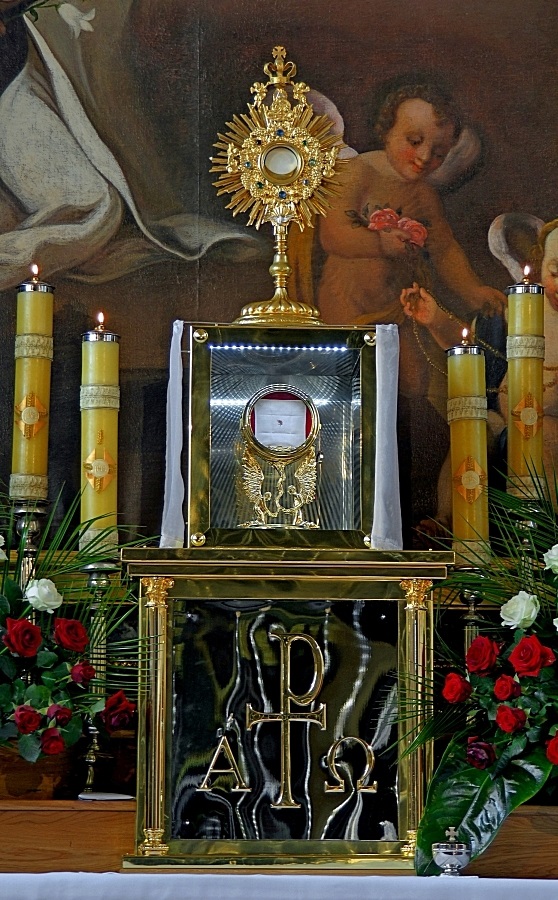
At Santa María parish, changes described as flesh and blood were observed on consecrated Hosts and Host fragments. The priest involved, Eduardo Pérez Dal Lago, attests to the beginning in May 1992 and names the other priests and the physician called in. The events of 1992, 1994, and 1996 led to investigations and to Eucharistic veneration maintained to this day. In 2024, Archbishop Jorge García Cuerva regulated their shared custody and presentation at Santa María.
Striking changes occurred on the consecrated Hosts or fragments kept at Santa María. The named witnesses reported the appearance of flesh and blood; later examinations were associated with a heart muscle finding.
Further original photographs from the publisher
The Host Fragments at the Tabernacle
As a priest involved, Eduardo Pérez Dal Lago describes the beginning: on May 1, 1992, two pieces of a Host were found near the tabernacle and reverently placed in water. A week later, those involved noticed a change. The priest names parish priest Juan Salvador Carlomagno, Marcelo Tomaino, and Eduardo Graham; physician Isabel Botto was also called in. What had begun with careful handling of the Blessed Sacrament became the occasion for shared observation and further investigation. Pérez Dal Lago gave his personal testimony in a detailed interview for the thirtieth anniversary in 2022.[2]
Three Years of Events in the Same Parish
The archbishop's regulation expressly names the years 1992, 1994, and 1996. Santa María thus preserves several related Eucharistic events. Their shared center is the local parish; at the same time, each fragment has its own beginning and history of custody. Pérez Dal Lago's testimony directly concerns the first episode. Precise attribution of statements and later samples clarifies which observation belongs to which event and preserves each testimony's own evidential force.[1]
The Accounts of the Tissue Examinations
Pérez Dal Lago also reports later examinations and a heart muscle finding. The international exhibition's account mentions investigations coordinated by Ricardo Castañón Gómez in this connection. There is thus specific information about research on the preserved material. The interview is personal testimony concerning the results known to the priest; the exhibition summarizes investigations. Complete laboratory reports with images of preparations, controls, and an unbroken assignment of samples are not present in these publicly accessible sources. These very records would be decisive for specialist examination of further individual claims.[2][4]
The Archbishop Confirms the Place of Veneration
In 2024, Jorge García Cuerva required fragments stored elsewhere to be returned to Santa María. Veneration and official presentation were expressly assigned to the parish. The parish priest serving at any given time is responsible as custodian to the vicar general. The decision gives the faithful a clear ecclesiastical reference point: here the objects are preserved, here their history is presented, and here veneration takes place under the archbishop's responsibility.[1]
A Shared Custodian for the Fragments and Their History
Centralized custody helps connect each object with its respective history. Especially with events in three different years, it matters when a Host was found, where it was stored, and which fragment was later examined. A fixed place of preservation and a responsible custodian facilitate reliable information and further research. The return organizes the present collection; earlier sample routes must still be reconstructed from their own records. Santa María thus becomes a clearly designated point of contact for pilgrims and researchers. The Church's care for the Blessed Sacrament includes care for its documented history.[1]
The Weight of Named Testimonies
A specific community, named participating priests, the involvement of a physician, reports of tissue examinations, and explicit archiepiscopal regulation speak in favor of Buenos Aires. The case therefore cannot be dismissed as an anonymous rumor. Its weight lies in these tangible testimonies. For scientific assessment, precise attribution of laboratory data to the individual fragments remains decisive. Ecclesiastical responsibility and specialist records complement each other: an official's standing does not replace a sample, while a sample without its provenance does not fully reveal the event.[1][2][3]
Placing Christ at the Center Again
The parish connects remembrance with the call to make Christ the center of faith again. Its publications also use the biblical word “sign”: the visible miracle points to the Lord present in the Eucharist. The response should be Holy Mass, prayer before the tabernacle, conversion, and love of neighbor. This reveals the spiritual unity of the events at Santa María.[3]
Witnesses & Investigators
Eduardo Pérez Dal Lago
Priest and participant in 1992
Personally attests to the first episode and reports later investigations known to him.[2]
Juan Salvador Carlomagno
Then parish priest of Santa María
Was involved in the events as a participating priest and ecclesiastically responsible custodian.[2]
Jorge García Cuerva
Archbishop of Buenos Aires
Regulated custody, veneration, and official presentation at Santa María in 2024.[1]
The unfolding story
- First Episode
The first Host fragments are preserved at Santa María; Pérez Dal Lago personally attests to the events.[2]
- Further Event
The later archiepiscopal regulation also names this year.[1]
- Third Episode
A further event belongs to the Host fragments kept by the Church at Santa María.[1]
- Anniversary and Testimony
The parish marks thirty years since the first episode.[3]
- Custody Regulated
The archbishop assigns veneration and presentation to Santa María.[1]
Ecclesiastical assessment
In 2024, Archbishop Jorge García Cuerva designated Santa María as the place of veneration and official presentation. The Host fragments may leave the parish only on his express instruction.
Objections & Answers
What Significance Does Ecclesiastical Authority Have for the Laboratory Finding?
An archbishop can commission investigations, assess testimonies, and regulate veneration within the Church. This is a substantial part of the overall assessment. The biological statement about a sample, however, arises from its examinations. A reported heart muscle finding must therefore be identified as such; an individual identification of Jesus cannot be inferred from it. The later election as pope of an ecclesiastical official involved does not alter the finding either. The case's value rests on the interplay of testimony, material investigation, and ecclesiastical responsibility, not on an attributed papal laboratory decision.[1][2]
Are Numerous Publications Each Separate Confirmations?
Several publications can reliably disseminate the same testimony or expert report. They make the finding accessible but do not multiply the number of investigations. Additional confirmation requires a further independent testimony or assessment. For Santa María, one must therefore ask which year of events and which fragment a report concerns. This attribution protects the existing positive testimonies from confusion. Their religious context of dissemination does not diminish their value; what remains decisive is the named person, that person's own observation, and traceable investigative records.[1][2][4]
Meaning for faith
Santa María preserves specific Eucharistic events attested by participating priests and expressly placed within ecclesiastical veneration by the archbishop. The individual testimonies and investigations lead to the same center: Christ in the Blessed Sacrament and the renewal of Eucharistic life.[1][2][3]
How Eucharistic Miracles Are Examined
Securing the account of events, identifying the material, and reading the Church's judgment precisely.
Methods of examination and ecclesiastical procedure →Sources & Evidence
Information on accessibility and scope helps you assess the evidence for yourself.
- [1] Mons. García Cuerva puntualiza la versión oficial sobre un milagro eucarístico
Report on specific archiepiscopal directives.
Open source · aica.org ↗ - [2] A 30 años del primer Milagro Eucarístico, Jesús nos pide volver a ser el centro de nuestra fe
Personal recollection concerning 1992; later laboratory results are reported by the interviewee.
Open source · aica.org ↗ - [3] Santa María comienza a celebrar los 30 años del Signo Eucarístico de Buenos Aires
Parish anniversary report and explanation of the term sign.
Open source · aica.org ↗ - [4] Tixtla: Reference Back to Investigations in Buenos Aires
Secondary exhibition account; not an independent expert report from Buenos Aires.
Open source · realpresence.org ↗