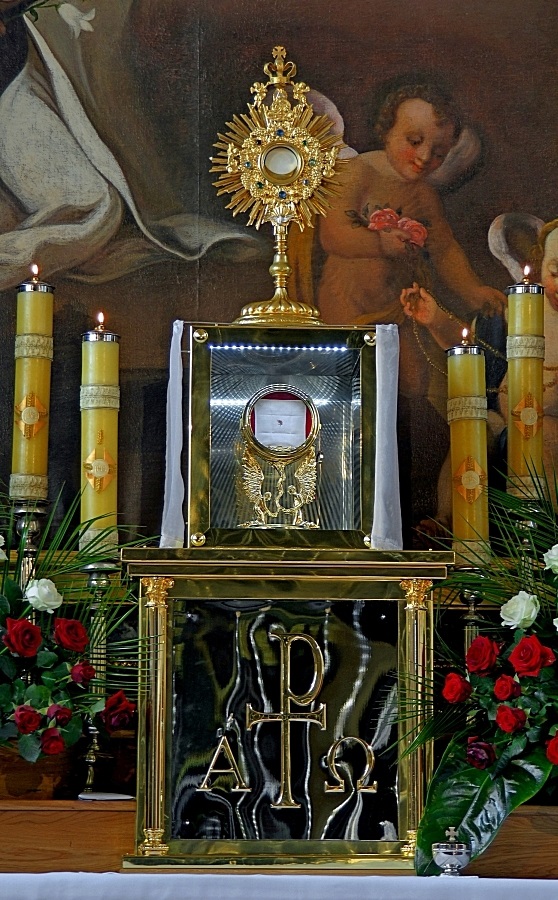
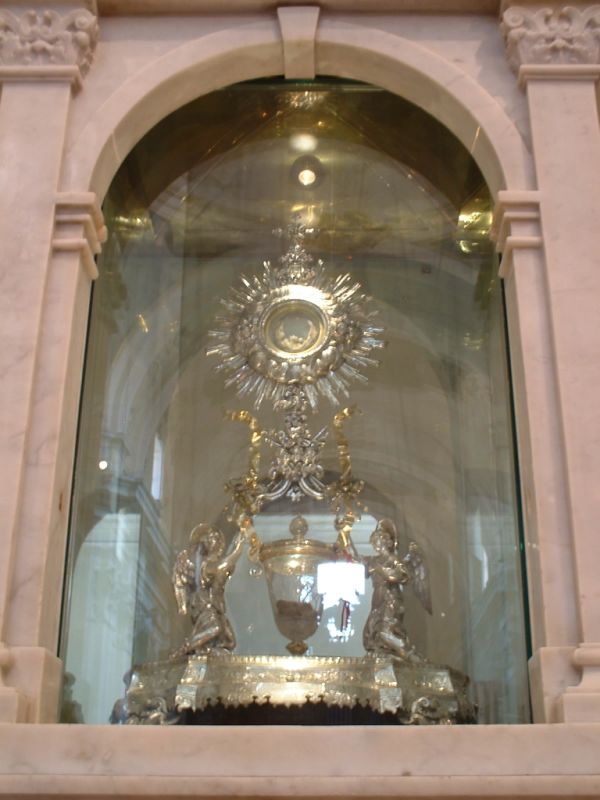
On Christmas Day 2013, a consecrated Host fell to the floor in Saint Hyacinth's in Legnica. It was placed in water; reddish areas later appeared. An episcopal commission arranged material examinations. The published result describes fragments of striated muscle whose overall structure most closely resembled heart muscle, together with genetic indications of human origin. In 2016, after the involvement of the Congregation for the Doctrine of the Faith, Bishop Zbigniew Kiernikowski ordered the establishment of a fitting place for public veneration.
Reddish changes appeared on the consecrated Host kept in water. The examination finding reproduced in the episcopal communiqué describes human tissue most closely resembling heart muscle.
Further original photographs from the publisher
The Host Is Carefully Preserved
The bishop's report describes the sequence: on December 25, 2013, a consecrated Host fell to the floor in Saint Hyacinth's. It was placed in water. When reddish changes later appeared, the bishop at the time, Stefan Cichy, established a commission. In February 2014, the red portion of the material was placed on a corporal; samples were subsequently taken for examination. The discovery was thus placed under concrete ecclesiastical responsibility from the outset.[1]
Striated Muscle Fibers and Human Origin
The official communiqué reports fragments of striated muscle. According to the expert assessment, their overall structure most closely resembled heart muscle; genetic tests indicated human origin. This is a positive tissue finding and concerns more than mere red color. The specialist qualification “most closely” belongs to the published result. The assessment contains no personal identification as the “living heart of Jesus.” The bishop's summary does not replace the complete laboratory file; that file would be decisive for a further independent review of the methods and controls.[1]
A Concrete Ecclesiastical Decision
In 2016, Zbigniew Kiernikowski made the event public and charged parish priest Andrzej Ziombra with establishing a fitting place of veneration. Information and catechesis were also to be provided. The statement explicitly mentions the prior involvement of the Congregation for the Doctrine of the Faith. Public exposition began on July 2, 2016. The positive decision exists as an accountable episcopal act; no additional separate papal decree is claimed here.[1][2][4]
The Value of the Officially Published Finding
In Legnica, named individuals bear responsibility for the investigation, custody, and ecclesiastical interpretation. The bishop publishes the results and determines how the object is to be treated; the parish priest bears local responsibility. This connection gives the case a traceable form. The specimens, methods, and controls matter for scientific assessment. For the overall history, the participants' statements and the provenance of the samples are also essential. Official testimony and specialist documentation have different functions and complement one another.[1][2]
Answers to Prayer Are Recorded
The bishop had a book established in which possible graces and further extraordinary events are recorded. The fruits of veneration are thus also to be documented. A testimony of healing must be examined through diagnosis, treatment, and course; a conversion is explored as a spiritual life journey. Such testimonies must be distinguished from the original material examination. Recording them in writing makes precisely this accurate attribution possible. The arrangement also shows the shrine's spiritual purpose: people are to encounter the hidden Lord and orient their lives toward him.[1]
Christmas and the Real Humanity of Christ
The beginning on Christmas Day places the miracle in a compelling context. The Son of God truly assumed human nature. The same Lord encounters his Church in the Blessed Sacrament. The shrine's enduring veneration and catechetical work therefore lead to reverence, conversion, and love. A shrine publication presented in 2022 recalls the public exposition of 2016 and makes this Eucharistic history accessible to the faithful.[4]
Witnesses & Investigators
Stefan Cichy
Diocesan bishop at the start of the investigation
Established an ecclesiastical commission after the observed change.[1]
Zbigniew Kiernikowski
Diocesan bishop at the time of publication
Published the finding in 2016 and ordered public veneration.[2]
Andrzej Ziombra
Parish priest and custodian at the shrine
Was entrusted with fitting custody, information, and catechesis.[1]
The unfolding story
Ecclesiastical assessment
In 2016, Bishop Kiernikowski described the occurrence as an event with the characteristics of a Eucharistic miracle. After the Congregation for the Doctrine of the Faith had considered it, he ordered veneration, information, and catechesis at the site.
Do red bacteria explain the tissue finding?
Bacteria such as Serratia marcescens can produce red pigments. The experimental research cited for this establishes a general natural possibility but did not examine the Host of Legnica. Pigment formation initially explains color; it does not in itself explain the reported fragments of striated muscle. Anyone proposing this alternative must test it against the actual tissue finding. This would require the original specimens, stains, controls, and documented handling of the samples. The general pigment study is not a counterfinding on the material from Legnica.[3][1]
Objections & Answers
Could microorganisms have caused the red area?
A microbiological explanation must address the entire reported finding. Red pigments alone do not produce a striated muscle structure. The general possibility of discoloration is therefore not a complete refutation of the Legnica investigation. To decide a concrete alternative on specialist grounds, the original specimens and control procedures would need to be compared. The available statement is a summary, not a complete laboratory file. This permits neither the claim that every objection has been experimentally excluded nor the dismissal of the documented tissue finding as a mere mistake about color.[1][3]
What significance does permission for veneration have?
It is an accountable overall ecclesiastical decision that considers the sequence of events, the testimonies, the specialist findings, and the spiritual context. The bishop explicitly names characteristics of a Eucharistic miracle and connects veneration with instruction. This positive decision is more than a nonbinding recommendation. Its precise subject nevertheless remains distinguishable from the narrower scientific finding about the material. It neither confirms every later popular formulation nor amounts to individual genetic proof of origin from Jesus.[1][2]
Meaning for faith
Legnica possesses an officially published positive tissue finding and a concrete episcopal decision for public veneration. The sequence, investigations, and ecclesiastical responsibility make the case traceable. Its spiritual center is the Lord made man, who remains present in the Eucharist.[1][2]
How Eucharistic Miracles Are Examined
Securing the account of events, identifying the material, and reading the Church's judgment precisely.
Methods of examination and ecclesiastical procedure →Sources & Evidence
Information on accessibility and scope helps you assess the evidence for yourself.
- [1] Komunikat w sprawie Wydarzenia Eucharystycznego w parafii św. Jacka w Legnicy
Original wording accessible; quotes excerpts from a laboratory finding and does not replace a complete laboratory file.
Open source · jacek-legnica-sanktuarium.pl ↗ - [2] Cud eucharystyczny w Legnicy? – komunikat biskupa legnickiego
Reports the bishop's decision; not an independent new laboratory test.
Open source · archivioradiovaticana.va ↗ - [3] Kinetic analysis of growth rate, ATP, and pigmentation suggests an energy-spilling function for the pigment prodigiosin of Serratia marcescens
Experimental pigment research; not an examination of the Host of Legnica.
Open source · pubmed.ncbi.nlm.nih.gov ↗ - [4] Nowa publikacja o sanktuarium św. Jacka
Documents the commemoration of the beginning of public veneration.
Open source · legnica.fm ↗