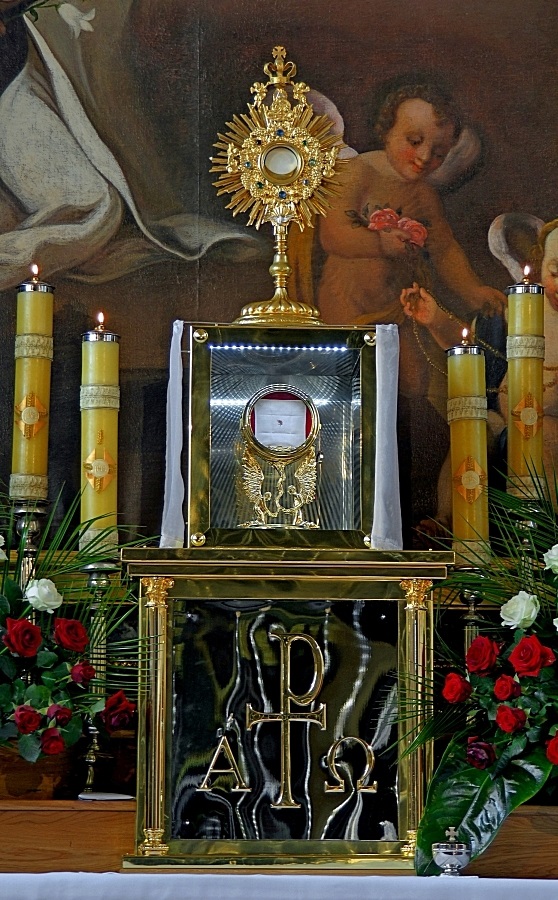
A monk in Lanciano doubted Christ's real presence during Holy Mass. According to the testimony preserved at the shrine, flesh and blood appeared at the consecration in place of the previous visible species. The flesh and five blood clots are venerated to this day. Odoardo Linoli's medical examination produced a significant positive finding: he identified human heart muscle tissue and human blood of group AB. His work, published in 1971, includes methods and illustrations; the anatomist Ruggero Bertelli confirmed the histological assessment.
Ecclesiastical tradition attests to a visible transformation during Mass. In 1971, Linoli reported finding human heart muscle tissue and human blood of group AB in the preserved relics.
The Answer to the Monk's Doubt
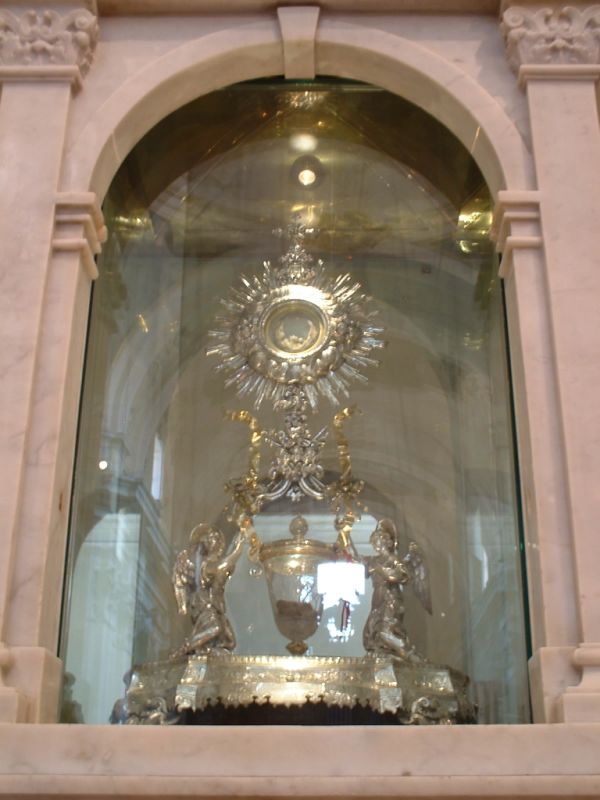
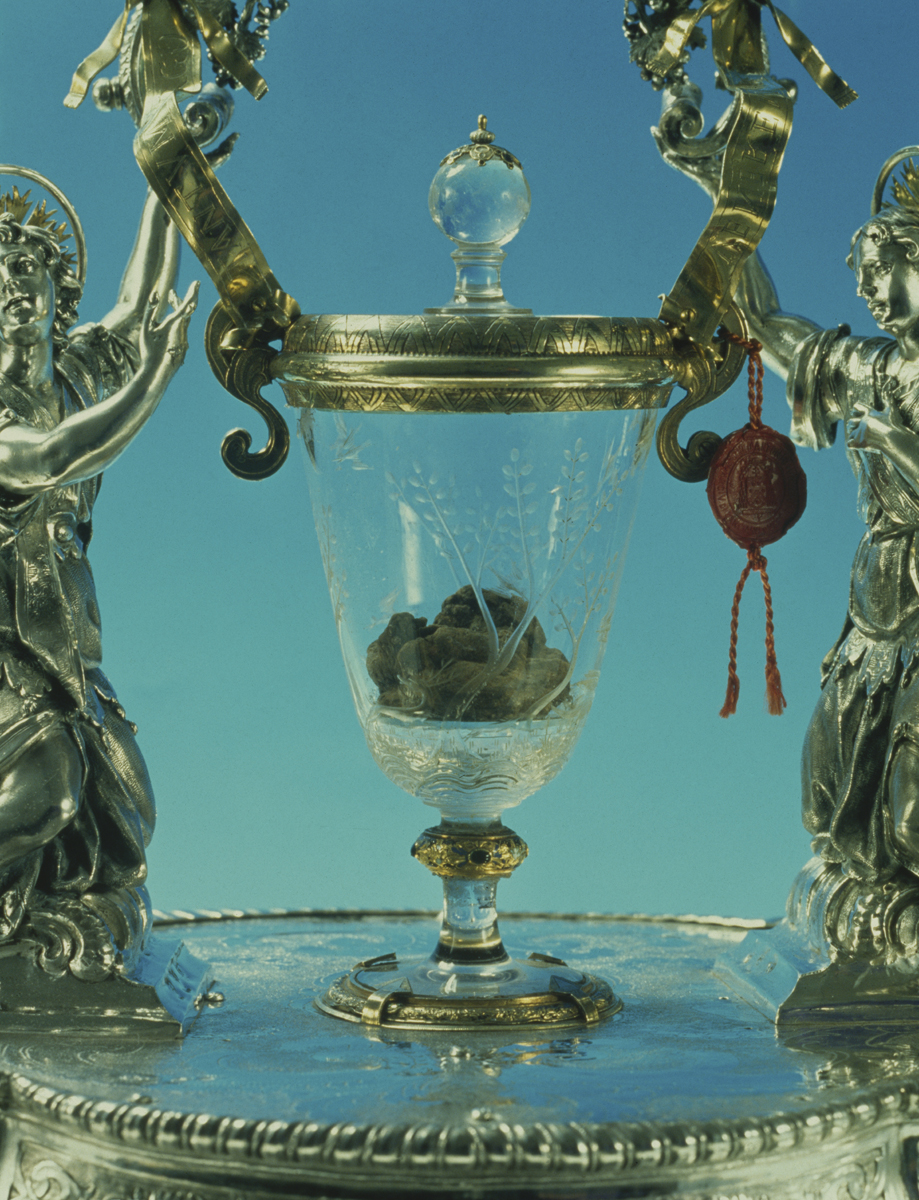
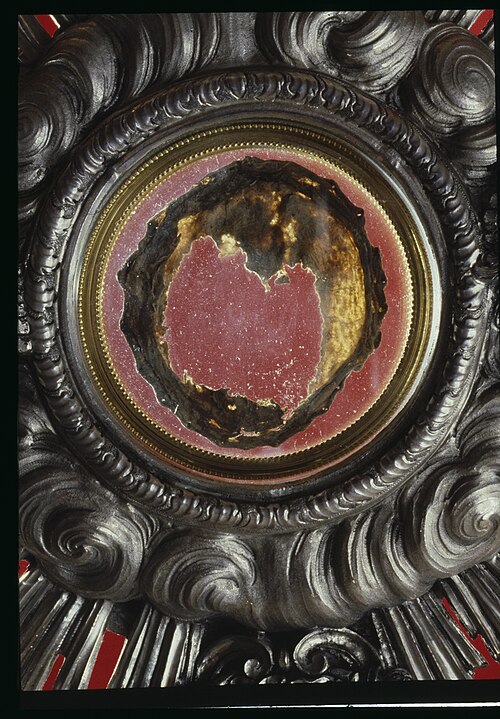
The account preserved at the shrine leads to the early Middle Ages, traditionally around 750. A monk was celebrating Holy Mass and struggling with doubts about Christ's real presence. During the consecration, he saw flesh and blood: the miracle gave his doubt a visible answer. The preserved relics consist of the piece of tissue and five dark blood clots. The monk's name has not been handed down. The international exhibition presents the event in part through an early modern inscription; the year belongs to local tradition.[3]
Human Heart Muscle Tissue and Blood Group AB
Odoardo Linoli published his investigation in 1971 in Quaderni Sclavo di diagnostica clinica e di laboratorio, volume 7, pages 661–674. He examined the tissue structure, conducted immunological and biochemical analyses, and documented his methods with illustrations. His result: the tissue examined was identified as heart muscle; the blood components were assessed as human and belonging to blood group AB. Linoli also records the anatomist Ruggero Bertelli's agreement with the histological diagnosis. Lanciano therefore has an accessible original medical paper, not merely the repetition of an oral finding.[1][2]
Several Investigative Methods Complement One Another
Linoli's work does not rely solely on the color or outward appearance of the relics. It combines histological structural features with immunological and biochemical results. This combination is the substantive reason why the finding says more than the observation of a red stain. Each method has its own specific subject: histology concerns the tissue type, while the other procedures concern material properties and biological identification. Blood group AB is a concrete characteristic of the sample examined; it is not proof of individual identity. Nor are the material's age and historical journey determined by its tissue type alone.[1]
The Historical Journey of the Relics
The shrine and continuing veneration provide access to the historical context of the object examined. The early centuries are less densely documented than the modern material investigation. The sources consulted here contain no contemporary examination record from the eighth century; the inscription and later texts preserve the earlier event. A later written account is not in itself evidence of invention. It requires historical examination of its origin and dependence on other sources. Lanciano's distinctive feature is that this historical testimony meets a material relic that has actually been examined.[3][4]
Why Lanciano Is a Significant Testimony
The explanation that Eucharistic blood miracles are merely unexamined red discolorations does not apply to Lanciano. Here there are a concrete object and a published specialist finding of human tissue and blood. Ecclesiastical tradition gives this finding its Eucharistic context. A judgment on the entire case therefore considers both the laboratory work and the provenance, custody, and history of testimony. The medical paper provides strong positive information about the material; its meaning becomes clear precisely because the further historical question is explicitly set beside it.[1][3]
The Heart of Christ and His Real Self-Giving
The Heart of Christ signifies his real human love, his obedience, and his voluntary sacrifice. The finding of heart muscle therefore has a compelling significance within this Eucharistic miracle: it points to the Redeemer's self-giving. Catholic teaching professes the whole living Christ in every consecrated Host under the sacramental species. This particular miracle is a call to adore this Lord; it does not mean that microscopically identifiable pieces of organs are distributed at every Communion.[5]
Witnesses & Investigators
The unnamed monk
Celebrant and observer in ecclesiastical tradition
Experienced the visible answer to his doubt during Mass; his name has not survived.[3]
Odoardo Linoli
Examining physician and author of the original paper
Published the histological, immunological, and biochemical findings on the relics in 1971.[1]
Ruggero Bertelli
Expert anatomical assessor
Linoli records his agreement with the histological diagnosis.[1]
The unfolding story
- Traditional Origin
The tradition places the doubting monk's Mass in the early Middle Ages.[3]
- Inscription
An inscription records the narrative of the origin.[3]
- Material Examination
Linoli examines the relic samples entrusted to him.[1]
- Scholarly Publication
The report appears in Quaderni Sclavo with methods and findings.[2]
Ecclesiastical assessment
The relics are venerated by the Church at the shrine. Linoli's published histological, immunological, and biochemical investigation identifies the material examined as human heart muscle tissue and blood of group AB.
Does a conceivable substitution already prove a forgery?
No. A substitution would need to be established as a concrete historical event: who would have obtained the material, when would access have been possible, and what traces document the intervention? The word “forgery” does not answer these questions. Conversely, Linoli's histology identifies the material examined without retrospectively observing its entry into the collection of relics. Provenance and custody therefore remain independent historical questions for investigation. An unsupported substitution hypothesis does not negate the published tissue finding.[1]
Further investigations that minimize damage to the material could build on the existing work with documented sampling, blinded assessment, and accessible complete protocols. This is a possible avenue for further research, not a report of new tests already completed. Frequently repeated claims about hundreds of confirmatory WHO or UN investigations are not used here as evidence, because no corresponding original report is available in the sources consulted. To convey the weight of the case, it is enough to state precisely the finding that was actually published.[1][4]
Objections & Answers
Does blood group AB prove personal origin from Jesus?
A blood group does not identify an individual person. Many people can have the same group. The designation AB is therefore significant as a concrete biological characteristic of the sample examined, not as a personal identification. Comparisons with other relics each require their own original findings, suitable methods, and an established sample provenance. In the judgment concerning the miracle, the relationship to Christ arises from the Eucharistic event and its historical tradition. This overall assessment differs from an individual identification derived from blood group alone.[1]
Is the possibility of forgery enough to refute the case?
No. Possibility and proof must be distinguished. A substitution hypothesis would have to explain the timing, access, procurement of material, and concrete indications. Linoli's positive material finding remains valid unless a specialist counterfinding refutes it. At the same time, the historical sources must be examined for the question of origin; they are less dense for the early centuries than for the modern investigation. This limits any claim to have completely excluded every conceivable alternative, but it does not turn an unsupported alternative into a refutation. The case must be assessed on the basis of its actual historical and medical testimony.[1][3]
Meaning for faith
With the miracle tradition preserved by the Church and Linoli's published investigation, Lanciano possesses significant historical and material testimony. Human heart muscle tissue and blood of group AB are concrete positive findings of the 1971 work. In their Eucharistic context, the relics point to Christ's real self-giving and lead to adoration.[1][2][3]
How Eucharistic Miracles Are Examined
Securing the account of events, identifying the material, and reading the Church's judgment precisely.
Methods of examination and ecclesiastical procedure →Sources & Evidence
Information on accessibility and scope helps you assess the evidence for yourself.
- [1] Ricerche istologiche, immunologiche e biochimiche sulla carne e sul sangue del Miracolo Eucaristico di Lanciano
Original paper consulted. Identification of the material; no radiometric dating or identification of Jesus.
Open source · popline.org ↗ - [2] Bibliographic entry PMID 4950729
Confirms author, journal, year, and pages; contains no abstract.
Open source · europepmc.org ↗ - [3] Il Miracolo Eucaristico di Lanciano
Secondary devotional and historical summary; no independent laboratory confirmation.
Open source · miracolieucaristici.com ↗ - [4] Il Miracolo Eucaristico di Lanciano
The account itself mentions the sparse early documentation. Not all further scientific claims are adopted.
Open source · parrocchiasanvitale.it ↗ - [5] Mysterium fidei
Doctrinal foundation; not recognition of an individual laboratory finding.
Open source · vatican.va ↗