According to the historical trial tradition, Miguel Juan Pellicer received back his previously amputated right leg in Calanda on March 29, 1640. He had lost it in 1637 after a cart accident and had traveled with a wooden leg and crutch. The event was recorded by a notary a few days later and subsequently investigated by the Church. The witnesses included the surgeons involved in the amputation. Archbishop Pedro Apaolaza recognized the miracle on April 27, 1641.
The historical trial concerns the restoration of the right leg previously amputated below the knee. Medical witnesses confirmed the earlier amputation and recognized the man who later appeared with both legs as their patient.
From the Accident to the Night in Calanda
The trial tradition and the City of Zaragoza's historical account describe Pellicer's story: after a cart accident, his right leg had to be amputated below the knee at the hospital in Zaragoza in 1637. He later moved about with a wooden leg and crutch. On March 29, 1640, he received the leg back while asleep in Calanda. He was devoted to Our Lady of the Pillar and understood the event as the help he had asked of her.[1][4]
Encounters after the Healing
Family members and people from the local community recognized Pellicer with both legs again after the night in Calanda. His treating surgeon, Juan de Estanga, also met him later. At this encounter, his capacity to bear weight was still limited; Estanga recorded this circumstance as well. The testimonies thus describe both the restored bodily condition and the initial period afterward.[1]
The Statements of the Surgeons Involved
Juan de Estanga, surgeon at the General Hospital and university teacher in Zaragoza, confirmed the treatment decision and amputation below the knee during the proceedings. He had provided aftercare for the stump and later seen Pellicer with a wooden leg and crutch. In court, he expressly recognized the young man presented to him as the same patient. Diego Millaruelo confirmed that he had assisted with the operation and had seen the severed leg.[1]
Amputation and Identity Are Examined
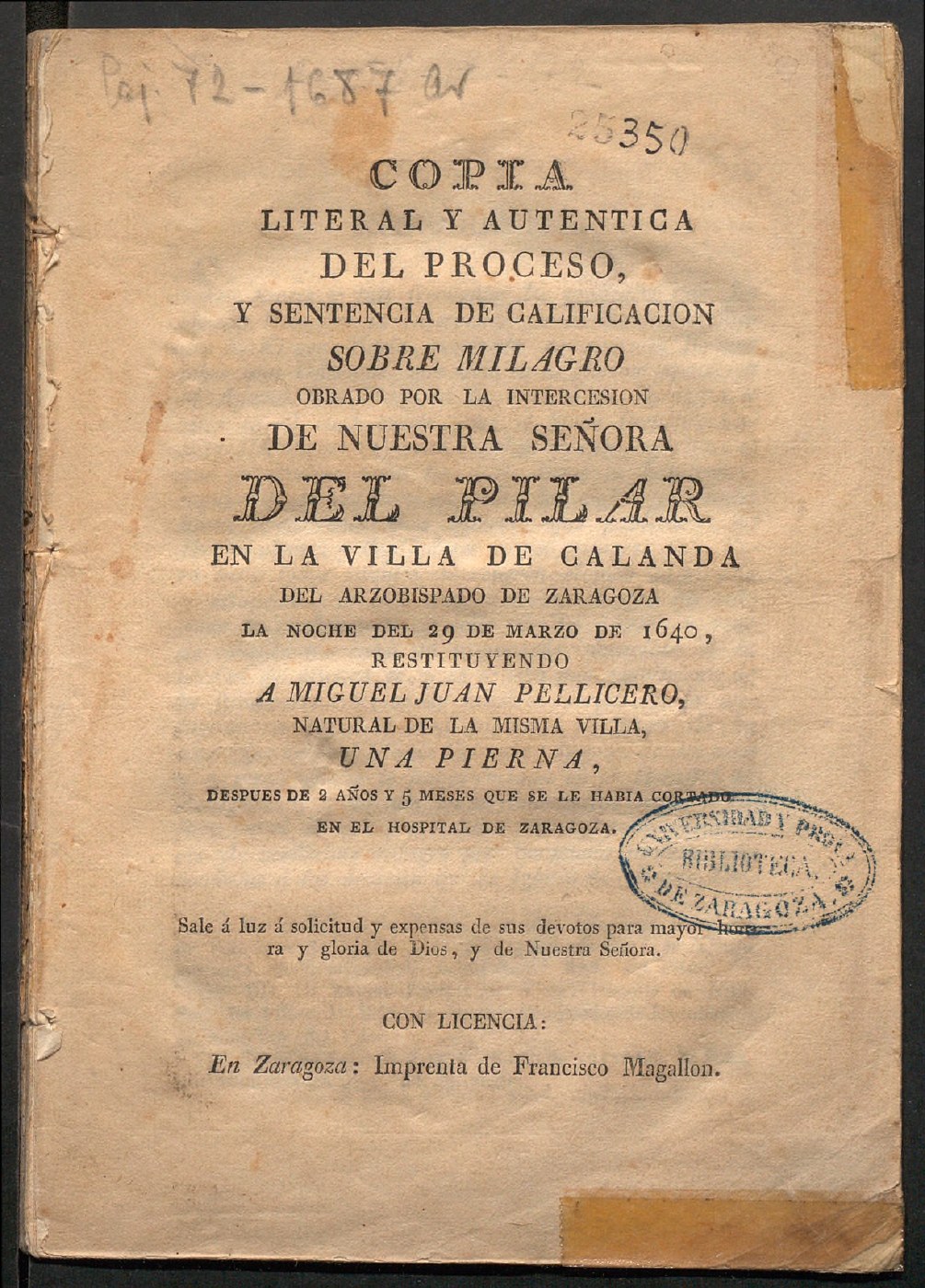
The ecclesiastical trial took statements from the hospital, the family, and the residential community. This connected two decisive points: the loss of the leg and the identity of the man who later appeared with both legs. The printed trial record digitized by the University of Zaragoza contains the witness statements and judgment.[1]
A Record a Few Days after the Event
As early as April 2, 1640, notary Miguel Andreu recorded statements about the event in Mazaleón. This record forms its own line of transmission alongside the ecclesiastical trial. Historian Leandro Aina Naval received the manuscript in 1969 from an heir of its former owner and handed it over to the City of Zaragoza in 1972. The city's library catalog continues to list it as a manuscript.[2][3]
Recognition on April 27, 1641
On May 8, 1640, the City of Zaragoza requested ecclesiastical proceedings from the archbishop. After the investigation, Pedro Apaolaza recognized the miracle on April 27, 1641. Both the printed trial record and Aina's documentation preserve these procedural dates. The decision thus took place in the event's immediate historical setting.[1][2]
Why the Testimonies Carry Particular Weight
The decisive statements come from named people who knew Pellicer in different contexts. Especially significant is the connection between participation in the surgery and the later recognition of the patient. The Catholic interpretation sees in his restoration God's help through Mary's intercession.[1][4]
Witnesses & Investigators
Miguel Juan Pellicer
Person healed
His identity and bodily condition are the central subject of the proceedings.[1]
Juan de Estanga
Treating surgeon
Attests to the treatment decision, aftercare, and later identity of the patient.[1]
Diego Millaruelo
Participant in the operation
States that he assisted with the amputation.[1]
Miguel Andreu
Notary of Mazaleón
Responsible for the notarial record of April 2, 1640.[2]
Leandro Aina Naval
Historian and later witness to the document's transmission
Documented the rediscovery and handover of the notarial record in 1972.[2]
The unfolding story
- Hospital and Amputation
The trial tradition reports treatment in Zaragoza and amputation below the knee.[1]
- Calanda
Date of the restoration according to the trial tradition.[4]
- Notarial Record
Miguel Andreu records statements close to the event.[2]
- The City's Request
Zaragoza requests ecclesiastical proceedings.[2]
- Ecclesiastical Judgment
- Handover of the Notarial Record
Leandro Aina hands the historical document over to the City of Zaragoza.[2]
Ecclesiastical assessment
Archbishop Pedro Apaolaza of Zaragoza recognized the event as a miracle on April 27, 1641. An early notarial report and the records of the ecclesiastical proceedings survive.
Objections & Answers
What limits do the historical witness statements have?
The witnesses observed Pellicer's condition before or after the night; they do not describe a directly observed process of restoration during sleep. The records also distinguish individual limits of perception: Millaruelo saw the leg carried away but knew its burial place only by hearsay. Regarding a later foot injury, Estanga repeated an explanation given to him. Such differences belong to the historical assessment of evidence.[1]
What do the notarial document and surviving printed trial record establish?
The notarial record fixes statements and individuals close to the event. Its official form does not make their medical content infallible; comparison of the testimonies remains decisive. The digitized printed trial record is dated to around 1829 and transmits older records, so it is not itself the original manuscript of 1640. The early notarial record must be distinguished from it.[1][2][3]
Can Calanda be examined like a present-day clinical case?
The examination is historical and rests on statements concerning the amputation, the later bodily condition, and identity. Modern before-and-after images are not available. An alternative explanation must therefore address the specific content of the named surgical and local testimonies.[1][3]
Meaning for faith
Calanda is preserved through statements close to the event, named surgical witnesses, and early ecclesiastical proceedings. Their shared subject is the identity of a previously amputated man who appeared again with both legs. The judgment of 1641 recognized in this a miracle through the intercession of Our Lady of the Pillar.[1][2]
Examining Healings: From Findings to the Church's Judgment
Diagnosis, treatment, the course of healing, and ecclesiastical recognition are examined separately.
Methods of examination and ecclesiastical procedure →Sources & Evidence
Information on accessibility and scope helps you assess the evidence for yourself.
- [1] Copia literal y auténtica del proceso y sentencia de calificación sobre el milagro de Calanda
Complete historical printed trial record read. Later edition of records close to the event, not the original manuscript of 1640.
Open source · zaguan.unizar.es ↗ - [2] Entrega a la Ciudad, del Protocolo de Mazaleón
Contemporary account of the provenance and handover of the notarial record; not a modern medical examination.
Open source · zaragoza.es ↗ - [3] Biblioteca: Colección de manuscritos
Official evidence that the Mazaleón record of 1640 is held in the collection.
Open source · zaragoza.es ↗ - [4] La Virgen del Pilar y el milagro de Calanda
Municipal account of the tradition and its local significance.
Open source · zaragoza.es ↗