On April 15, 1899, at the first opening of Charbel's tomb, the monks and witnesses found a preserved, soft, and flexible body. Water and mud had entered the burial vault. Statements subsequently recorded for the ecclesiastical proceedings describe this initial discovery and the discharge of fluid. Treatments, further examinations, and changes followed over the next decades.
The testimonies concerning the first opening of the tomb describe preserved, soft, and flexible limbs despite water, mud, and surface mold. Repeated later observations also concern the discharge of fluid.
April 15, 1899: The First Discovery after Just under Four Months
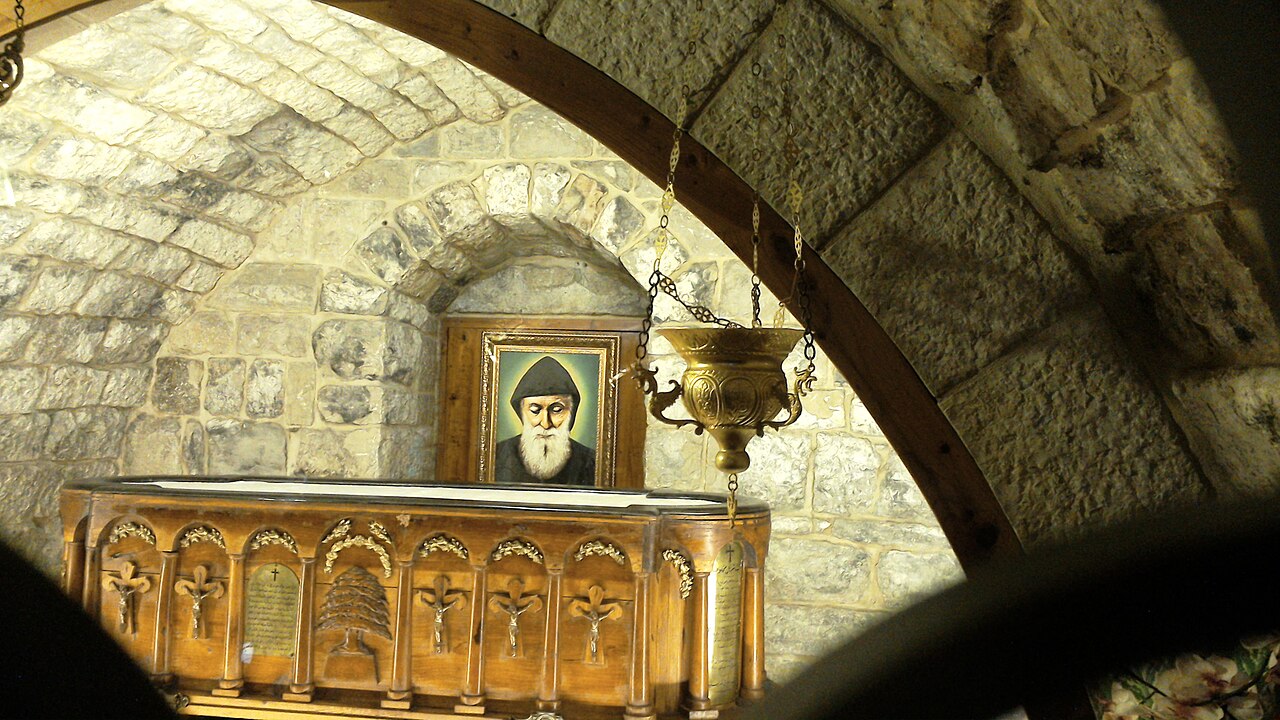
The statements subsequently recorded in the ecclesiastical proceedings form the basis of the following sequence. Charbel lay without a coffin on boards and a goat-hair cloth in a vault into which water seeped. On April 15, 1899, the superior, monks, and witnesses to the burial opened the tomb. Beneath the surface mold, they found the body soft and flexible. Water and mud had surrounded it; the limbs were preserved.[6]
Saba Bou Moussa and Brother François Al-Sebrini described the burial and the surroundings of the tomb. Fr. Joseph Younès described the initial discovery and removal of the mold. In the tradition presented by Hubert Larcher, their statements are linked to the later ecclesiastical questioning or to older accounts.[6]
Observations at the Tomb and on the Retrieved Body
The monks of Annaya record a light above the tomb and its opening with ecclesiastical permission. They describe the preserved body and the discharge of a fluid they call blood and water. The repeated discharge shaped the subsequent attention paid to the tomb and the examinations of the body.[1]
The Hidden Life of the Maronite Hermit
Youssef Makhlouf was born in Lebanon in 1828 and entered the Lebanese Maronite Order in 1851. After his priestly ordination, he lived in Annaya and, from 1875, in the hermitage of Saints Peter and Paul. Prayer, worship, and manual work shaped his daily life. He died on December 24, 1898. His later fame emerged from a life that had long remained hidden.[1][5]
Interventions after the First Opening of the Tomb
Larcher records the removal of internal organs about a year after death and an attempt at drying the body in 1900. These interventions took place after the initial discovery. In a letter dated February 11, 1951, the physician Théophile Maroun already described mummification and localized losses of substance. Exhumation, later treatment, and the later condition of the body can thus be identified as successive phases.[6]
Transfers and the Expansion of the Shrine
The monastery's account mentions several transfers and examinations of the fluid discharged. It gives August 7, 1952, as the date for the Lebanese cedar coffin on a marble base. With the expansion of the burial site and the later church, Annaya developed into a pilgrimage destination extending beyond the region. Each transfer also changed the conditions in which the body was kept.[2]
The Body's Subsequent Changes
The 2026 biography issued by the Governorate of Vatican City State limits the extraordinary physical condition described to the period ending with the beatification in 1965. This time limit concerns the subsequent history. It does not deprive the initial discovery of 1899 of its own subject: preservation during the original period in the grave.[3]
The Canonization and Charbel's Vocation
Paul VI canonized Charbel on October 9, 1977, following his beatification on December 5, 1965. In his homily, he honored the Maronite tradition, the search for God, and hidden prayer. He understood the hermit's asceticism as a response to Christ. This is the center of the Church's veneration of Charbel.[4]
Annaya as a Place of Silence and Intercession
Charbel's life belongs to the Eastern Christian way of prayer and life of the Maronite Church. His tomb leads pilgrims to silence, conversion, and intercession. The unusual accounts of the body are connected to this specific person: a priest and hermit whose daily life was directed toward God.[4][5]
Sources and the Scope of Statements about the Material
The early witness statements and Maroun's letter are available through Larcher's printed account. The complete original records of the ecclesiastical proceedings were not consulted here. The monastery's present websites likewise do not publish an unbroken series of preservation and examination records.[6][1][2]
Describing the fluid as blood and water reproduces the observational language of the tradition. Its chemical composition, blood group, or total quantity cannot be determined from that alone. The relevant samples, methods, and analytical results would be needed for that. The initial finding of preservation remains distinguishable from these further questions about the material.[1][2][6]
Witnesses & Investigators
Saba Bou Moussa and Brother François Al-Sebrini
Witnesses to the burial and the surroundings of the tomb
Their statements, recorded in 1926, are reproduced by Larcher through older sources.[6]
Fr. Joseph Younès
Witness to the first finding of preservation
His description of the exhumation is reproduced by Larcher after Fr. Daher.[6]
Théophile Maroun
Physician and later examiner
His letter of 1951 describes a later condition involving mummification and localized losses of substance.[6]
Monks of Saint Maron in Annaya
Custodians of the relics and local tradition
Their accounts preserve the history of the tomb, transfers, and veneration.[1][2]
Paul VI
Pope of the beatification and canonization
His homily of 1977 honors Charbel's vocation and the Maronite tradition.[4]
The unfolding story
- Birth in Lebanon
Youssef grows up in the Maronite tradition of faith.[5]
- Religious Order and Priesthood
Youssef becomes the monk and priest Charbel.[1]
- Hermitage
He begins the long hermit period of his life.[1]
- Death and Subsequent Accounts
The tradition concerning the tomb begins after his death.[1]
- First Opening of the Tomb
According to testimonies recorded later: a preserved body despite water and mud.[6]
- New Coffin
The monastery documents the installation of the present container.[2]
- Beatification
Paul VI raises Charbel to the honors of the altar on December 5.[5]
- Canonization
Ecclesiastical assessment
The monastic community of Annaya preserves Charbel's relics and the memory of the first finding of preservation. Witness statements and medical correspondence made available in print supplement its account. Charbel was beatified in 1965 and canonized in 1977.
Objections & Answers
Do the later interventions explain the discovery of 1899?
The interventions described took place after the first exhumation. They are important for later states of preservation, but cannot be the cause of an observation already made beforehand. The original burial and the testimony about the opening of the tomb are decisive for the initial discovery.[6]
Does later decay rule out a temporary sign?
No. Extraordinary preservation can be limited in time. Subsequent change does not retrospectively cancel the earlier finding. Whether it should be interpreted as a miracle depends on examining its own testimony and circumstances; permanent physical immutability is not a prerequisite.[3][6]
Did the canonization confirm every statement about fluid and tissue?
The canonization honors Charbel's holiness. Individual statements about natural phenomena require their own evidence. The person's standing in the Church does not imply a particular chemical composition of the fluid. The published statements therefore support the historical account without confirming all the claims about the material circulated later.[1][4]
Meaning for faith
Annaya preserves testimony to unusual preservation at the first opening of Charbel's tomb and the history of later examinations. The sequence of events allows the initial discovery to retain its own weight. At the hermit's tomb, this remembrance joins the Maronite tradition of prayer and intercession.[1][4][6]
Examining Incorruption: Bodily Preservation and Its Causes
The state of preservation, burial conditions, and later interventions must be investigated together.
Methods of examination and ecclesiastical procedure →Sources & Evidence
Information on accessibility and scope helps you assess the evidence for yourself.
- [1] Saint Charbel Biography
Official monastery tradition. An erroneous date for the beatification in the main text is corrected on the basis of the Dicastery and Paul VI.
Open source · saintcharbel.com ↗ - [2] Monastery / The Tomb Church
Primary account by the custodians on coffins, the burial site, and transfer; no complete examination records.
Open source · saintcharbel.com ↗ - [3] 24 juillet: Saint Charbel Makhlouf
Ecclesiastical biography with a time limit on the reported condition of the body; not a current medical finding.
Open source · vaticanstate.va ↗ - [4] Canonisation de l’ermite libanais Charbel Makhlouf
Primary document of the canonization and spiritual interpretation.
Open source · vatican.va ↗ - [5] Charbel Makhluf
Official dates concerning his life, beatification, and canonization.
Open source · causesanti.va ↗ - [6] Le sang peut-il vaincre la mort?
Printed presentation of witness testimony recorded later and medical correspondence; not a directly consulted original record from 1899.
Open source · imagomundi.biz ↗