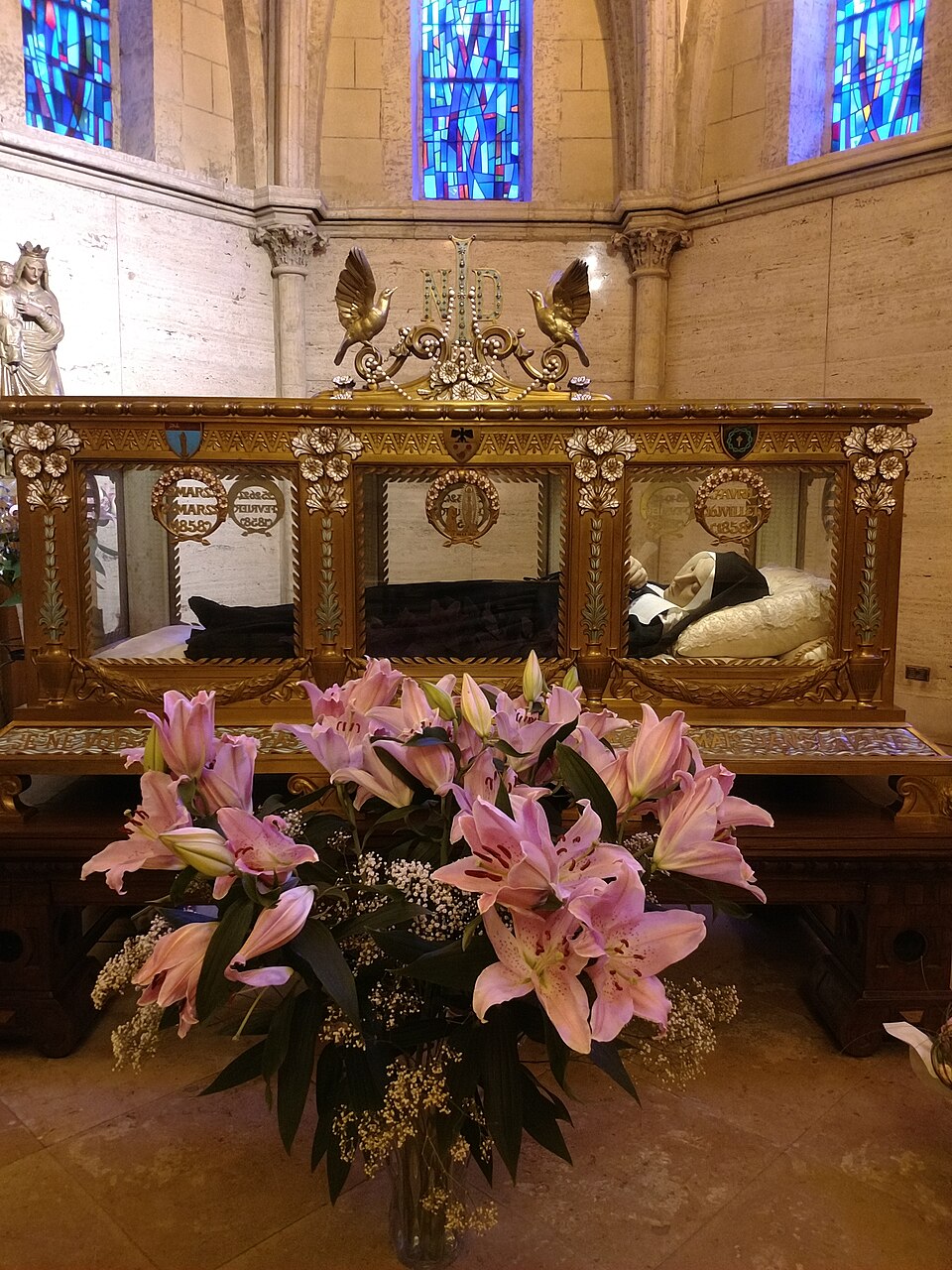
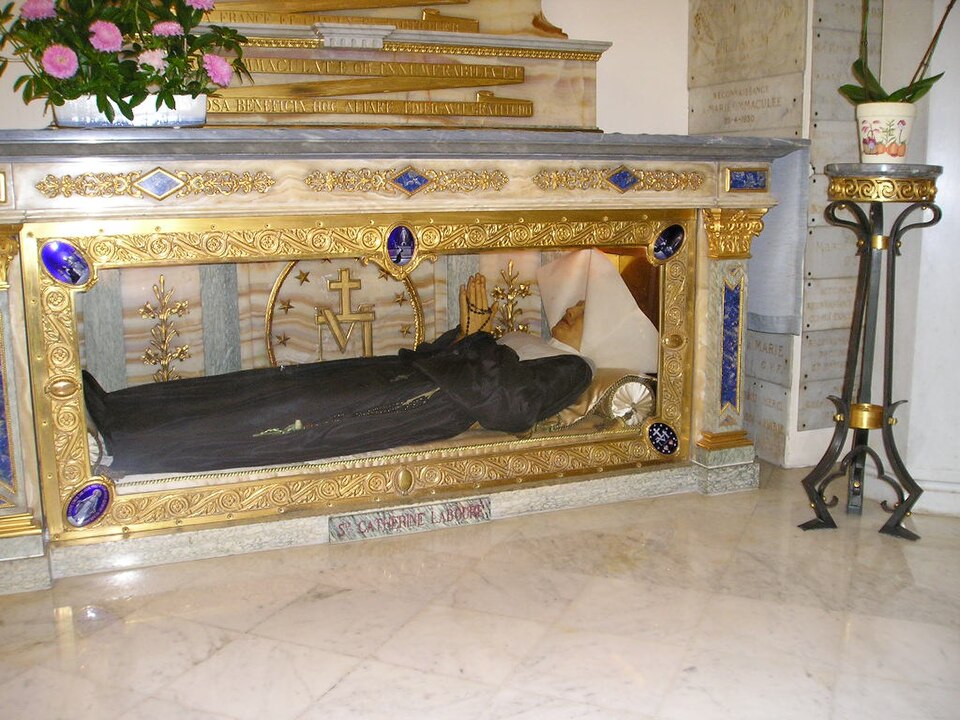
The Poor Clares found Catherine's body preserved and fragrant eighteen days after her burial in March 1463. She had been buried in the earth without a coffin. Her fellow sister Illuminata Bembo preserved the memory of the exhumation and the extraordinary events that followed. The body now venerated in a seated position and the later descriptions of its changes belong to the subsequent history of the Shrine of Corpus Domini.
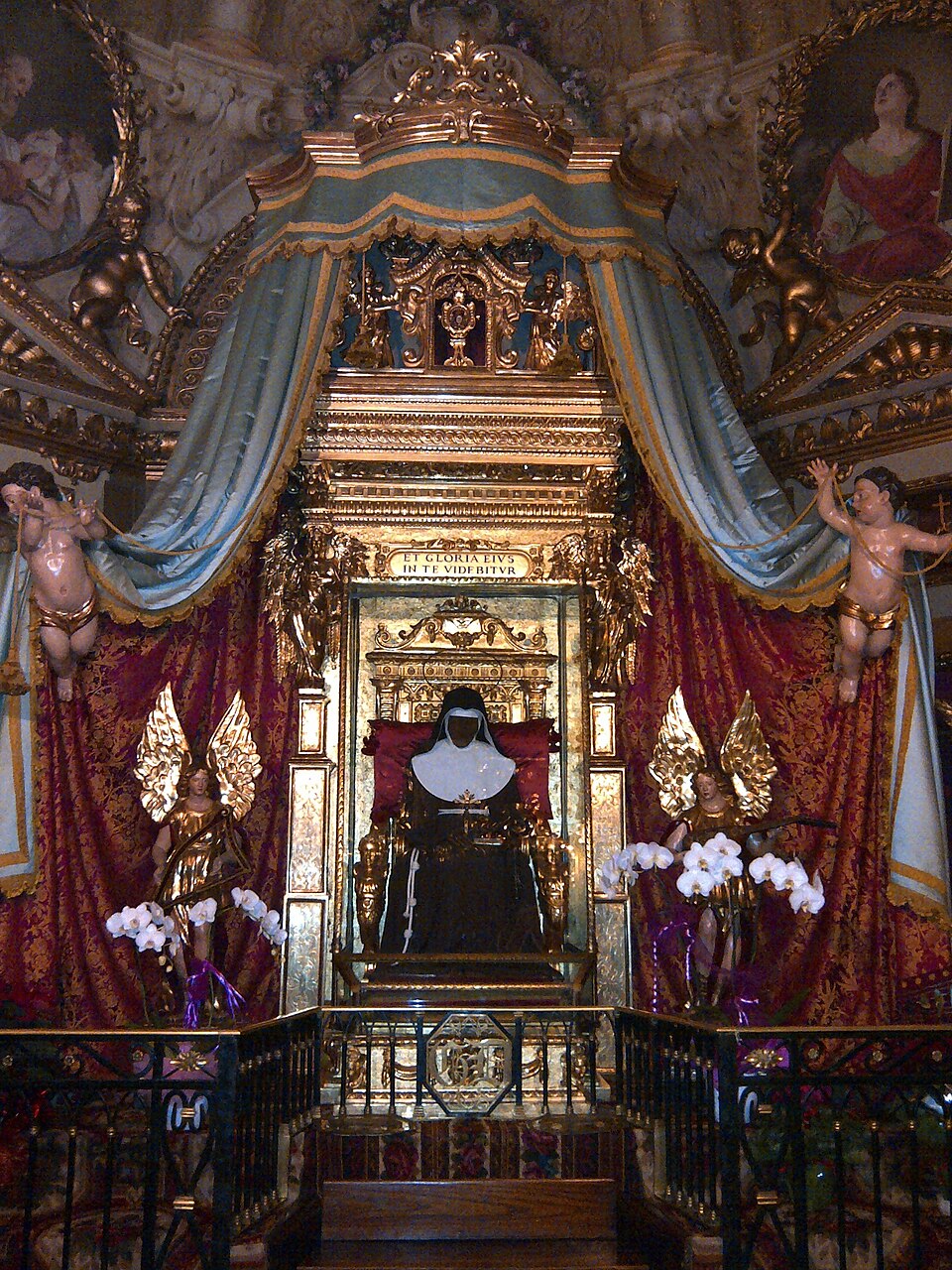
The monastic testimonies describe the body found preserved and fragrant at the first exhumation, later discharges of fluid, and its assumption of a seated posture. The venerated body remains in the shrine to this day.
March 1463: The First Exhumation After Eighteen Days
The account of the Shrine of Corpus Domini preserves the sequence from monastic tradition. Catherine had been buried in the earth without a coffin. Eighteen days later, the sisters dug her up again and found the body preserved and fragrant. Excavation caused an injury to the face and nose; the account describes its subsequent restoration as a miraculous event.[1]
Illuminata Bembo: A Fellow Sister as an Early Witness
Illuminata Bembo lived with Catherine in the community. In her Specchio di illuminazione, she recorded Catherine's life and the extraordinary events she witnessed. The shrine explicitly names her in connection with the exhumation. The early tradition thus leads to a named fellow sister who had access to the community's life and to the events surrounding the body.[1]
The Sisters' Further Observations
The monastic tradition describes an aromatically scented discharge of fluid after the exhumation, sometimes clear and sometimes reddish, and its collection in a vessel. For years, the sisters showed the body to the faithful through a small opening. The assumption of a seated posture at the superior's request forms another extraordinary event in this account. The posture visible today preserves its memory.[1]
Catherine's Journey from Court to the Poor Clare Convent
Catherine dei Vigri lived from 1413 to 1463. She was educated at the court of Ferrara and then chose religious life. In 1456, she was sent to Bologna to lead a new community. Prayer, work, art, and spiritual instruction belonged together. Her work on the seven spiritual weapons preserves her experience for the sisters and later readers.[2]
The Body in the Chapel
The local description of the chapel presents the body seated and without a face mask. The fashioned seat, clothing, and furnishings altered over the centuries belong to the place of veneration. The visible dark, dry surface belongs to a later condition than the initial discovery described by the community.[3][4]
The Seven Spiritual Weapons
Catherine names good action, renunciation of self-sufficiency, trust in God, remembrance of Christ's suffering, remembrance of death, heavenly hope, and Holy Scripture. These themes lead to the substance of her religious life. The body in the chapel and her writings point to the same person: a woman who guided her community toward persevering prayer and active charity.[2]
Later Findings and Their Historical Transmission
The later tradition of the proceedings contains differing observations. Physician Carlo Riario distinguished preserved skin from the absence of flesh proper. A custodian explained protective linen on the arms by the heavy clothing. Perceptions of fragrance did not consistently agree either. Laura M. Ragg examined such statements in her historical work on women artists of Bologna in 1907. In this, she transmits older statements; she is not a witness to the exhumation of 1463.[4]
The critical edition of Bembo's account and the complete original procedural records were not consulted for this dossier. Nor do the sources contain sufficient measurements of the burial environment in 1463 or an unbroken conservation history. Later statements must be read according to their dates: dry skin and protective linen at a later time do not retrospectively explain the first discovery in the earthen grave.[1][4]
Witnesses & Investigators
Illuminata Bembo
Fellow sister and early biographer
Author of the Specchio di illuminazione; the shrine names her as a witness to events surrounding the exhumation.[1]
Carlo Riario
Physician at a later examination
His distinction between skin and flesh is accessible through Ragg's analysis of earlier statements.[4]
The unfolding story
- Birth
Catherine's life begins in Bologna.[2]
- Abbess in Bologna
Her Franciscan vocation receives a new geographical center.[2]
- Death and Early Tomb Opening
Monastic tradition places the beginning of the accounts concerning the body here.[1]
- Tradition of the Proceedings
Ragg refers to a collection of witness statements printed at that time.[4]
- Canonization
Clement XI canonizes Catherine.[2]
- Historical Counter-Reading
Ragg's presentation also makes differing observations accessible.[4]
Ecclesiastical assessment
Catherine's body is venerated at the Shrine of Corpus Domini in Bologna. Monastic tradition preserves the first findings of preservation and names Illuminata Bembo as an early witness. Clement XI canonized Catherine in 1712.
Objections & Answers
Does the Seated Posture Prove Continuing Biological Life?
The tradition speaks of the posture of the deceased body. Life and preservation are different questions. The early accounts and history of later display are decisive for how the posture originated; a present-day photograph alone does not settle this historical question.[1][3]
How Should the Differing Later Findings Be Understood?
They concern different observations and times. Preserved skin is not the same as fresh muscle tissue; failure to perceive a fragrance does not confirm a constantly present fragrance. The differences therefore belong to the body's history. They must neither be harmonized into uniformity nor treated as an automatic refutation of the first exhumation.[4]
Does later desiccation rule out the initial finding?
No. Extraordinary preservation limited to the first period in the grave is also a phenomenon to be examined in its own right. Later desiccation and care of the body concern its subsequent history. What remains decisive for 1463 is the burial without a coffin and the early testimony about the discovery after eighteen days.[1][4]
Meaning for faith
Catherine's exhumation connects an unusual initial finding with the testimony of her own community. The preserved body, Bembo's recollections, and Catherine's writings together lead back to her life in the Corpus Domini convent and to the Christian hope of the resurrection.[1][2]
Examining Incorruption: Bodily Preservation and Its Causes
The state of preservation, burial conditions, and later interventions must be investigated together.
Methods of examination and ecclesiastical procedure →Sources & Evidence
Information on accessibility and scope helps you assess the evidence for yourself.
- [1] Santa Caterina da Bologna
The shrine's present-day account; early miracle accounts are presented as tradition, not as an original record.
Open source · santuariocorpusdomini.it ↗ - [2] Saint Catherine of Bologna
Papal catechesis on her life, canonization, and spiritual teaching.
Open source · vatican.va ↗ - [3] La Chiesa Santuario del Corpus Domini di Bologna
Local description of the display and chapel. Its sometimes contradictory historical dates are not adopted here.
Open source · bolognacristiana.it ↗ - [4] The Women Artists of Bologna
Historical source study drawing on early witness testimony; not equivalent to the original proceedings or a modern expert report.
Open source · resources.warburg.sas.ac.uk ↗