On March 20, 698, the monks of Lindisfarne opened Cuthbert's grave to transfer his bones. Bede's account describes their surprising discovery after eleven years: a preserved body with flexible joints and preserved garments. The brothers informed Bishop Eadbert and clothed the body anew at his instruction. The much later examinations in Durham form further stages in its history.
Bede documents the first exhumation eleven years after Cuthbert's death: the monks found an entire body with flexible joints and preserved garments, although they had expected bones.
March 20, 698: The First Opening of the Grave after Eleven Years
Bede describes the exhumation in his Ecclesiastical History and Life of Cuthbert. The monks opened the stone coffin in the church at Lindisfarne in order to transfer the bones they expected into a smaller container. They found the entire body preserved. The joints could be moved, and the garments were also preserved. This first observation thus differed markedly from the decomposition expected after eleven years.[1][7]
The Report to Bishop Eadbert
The brothers went to Bishop Eadbert and told him what they had found. They brought a piece of the garment with them. Eadbert ordered that the body be clothed anew and placed in the prepared coffin. Bede thus anchors the event in a specific sequence of actions: opening, examination, report to the bishop, and reburial. He understands the preservation as a divine honor bestowed on Cuthbert.[1]
Bede's Informants and the Review of His Text
In the preface to his Life of Cuthbert, Bede explains that he questioned people who had known Cuthbert. He submitted the draft to the priest Herefrid, among others, and had it reviewed by the community of Lindisfarne. His account thus reaches back into the community's living memory. Bede is the early author, and Herefrid one of his named informants; Bede's own preface does not claim personal eyewitness knowledge of every event reported.[2]
From Lindisfarne to Durham
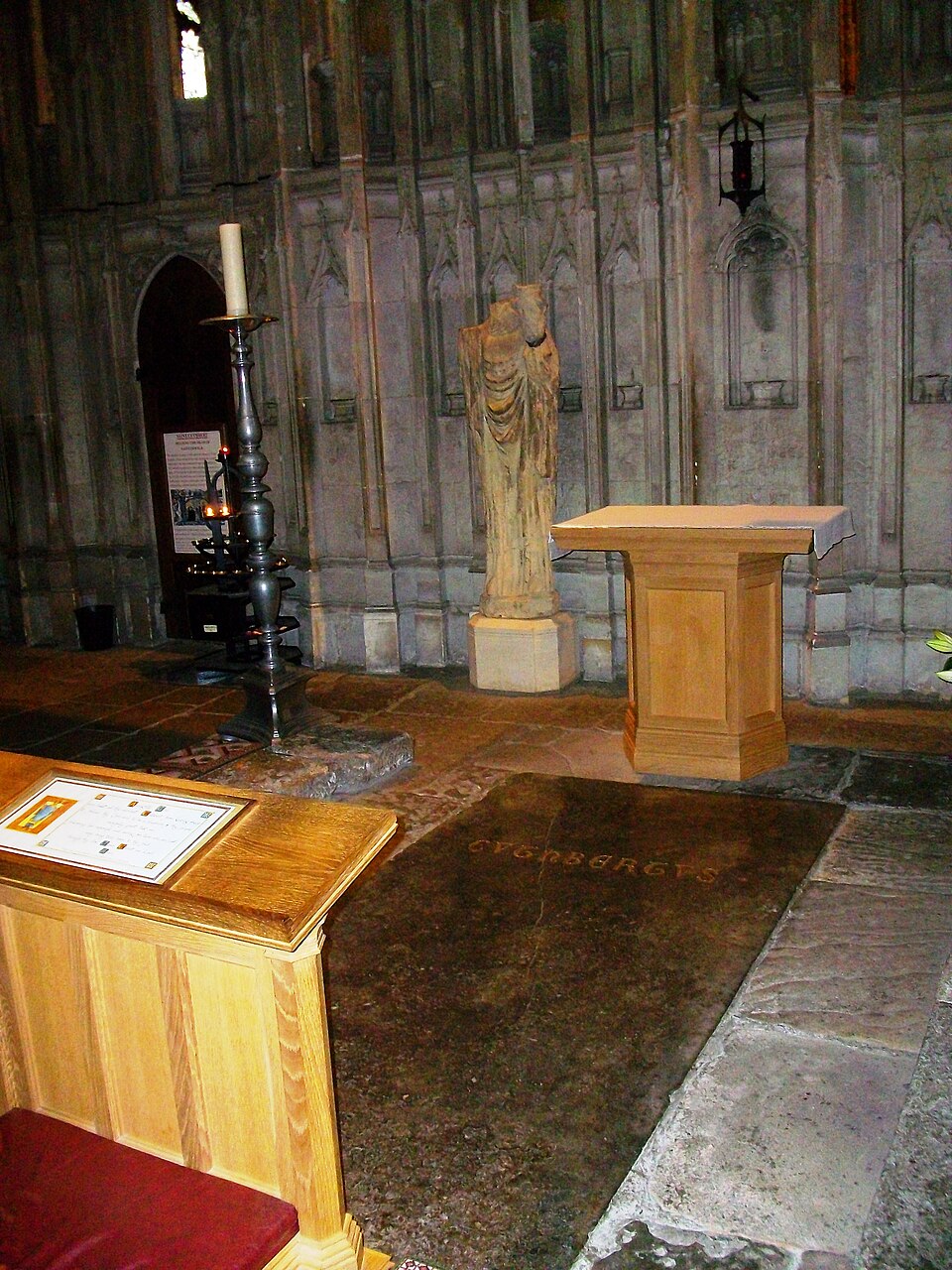
Cuthbert died in 687 and was buried on Lindisfarne. Later, the danger posed by Viking raids led the community to seek a safe place with his relics. Durham became their permanent home. The cathedral preserves the tomb behind the choir. There, the memory of the bishop, the history of his community, and a place of prayer still alive today come together.[3]
The Examinations of 1827 and 1899
James Raine opened the tomb in 1827 and found a skeleton wrapped in garments. The cathedral's present museum account documents the objects removed and identifies the haste and sectarian polemic that marked his approach. These circumstances belong in an assessment of his examination, as do the recorded findings.[4]
In 1899, J. T. Fowler and Dr. Selby Plummer examined the remains again. The cathedral mentions remnants of mummified tissue on the skull and near the ribs and vertebrae, among other places. The examiners differed in their judgment of material in one eye socket. Fowler's report appeared in Archaeologia in 1900. The later observations are thus also tied to specific people, dates, and a publication.[5][6]
The Community and the Memory of the Saint
Veneration of Cuthbert connects monastic life, episcopal ministry, and intercession for one another. At the end of his preface, Bede himself asks for prayer. This explains the close connection between the biography and veneration of the relics: the community preserves the remains of the man whose Christian life shaped it. In Durham, this remembrance continues at the tomb.[2][3]
The Time Span Covered by the Testimony
More than a millennium separates the initial finding in 698 from the discoveries of bones and tissue in the nineteenth century. In between, locations and conditions of preservation changed. Later skeletonization therefore does not retrospectively explain what the monks found at the first opening. The historical question of temporary preservation must still be assessed on the basis of the early tradition.[1][4][5]
Bede mentions a stone coffin, but does not describe humidity, temperature, and ventilation fully enough to reconstruct natural preservation from them today. His two works transmit the same early context and are not two independent anatomical examinations. Of Fowler's paper, the freely available extract and bibliographic details were checked, not the full text.[1][2][6][7]
Witnesses & Investigators
The Brothers of Lindisfarne
Witnesses to the exhumation of 698
They found the body and reported the finding to Bishop Eadbert; Bede transmits their account.[1]
Bishop Eadbert
Recipient of the report
He received a piece of the garment and ordered the body to be clothed anew and reburied.[1]
The Venerable Bede
Early author who questioned the community
He describes his work with informants and the review of the text at Lindisfarne.[2]
Herefrid
Priest and Bede's informant
Bede submitted the draft to him for review.[2]
James Raine
Examiner in 1827
Documented a skeleton wrapped in garments.[4]
J. T. Fowler and Selby Plummer
Examiners in 1899
The unfolding story
- Death on the Farne Islands
- Exhumation
Bede places the extraordinary finding recorded in the tradition here.[1][7]
- Search for a Safe Place
The community takes its relics with it on the journey to a new home.[3]
- Destruction of the Shrine
The cathedral recalls the interventions under Henry VIII; the tomb survives.[3]
- Raine's Examination
Bones, garments, and important objects are documented.[4]
- Further Examination
The remains are recorded in greater detail and then reburied.[5][6]
Ecclesiastical assessment
Bede records the finding of preservation in 698 in his Ecclesiastical History and Life of Cuthbert. Veneration of the saint belongs to the Church's ancient tradition; his tomb is now in Durham.
Objections & Answers
Does Bede's religious interpretation make his testimony unusable?
A religious standpoint does not by itself determine reliability. Bede's proximity in time, his named informants, and the community's review speak in his favor. His interpretation of the event as a divine sign can be distinguished from the observed properties. Raine's later sectarian interests must likewise be considered when assessing his approach.[2][4]
Does the skeleton found in 1827 refute the discovery of 698?
No. The later condition does not necessarily apply to a point more than a thousand years earlier. Temporary extraordinary preservation does not presuppose permanent physical immutability. The earlier account requires its own historical assessment; the later findings document how the remains had been preserved and changed by then.[1][4][5]
Meaning for faith
Cuthbert's first exhumation is among the early recorded testimonies to extraordinary bodily preservation. Bede names a specific observation and its ecclesiastical course. The later findings in Durham add to the history, while the tomb keeps the memory of the monk and bishop alive.[1][2][3]
Examining Incorruption: Bodily Preservation and Its Causes
The state of preservation, burial conditions, and later interventions must be investigated together.
Methods of examination and ecclesiastical procedure →Sources & Evidence
Information on accessibility and scope helps you assess the evidence for yourself.
- [1] Historia ecclesiastica gentis Anglorum, Book IV
Early medieval primary source in an older English translation.
Open source · sourcebooks.web.fordham.edu ↗ - [2] Life of St. Cuthbert
The preface explains the informants and review. The Ecclesiastical History is used for the date; the online version contains discrepancies in chapter headings.
Open source · sourcebooks.web.fordham.edu ↗ - [3] The Shrine of St Cuthbert
The present custodians of the tomb on its location and history; their account of the earlier bodily findings is not a new examination.
Open source · durhamcathedral.co.uk ↗ - [4] 19th Century Discoveries: Opening St Cuthbert’s Tomb – Part 1
A museum staff member presents the examination of 1827 and archival images.
Open source · durhamcathedral.wordpress.com ↗ - [5] 19th Century Discoveries: Opening St Cuthbert’s Tomb – Part 2
Institutional summary of the examination of 1899; the introductory reference to 1898 concerns preparatory work.
Open source · durhamcathedral.wordpress.com ↗ - [6] On an Examination of the Grave of St. Cuthbert in Durham Cathedral Church, in March, 1899
Contemporary publication of the examination; the freely accessible extract and bibliographic details were checked, not the full paper.
Open source · cambridge.org ↗ - [7] Vita sancti Cuthberti: Latin text
The Latin text was checked for the date and the eleven years in the grave. The older English translation alongside it contains errors in these passages.
Open source · ldysinger.com ↗