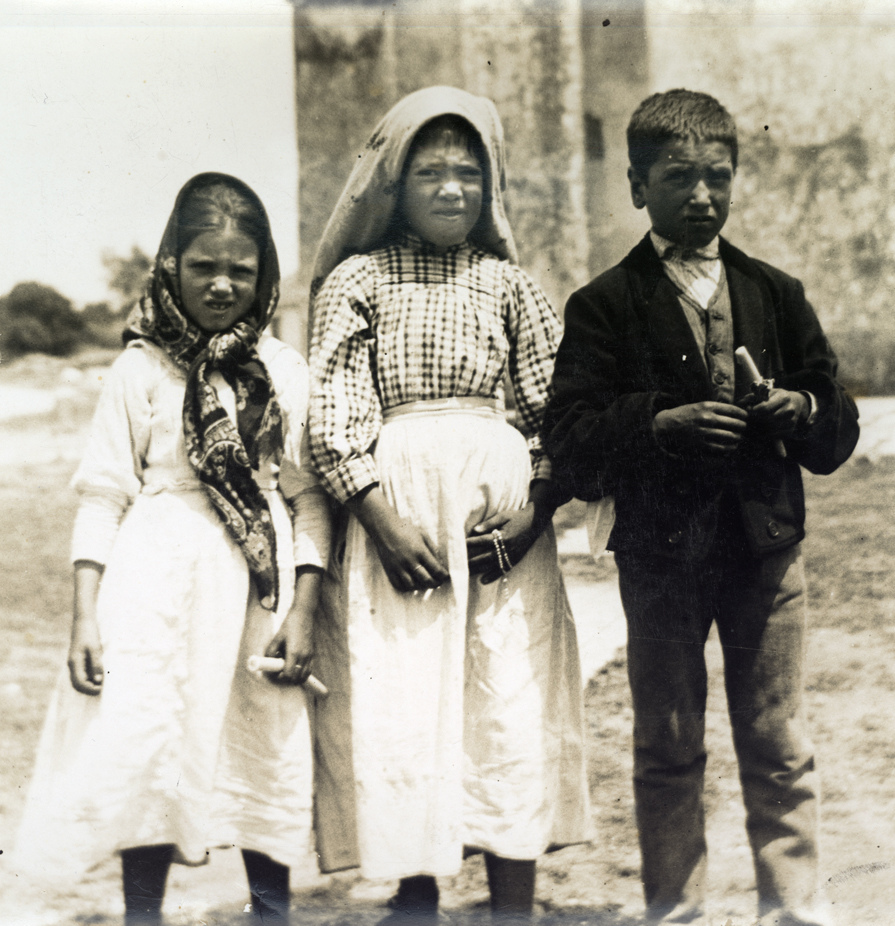
On May 13, 1917, the Mother of God appeared to the shepherd children Lúcia, Francisco, and Jacinta near Fátima. She called for prayer and conversion. For the conclusion of the encounters, she announced a public miracle. On October 13, many people gathered in the Cova da Iria and experienced the miracle of the sun: the striking colors and movements of the sun, also described by witnesses outside the children's circle. Questioning close to the events, press reports, and the subsequent ecclesiastical proceedings give Fátima an especially rich foundation of sources. In 1930, the responsible bishop declared the visions worthy of belief.
Lúcia dos Santos and Francisco and Jacinta Marto attest to the apparitions of the Mother of God. On the announced final day, many people saw unusual phenomena of light, color, and movement in the sun. The public miracle confirmed for the children and the assembled faithful the call to prayer and conversion.
The Apparitions and the Announced Miracle of the Sun
The shrine's early documentation preserves the statements of the three shepherd children. On May 13, 1917, ten-year-old Lúcia dos Santos, nine-year-old Francisco Marto, and his seven-year-old sister Jacinta were tending their animals together near the Cova da Iria. There they encountered the Mother of God. The children came from nearby Aljustrel. In the following months, they returned to the place of the encounters; increasing numbers accompanied them. Mary addressed the children, while the others present observed their behavior and the extraordinary accompanying phenomena. The request for prayer and conversion remained the center of the encounters.[1][5]
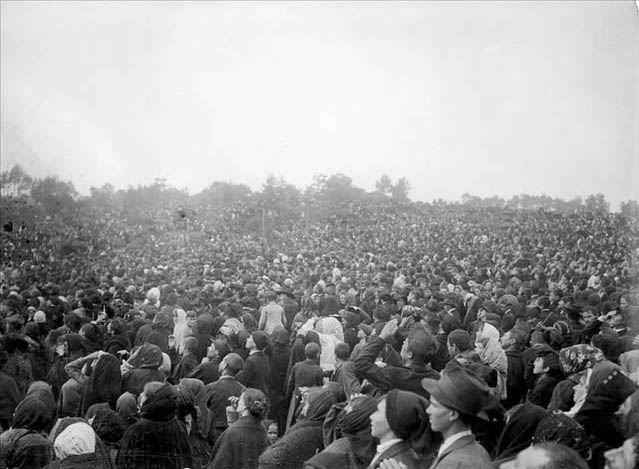
A public miracle had been announced for October. On October 13, 1917, many people therefore flocked to the Cova da Iria despite the rain. Many of those present then saw a solar disc that took on unusual colors, seemed to spin, and gave the impression of plunging toward the earth. People reacted with fear, prayer, and wonder. The miracle occurred on the previously specified day and was described immediately afterward. Estimates of the crowd differ; what matters are the surviving early statements about the event experienced together. They make the miracle of the sun a publicly witnessed event.[1]
Prayer, Penance, and Turning to Christ
The message of Fátima calls for prayer, penance, and conversion. The Vatican documentation of 2000 also places the so-called secrets in this context and connects them with the history of suffering in the faith. In it, Joseph Ratzinger explains the character of prophetic images: they address people and demand their response. Fátima therefore leads to responsibility for one's own way of life, intercession, and trust in Christ. This is precisely where the significance of the public miracle lies. The Mother of God directs attention to her Son and to the urgency of his message.[3]
Eyewitnesses and Publications Close to the Event
Avelino de Almeida was present as a journalist. He published his observations in O Século as early as October 15, followed by another account in Ilustração Portuguesa on October 29. The testimony thus comes from the event's immediate public setting, not only from the later ecclesiastical proceedings. Almeida worked for a republican newspaper and described what he himself had perceived; he left the final explanation to science and the Church. This provenance matters for credibility. A personal profession of atheism, however, cannot be inferred solely from his newspaper work.[1]
Another eyewitness, José Maria de Proença de Almeida Garrett, recorded his observations in detail in writing on December 18, 1917. Alongside such testimonies, early questioning of the children survives. The published documentation makes these records available with dates and provenance and permits comparison with Lúcia's later memoirs. It is thus possible to trace which statements already existed in 1917 and which details were described more fully later. Fátima therefore rests on several specifically identifiable paths of transmission: the children's testimony, observations from the crowd, press reports, and the records of the ecclesiastical investigation.[1]
The Church's Recognition of 1930
In 1922, the diocese opened the ecclesiastical investigation. After examining the statements, developments, and religious fruits, Bishop José Alves Correia da Silva declared the visions worthy of belief on October 13, 1930, and permitted devotion to Our Lady of Fátima. This favorable judgment is a substantial reason to place trust in the apparitions. Its subject is the visions and their religious context. The bishop did not thereby establish an astronomical theory about the observed solar phenomena. Ecclesiastical recognition and further investigation of individual observations each have a specific subject.[2]
Why the Testimony of Fátima Carries Weight
In Fátima, several documented facts interlock: the early announcement of a public miracle, the event occurring on the specified day, statements close to the event from people outside the circle of the three children, and the many years of ecclesiastical investigation. This combination supports the case's credibility. The claim that everything was invented only decades later contradicts the surviving documentation. The testimonies are historical observations and must be read as such. Their value lies in their specific proximity to place, time, and participants and in the correspondence between the event attested and its preceding announcement.[1][2]
Witnesses & Investigators
Lúcia dos Santos
Principal witness to the apparitions
Describes the apparitions; early questioning and later detailed memoirs survive.[1]
Francisco and Jacinta Marto
Fellow shepherd children who experienced the events
Together with Lúcia, they attest to the encounters with the Mother of God. Their statements belong to the early sources.[1]
Avelino de Almeida
Journalist at the scene
Described the solar phenomenon in press articles close to the event; held no ecclesiastical investigative role.[1]
José Maria de Proença de Almeida Garrett
Eyewitness
Written account dated December 18, 1917; not to be confused with his father Gonçalo.[1]
The unfolding story
- First Apparition
The Mother of God encounters Lúcia, Francisco, and Jacinta in the Cova da Iria.[1]
- Miracle of the Sun
Many people present experience the extraordinary solar phenomenon on the announced day.[1]
- Press Coverage Close to the Event
Avelino de Almeida publishes his observations.[1]
- Canonical Proceedings
Diocesan examination leading to a favorable judgment.[2]
- Vatican Documentation
Publication with theological commentary.[3]
Ecclesiastical assessment
On October 13, 1930, Bishop José Alves Correia da Silva declared the children's visions in the Cova da Iria from May to October 1917 worthy of belief and permitted devotion to Our Lady of Fátima. Private revelation, not an additional article of faith.
Do Optical Effects Explain the Miracle of the Sun?
Physicist Auguste Meessen points to the effects of intense light on the retina and perception. In principle, these can explain certain impressions of color and movement. Such a possibility, however, is not yet a reconstruction of the event of October 13, 1917. It must be assessed against the statements from the time, their differences, and the announced timing. The testimonies describe a shared extraordinary event; they do not require that the sun actually left its astronomical orbit. The open question of the optical sequence overturns neither the early announcement nor the attested event nor the ecclesiastical finding.[4]
Objections & Answers
Do Expectation and Optical Effects Explain the Miracle of the Sun?
Expectation and observing a bright light source can influence perception. This does not yet explain the specific sequence at Fátima. The early accounts, their different locations, and the previously known announcement must be considered together. A general optical possibility refutes neither the testimonies close to the event nor the connection that occurred. The number of people present alone would not be sufficient proof; stronger is the combination of early testimony from the children, a public event, accounts from outside their immediate circle, and many years of ecclesiastical investigation. Reasoned assent rests on this, while details of the perceived light event can continue to be investigated.[1][4]
How Should the Secrets and Their Later Interpretations Be Assessed?
The message calls for prayer, penance, and conversion. For a particular prophetic statement, its wording, the date it was written down, and how widely it was known at the time must additionally be established. A later recollection can be truthful testimony to earlier words but has a different evidential value from a document already published beforehand. The Vatican interpretation understands the images as an appeal to human freedom. Fátima is therefore sustained by its spiritual content and documented history. Unsupported remaining secrets or arbitrarily fixed end-time dates are no foundation for this trust.[1][3]
Meaning for faith
Fátima connects a publicly witnessed miracle with a clear message and a favorable ecclesiastical judgment. The early sources give good reasons to trust the apparitions. The miracle of the sun confirms the call entrusted to the children by the Mother of God: to pray, convert, and turn to Christ.[1][2][3]
How Apparitions and Private Revelations Are Examined
Testimony, messages, spiritual fruits, and ecclesiastical decisions.
Methods of examination and ecclesiastical procedure →Sources & Evidence
Information on accessibility and scope helps you assess the evidence for yourself.
- [1] Documentação Crítica de Fátima: Seleção de documentos (1917–1930)
The older testimonies edited there are used; the modern introduction is not treated as an eyewitness account.
Open source · fatima.pt ↗ - [2] Pastoral sobre o culto de Nossa Senhora de FátimaOpen source · fatima.pt ↗
- [3] The Message of FatimaOpen source · vatican.va ↗
- [4] Apparitions and Miracles of the Sun
Explanatory model by a physicist; no retrospective measurement of the specific event.
Open source · meessen.net ↗ - [5] Cronologia dos videntesOpen source · santuario-fatima.pt ↗