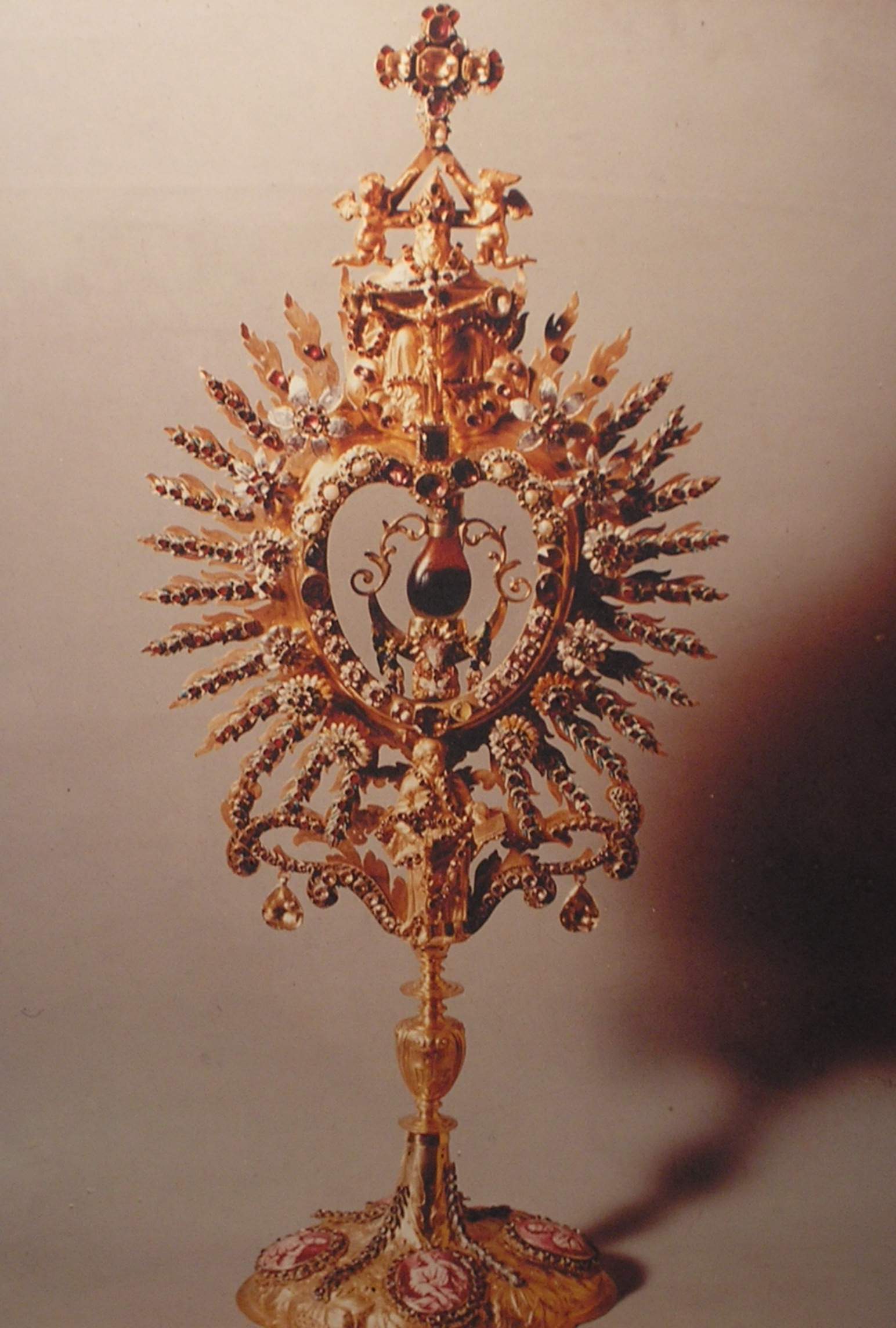
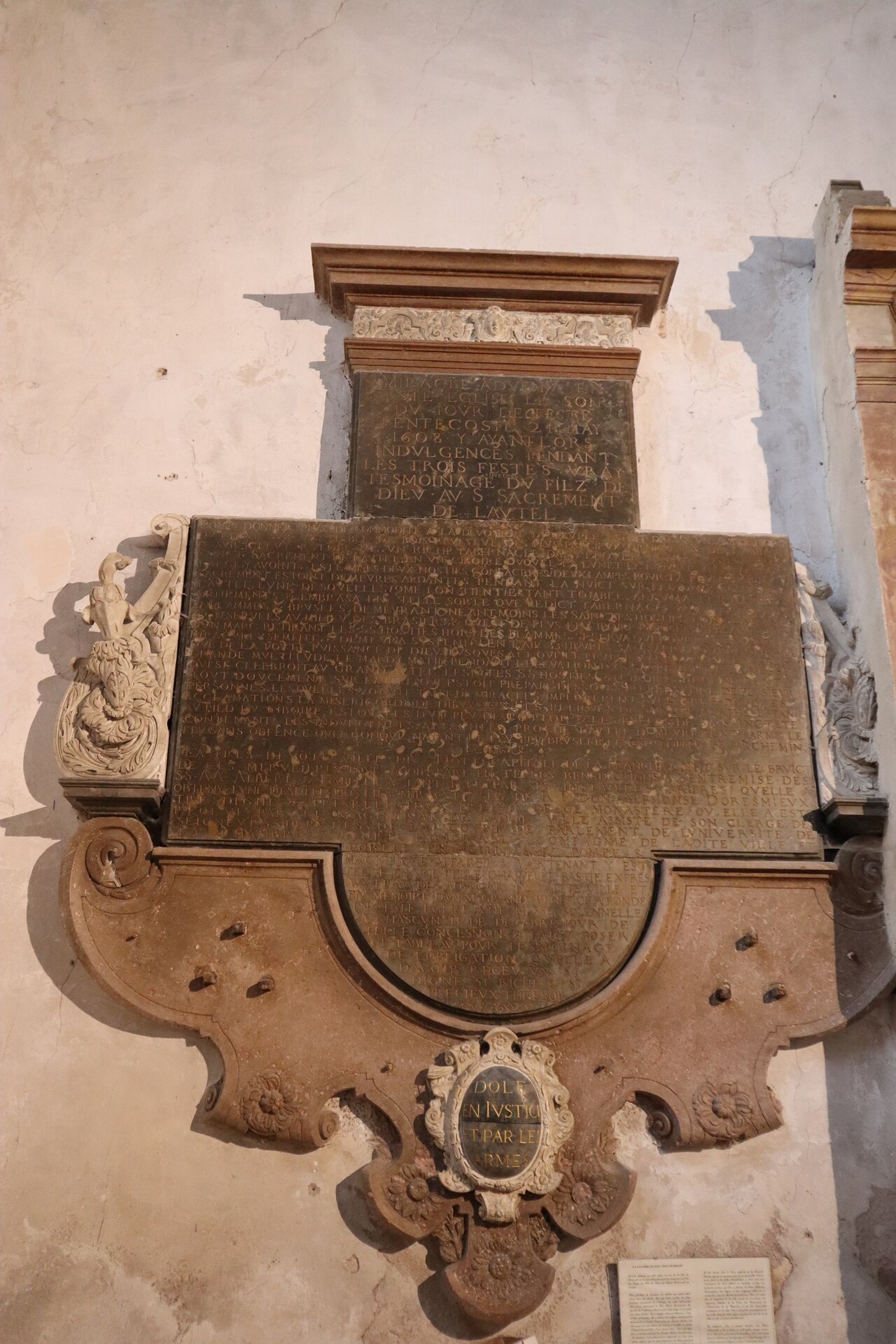
At Pentecost 1608, a fire destroyed the wooden structure for Eucharistic exposition in Faverney. According to the preserved testimonies, the monstrance containing two consecrated Hosts remained above the charred remains without visible support for approximately 33 hours. Monks, clergy, and laypeople observed the event. The investigation began that same May and led to ecclesiastical recognition on June 9, 1608. Its transmitted records can be traced in the public archive.
The eyewitness tradition of Faverney attests that the monstrance containing two consecrated Hosts remained in the air without visible support for approximately 33 hours after the fire.
The Monstrance Remains Above the Fire's Remains
The history presented by Louis Éberlé with references to records begins at Pentecost 1608. A special structure with lights had been erected in the abbey church for Eucharistic exposition. A nighttime fire burned the wooden supporting structure. Above its remains, the monstrance containing two consecrated Hosts remained freely in the air. According to the preserved witness statements, this condition lasted approximately 33 hours. Monks, clergy, and laypeople came and were able to see the monstrance at different times. The event led directly to an ecclesiastical investigation.[1]
Named Observers and a Long Period
Éberlé's account names, among others, the monks Jean Sarron and Nicolas Clamey and the cleric Hubert Oudot. Their statements and the further observations form the material for historical investigation. The long duration is significant: this was not a moment perceived by one person alone, but a continuing condition with several observers. Precise assessment requires examining when the statements were made, the witnesses' own acts of inspection, and possible communication among them. The names and archival references provide concrete starting points.[1]
Public Documentation of the Investigation Records
Besançon's municipal library lists a copy of the investigation record certified in 1760 under Ms 829. The catalog names the commission of May 29, 1608, the appointed investigators Pierre Chevroton and Jean Morelot, and the conclusion on June 4. Documents concerning canonical recognition on June 9 and the later transfer of one Host to Dole follow. The investigation and its ecclesiastical outcome can thus be traced in an identified public collection. The catalog identifies the holdings; it does not yet replace a complete critical edition of all the examinations.[2]
Historical Research on Faverney
A scholarly conference took place for the four hundredth anniversary. The contributions edited by Corinne Marchal and Manuel Tramaux make rare documents accessible and place the case within the history of Eucharistic devotion. This work broadens knowledge of the sources and their influence. Its subject is historical investigation, not a retrospective experimental repetition of the levitation. The university's report documents the research context; the records and their editions remain decisive for the individual witness statements.[3]
The Blessed Sacrament as the Center of the Church
Amid the destroyed structure, the Eucharist remained at the center. Here lies Faverney's spiritual power: the Lord is not an external furnishing of the Church but her living center. The preservation leads to gratitude and adoration. The continuing pilgrimage celebrates this memory with Mass and common prayer. The miracle is a particular divine gift; it is not a promise that sacred objects or church buildings will henceforth be protected against every fire.[4]
Witnesses & Investigators
Jean Sarron and Nicolas Clamey
Monks among the named participants
Éberlé lists them in connection with the event and its transmitted records.[1]
Hubert Oudot
Cleric among the named participants
Is among the people involved in the event listed in the historical account.[1]
Pierre Chevroton and Jean Morelot
Investigators appointed by the Church
The public archival catalog names their commission and the proceedings from May 29 to June 4, 1608.[2]
The unfolding story
- Exposition and Fire
During the feast days, the monstrance with two Hosts is exposed; a fire destroys the structure.[1]
- Reported Levitation
The tradition speaks of approximately 33 hours without visible support.[3]
- Ecclesiastical Investigation
The archival catalog dates the commission and conclusion of the recorded procedure.[2]
- Recognition Documents
According to the catalog, Ms 829 contains the relevant canonical documents.[2]
- Certified Copy
The surviving manuscript with the shelfmark named here is produced and certified.[2]
- Historical Conference
The four hundredth anniversary leads to scholarly engagement with the tradition.[3]
Ecclesiastical assessment
The archival catalog records the ecclesiastical investigation from May 29 to June 4 and recognition documents dated June 9, 1608. The manuscript identified as Ms 829 is a certified copy from 1760.
Does resistance to fire already explain the event?
An object's survival of a fire can be naturally explicable, depending on temperature, duration, and material. Faverney's distinctive finding, however, goes further: according to the testimonies, the monstrance remained in its place without visible support. An alternative explanation must also address this part. A hidden support would require examination of the spatial conditions, possible attachments, and the observations of those present. Mere speculation is no substitute for such evidence, just as the number of visitors is no substitute for a precise evaluation of their statements.[1][2]
Objections & Answers
Could a hidden wire explain the levitation?
A hidden support would be a concrete technical hypothesis. Establishing it for Faverney would require information about attachment, space, the course of the fire, and the observers' view. Merely naming a wire does not demonstrate a device. The reported long duration and the different observers heighten the importance of evaluating the testimony. What matters is the surroundings they saw and the checks they performed. The existing investigation records make it possible to examine this question through concrete statements, rather than dismissing it with a general assertion of credulity.[1][2]
Is a certified copy from 1760 useful evidence?
Yes. Historical texts often survive through later copies. Their provenance, certification, and comparison with other textual witnesses are decisive. The public catalog names both the date of the surviving copy and the investigation of 1608, with its appointed investigators and subsequent documents. This must neither be turned into an original autograph from 1608 nor used to infer an invention in 1760. A critical edition can compare further copies and administrative traces. In any event, the identified transmission of records gives Faverney a concrete, verifiable historical basis.[2][3]
Meaning for faith
Faverney possesses a prompt ecclesiastical investigation, named participants, and publicly traceable records. The unusually long observation of the monstrance remaining in place gives the testimony its particular weight. The Church-recognized preservation of the Blessed Sacrament continues to call for gratitude and adoration.[1][2][3]
How Eucharistic Miracles Are Examined
Securing the account of events, identifying the material, and reading the Church's judgment precisely.
Methods of examination and ecclesiastical procedure →Sources & Evidence
Information on accessibility and scope helps you assess the evidence for yourself.
- [1] Faverney, son abbaye et le miracle des Saintes Hosties, Part III, Chapter I
Older historical monograph, transcribed online. Not an autograph from 1608.
Open source · wissensdrang.com ↗ - [2] Ms 829 – Procès-verbal dressé à l’occasion du miracle arrivé en l’église abbatiale de Faverney, en l’an 1608
The manuscript dates from 1760. The catalog dates the investigation and recognition documents to 1608; no complete transcription of the examinations was consulted.
Open source · memoirevive.besancon.fr ↗ - [3] Le miracle de Faverney (1608) – L’eucharistie : environnement et temps de l’histoire
Evidence of historical research, not experimental proof of levitation.
Open source · endirect.univ-fcomte.fr ↗ - [4] Pèlerinage à Faverney pour fêter le miracle de la Sainte Hostie
Documents present-day ecclesiastical pilgrimage.
Open source · eglisejura.com ↗