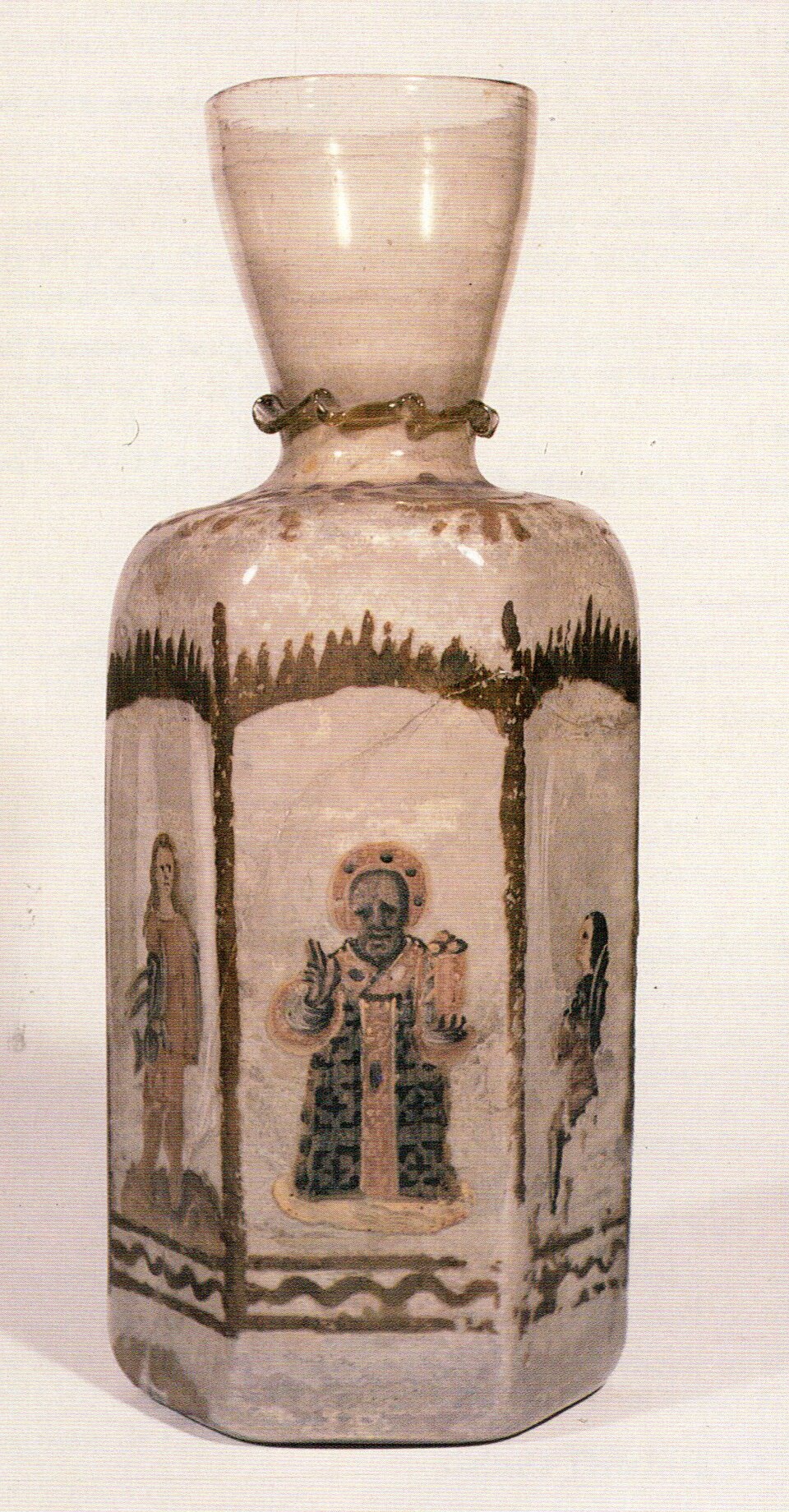
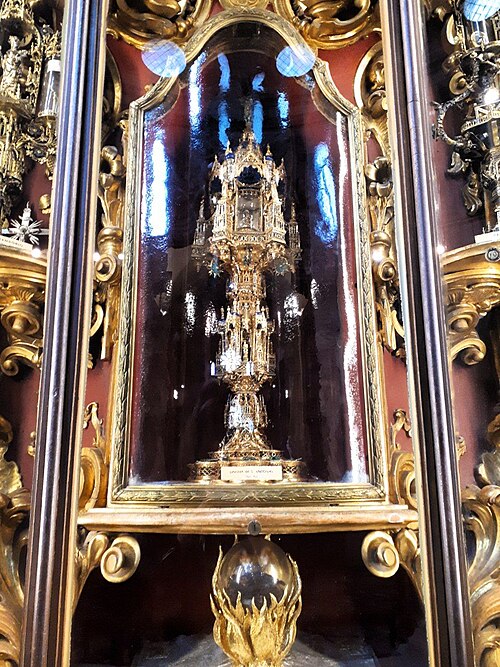
At the public celebrations of Saint Januarius in Naples, the mass preserved in the reliquary repeatedly becomes liquid. The faithful observe the change in the sealed vessel and thank God for the event venerated as a blood miracle. This tradition of observation reaches back to the late Middle Ages. The Church of Naples connects it with Holy Mass, prayer, and veneration of its martyr patron. The liquefaction is a real, publicly observable phenomenon. Explaining it requires close consideration of the relic itself; a reproduced model material cannot replace examination of the original.
The mass venerated as the blood of Saint Januarius repeatedly becomes fluid during public expositions and later returns to an apparently solid state. Naples venerates the liquefaction as a special sign in connection with the intercession of its patron saint.
The Relic of Naples' Martyr
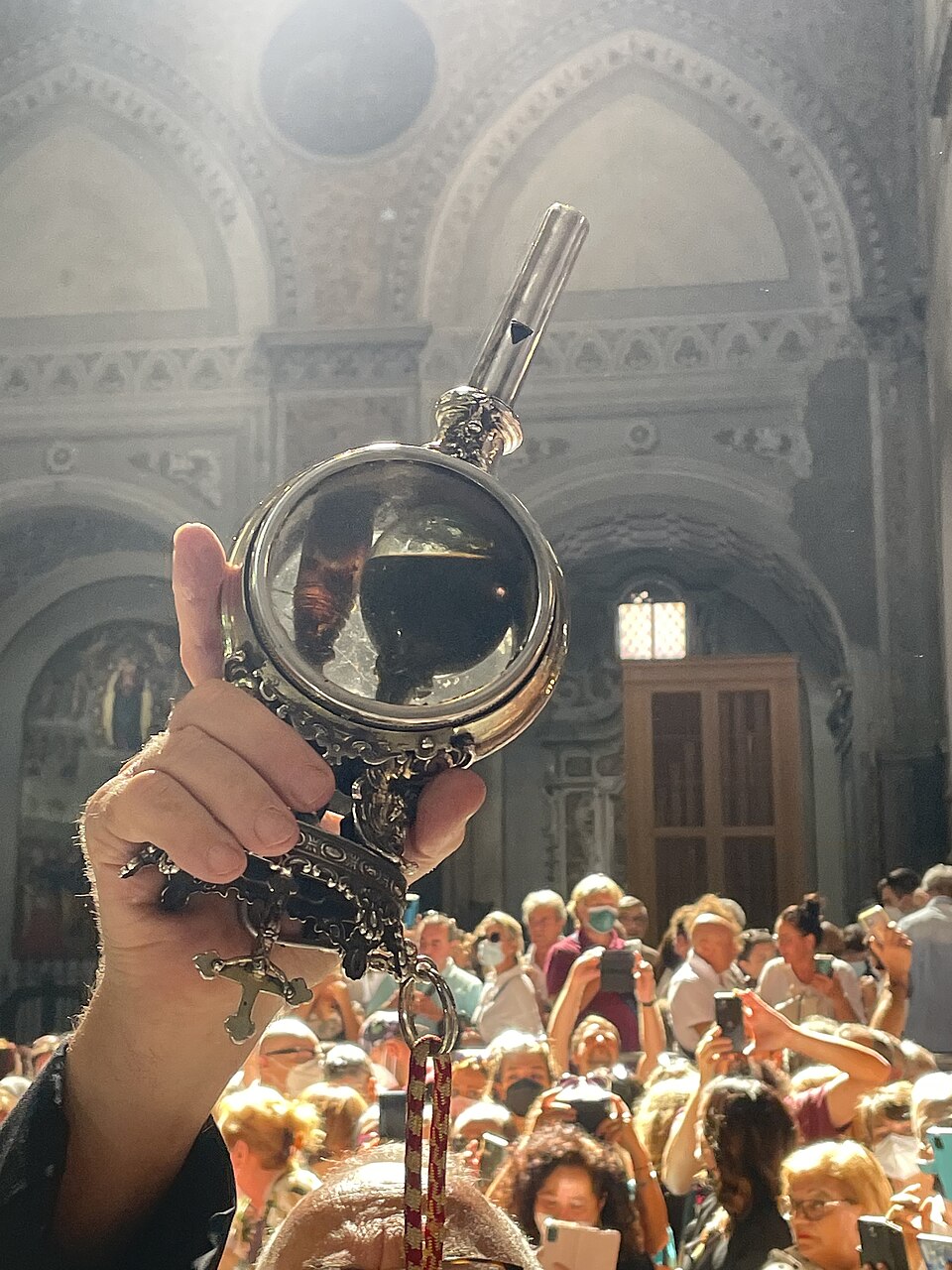
Januarius is venerated as a bishop and martyr of the early persecutions of Christians. In Naples, a reliquary preserves two ampullae whose contents are associated with his blood. The liquefaction is documented in writing from the late Middle Ages onward. The historical Catholic account records the veneration and repeated observations at the celebrations. The ampullae stand at the center of an established civic and ecclesiastical devotion. The earliest history of the martyrdom and the contents' journey to the late medieval accounts must each be examined through their respective sources.[1]
Liquefaction Before the Assembled Faithful
During the public celebration, the reliquary is displayed and turned. In the larger ampulla, it is possible to see whether the dark mass stays in place or flows within the vessel. Liquefaction occurs at different times; the transmitted observations also mention changes in color and apparent volume. Those present can see the change of state. It therefore belongs to the public experience of the feast and is also documented in images. Visible movement is the immediate object of observation. Composition and internal temperature require additional investigations that cannot be derived from simply looking at the vessel.[1]
Thanksgiving and Prayer on the Patron Saint's Feast
In 2026, the Archdiocese of Naples again reports the repeated liquefaction and calls it a prodigio. The event is received within Holy Mass and veneration of the martyr. The faithful thank God and ask for their patron saint's intercession. This religious context gives the feast its meaning: faithfulness to Christ, common prayer, and conversion. The celebration must also be distinguished from a conclusive scientific examination of the ampulla's contents. A failure to liquefy cannot provide a reliable prediction of future disaster.[4]
Centuries of Public Veneration
The relic is preserved under ordered civic and ecclesiastical responsibility and publicly venerated. Its behavior has been described and transmitted over generations. This duration and public character are significant facts. They argue against the careless assertion that the faithful see nothing at all or that everyone involved knowingly performs a trick. The historical tradition documents an event actually observed and the conviction associated with it. Separate questions remain for the material explanation: unusual material behavior would also be conceivable without deliberate deception and must be tested against the original.[1]
The Weight of the Traditional Blood Miracle
The liquefaction is publicly attested over a long period. It stands within a living veneration of the martyr Januarius and is received in prayer by the Church of Naples. These positive foundations may be clearly stated. Further investigation concerns the contents' origin and composition and the complete sequence of their changes. An unresolved material question removes neither the observed phenomenon nor the memory of the saint. Those who venerate the relic turn toward Christ and the intercession of his martyr; they need not thereby assert a particular chemical explanation.[1][4]
Witnesses & Investigators
Celebrants and assembled faithful
Observers of the exposition
Observe during the public exposition whether the mass in the reliquary remains solid or flows.[1][4]
Garlaschelli, Ramaccini, and Della Sala
Authors of the experimental model
Examined a thixotropic mixture they made themselves, not a sample of the original.[2][3]
The unfolding story
- Martyr Tradition
The martyrdom of Januarius is placed in this period.[1]
- Liquefaction Accounts
The public tradition has been documented since the Middle Ages.[1][2]
- Historical Debate on the Investigation
Catholic authors discuss observations and proposed natural explanations.[1]
- Thixotropy Model
A Nature communication describes an experimental reproduction.[3]
- Continuing Celebration
The archdiocese publishes another report on the liquefaction.[4]
Ecclesiastical assessment
The Church of Naples celebrates and reports the liquefaction as a prodigio. No universal Church judgment of scientific authenticity is inferred from this here. The composition, origin, and complete mechanism of the sealed original relic have not been conclusively clarified by the investigations evaluated.
What the Thixotropy Model Explains
In 1991, Luigi Garlaschelli, Franco Ramaccini, and Sergio Della Sala published a model in Nature using a dark brown gel. Movement or shear made it more fluid, and it solidified again at rest. The authors tested this property, called thixotropy, on their own mixture. The experiment shows that a change in fluidity is naturally possible in a suitable material. It does not, however, identify the contents of the Neapolitan ampulla. No sample taken from this relic was analyzed. Model and original must therefore be kept clearly distinct.[2][3]
A Reproduction Is Not Yet an Identification
The experiment deserves serious consideration as a material model. Its scope ends where the relic's composition is inferred from it without analysis of the original. Determining that composition would require suitable measurements on the original, secure identification, and comparison of all relevant properties. A researcher's worldview does not settle the question either: what matters is the method and the sample actually examined. The reproduction offers a possible natural explanation for similar behavior. It does not demonstrate that precisely this cause is present in the reliquary.[2]
Objections & Answers
Does a natural reproduction refute the blood miracle?
It shows that certain materials can exhibit similar behavior naturally. This refutes the general claim that every such change of state is impossible under natural laws. The reproduction does not, however, determine either the composition or the origin of the sealed original. Suitable examinations of the relic itself would be needed for that. The public liquefaction and the long tradition of observation remain real facts. Their supernatural explanation must be distinguished from the visible change. The religious meaning of the veneration is directed toward Christ and his martyr and is not proved to be deception by a model mixture.[1][4]
Does a natural explanation presuppose deliberate fraud?
No. An object handed down can possess properties whose precise cause its present custodians do not know. Their sincerity and a possible natural material property do not exclude one another. Conversely, an allegation of fraud would require its own evidence of manufacture, substitution, or intent to deceive. The long public and ordered veneration argues against sweeping accusations. A factual investigation respects the people involved while also examining the object. Personal accusations thus remain separate from open questions about the contents' composition and behavior.[1]
Meaning for faith
The blood miracle of San Gennaro has a long tradition of public observation and a firm place in the prayer life of Naples. The actual liquefaction deserves close investigation. The thixotropy model shows a natural possibility for similar behavior but has not identified the relic's contents. The unresolved scientific subject thus remains clearly stated.[1][4]
How Miracles in the Lives of the Saints Are Examined
Stigmata, bilocation, and material changes require different examinations.
Methods of examination and ecclesiastical procedure →Sources & Evidence
Information on accessibility and scope helps you assess the evidence for yourself.
- [1] St. Januarius
Public-domain historical overview. Individual scientific assessments from that time are not adopted as the current state of research.
Open source · newadvent.org ↗ - [2] A Thixotropic mixture like the blood of Saint Januarius – Working Bloody Miracles
Primary report of the model experiment; not an analysis of the ampulla's contents.
Open source · cicap.org ↗ - [3] Working bloody miracles
Publisher's record of the same investigation as s2; not counted as a second independent study.
Open source · nature.com ↗ - [4] Solennità di San Gennaro 2026: si è ripetuto il prodigio della liquefazione del Sangue
Documents the present-day ecclesiastical celebration and reported observation; not a chemical assessment.
Open source · chiesadinapoli.it ↗