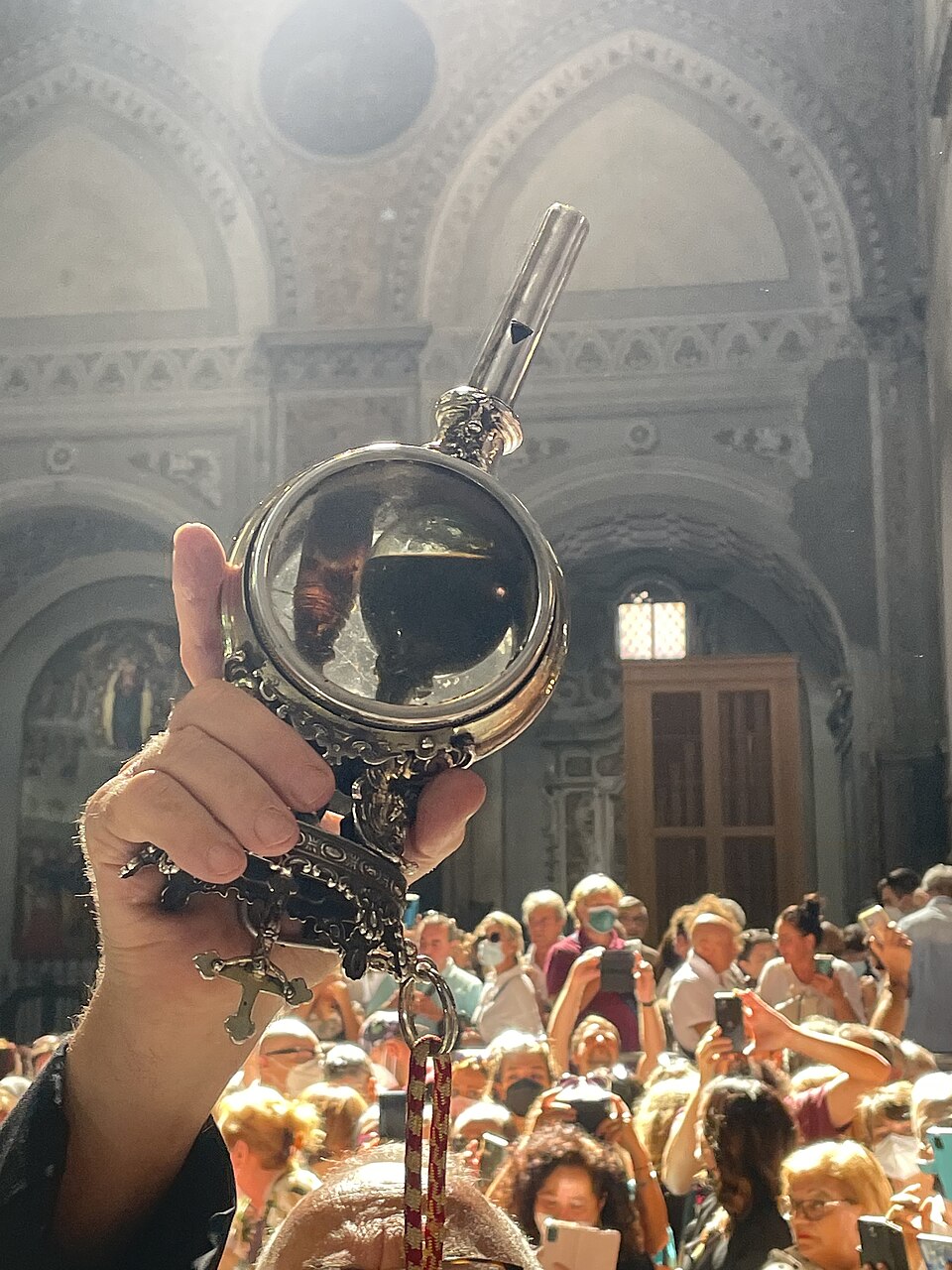
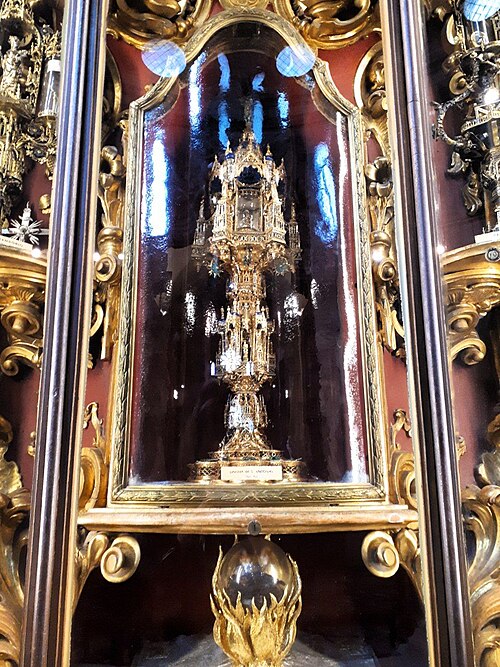
A small amount of water still collects at Saint Nicholas's tomb in Bari and is venerated as manna or myron. The tradition reaches back to his burial place in Myra and continued in Bari after the transfer of the relics in 1087. The liquid is collected annually on May 9. Investigations by the University of Bari in 1925 found nearly pure water and clear differences from an external comparison sample of that time. The published reports preserve the measurements. The manna connects the saint's memory with prayer for his intercession; the precise physical origin of the water remains a subject of separate questions.
Water collects near the relics of Saint Nicholas. The Church of Bari collects and venerates it as the saint's manna. Historical investigations establish properties of the liquid; they do not provide a conclusive explanation of its formation.
From the Tomb in Myra to the Basilica in Bari
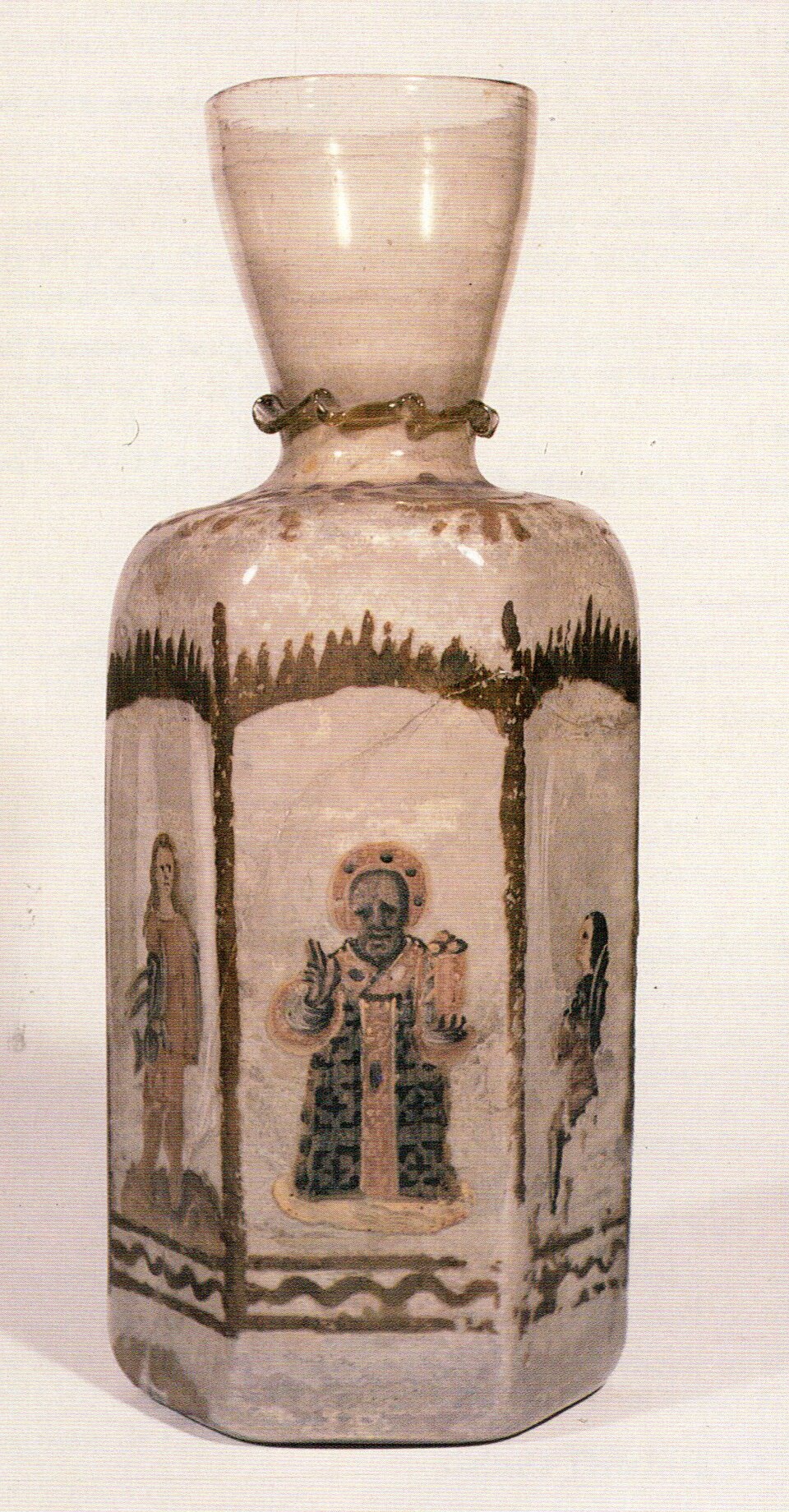
The basilica's history preserves the association of Saint Nicholas with a special liquid already at his tomb in Myra. Pilgrims and old texts called it myron, manna, oil, or ointment. These names express veneration; they are not consistently chemical identifications. The tradition directs attention to the saint's tomb and the graces received there. Whether an individual early text means an emergence from the bones or from the tomb must be clarified through its wording in each case.[3]
In 1087, the relics were transferred to Bari. Veneration continued there and found its new center in the basilica. The liquid remained associated with the saint's memory. The centuries-old tradition and the later dated laboratory investigations complement one another but belong to different kinds of sources: one reveals the history of veneration, while the others determine the properties of specific collected samples.[3][4]
The Annual Collection on May 9
On May 9, the feast of the transfer of the relics, the accumulated manna is collected. Its quantity is limited. According to the basilica's explicit information, it is added to large vessels of holy water for the small bottles pilgrims receive. The faithful thus receive a mixture connected with the water from Nicholas's tomb. Collection takes place in the context of the celebration, thanksgiving, and petition for the saint's intercession. This practice also explains how many pilgrims can share in the venerated water.[1]
Prayer at Saint Nicholas's Tomb
The Dominican custodians maintain veneration of the relics and the manna associated with them. Its center is the memory of Saint Nicholas and the petition for his intercession. Pilgrims thank God for his work in the saint's life and entrust their concerns to him. The basilica does not require commitment to a particular supernatural mechanism for the water's formation. Prayer is directed to God and lives from trust in his grace.[1]
The ancient symbolism of myron recalls the fragrance of a holy life. In it, the bodily memory of the saint is joined with the hope of those who pray. The origin in Myra, the transfer to Bari, and continuing veneration form a long history. Scientific investigations add concrete knowledge about the water. Both approaches reveal their respective subjects and make the spiritual meaning of the pilgrimage understandable.[3]
Riccardo Ciusa's Chemical Findings
In 1925, Riccardo Ciusa of the University of Bari examined two samples designated as manna from 1910 and 1925, together with external water that collected in the church. Because of the small quantity, he determined density and solid residue. The manna from 1925 left 0.048 grams of residue per liter, that from 1910 approximately 0.04 grams. The external comparison water left 1.038 grams per liter. This is a clear measured difference between the samples examined. The report describes the manna as nearly pure water.[2]
Ciusa concluded from his results that the manna did not originate from the external infiltration water submitted to him. This positive finding is more precise than a general conjecture about water in the church: specific samples were actually compared. Its scope is tied to this selection and the properties tested. It did not entail a comprehensive investigation of all moisture pathways of the tomb throughout the entire year.[2]
Filippo Neri's Bacteriological Investigation
Filippo Neri, director of the university's Institute of Hygiene, documented the samples of July 8 and 12, 1925. The urn remained sealed between the two collections. A sterile pipette and a sterile sponge were used for sampling, respectively. Neri saw some liquid at the bottom beneath the bones. Approximately fifty bacterial colonies per cubic centimeter grew in the samples examined; the organism then called Bacterium coli was not detected. The report thus explicitly records the sampling conditions and actual results.[2]
Neri regarded the low number and limited variety of microorganisms as an indication against contamination by surface water. His finding describes relatively low-microbe water, not sterile water. In an addendum of July 20, he also explained that natural waters can have very low solid residues. The values must therefore be appreciated as concrete material findings. They determine properties of the samples without alone demonstrating a supernatural origin.[2]
Witnesses & Investigators
Riccardo Ciusa
Chemist, University of Bari
Determined the density and solid residue of the manna and an external comparison sample in 1925.[2]
Filippo Neri
Hygienist, University of Bari
Documented sampling and bacterial cultures. His report records the presence of microorganisms.[2]
Pio Scognamiglio OP
Ecclesiastical commissioner
The Dominican submitted or arranged the samples examined and received the reports.[2]
The unfolding story
- Tradition in Myra
The ancient veneration already connects the tomb with myron; the texts do not always clearly distinguish between bones and tomb.[3]
- Relics in Bari
The transfer establishes the new center of pilgrimage.[4]
- Chemical Report
Ciusa describes the samples from 1910 and 1925 and the external comparison water that differs from them.[2]
- Bacteriological Examination
Sampling, report, and supplementary interpretation by Filippo Neri.[2]
- Public Collection
The basilica connects collection with the feast of the transfer of the relics.[1]
Ecclesiastical assessment
The basilica maintains veneration of the relics but does not present the water's supernatural origin as a universally binding statement of faith. The published investigations determine properties of the samples, not a divine mechanism of formation.
Has Condensation Already Been Demonstrated?
Alongside a miraculous interpretation, the basilica also names natural possibilities such as condensation. A possibility, however, is not yet a quantitatively demonstrated explanation for this tomb. That would require measurements of temperature, humidity, material transport, and possible water pathways over an extended period. The published investigations of 1925 provide important comparative values but no complete water balance. The precise route of formation therefore remains an open scientific question. It would be just as inaccurate to claim a completed natural explanation as to infer proven supernatural production solely from the present openness of the question.[1][2]
The seal protects against direct human intervention; it does not by itself exclude physical exchange with the surroundings. Conversely, a condensation explanation must show how much water can form under the specific conditions. Both stronger claims require data. Veneration at the saint's tomb must be distinguished from this still unresolved question of origin.[1][2]
Objections & Answers
Has the manna already been conclusively explained as condensation water?
Condensation is a natural possibility also named by the basilica. The sources consulted here, however, contain no complete measurement series of the tomb's water balance. In 1925, Ciusa compared specific samples and found a clear difference from the external water submitted. This is a concrete finding, but not an exclusion of every other natural pathway. A completed condensation explanation would need to demonstrate quantity and conditions. Conversely, the unresolved route of formation does not by itself prove supernatural production. The sources permit this precise distinction; veneration at Nicholas's tomb requires no commitment beyond the published finding.[1][2]
Does the high purity prove supernatural origin?
The purity is a real measured finding, but not by itself proof of divine formation. Neri himself points out that certain natural waters have very low residues. His cultures also showed bacteria; complete sterility therefore cannot be claimed. The published numbers are precisely what make the investigations valuable. They distinguish the specific samples from the external water examined and describe their properties. The spiritual meaning lies in remembrance of the saint and in intercession. It need not be grounded in a further scientific claim that the report does not support.[2][3]
Meaning for faith
At Nicholas's tomb in Bari, an actual accumulation of liquid, ancient veneration, and published examination findings are connected. The measurements of 1925 showed nearly pure water and differences from the external water examined. Its origin has not thereby been conclusively explained. The manna remains a venerated sign of the memory and intercession of Saint Nicholas.[1][2][3]
How Miracles in the Lives of the Saints Are Examined
Stigmata, bilocation, and material changes require different examinations.
Methods of examination and ecclesiastical procedure →Sources & Evidence
Information on accessibility and scope helps you assess the evidence for yourself.
- [1] La Manna di San Nicola
Institutional self-description; not an independent scientific study.
Open source · basilicasannicola.it ↗ - [2] Documenti scientifici sulla natura della Manna
Primary reports with methods and measurements; not to be read as a current drinking-water test or a general exclusion of natural causes.
Open source · basilicasannicola.it ↗ - [3] La Manna o Myron
Historical account by the basilica with source excerpts.
Open source · basilicasannicola.it ↗ - [4] Traslazione delle reliquie
Context of the pilgrimage site.
Open source · basilicasannicola.it ↗ - [5] Scientific documents on the nature of Manna
Confirms the accessible textual tradition; not a second independent investigation.
Open source · stnicholascenter.org ↗