On the rainy evening of August 21, 1879, a bright, silent image appeared at the gable wall of Knock's parish church: Mary, Joseph, and John the Evangelist, alongside an altar with the Lamb, the cross, and angels. Villagers observed the event for about two hours. Only a few weeks later, their statements were recorded by the Church and judged credible. A further investigation questioned the surviving witnesses. From this shared testimony grew the pilgrimage to what is now an international Marian and Eucharistic shrine.
The inhabitants of Knock attest to an apparition lasting about two hours at the church's south gable wall. They saw Mary, Joseph, and John the Evangelist, as well as an altar with the Lamb, the cross, and angels. The apparition had no spoken message.
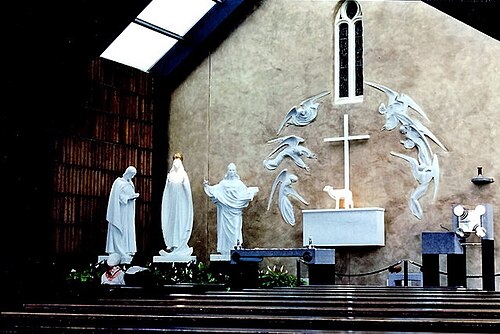
Mary, the Saints, and the Lamb at the Altar
The surviving witness statements lead into the rainy evening of August 21, 1879. Before the church's south gable wall, residents of Knock saw a bright apparition. They recognized Mary, Joseph, and John the Evangelist; beside them stood an altar, the Lamb, and the cross, surrounded by angels. The event lasted about two hours. No word was spoken. Some witnesses observed the figures at close range, while others stood farther away. Together, they attest to an extraordinary public event centered on Christ as the sacrificed Lamb.[2][4]
The Message of the Silent Image
At the center of the apparition stands the Lamb on the altar. The image leads to Christ's self-giving and the Holy Eucharist; Mary, Joseph, and John accompany this orientation toward the Redeemer. The biblical connection with the Revelation of John makes its meaning understandable. The papal appreciation of 2021 likewise places the Lamb and prayer at the center. Knock speaks through the figures shown. The silence allows the faithful to remain before Christ and invites adoration. The shared experience thus receives its recognizable spiritual content.[5]
Fifteen Statements in the First Investigation
Archbishop John MacHale established an investigation in October 1879. Parish priest Bartholomew Cavanagh, Canon Waldron, and Canon Ulick Bourke were among the examiners. The commission recorded fifteen statements: fourteen people had been nearer the event, while Patrick Walsh had observed the bright light from farther away. It judged the body of testimony credible and satisfactory. This questioning close to the event is the case's most important written foundation. It records the different observation points and preserves the event in the statements of those involved.[1]
The Witnesses Reaffirm Their Statements
In 1935–1936, surviving witnesses were questioned again, including Mary O'Connell, née Byrne, and Patrick Byrne. For John Curry, who had since emigrated to America, separate ecclesiastical proceedings took place in New York in 1937. He reaffirmed the experience of his childhood. He had been five years old in 1879; Patrick Hill had lifted him so that he could see better. The later statements show the witnesses' enduring conviction and supplement the early investigation. For precise details, the time of each statement, the witness's age at the event, and the observation point must also be considered.[1][3]
The Church's Reception of Knock
The first commission reached a favorable judgment on the testimonies. The shrine's chronology also records that no public declaration by the archbishop followed at that time. Ecclesiastical reception continued to develop through pilgrimages, services, and papal visits. In 2021, Francis elevated Knock to an international Marian and Eucharistic shrine. The Church thus expressly supports its veneration. For an accurate history, the favorable commission finding and later public acts must each be named in their own form; both belong to the place's documented history.[2][5]
Witnesses & Investigators
Mary Byrne, later O'Connell
Adult witness to the apparition
One of the early witnesses, questioned again in old age.[1]
Patrick Walsh
Observer from a distance
Observed the bright area from farther away; the nearer witnesses described the figures.[1]
John Curry
Child witness
Five years old in 1879; later questioned as an emigrant in New York in 1937.[3]
Bartholomew Cavanagh
Parish priest and member of the investigation
Accompanied the community as parish priest and participated in the ecclesiastical investigation.[1]
The unfolding story
- Evening of the Apparition
The inhabitants see the silent image with Mary, the saints, and the Lamb at the church.[2]
- First Investigation
MacHale appoints the commission.[2]
- Second Investigation
Surviving witnesses are questioned again.[1]
- John Curry in New York
The former child witness testifies before an ecclesiastical tribunal.[3]
- International Shrine
Papal recognition of the Marian and Eucharistic pilgrimage site.[5]
Ecclesiastical assessment
The commissions of 1879–1880 and 1935–1936 assessed the testimonies favorably. For the conclusion of the first investigation, the official chronology records no public declaration by the archbishop. Since 2021, Knock has been an international Marian and Eucharistic shrine.
What a Natural Explanation Would Need to Show
The early questioning contains details about light, duration, and locations. Every proposed natural explanation must be assessed against them. Anyone proposing a projection would need to demonstrate a contemporary light source, an image medium, and a suitable arrangement matching the different observations. No such historical evidence is present in the sources examined here. This does not make the hypothesis impossible, but clearly distinguishes it from an established explanation. Opposed to it stands specifically identified shared testimony, examined early and reaffirmed over decades.[1][4]
Objections & Answers
Do Family Relationships and Later Recollections Weaken the Shared Testimony?
The witnesses knew one another and discussed the experience. Their statements therefore cannot be counted as entirely independent experiments. What matters, however, is that Knock was investigated by the Church shortly after the event. The early questioning preserves specific observations; the later interviews show that those involved maintained their testimony. Age, location, and the timing of each statement can be considered, especially for John Curry, then a child witness. Kinship does not make an observation false. Credibility rests on the actual statements, their early recording, and their renewed examination.[1][3][4]
Was the Apparition a Projection on the Church Wall?
A projection would become an established explanation only if a historically appropriate arrangement were demonstrated: light source, image medium, line of sight, and a sequence accounting for the different observations. The sources examined here provide no such evidence. The word projection alone does not replace it. The proposal stands against early statements by specific people and the favorable examination of their credibility. A complete experimental exclusion of every conceivable natural cause is likewise impossible retrospectively. Reasoned assessment therefore weighs the testimony actually available and distinguishes it from a technical hypothesis that remains unproven.[1][2][4]
Meaning for faith
Knock rests on the early examined testimony of specific villagers. Without words, the apparition leads to the Eucharist and the adoration of Christ. The favorable assessment of the statements and the shrine's explicit ecclesiastical reception give veneration a clear foundation.[1][2][5]
How Apparitions and Private Revelations Are Examined
Testimony, messages, spiritual fruits, and ecclesiastical decisions.
Methods of examination and ecclesiastical procedure →Sources & Evidence
Information on accessibility and scope helps you assess the evidence for yourself.
- [1] The Commissions of EnquiryOpen source · knockshrine.ie ↗
- [2] HistoryOpen source · knockshrine.ie ↗
- [3] The youngest apparition witnessOpen source · knockshrine.ie ↗
- [4] DocumentsOpen source · museumsofmayo.com ↗
- [5] Video message on the elevation of the Shrine of Knock to an International ShrineOpen source · vatican.va ↗