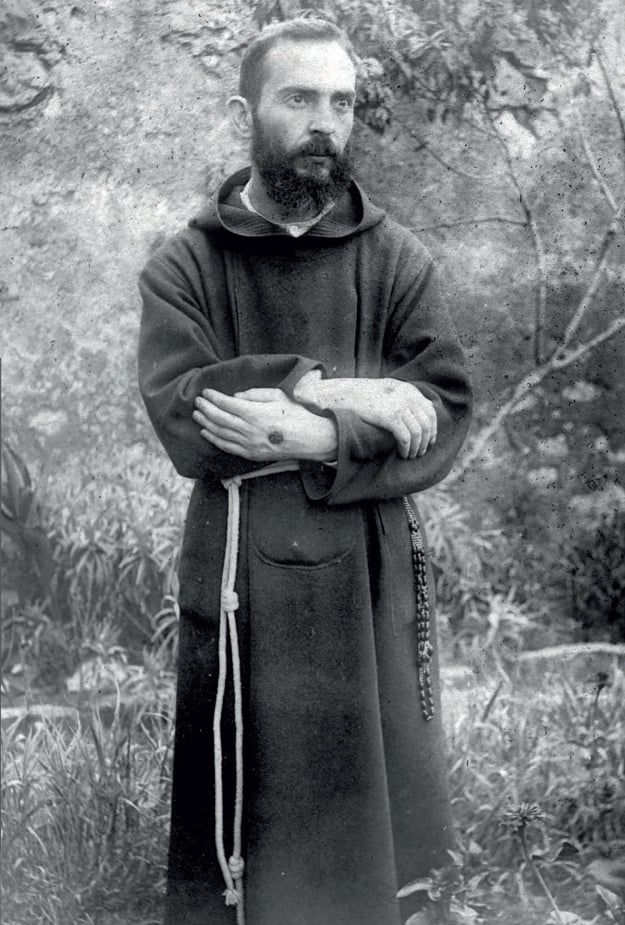
On September 20, 1918, after Holy Mass, Padre Pio received the wounds on his hands, feet, and side. A month later, he described the event to his superior, Father Benedetto: the vision of a bleeding figure, the wounds on his own body, and his desire to conceal the outward signs. Several physicians examined the injuries. Luigi Romanelli and Giorgio Festa reached positive judgments concerning their extraordinary character. The surviving letters and reports give the case unusually close documentation. Pio's life connected suffering with confession, prayer, and practical help for the sick.
Pio attests to the onset of the bleeding wounds after a vision of Christ on September 20, 1918. Physicians examined the signs on his hands, feet, and side. Romanelli and Festa recognized their extraordinary character; Catholic veneration sees in them a special participation in Christ's Passion.
The Morning of September 20, 1918
Pio's letter to Father Benedetto dated October 22, 1918, preserves his personal testimony close to the event. After Holy Mass, he was praying in the monastery choir. He experienced deep inner peace and saw a mysterious figure with bleeding wounds. When the vision ended, he found the same places on his own body wounded. His hands, feet, and side were bleeding. Pio describes the pain and his embarrassment at the visible signs; he asked for them to disappear. The letter leads directly into his response to the event: he confided it to his superior and sought spiritual guidance.[1]
The Wounds Lead to the Cross and to One's Neighbor
Pio's life was shaped by prayer, reconciliation in the sacrament of confession, and active love of neighbor. The hospital Casa Sollievo della Sofferenza gives lasting form to his commitment to those who suffer. The homily at his canonization on June 16, 2002, also places the cross and this service at the center. The wounds are considered within this context: as bodily participation in the Passion and as a call to turn toward people who suffer.[7]
The letters written close to the event, the actual medical examinations, and the visible fruits of his life together form the foundation of this appreciation. The positive reports deserve to emerge with their full weight. Counterquestions are examined against the surviving documents. Pio himself thus remains visible: a Capuchin who bore his suffering in prayer and obedience and led many people to confession, trust in Christ, and practical help.[2][5][7]
The Medical Examinations
Luigi Romanelli, Amico Bignami, and Giorgio Festa examined Pio's injuries. Their reports are published in Gerardo Di Flumeri's collection of documents. Romanelli was convinced of the wounds' extraordinary character; Festa considered his findings inexplicable by ordinary causes. These judgments come from physicians who examined Pio themselves and are therefore significant testimonies. Bignami reached a different interpretation: his report of July 26, 1919, describes superficial skin changes and considers a pathological origin with possible maintenance by irritants. The original statements permit a factual comparison of the findings and their explanations.[2]
The reports also differ in individual bodily details. Romanelli interpreted his tactile perception of the hands as penetration; Festa described the underlying bones as intact. The sources thus document examined injuries but not a uniform finding that all tissues were severed. This precise presentation is important for assessment. The unusual course of the wounds and the two physicians' positive conclusions about their cause can be appreciated on the basis of their actual observations.[2]
What Supported Festa's Positive Judgment
Festa examined the form, coloration, blood discharge, and surroundings of the injuries. He was particularly concerned that the wounds did not follow an ordinary healing course. He also included Pio's sincerity and psychological balance in his assessment and reached a positive judgment about the extraordinary event. His reasoning can be followed in the published records. Clinical observations and his personal assessment must be distinguished: both explain his conclusion, while examination of possible external intervention requires additional concrete observations.[2][3]
The documentary edition provides access to the historical examination reports. Its strength lies in making the observations and arguments of the time comparable in their original wording. The examiners worked with the procedures available to them. A present-day continuous standardized photographic record or a prospectively designed controlled study is unavailable for this historical course. This limits certain retrospective medical conclusions but does not negate the examinations actually performed.[2]
Ecclesiastical Investigation and Later Canonization
On May 31, 1923, the Holy Office declared that the investigation at that time did not establish the supernatural character of the events attributed to Pio. The official Latin declaration survives. It expresses a cautious judgment about origin on the basis then available. It does not establish proven fraudulent production. This investigation and the resulting restrictions belong to the history, as do Pio's obedience and the subsequent course of his life.[4]
The official account of the canonization process honors Pio's heroic virtues, his apostolate of confession, his prayer, and his help for the sick. Separately investigated healings through his intercession were also included. His canonization in 2002 concerns this ecclesiastical judgment about his person and life. The older medical reports on the wounds remain with their own findings and differences. Veneration of the saint and precise historical examination of these records can therefore be brought together.[5]
Witnesses & Investigators
Pio of Pietrelcina
Recipient and letter writer
Describes the onset of the wounds and his inner response in the letter to Father Benedetto of October 22, 1918.[1]
Amico Bignami
Examining physician
Describes the injuries in 1919 and discusses a natural origin, partly maintained by chemicals.[2]
Giorgio Festa
Examining physician and defender
Interprets his findings as unexplained by ordinary causes; his argument includes clinical and personal considerations.[2]
Luigi Romanelli
Examining surgeon
Examined the wounds and assessed their character positively; his findings can be compared with the other surviving reports.[2]
The unfolding story
- Beginning of the Visible Stigmata
Pio receives the wounds after Mass in the monastery choir; his letter records the date.[1]
- Written Personal Testimony
His letter to Father Benedetto describes the vision, wounds, and inner response.[1]
- Medical Assessments
Bignami, Romanelli, and Festa assess the findings with partly opposing results.[2]
- Declaration of the Holy Office
The supernatural character is not declared established by the investigation available.[4]
- Death
Pio dies in San Giovanni Rotondo.[5]
- Canonization
John Paul II canonizes the Capuchin.[7]
Ecclesiastical assessment
Pio was canonized in 2002. This is not a retrospective medical confirmation of every individual account of his wounds. The Holy Office's declaration of 1923 held that the supernatural character of the phenomena then examined had not been established.
The Chemical Objection and the Necessary Chain of Evidence
Bignami considered tincture of iodine as a possible factor. Festa also addressed carbolic acid and named disinfection in the monastery as its use. The edition preserves differing recollections by friars. It follows that the handling of such substances must be examined. Evidence of their procurement, however, is not yet evidence that Pio used them to produce or continually maintain the wounds. That would require concrete observations of application, a traceable connection with onset and course, and an explanation of the contrary medical findings.[2]
In 2007, Sergio Luzzatto made the suspicion public again on the basis of earlier statements about chemical procurement. The press report of the time documents this controversy but provides no toxicological finding from Pio's wounds. The complete chain of ordering, delivery, actual use, and observed effect remains decisive. As long as this connection has not been demonstrated, access to a substance must not be used to infer proven lifelong fraud.[6]
Objections & Answers
Does procurement of carbolic acid prove that the wounds were manufactured?
It initially establishes access to a substance. Further evidence would be needed for deliberate production of the wounds: concrete application to the affected areas, the temporal connection with onset and course, and an explanation of conflicting medical observations. Festa named disinfection in the monastery as its use. This is a possible alternative explanation for the procurement. The documented questions must therefore neither be concealed nor expanded into already proven fraud. The complete chain of evidence remains decisive. The order alone does not refute the positive examination findings.[2][6]
What does canonization confirm in relation to the stigmata?
Canonization honors Pio's person, heroic virtues, and holy life; its process also included separately investigated healings. The homily highlights his following of the cross, apostolate of confession, and help for the sick. This does not produce a retrospective uniform diagnosis of all earlier wound reports. Nor does a medical dispute automatically invalidate his recognized holiness. The positive assessments of the stigmata stand with their actual arguments alongside the Church's testimony to his life. This precise attribution permits a strong appreciation without conflating different judgments.[4][5][7]
Is Padre Pio's body a proven miracle of incorruption?
The experts involved in the 2008 exhumation described natural changes and subsequent conservation. Forensic physician Orazio Pennelli explained that the hoped-for incorrupt body, or a supernatural sign of preservation, had not been found. Nazzareno Gabrielli explained the effects of moisture and the later treatment with preservatives. Pio's body is therefore not listed here as a proven case of miraculous incorruption. This concerns preservation after death. The medically examined stigmata during his life are a different subject and are assessed through their own documents.[8]
Meaning for faith
Pio's wounds are documented through letters written close to the event and concrete medical examinations. Romanelli's and Festa's positive judgments deserve careful appreciation; objections must be tested against the actual chain of evidence. In the saint's life, the stigmata are connected with following the cross, reconciliation, and help for those who suffer.[2][5][7]
How Miracles in the Lives of the Saints Are Examined
Stigmata, bilocation, and material changes require different examinations.
Methods of examination and ecclesiastical procedure →Sources & Evidence
Information on accessibility and scope helps you assess the evidence for yourself.
- [1] Padre Pio racconta la sua crocifissione
Personal testimony close to the event; not to be confused with independent observation of the onset.
Open source · padrepio.it ↗ - [2] Le stigmate di Padre Pio da Pietrelcina: Testimonianze – Relazioni
Digitized edition of historical primary reports. Statements by the physicians of the time are evaluated here, not presented as a current scientific consensus.
Open source · imagomundi.biz ↗ - [3] Le stimmate di San Pio secondo la scienza medica
Positive Catholic interpretation and excerpts; not an independent new examination.
Open source · settimanaleppio.it ↗ - [4] Declaratio, May 31, 1923
Official original wording of the caution expressed at the time.
Open source · vatican.va ↗ - [5] Padre Pio of Pietrelcina (1887–1968)
Documents ecclesiastical appreciation and separate healing proceedings.
Open source · vatican.va ↗ - [6] Historiker: Zweifel an Wunden und Wundern von Padre Pio
Solely to document the public historical controversy; no medical finding of its own.
Open source · diepresse.com ↗ - [7] Homily at Padre Pio's Canonization
Authoritative spiritual appreciation; not a scientific treatise.
Open source · vatican.va ↗ - [8] Il trattamento e le emozioni dei periti
Direct statements by the exhumation commission on the body's condition and conservation.
Open source · vocedipadrepio.com ↗