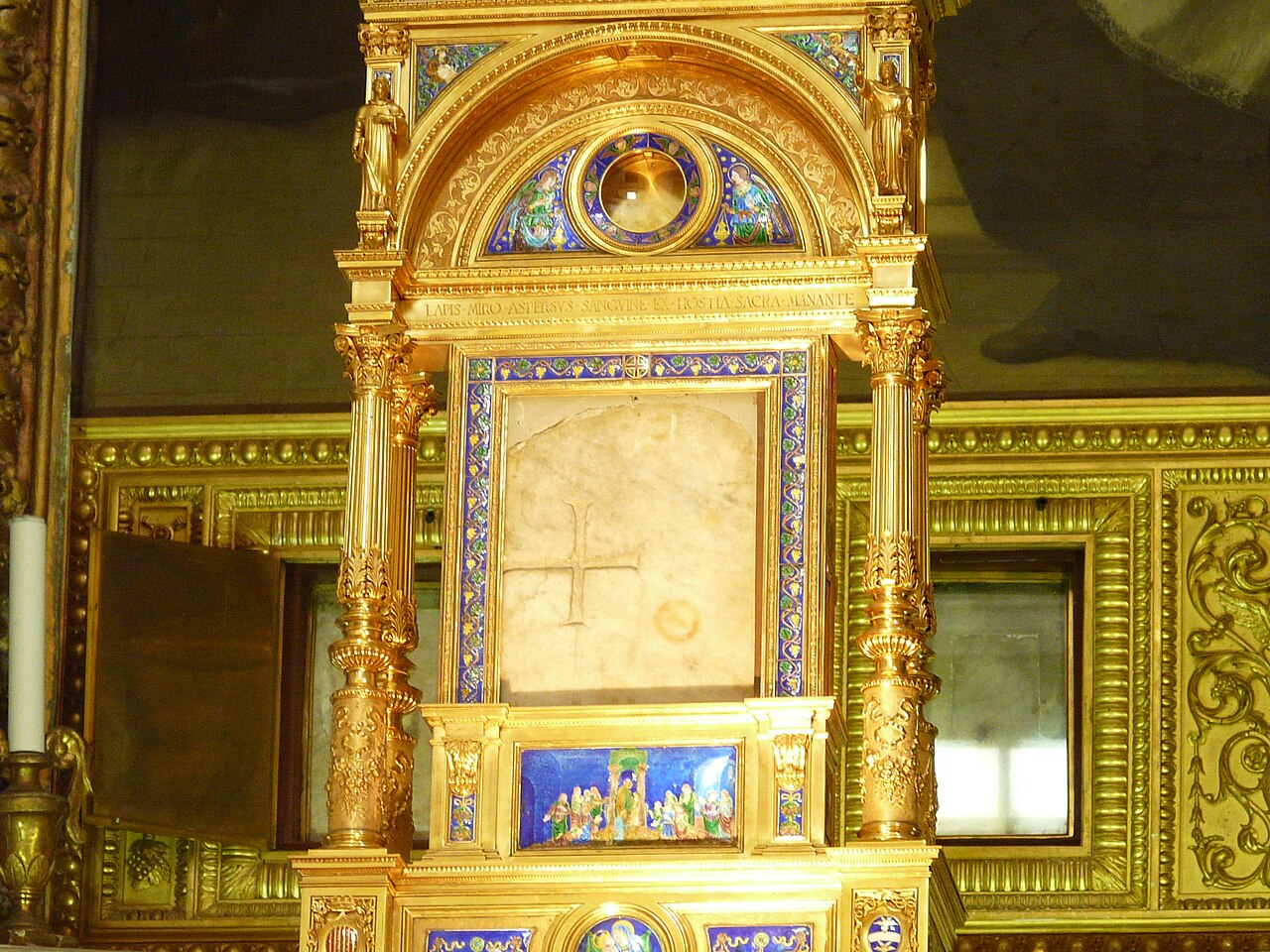
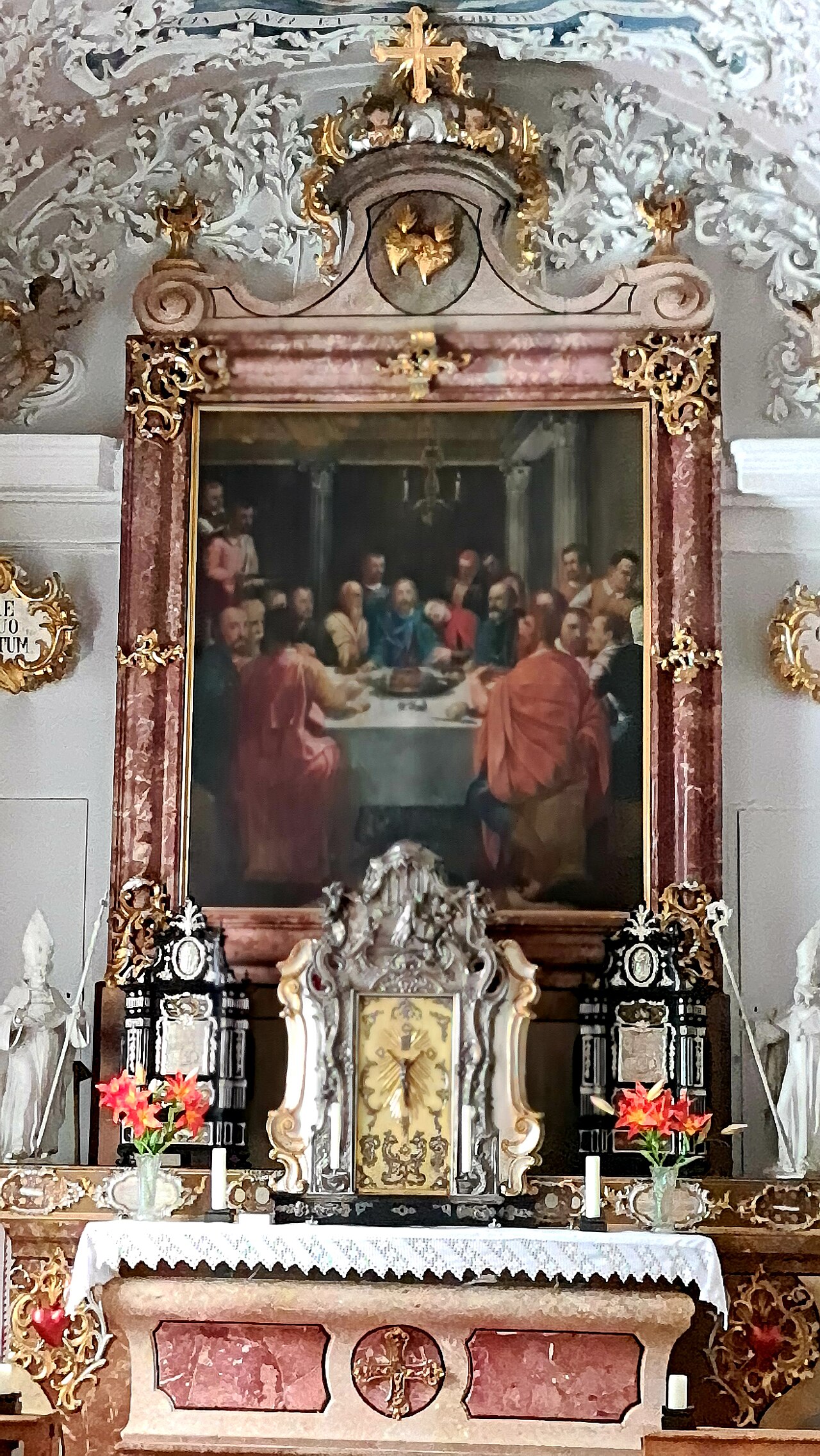
Around 1330, the priest Heinrich Otto knocked over the chalice during Mass. Its consecrated contents spilled onto the corporal. According to the account preserved by the pilgrimage, the Crucified One and further images of Christ appeared on the cloth. The priest initially hid the corporal and revealed the event only before his death. His confession gave rise to the pilgrimage to the Holy Blood. An ecclesiastical investigation in 1408 and Eugene IV's indulgence privilege of 1445 are among its early documented milestones.
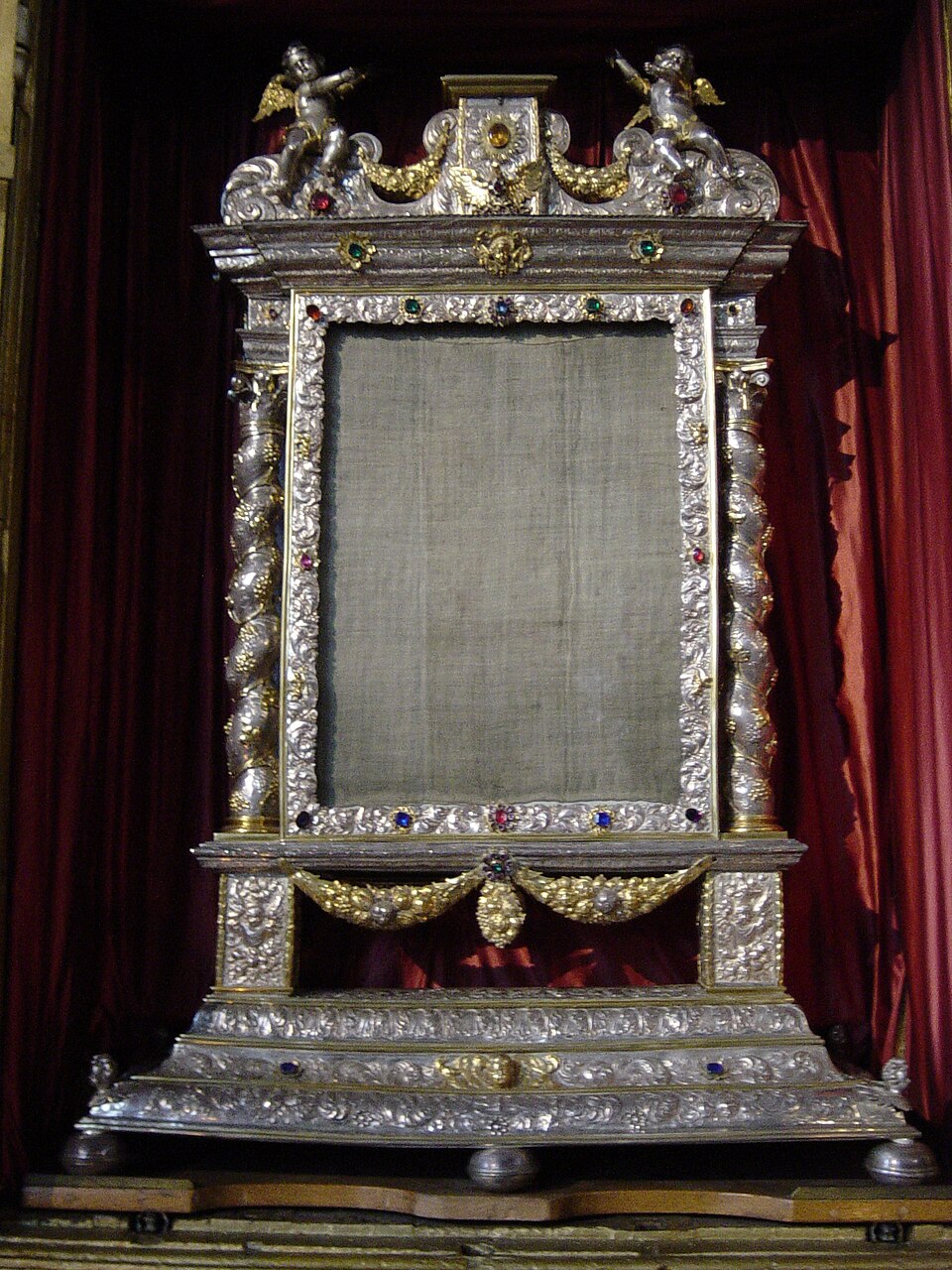
The Walldürn tradition attests to the formation of a Crucifixion image and further images of Christ on the corporal after the consecrated contents of the chalice were spilled. The cloth, later made known and preserved, became the center of veneration.
Further original photographs from the publisher
The Overturned Chalice and the Hidden Cloth
The official pilgrimage website preserves the account written down in 1589 by Magister Jodocus Hoffius, also known as Jost Hoffmann. Around 1330, Heinrich Otto knocked over the chalice during Mass; its consecrated contents flowed onto the corporal. Images of Christ appeared on it. Frightened, the priest hid the cloth. Only before his death did he confess the event, opening the way for its discovery and veneration. The formation of the image and the later confession constitute the context of the miracle.[1]
The Crucified One Amid the Images of Christ
The transmitted account describes the Crucified One in the center of the corporal, surrounded by further images of Christ following the motif of Veronica's veil. The miracle is thus seen not in the spilling alone, but in the specific imagery that arose from it. The Eucharistic contents of the chalice and Christ's Passion are related to one another in this image. The cloth became the visible bearer of a memory that later found its lasting center at the Holy Blood Altar.[1]
Investigation in 1408 and Papal Privilege in 1445
The ecclesiastical timeline names an investigation in 1408 and a bull of Eugene IV in 1445. A copy of the papal document is preserved in the parish archive. Further authentications and the publication of 1589 provide access to the continuing reception of the event. These concrete milestones document early ecclesiastical involvement. The indulgence privilege promotes the pilgrimage and its religious practice; its precise meaning must be determined from the document itself.[2]
Sources for the Cloth and Its History
Walldürn has a named early author, traces of ecclesiastical proceedings, archival references, and a specific place of veneration. Hoffius is an important transmitter of the tradition in 1589, not an eyewitness to the event around 1330. The early investigation and the later privilege also each have their own purpose. Further statements about blood components, modern imaging methods, or the precise material formation require the respective original investigations. Such laboratory details that have not been established are not added here to the historical evidence.[1][2]
The Holy Blood Altar as the Lasting Center
The Baroque basilica and its Holy Blood Altar give visible form to the long veneration. The pilgrimage has shaped Walldürn's spiritual and public life over generations. Endowments, church construction, and art attest to the seriousness with which the faithful received this Eucharistic memory. For the pilgrim, these works lead to the altar and to adoration. Their architectural history complements the earlier written testimonies and makes the continuing response to the miracle tangible.[3][4]
The Priest Too Is Called to Truth
Heinrich Otto's concealment of the cloth belongs to the gravity of the account. The priest is not an untouchable hero; he must confront his own conduct. His confession makes accessible what was previously hidden. The miracle therefore also calls the ministers of the altar to truthfulness, reverence, and conversion. The enclosed testimony becomes public adoration. This movement shapes the spiritual meaning of the pilgrimage to the Holy Blood.[1]
Witnesses & Investigators
Heinrich Otto
Celebrant and participant in the transmitted event
Spilled the contents of the chalice and later confessed the hidden cloth and the images of Christ.[1]
Jodocus Hoffius / Jost Hoffmann
Author of the miracle account of 1589
Preserved the older tradition in a text attributed by name.[1]
Ecclesiastical examiners of 1408
Early ecclesiastical investigating authority
The official pilgrimage chronology documents their involvement; the complete file is not available here.[2]
The unfolding story
- Traditional Event at Mass
Heinrich Otto and the corporal stand at the center of the narrative of the origin.[1]
- Ecclesiastical Investigation
The local chronology names an early official examination.[2]
- Indulgence Privilege
Eugene IV promotes the pilgrimage; a copy is recorded in the parish archive.[2]
- Printed Account
Jodocus Hoffius publishes the familiar narrative of the origin.[1]
- Holy Blood Altar
Veneration receives an elaborate artistic setting.[2]
- Pilgrimage and Basilica
Walldürn remains a major place of devotion to the Holy Blood.[3]
Ecclesiastical assessment
The local chronology names the ecclesiastical investigation of 1408 and Eugene IV's indulgence privilege of 1445. Veneration at the Holy Blood Altar remains firmly rooted in Church life.
Objections & Answers
Can people recognize images of Christ in random stains?
People can recognize familiar motifs in irregular shapes. This general possibility, however, does not yet explain the specific Walldürn account. It describes a particular sequence of Mass, spilling, image formation, concealment, and later confession. The earliest descriptions, the clarity of the motifs, and possible later alterations to the cloth are decisive for examination. A present-day subjective impression of a photograph does not settle these historical questions. The counterhypothesis must therefore be tested against the testimony as a whole, just as the positive interpretation must.[1][2]
Does the indulgence bull confirm all later details?
The privilege is a genuine papal endorsement and ordering of the pilgrimage. It therefore carries considerable ecclesiastical and historical weight. Its subject, however, must be determined from its own text; later details from Hoffius's account of 1589 are not authenticated solely by the earlier privilege. The investigation, indulgence bull, later authentications, and printed account form distinguishable stages. Precisely these concrete points of reference sustain the positive history of the pilgrimage without needing to be reinterpreted as comprehensive modern forensic proof.[1][2]
Meaning for faith
Walldürn preserves the blood image as testimony to Christ's Passion in the context of the Eucharist. Heinrich Otto's confession, the early traces of ecclesiastical proceedings, and enduring veneration give the case its concrete history. The pilgrimage leads to adoration and calls priests and faithful alike to reverence and truthfulness.[1][2][3]
How Eucharistic Miracles Are Examined
Securing the account of events, identifying the material, and reading the Church's judgment precisely.
Methods of examination and ecclesiastical procedure →Sources & Evidence
Information on accessibility and scope helps you assess the evidence for yourself.
- [1] Das Blutwunder
Old narrative of the origin on the official pilgrimage website; not a contemporary eyewitness account from 1330.
Open source · wallfahrt-wallduern.de ↗ - [2] Timeline of the Pilgrimage and the Holy Blood Altar
Ecclesiastical chronology with archival and bibliographic references; original records not consulted in full.
Open source · zumheiligenblut.de ↗ - [3] Das Blutwunder
Municipal account of the local tradition and its significance.
Open source · wallduern.de ↗ - [4] Basilica
Documents the visible history of its influence, not the formation of the image on the cloth.
Open source · wallduern.de ↗