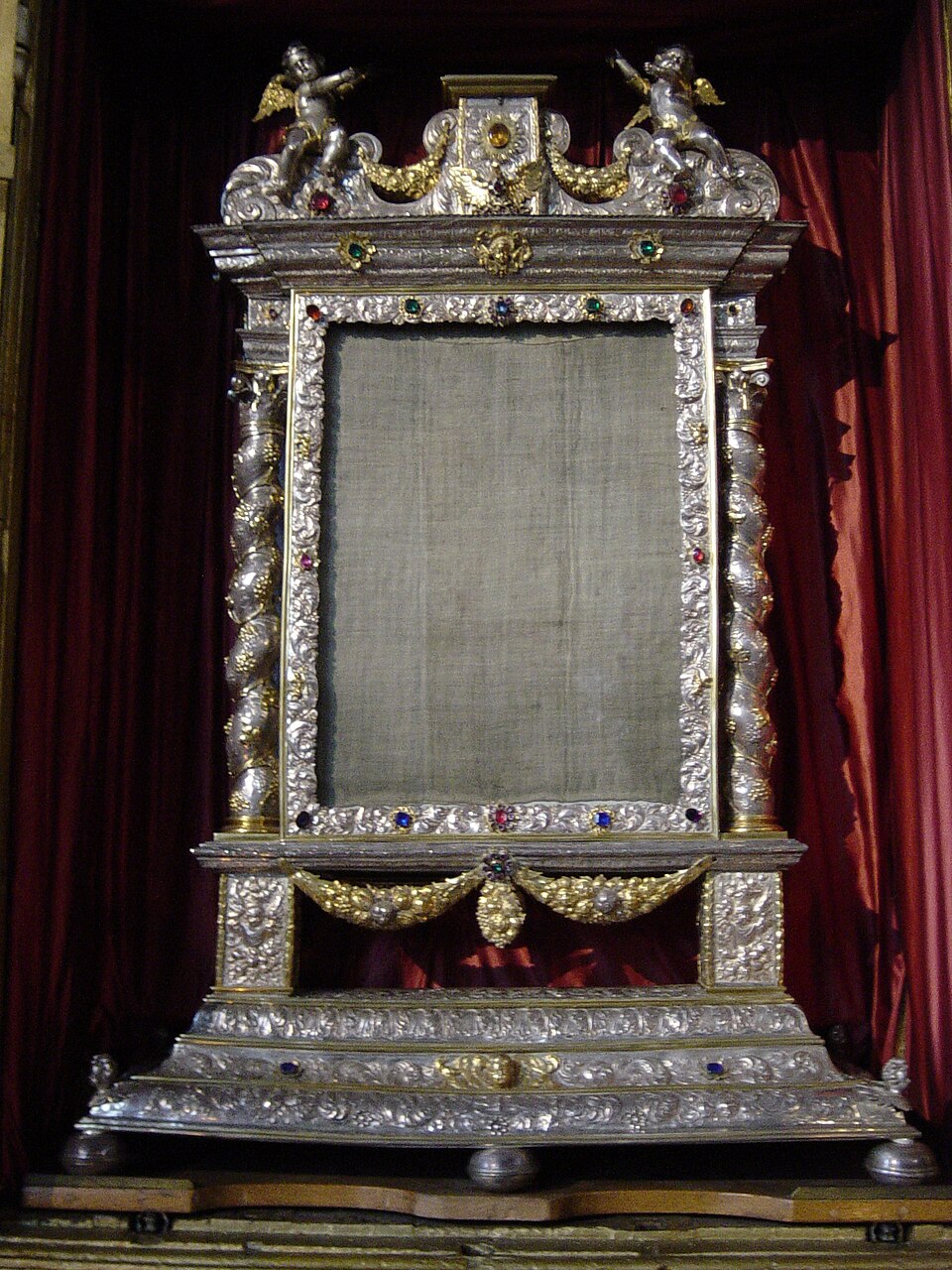
In 1384, Oswald Milser demanded a larger Host than the other faithful in Seefeld. According to the account preserved by the parish, the ground gave way beneath him when he received it. The altar stone on which he sought support also yielded. Only when the priest took the Host back did the event end; traces of blood appeared on it. Milser converted. The miracle established a major Tyrolean pilgrimage and was transmitted in images, architecture, and writing.
Local ecclesiastical tradition attests to Oswald Milser sinking down when he received a larger Host demanded out of pride in his rank, and to bloodstains on the Host that was taken back.
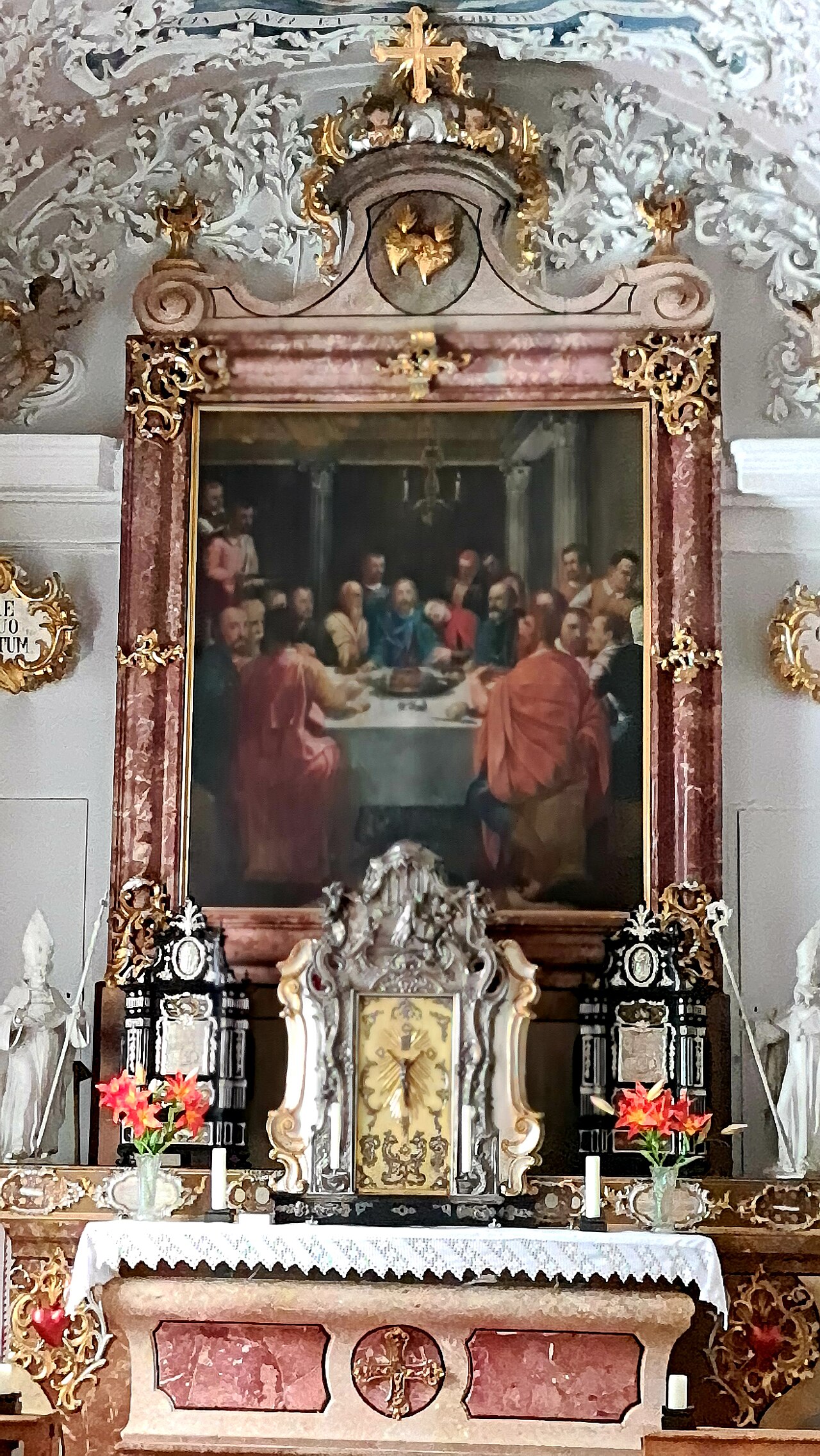
Further original photographs from the publisher
Milser Demands a Privilege at the Altar
The parish of Seefeld recounts the event of 1384: Oswald Milser wanted his rank to be distinguished at Communion and demanded a large priest's Host. As he received it, the ground beneath him gave way up to his knees. He sought support at the altar, but the stone also yielded beneath his grasp. The priest took the Host back; traces of blood became visible on it. Milser was led from his claim to precedence to humility and conversion. The event thereafter shaped the place and its Eucharistic pilgrimage.[1]
Early Images Preserve the Event
Saint Oswald's possesses a tympanum relief depicting the miracle and significant late Gothic furnishings. The parish account mentions fifteenth-century frescoes and Jörg Köderer's panel painting of 1502. These works attest to the early public reception of the event. Their motifs, arrangement, and location make visible how the community remembered the event and conveyed it to pilgrims. Visual testimonies must be assessed according to their date and context; they complement the written sources.[2]
Peter Canisius and the Publication of 1580
Research on the Latin literature of Tyrol documents the promotion of the pilgrimage by the territorial rulers. In 1580, a description of the miraculous sign appeared with a foreword by Saint Peter Canisius. His involvement documents explicit ecclesiastical reception and interpretation. Canisius is a later promoter, not an eyewitness to the event of 1384. The early visual memory and the history of print together provide a multifaceted historical approach.[3]
The Visitation Report of 1602
An episcopal visitation in 1602 found the Host in poor condition and recommended restoration. Historical research makes this finding accessible. It concerns the later preservation of the object. The original miracle consists in the attested event during Communion and the bloodstains discovered at that time; it does not presuppose uninterrupted material immutability throughout all later centuries. The visitation report is therefore part of the relic's history, not in itself a refutation of the event.[3]
Christ Is Not Received According to Rank
A larger Host is not a larger Christ. The Lord gives himself wholly and cannot be apportioned according to social rank. Seefeld directs this solemn truth against the claim that one can force a privilege at the altar. Milser's conversion is therefore the decisive response to the miracle. Humility frees people from self-exaltation and opens them to the gift they cannot acquire by their own power.[1]
Witnesses & Investigators
Oswald Milser
Participant in the miracle account preserved by the Church
Demanded the larger Host and was led to conversion through the event.[1]
The local priest
Celebrant and participant
Took the Host back from Milser; the local ecclesiastical source preserves his role.[1]
Peter Canisius
Later spiritual promoter
Contributed to the Church's presentation of the miracle with his foreword of 1580.[3]
The unfolding story
- Traditional Miracle of the Host
The tradition names Oswald Milser and his reception of Communion in Seefeld.[1]
- Late Gothic Imagery
The parish church develops a visible presentation of the veneration.[2]
- Panel Painting
Jörg Köderer's painting is among the surviving church furnishings.[2]
- Printed Description of the Miracle
A publication includes a foreword by Peter Canisius.[3]
- Episcopal Visitation
The transmitted finding about its condition requires a differentiated history of the relic.[3]
Ecclesiastical assessment
The Parish of Saint Oswald preserves the memory of the miracle of the Host. Early visual testimonies, the later printed tradition, and ecclesiastical visitations provide access to its history.
Does the clear message make the account implausible?
The fact that an event conveys a clear spiritual lesson does not prove invention. The question of its historical attestation is examined through texts, artworks, and ecclesiastical documents. It is necessary to distinguish which details can be documented early and which only appear more fully later. Seefeld's concrete tradition deserves this examination. The moral message must serve neither as a substitute for historical evidence nor as a pretext for rejecting the testimony without investigation.[1][2][3]
Objections & Answers
What significance do the depressions in the stone have?
They are local bearers of memory and belong to the pilgrimage ensemble that developed over time. Their precise material origin would need to be examined through age, workmanship, building phases, and early descriptions. A present-day photograph does not by itself prove the entire event, but neither does it refute it. In Seefeld, the features of the site stand alongside visual and written testimonies. This connection is historically more informative than considering a depression in isolation.[1][2]
Does the account serve only to intimidate powerful laypeople?
It is directed against a particular claim: that worldly rank may force a privilege at the altar. This limit applies equally to the priest, who must not make the sacrament a distinction for a favorite. Its spiritual content therefore consists in common submission to Christ and in conversion. This does not predict physical punishments for present-day communicants. Historically, the early attestation of individual details remains to be examined. The clear teaching is neither proof of invention nor a substitute for this work on the sources.[1][3]
Meaning for faith
Seefeld attests to the limit of worldly power before the Blessed Sacrament. Oswald Milser's conversion stands at the center of the miracle and its long ecclesiastical veneration. Early artworks and the written tradition preserve the call to receive Christ in humility and reverence.[1][2][3]
How Eucharistic Miracles Are Examined
Securing the account of events, identifying the material, and reading the Church's judgment precisely.
Methods of examination and ecclesiastical procedure →Sources & Evidence
Information on accessibility and scope helps you assess the evidence for yourself.
- [1] Pfarrkirche St. Oswald – Geschichte des Hostienwunders
Local ecclesiastical reproduction of the tradition; not a contemporary investigation record.
Open source · sr-seefelderplateau.at ↗ - [2] Pfarre Seefeld – Katholische Pfarrkirche St. Oswald
Documents visual testimonies and present-day commemoration.
Open source · sr-seefelderplateau.at ↗ - [3] Tyrolis Latina. Geschichte der lateinischen Literatur in Tirol, Volume 1
Scholarly secondary account of the 1580 publication and 1602 visitation; not a scientific report on the relic.
Open source · austria-forum.org ↗