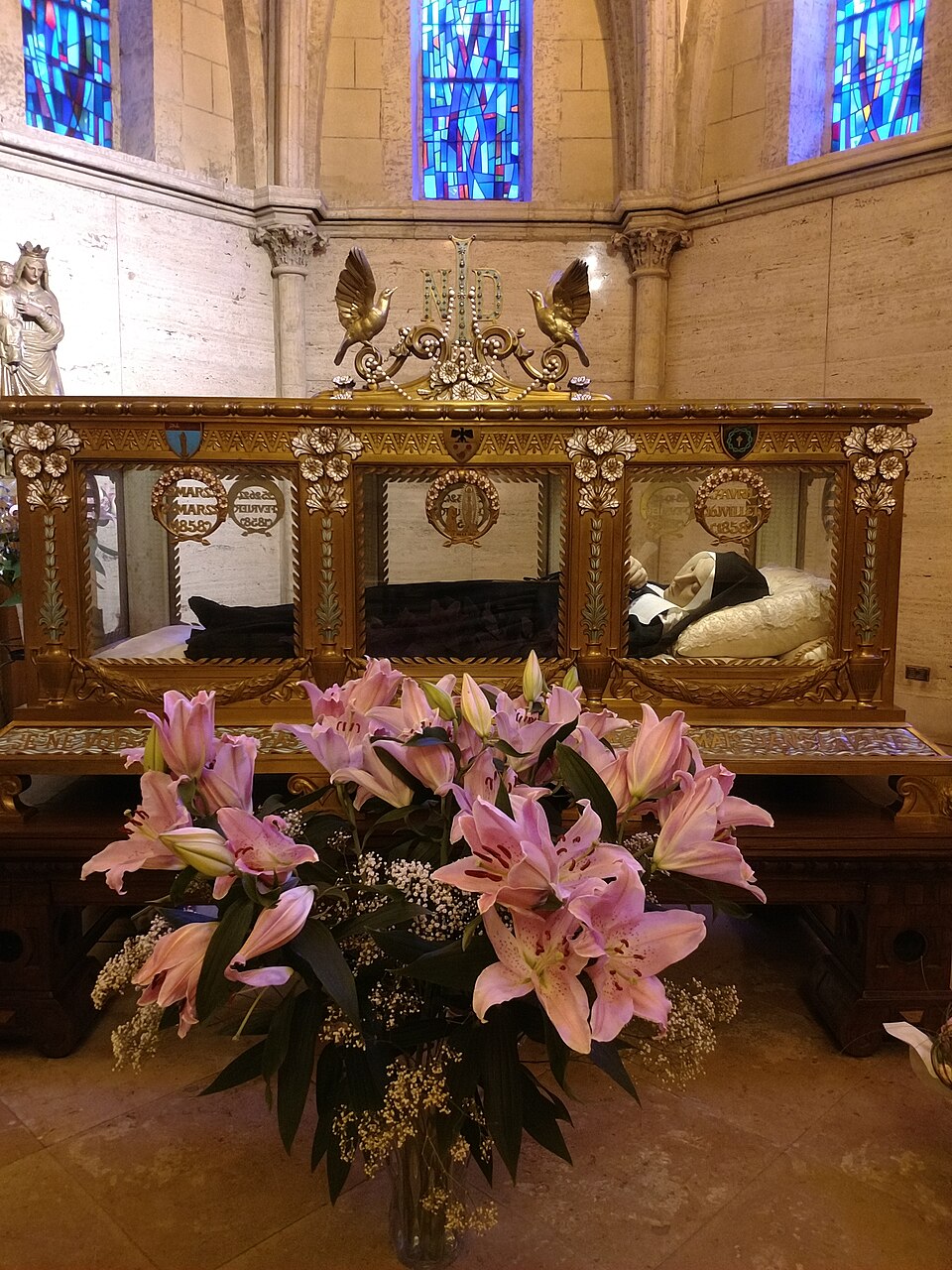
On 28 April 2023, the Benedictine sisters of Gower found their foundress's body unexpectedly preserved after just under four years. She had been buried without embalming in a simple, unsealed wooden coffin. While the coffin lining had decayed, the body and religious habit remained preserved. Abbess Cecilia Snell and Prioress Scholastica Radel described the recovery; the medical team commissioned by the bishop examined the discovery.
The unembalmed body and religious habit remained preserved after just under four years, while the lining of the unsealed wooden coffin decayed. The bishop's summary documents the condition the investigators considered highly atypical.
Further original photographs from the publisher
28 April 2023: The First Discovery After Just Under Four Years
The sisters opened the grave for the planned transfer to the abbey church. They expected bones. Instead, they found a preserved body in religious habit. The clay soil was very damp. Wilhelmina had been buried without embalming or other pretreatment in a simple, unsealed wooden coffin, whose lining had completely decayed. The contrast between coffin lining, clothing, and body belongs to the documented discovery.[1][2]
The Recovery and the Named Eyewitnesses
In a joint interview, Abbess Cecilia Snell and Prioress Scholastica Radel described how the community carried out the recovery. The transfer was connected with a new shrine to Saint Joseph. A forwarded private message made the discovery publicly known. The interview also corrected the early date of 18 May: the exhumation had already been completed on 28 April.[2][4]
Wilhelmina's Journey and the Foundation of 1995
Wilhelmina Lancaster lived from 13 April 1924 to 29 May 2019. After a long religious life, she helped begin the new Benedictine community in 1995. Her obituary of 2019 describes her attachment to the traditional liturgy, prayer, and devotion to Christ. Published before the tomb opening, this testimony leads to the life for which the sisters commemorated their foundress.[3]
The Medical Commission and Published Results
On 24 May 2023, Bishop James V. Johnston commissioned a team led by a pathologist; two additional physicians and a former coroner participated. It examined the body and coffin and interviewed witnesses about burial and exhumation. According to the bishop's publication of 22 August 2024, the body and clothing did not show the expected signs of decomposition. The history revealed no identifiable protection against decay. Soil analyses found no unusual constituents explaining the condition.[1]
Changes After the Recovery
Abbess Cecilia reported cleaning with warm water, subsequent discoloration, and loss of volume. Wax was applied to the face and hands for the display. These publicly described interventions followed the discovery. The later appearance therefore also includes care and preparation for display, while the first finding concerns the condition when the coffin was opened.[5]
The Spiritual Significance for the Community
The Benedictine sisters connect the event with gratitude for God's gifts and hope in the Resurrection. The preserved religious habit recalls Wilhelmina's dedication for them. Her life story also leads to a woman whose vocation included a new beginning even in old age. Attention to her body can thus lead to learning about her life of prayer and community.[2][3]
Scope of the Examination and Dated Ecclesiastical Directives
The investigation was explicitly limited; the published summary includes neither the full expert report nor raw data or the individual team members' names. It documents a medical assessment of the state of preservation. A complete exclusion of all natural causes cannot be inferred from it.[1]
On 26 May 2023, Johnston stated that no canonization cause had been opened at that time. He asked visitors not to touch the body or treat it like the recognized relics of a saint. The 2024 statement likewise distinguished bodily preservation from the determination of holiness. These statements must be read with their respective dates; they describe the position at that time.[6][1]
Witnesses & Investigators
Abbess Cecilia Snell OSB
Eyewitness to the recovery
She described the initial viewing and subsequent cleaning and wax coverings.[4][5]
Prioress Scholastica Radel OSB
Eyewitness to the recovery
She explained the sequence and date of the exhumation in the joint interview.[4]
Bishop James V. Johnston
Commissioned the medical examination
He published the investigative team's summary on 22 August 2024.[1]
The unfolding story
- Beginning of the New Community
The obituary recalls Wilhelmina's new beginning in Benedictine life.[3]
- Death and Burial
The foundress is buried without embalming.[2]
- Exhumation
Date confirmed by the abbey and the later diocesan statement.[2]
- Medical Commission
The bishop appoints an investigative team.[1]
- Public Summary
Unusual preservation and the investigation's limits are published.[1]
Ecclesiastical assessment
On 22 August 2024, Bishop James V. Johnston published the results of the medical examination he commissioned. The team described the condition as highly atypical under the given circumstances. The statement contains no final judgment on a supernatural cause.
Objections & Answers
Are Just Under Four Years Too Short to Call the Finding Unusual?
The number of years alone does not decide this. Soil, coffin, pretreatment, and the objects found alongside the body must also be assessed. It was precisely in this context that the team judged the condition highly atypical. The finding therefore deserves an explanation; which cause fully explains it remains open beyond the published summary.[1]
What Connection Do the Sisters See with Wilhelmina's Liturgical Vocation?
Her love for the traditional liturgy is already documented in the obituary. The sisters understand the preserved religious habit as a sign of her dedication. This is a spiritual interpretation of her life and the discovery. The medical examination concerned preservation under the burial conditions and does not decide general liturgical disputes.[2][3][4]
Do Later Wax Coverings or Changes Explain the Initial Discovery?
No. Cleaning, wax coverings, and the described changes followed the recovery. They concern the body's subsequent history. Even if an unusual condition is limited in time, the first observation must be assessed according to the conditions then prevailing and its documentation.[5]
Meaning for faith
The Gower discovery is documented by sisters directly involved and by a commissioned medical examination. The unusual contrast between decayed coffin lining and preserved body and habit remains the starting point of the assessment. The community connects it with Wilhelmina's dedication and Christian hope in the Resurrection.[1][2]
Examining Incorruption: Bodily Preservation and Its Causes
The state of preservation, burial conditions, and later interventions must be investigated together.
Methods of examination and ecclesiastical procedure →Sources & Evidence
Information on accessibility and scope helps you assess the evidence for yourself.
- [1] Update regarding remains of Sister Wilhelmina Lancaster, OSB
Primary episcopal summary. Not a complete laboratory report; the team members' names are not published.
Open source · kcsjcatholic.org ↗ - [2] Sr. Wilhelmina — Statement of the Community
Initial account from the community directly involved. Historical statement on a visitor page that remains current.
Open source · benedictinesofmary.org ↗ - [3] In Loving Memory of Our Foundress, April 13, 1924–May 29, 2019
Obituary with autobiographical details and an account of her final days; published before the discovery.
Open source · benedictinesofmary.org ↗ - [4] A unifying moment: Sister Wilhelmina’s nuns share their story in exclusive TV interview
Primary witness statements reproduced journalistically; correction of the date.
Open source · catholicworldreport.com ↗ - [5] A miracle in Missouri? Body of Benedictine Sisters’ foundress thought to be incorrupt
Eyewitness statements about cleaning and wax masking; the early date was later corrected.
Open source · ewtnnews.com ↗ - [6] Bishop’s May 26 statement regarding Sister Wilhelmina Lancaster
Primary directive at the time concerning treatment of the mortal remains.
Open source · kcsjcatholic.org ↗