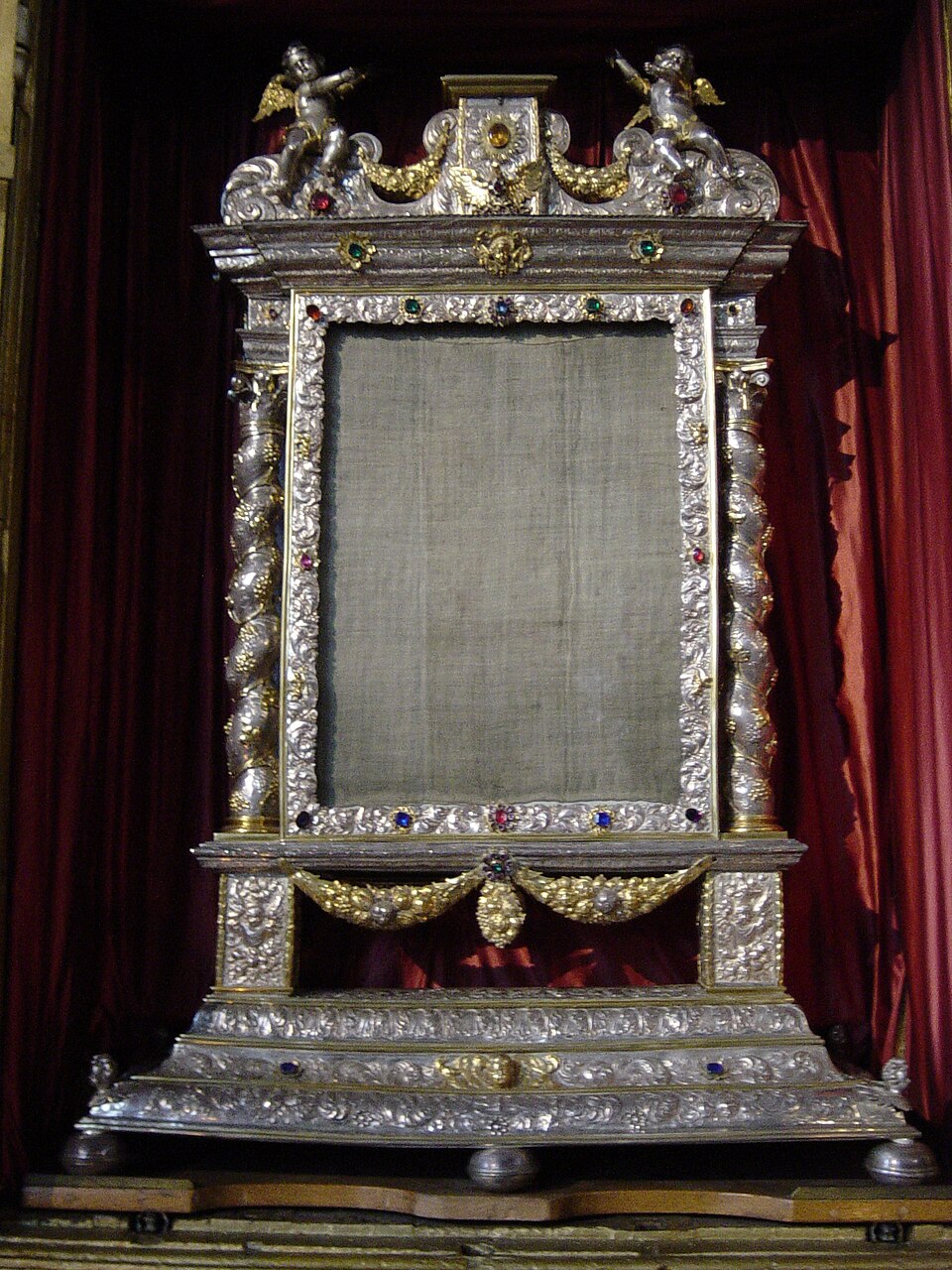
On March 31, 1331, the assistant Thomas Caillot noticed a fallen particle of the Host during Easter Communion in Blanot. He called the priest Hugues de la Baume back. At that spot on the Communion cloth, the priest saw blood. The tradition also names the communicant Jacquette and connects the event with an investigation under Bishop Pierre Bertrand and his official, Jean Jarossier. The venerated cloth preserves the memory of a miracle that sets before our eyes the whole presence of Christ even in the smallest Eucharistic species.
The transmitted testimonies report that blood appeared at the spot where a particle of the Host had fallen onto the Communion cloth. The relevant part of the cloth was preserved as testimony to the miracle.
Further original photographs from the publisher
Thomas Caillot Calls the Priest Back
The international exhibition preserves the sequence with the participants' names: on Easter, March 31, 1331, Hugues de la Baume celebrated Mass. During the Communion of the widow Jacquette, the assistant Thomas Caillot noticed that a particle of the Host had fallen onto the cloth held underneath. He alerted the priest. When the priest returned, he saw blood at the relevant spot. The cloth became the preserved testimony of the event. Caillot thus attests to noticing the fall, and the priest to the trace subsequently found.[1]
A Small Liturgical Object Preserves the Testimony
The Communion cloth served the reverent handling of the sacrament. It caught the particle and made the relevant spot clearly perceptible. The stained area was later venerated as a relic. Its custody, the cutting off of the affected part, and later descriptions are important for historical investigation. The specific liturgical setting explains how the event could be noticed and its material bearer secured.[1]
The Ecclesiastical Investigation in the Diocese of Autun
The exhibition names Bishop Pierre Bertrand and the official Jean Jarossier in connection with the investigation. This provides concrete points of reference for ecclesiastical involvement and further archival work. The source used here is a present-day summary of this earlier testimony. The complete original record is not made available in it; a critical edition could provide more precise access to individual statements and the investigative steps taken at the time.[1]
Blanot in the Côte-d’Or
The place meant is Blanot in the Côte-d’Or. The local account by Blanot 21 confirms the connection between its church and the Eucharistic miracle. The place must be distinguished from municipalities of the same name, especially in Saône-et-Loire. This identification connects the testimony, church interior, and relic history at the correct location and is also decisive for images and pilgrimage routes.[2]
Named People and a Preserved Object
Blanot offers a concrete event with named participants and an identified ecclesiastical investigating authority. Its evidence centers on historical tradition. A modern laboratory analysis conclusively determining the substance, age, and origin of the trace is not included in the sources consulted. The investigation records mentioned and the precise history of the cloth's custody are therefore particularly important for further research. The historical evidence is assessed through these sources, rather than against a modern laboratory procedure incorrectly presumed to have taken place.[1][2]
The Whole Christ Even in the Smallest Particle
The dignity of the Eucharist does not depend on the size of the visible species. Christ is no less present in a small particle. Thomas Caillot's attentiveness thus becomes an example of careful service to the Blessed Sacrament: he notices the fall and calls the priest back. The miracle vividly sets this reverence before our eyes. It is joined to the same love for Christ that should also sustain service to our neighbor.[1]
Witnesses & Investigators
Hugues de la Baume
Celebrant and observer according to the transmitted account
Saw the bloodstain at the indicated spot on the Communion cloth.[1]
Thomas Caillot
Assistant at Mass
Noticed the particle of the Host falling and called the priest back.[1]
Jacquette
Communicant
The named widow belongs to the sequence of Easter Communion presented in the exhibition.[1]
The unfolding story
- Easter Mass
The tradition places the particle of the Host and the bloodstain here.[1]
- Ecclesiastical Involvement Reported
The exhibition names the bishop and his official.[1]
- Preservation of the Cloth
Local veneration keeps the memory alive.[1]
- Local Account
The local cultural association describes the church and its relic.[2]
Ecclesiastical assessment
The exhibition documents named participants and an ecclesiastical investigation in the Diocese of Autun. The case is venerated locally in Blanot; the dossier explains the sources according to their respective stages of transmission.
Objections & Answers
Could blood from the communicant explain the trace?
Such a possibility would need to be examined against the observations and investigation records of the time. Its mere conceivability, however, does not prove that it actually explains the event. The tradition records the falling of a particle and the priest's subsequent discovery. What matters is how early and precisely these statements were recorded and which alternatives the investigation at the time addressed. The available summary does not permit a retrospective forensic decision on this individual hypothesis. Nor, however, does it make the positive historical testimony disappear.[1]
Why is such reverence shown to a small particle?
Because Christ's presence is not graded according to visible quantity. The Lord is wholly present in the sacrament. Care for a fallen particle is therefore a concrete form of love for Christ. It calls for reasonable liturgical care, not an anxious search for invisible traces. Blanot makes this attitude visible in a simple action: an assistant notices what has happened to the sacrament and informs the priest.[1]
Meaning for faith
Blanot preserves a concrete Eucharistic testimony with named participants and a tradition of ecclesiastical investigation. The blood on the Communion cloth directs attention to Christ's whole presence even in the smallest particle. The appropriate response is reverent care for the Blessed Sacrament.[1][2]
How Eucharistic Miracles Are Examined
Securing the account of events, identifying the material, and reading the Church's judgment precisely.
Methods of examination and ecclesiastical procedure →Sources & Evidence
Information on accessibility and scope helps you assess the evidence for yourself.
- [1] Blanot
Secondary account with named participants and reference to an investigation; original records not consulted.
Open source · realpresence.org ↗ - [2] L’église de Blanot (Côte d’Or), un lieu chargé d’histoire et de spiritualité
Local identification of the site and its memory; search index accessible, direct retrieval intermittently blocked.
Open source · lesamisdelaplaine-blanot21.over-blog.com ↗