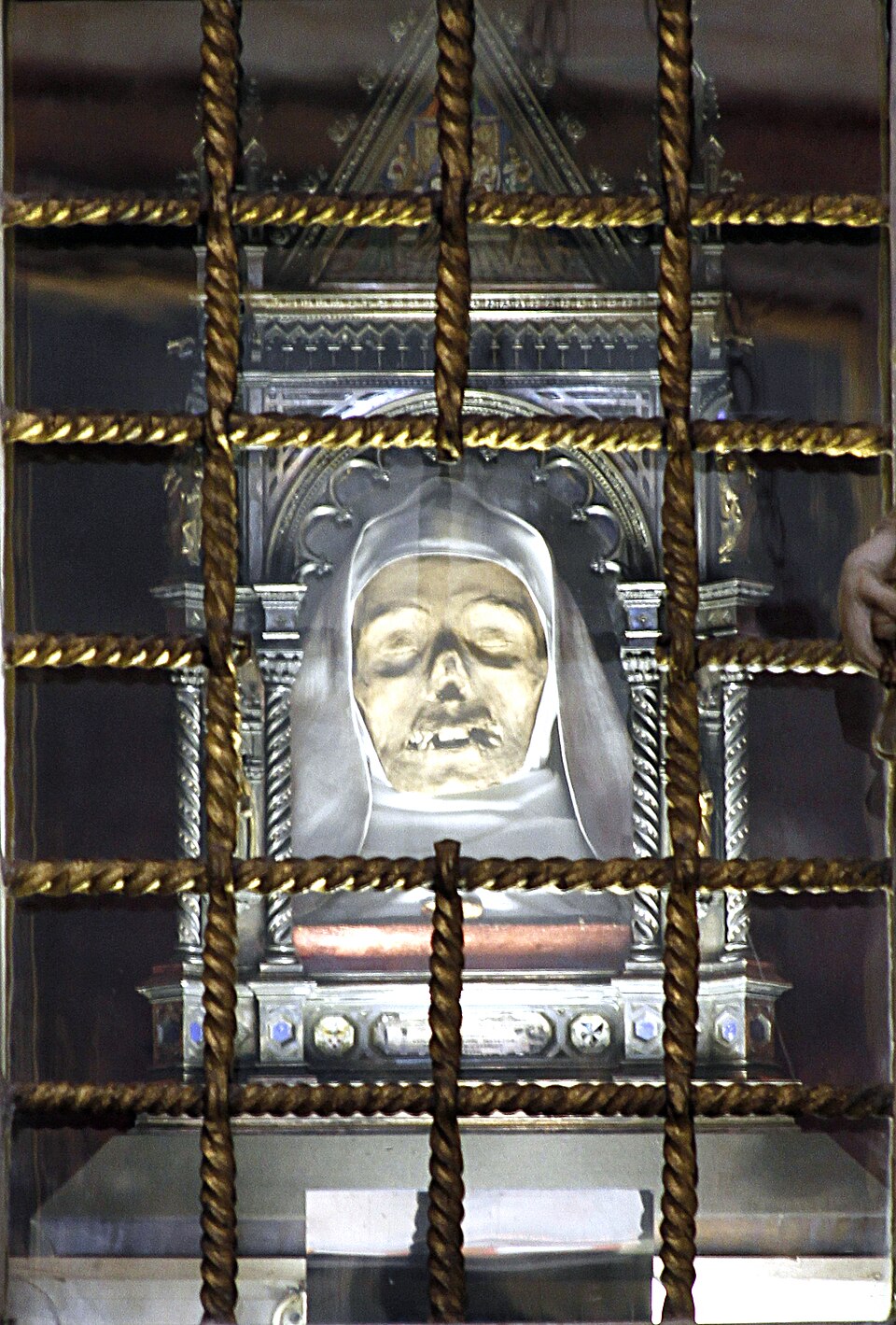
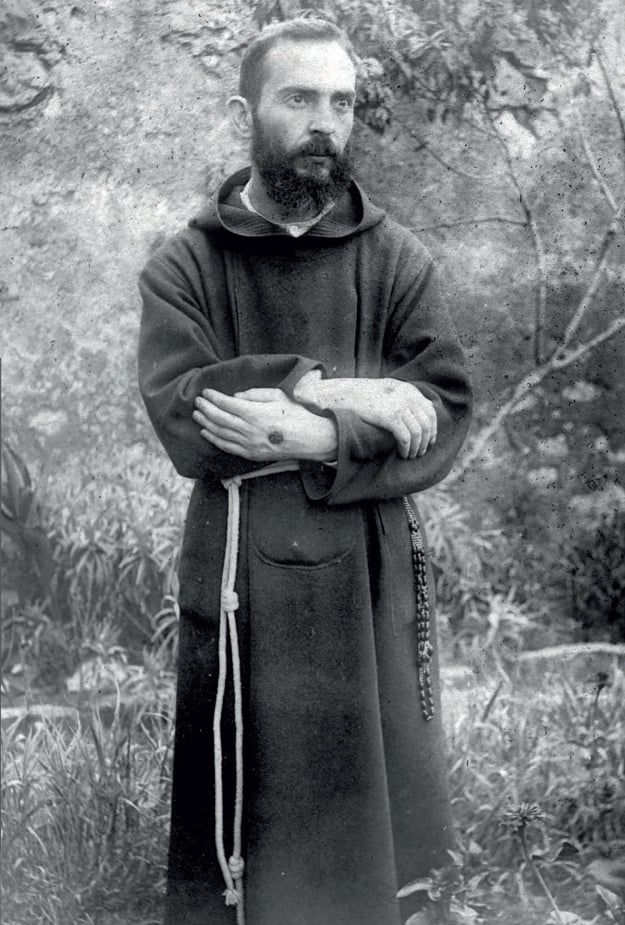
In September 1224, Francis received the wounds of Christ on Mount La Verna. During a period of prayer and fasting, he saw a crucified seraph. Afterward, he bore the signs on his hands, feet, and right side. The early Franciscan sources name observers of the wounds during his lifetime and on his body after death; Brother Leo's note and Thomas of Celano's early life anchor the event in the very first generation. Bonaventure collected further statements from companions still alive. The Church venerates the stigmata as a visible expression of the saint's conformity to the crucified Christ.
After seeing a crucified seraph on La Verna, Francis received visible wounds on his hands, feet, and right side. The early sources attest to the bodily signs through observers from his circle and people who saw him after his death.
Prayer and Fasting on La Verna
The early Franciscan tradition leads to September 1224. Francis withdrew with companions to La Verna to spend an extended period in prayer and fasting before the feast of Saint Michael. Illnesses and the exertions of his life had already weakened him. In the mountain's solitude, he contemplated Christ's suffering. The stigmatization falls in this period, near the Feast of the Exaltation of the Holy Cross. The later liturgical commemoration on September 17 celebrates this event. It shaped the last two years of his life.[2]
The Crucified Seraph
Bonaventure describes the vision of a seraph with six wings, in whose form Francis also perceived the Crucified One. Joy at God's nearness and grief at Christ's suffering penetrated him. When the vision ended, the wounds appeared. Bonaventure recognizes in this a transformation through the ardor of love: Francis was made like the one whose poverty and self-giving had shaped his entire life. The vision itself is preserved through the tradition of his life. Its bodily consequences were subsequently seen by other people and form a further part of the testimony.[1]
The Signs on Hands, Feet, and Side
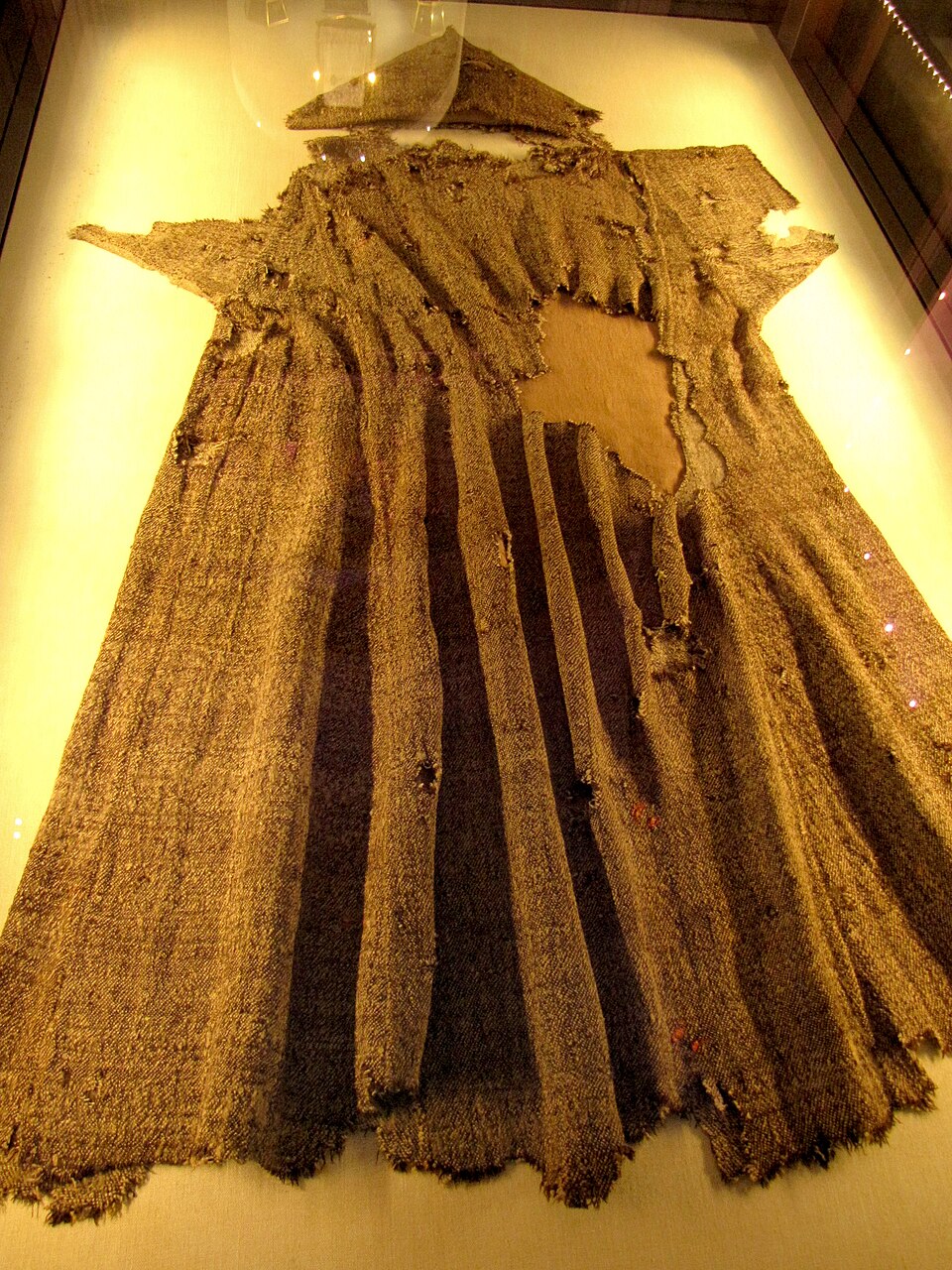
The early texts describe striking, nail-like forms on the hands and feet, together with a wound on the right side. Bonaventure speaks of nail-like formations of flesh; blood from the side wound could stain his clothing. Francis tried to conceal the signs. Nevertheless, his brothers learned of them while caring for him, through his clothing, or by touch. After his death, further people saw his body. These details give the account a specific bodily form. The sources speak of visible wounds that persisted over an extended period and were associated with Christ's Passion.[1]
Bonaventure's Inquiries and Alexander's Testimony
Bonaventure wrote his major life several decades after the event and states in the prologue that he questioned companions who were still alive. He also names a particular public testimony: Pope Alexander IV declared before the brothers that he had himself seen the wounds during Francis's lifetime. Bonaventure reports having been present at this declaration. The route of transmission is thus specifically identified. Alexander attested to the bodily signs; Bonaventure attested to his statement. Accounts of brothers who cared for him and of the viewing of his body after death are added to this. The different observations complement one another.[1]
The Wounds Are Attested Early
Thomas of Celano's first life already reports the stigmata. Brother Leo's note on the autograph sheet bearing the blessing also connects La Verna with the wounds. The case thus stands in the early tradition from the saint's circle. This contradicts the claim that the stigmatization was invented only centuries later. Later biographies take up these sources and supplement them with further information. Their comparison must account for shared sources; the early grounding itself remains unaffected. It is one of the strongest historical reasons for the event's credibility.[2]
The Church's Veneration of the Wounds
Gregory IX canonized Francis in 1228. The stigmata received their own liturgical commemoration and became an essential expression of Franciscan discipleship of Christ. The papal address for the eight hundredth anniversary in 2024 also honors them as a gift of conformity to the poor and crucified Christ. Ecclesiastical reception joins contemplation of the wounds with care for suffering people. Those who look upon the saint's marked body are called to notice the wounded in their own surroundings. Veneration thus leads into the concrete love Francis lived.[2][3]
The Historical Evidence
Examination of the case rests on early written testimonies, named transmitters, and observations over an extended period. Surviving texts can be compared according to their date, proximity to Francis, and dependence on one another. A present-day dermatological examination of the wounds of that time, however, is impossible: photographs, tissue samples, and continuous measurements are unavailable for 1224. The historical evidence therefore takes a different form from a modern medical record. Its strength lies in the early and differentiated statements from the circle of a publicly known life and in their enduring reception by the Church.[1][2]
Witnesses & Investigators
Brother Leo
Close companion
His note on the blessing sheet is among the important early references to La Verna and the wounds.[2]
Alexander IV
Observer quoted by Bonaventure
Bonaventure reports that Alexander publicly declared he had seen the signs during the saint's lifetime.[1]
Bonaventure
Biographer and witness to a later statement
Questioned companions; according to his own account, he was present at Alexander's testimony, not at the event of 1224.[1]
The unfolding story
- La Verna as a Place of Retreat
The mountain becomes associated with the Franciscan movement.[2]
- Stigmatization
During his time of prayer on La Verna, Francis receives the wounds of Christ.[1][2]
- Death of Francis
The sources report that the signs were visible on his body after death.[1][2]
- Canonization
Gregory IX canonizes Francis.[2]
- Bonaventure's Legenda maior
Bonaventure organizes earlier testimonies and statements from companions.[1]
- Eight Hundredth Anniversary
The Church commemorates the stigmata as a sign of discipleship of Christ.[3]
Ecclesiastical assessment
Francis's wounds belong to longstanding ecclesiastical veneration and have their own commemoration in the Franciscan calendar. This reception is substantially stronger than an arbitrary, unassessed private account, but it is not a modern medical opinion.
Objections & Answers
Are the wounds merely an idealization of his discipleship of Christ?
The Franciscan authors explicitly interpret Francis as a follower of the Crucified One. This meaning does not prove that the bodily event was invented. Thomas of Celano's early life, Brother Leo's note, and reports of specific observers argue against an embellishment arising only much later. The sources also distinguish the vision from the wounds subsequently visible. Later authors use earlier sources and must not simply be counted as additional independent witnesses. The early core, however, remains. A historical event can also possess profound theological significance and be presented accordingly.[1][2]
Have self-injury or psychosomatic causes been demonstrated?
The surviving sources provide no positive evidence of self-injury. Such a conjecture would need concrete indications and an explanation of the described course. A psychosomatic interpretation must likewise show which details it actually accounts for. Within the tradition, Francis's efforts at concealment and his caregivers' observations argue against a simple public staging. A complete modern differential diagnosis is no longer possible from medieval texts. Yet this does not establish a natural cause either. The overall historical testimony and its ecclesiastical reception support a reasoned affirmation of the stigmatization.[1][2]
Meaning for faith
Francis's stigmata are attested within the very first generation of his companions. Early sources, named observers, and enduring ecclesiastical veneration support their credibility. On La Verna, what shaped his life became visible: love for the poor and crucified Christ and the willingness to follow him completely.[1][2][3]
How Miracles in the Lives of the Saints Are Examined
Stigmata, bilocation, and material changes require different examinations.
Methods of examination and ecclesiastical procedure →Sources & Evidence
Information on accessibility and scope helps you assess the evidence for yourself.
- [1] The Life of Saint Francis of Assisi
Public-domain primary source; Bonaventure conveys earlier observations and claims his own presence at Alexander's statement.
Open source · ecatholic2000.com ↗ - [2] St. Francis of Assisi
Public-domain overview of sources; not medically equivalent to a present-day assessment.
Open source · newadvent.org ↗ - [3] To the Community of Franciscan Friars of La Verna and the Province of Tuscany
Documents present-day papal reception and spiritual interpretation, not a new factual investigation.
Open source · vatican.va ↗