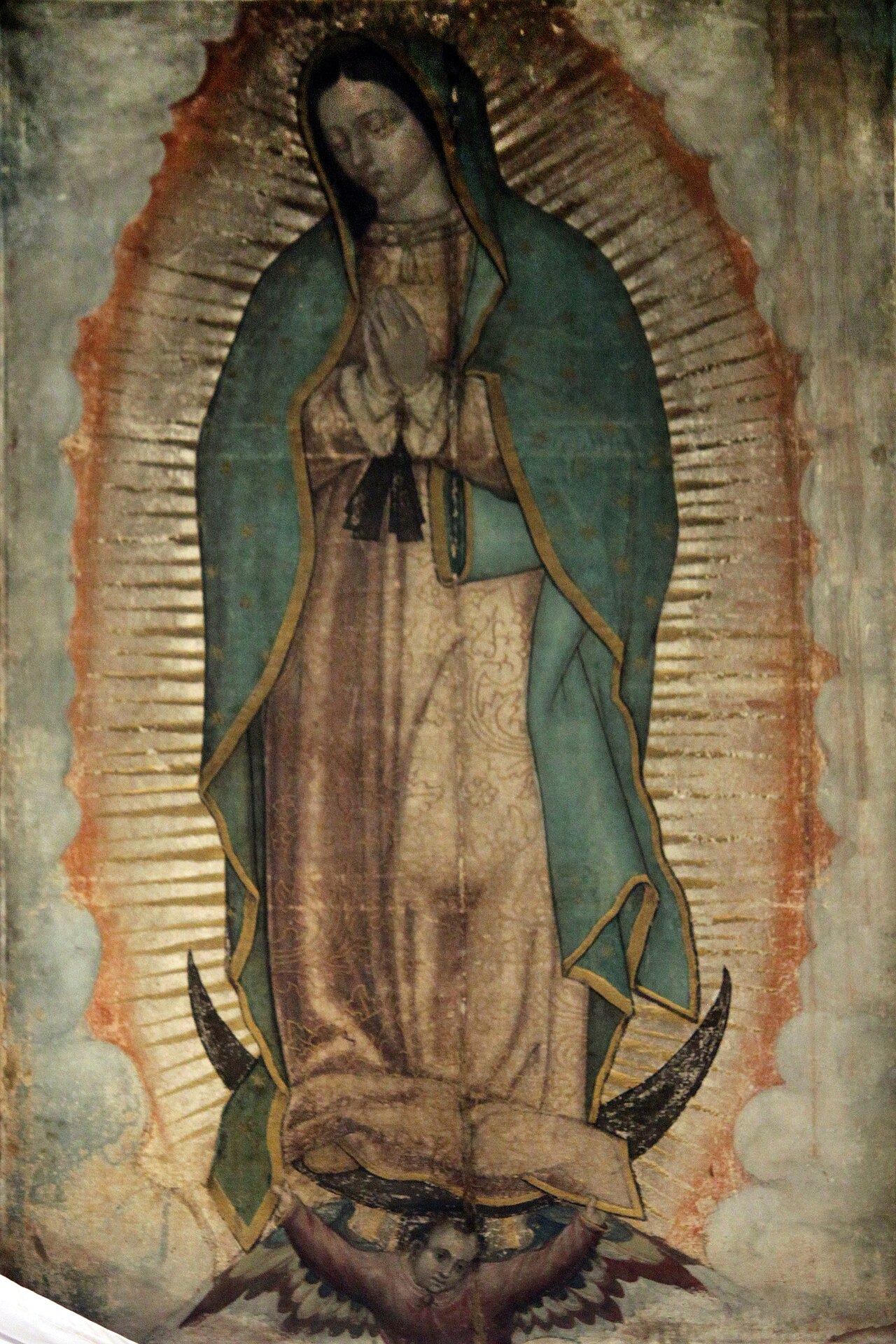
From December 9 to 12, 1531, Mary encounters Juan Diego at Tepeyac and charges him with asking Bishop Juan de Zumárraga for a shrine. When the bishop requests confirmation, Juan Diego brings him flowers; when he opens his cloak, the image of Mary appears on it. His uncle Juan Bernardino experiences healing at the same time. Juan Diego's testimony, the surviving tilma, and the history of its veneration stand at the center of this dossier.
In the Nican Mopohua, Mary encounters Juan Diego at Tepeyac. At her instruction, he brings flowers to the bishop; when his tilma is unfolded, the image of Mary becomes visible.
December 9, 1531: The First Encounter at Tepeyac
On Saturday morning, December 9, Juan Diego was on his way to Tlatelolco. At Tepeyac, he heard unusually beautiful singing and a voice calling him by name. On the hill, he encountered a luminous woman. She introduced herself as Mary, the mother of the true God, and asked for a shrine at this place. There she wished to show people her maternal help. Juan Diego was charged with presenting this request to the bishop.[7][8]
Bishop Juan de Zumárraga listened to Juan Diego but initially made no commitment. That same day, the messenger returned to Mary. He asked that someone more highly regarded be sent. Mary remained firm in choosing him. On Sunday, December 10, Juan Diego appeared before the bishop again. Zumárraga now requested a sign. The third encounter at Tepeyac concerned this request: Mary announced the confirmation he would bring to the bishop.[8]
December 11 and 12: Concern for Juan Bernardino
On Monday, Juan Diego stayed with his seriously ill uncle Juan Bernardino. On Tuesday, he set out before dawn to fetch a priest from Tlatelolco for confession and preparation for death. He took a different path past the hill because concern for his uncle was urgent. Mary came toward him, heard his explanation, and reassured him. She assured him of her maternal protection and his uncle's recovery. Juan Diego could now carry out the mission without leaving the sick man unprotected.[9]
December 12: The Flowers and the Image before the Bishop
On the hilltop, Juan Diego found fresh, fragrant flowers despite the cold season. He gathered them in his tilma, a cloth worn as a cloak. Mary arranged the flowers and sent him with them to Zumárraga. At the bishop's house, he initially waited; the servants eventually noticed his unusual gift. Before the bishop, he opened the cloak. The flowers fell out, and the image of Mary became visible on the fabric. Zumárraga and those present knelt. The bishop took the cloth into his chapel.[7]
The basilica's chronology dates this sign to December 12. On returning, Juan Diego found his uncle well. Juan Bernardino reported an encounter of his own with Mary and gave the name under which she wished to be venerated: Santa María de Guadalupe. The account thus connects the public sign before the bishop with personal help for the sick man.[8][9]
How the Account Was Transmitted
Luis Lasso de la Vega published the Nican Mopohua in 1649 within the Huei Tlamahuiçoltica. The basilica attributes the text to Antonio Valeriano and places its composition earlier. The printing of 1649 is securely datable; the attribution to Valeriano and the precise date of composition must be distinguished from it. Miguel Sánchez had already published a detailed Spanish account in 1648. The Nican Mopohua preserves a coherent narrative of events in the language of the Indigenous population, not a record written during the encounters.[1]
An earlier point of access to the history is the controversy of 1556. On September 8, Franciscan Francisco de Bustamante criticized the devotion promoted by Archbishop Alonso de Montúfar and described the image as the work of an Indigenous painter named Marcos. Montúfar had statements about this sermon recorded. The basilica provides extracts and facsimiles of these Informaciones. The document demonstrates an already existing public devotion and, at the same time, an early objection concerning the image's origin. It is therefore significant for both sides of the historical examination.[12]
The Informaciones jurídicas of 1666 contain further testimonies from Cuauhtitlán. The official account of Juan Diego names Marcos Pacheco and Andrés Juan, among others. They transmitted memories of Juan Diego from their families and local community. Their statements bear witness to transmitted memory; they were not personal observations of the encounters of 1531.[9]
1979: What Callahan and Smith Examined in the Image
Philip Serna Callahan and Jody Brant Smith photographed the tilma in infrared in 1979. Smith's report describes no discernible underdrawing in central areas and behavior of certain colors unusual to the investigators. At the same time, they attributed golden rays, stars, and other areas to later painted additions, among other findings. Their observations thus concern different parts of the image and cannot be reduced to a single statement about the whole image.[3]
Callahan's own investigation report appeared in 1981 as The Tilma Under Infra-Red Radiation, a 45-page volume of the CARA Studies on Popular Devotion. The official CARA catalog confirms this publication. For the individual findings presented here, Smith's accessible account as a participating investigator was evaluated; the complete CARA volume was not consulted.[11][3]
Infrared photographs can reveal concealed drawings when light penetrates the overlying paint layers and is absorbed beneath them, for example by carbon-containing drawing material. The National Gallery explains this dependence on the material. An invisible underdrawing therefore initially means that the photograph taken does not show such a structure. It follows neither that every conceivable preparation has been excluded nor that the chemical composition of all colors has been determined.[10]
Analysis of the Eye Areas
Smith also reports on José Aste Tönsmann's digital enlargements of the eyes. Aste Tönsmann interpreted forms within them as human figures; Smith visited him in 1982. The published examples show processed image details, in some cases clarified with outlines. This is an identifiable investigative approach, not a direct photograph of the people present in 1531.[3]
Testing such an interpretation would require the unaltered source photographs, resolution and processing steps, and independent comparative analyses. Enlargement adds no details originally absent from an image. The resemblance of a small pattern to a face does not by itself identify Zumárraga or anyone else. This methodological assessment leaves the image's religious significance untouched; it determines what technical conclusion an image analysis can support.[3][10]
The Church's Understanding of the Sign
At Juan Diego's canonization on July 31, 2002, John Paul II placed his encounter with Mary, the roses, and the image visible on the tilma at the center. He connected the devotion with faith in Christ and the dignity of the Indigenous population. The simple messenger is taken seriously and entrusted with a mission; the bishop receives the sign. The Church's appreciation concerns this witness of faith and Juan Diego's holiness. It makes no chemical finding concerning individual pigments and no decision on every later digital interpretation of the image.[4]
Witnesses & Investigators
Juan Diego Cuauhtlatoatzin
Messenger and witness to the apparitions in the Nican Mopohua
He carries Mary's request to the bishop and brings the flowers.[7]
Juan de Zumárraga
Bishop of Mexico
Recipient of the sign in the narrative of events; no record of the event signed by him is available here.[7]
Juan Bernardino
Juan Diego's uncle
After his recovery, reports an encounter of his own with Mary.[9]
Marcos Pacheco and Andrés Juan
Witnesses in the questioning of 1666
Bearers of local and family memory.[9]
Luis Lasso de la Vega
Publisher in 1649
Responsible for printing the Huei Tlamahuiçoltica.[1]
Philip Serna Callahan and Jody Brant Smith
Investigators of the tilma
Participants in the infrared photography of 1979.[3]
The unfolding story
- First Mission
Juan Diego encounters Mary at Tepeyac and goes to Zumárraga.[8]
- Request for a Sign
Second audience with the bishop.[8]
- Flowers and Tilma
The sign before Zumárraga; Juan Bernardino's recovery.[8]
- Early Controversy
Montúfar has statements concerning Bustamante's sermon recorded.[12]
- Printed Accounts
Sánchez publishes in 1648; Lasso de la Vega in 1649.[1]
- Legal Witness Statements
Recording of testimonies of remembrance in Cuauhtitlán.[9]
- Infrared Investigation and Report
Photographs in 1979; Callahan's CARA monograph in 1981.[3][11]
- Canonization of Juan Diego
Celebration in Mexico City.[4]
Ecclesiastical assessment
The Church venerates Our Lady of Guadalupe as mother and intercessor. The tilma is preserved in the basilica at Tepeyac. Juan Diego was canonized on July 31, 2002.
Objections & Answers
Did the Devotion Begin Only with the Printing of the Nican Mopohua?
No. The controversy of 1556 documents public devotion long before 1649. It does not, however, thereby prove every detail of the account printed later. Its precise date of composition and sources require separate investigation of the textual tradition and its historical connections. The distance between event and printing remains a real question; it is not proof that no one knew of Guadalupe beforehand.[1][12]
How Should Bustamante's Reference to a Painter Named Marcos Be Assessed?
As an early, specifically named objection. Its occurrence in a sermon during an ecclesiastical conflict explains the context but does not refute it. Conversely, the statement alone provides neither a documented commission nor a technical analysis of the material. It remains open what Bustamante's knowledge rested on and which work on the image it concerned. Later infrared photography cannot retrospectively decide this question.[12][3]
Has It Been Demonstrated That the Entire Tilma Contains No Pigments or Traces of Human Work?
The investigation evaluated here does not support this comprehensive statement. Photographic observation, chemical identification of materials, and historical attribution answer different questions. An area of the image can appear unusual in a photograph without thereby excluding all coloring materials. A sound chemical finding would have to specify samples or measurement areas, methods, and results.[3][10]
Do the Images in the Eyes Prove the Presence of Particular People?
Such identification requires more than recognizable similarities in an enlarged photograph. Unaltered image data, alternative interpretations, and reproducibility of the analysis would need examination, among other things. What is documented here is an interpretation of particular forms, not an independently established list of the people present.[3][10]
Meaning for faith
Guadalupe shows Mary as a mother who takes a simple messenger seriously, draws near to a sick man, and leads toward Christ. The Nican Mopohua, the early history of devotion, and the surviving tilma give the shrine a concrete historical character. Examination of individual material and image questions accompanies this history without narrowing its spiritual content to a technical peculiarity.[1][4][7]
How Apparitions and Private Revelations Are Examined
Testimony, messages, spiritual fruits, and ecclesiastical decisions.
Methods of examination and ecclesiastical procedure →Sources & Evidence
Information on accessibility and scope helps you assess the evidence for yourself.
- [1] Documentos HistóricosOpen source · virgendeguadalupe.org.mx ↗
- [2] The First Guadalupan Pastoral Manual: Luis Laso De La Vega’s Huei Tlamahuiçoltica (1649)
Theological and literary function of the text; full text not completely accessible here.
Open source · cambridge.org ↗ - [3] The Image of Guadalupe: Myth or Miracle?
Accessible text of a participant's account: infrared photography with Callahan and visit to Aste Tönsmann. Not an independent consensus report.
Open source · scribd.com ↗ - [4] Canonization of Blessed Juan Diego CuauhtlatoatzinOpen source · vatican.va ↗
- [5] The Story of Guadalupe: Luis Laso de la Vega’s Huei tlamahuiçoltica of 1649
Source-critical edition; only the accessible preview evaluated here.
Open source · books.google.com ↗ - [6] Nican MopohuaOpen source · notredamedeguadalupe.org ↗
- [7] Nican Mopohua – El Relato
Primary text of the Guadalupan tradition in an accessible translation. The first printing appeared in 1649; the present website is not a document from 1531.
Open source · virgendeguadalupe.org.mx ↗ - [8] Síntesis de las Apariciones
Official summary of the apparition account.
Open source · virgendeguadalupe.org.mx ↗ - [9] San Juan Diego
Contains references to Marcos Pacheco (f. 12v) and Andrés Juan (f. 28v), Archivo Histórico de la Basílica de Guadalupe, Ramo Histórico.
Open source · virgendeguadalupe.org.mx ↗ - [10] Infrared
Primary methodological explanation by a museum; not an investigation of the tilma.
Open source · nationalgallery.org.uk ↗ - [11] The Tilma Under Infra-Red Radiation – Publication Record
Official publication catalog. The complete paid investigation report was not consulted; detailed findings in the dossier follow Smith 1983.
Open source · cara.georgetown.edu ↗ - [12] Informaciones de 1556
Official basilica publication concerning the questioning of 1556. The author explains that the original was missing at the time and that he uses copies.
Open source · virgendeguadalupe.org.mx ↗