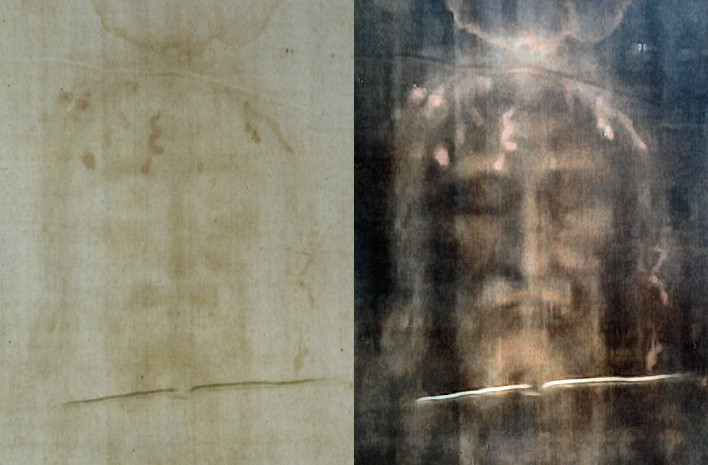
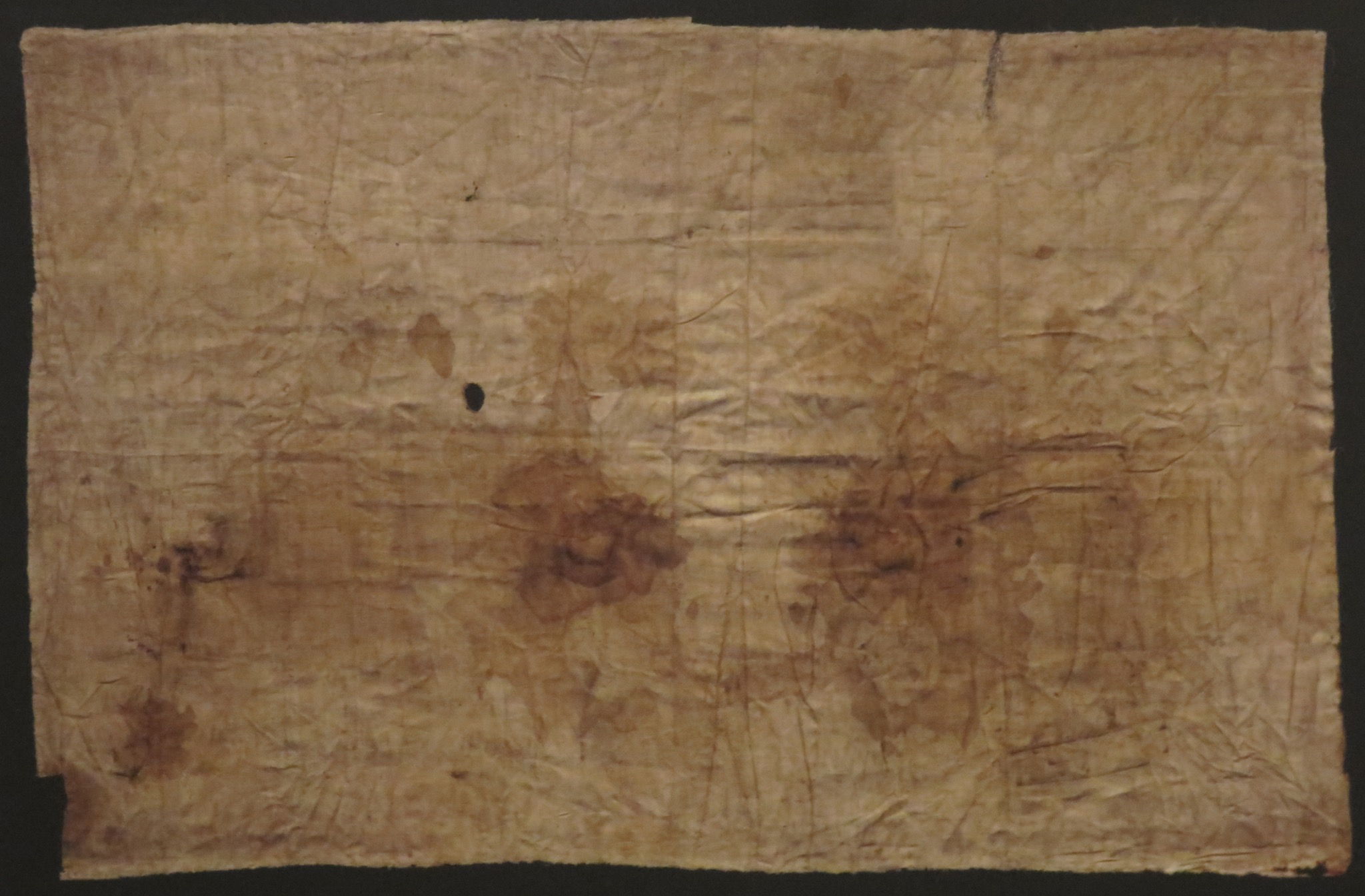
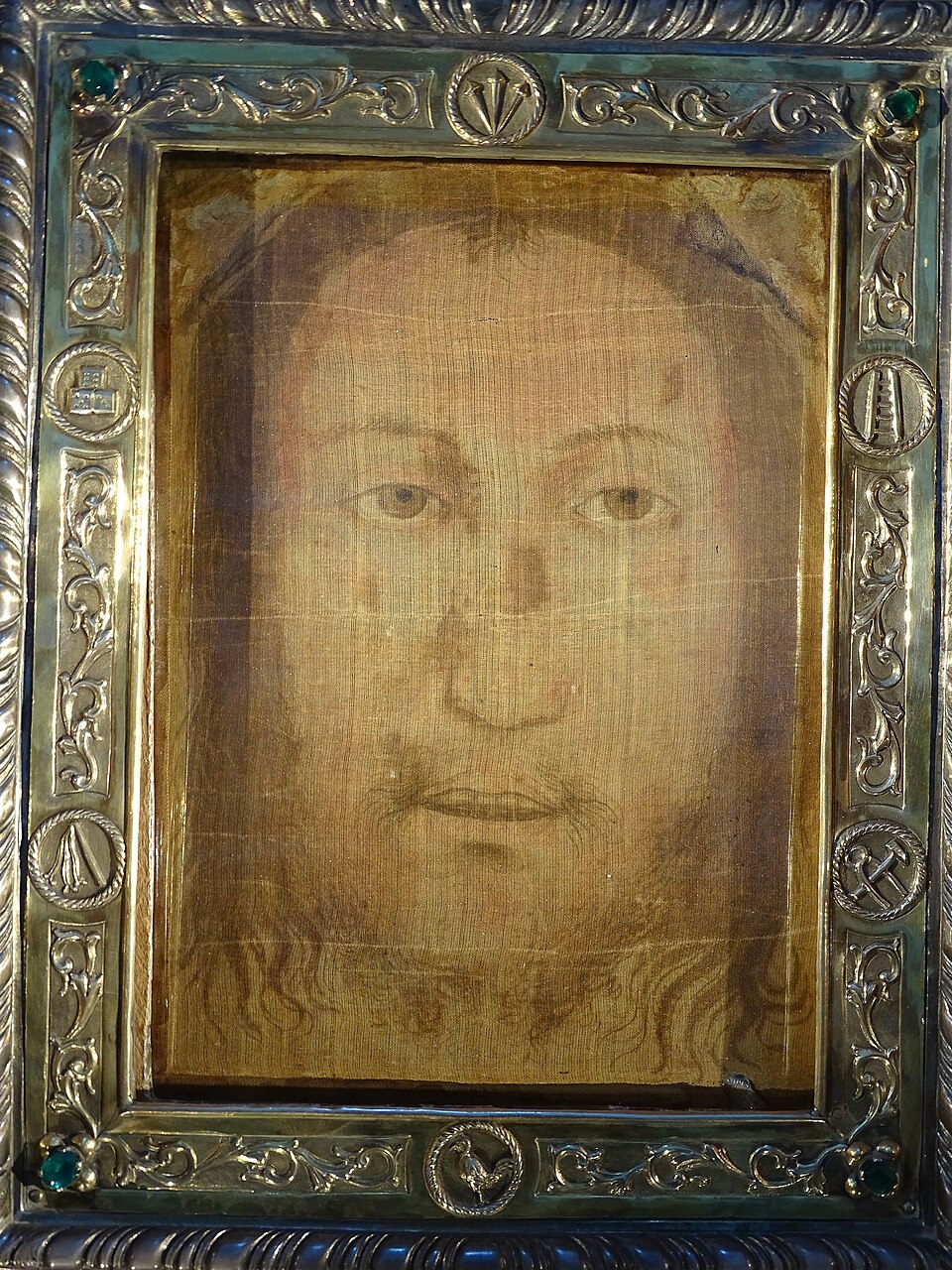
On a small translucent veil in Manoppello appears the face of a bearded man with open eyes. Viewing angle and lighting change its effect; the image can be perceived from both sides. It has been guarded by the Capuchins since the 17th century. Historical research connects it with the Veronica tradition, while optical studies examine fibers, light, and image proportions. Benedict XVI made a pilgrimage to the shrine in 2006 and spoke about seeking the face of Christ. Here, contemplation of an image, research, and living devotion to Christ meet.
The veil image is venerated as the Holy Face of Christ. Heinrich Pfeiffer connected it with the Roman Veronica; other advocates see it as an image not made by human hands, related to Jesus' tomb.
A Face on Translucent Fabric
A fine fabric bears the image of a bearded man with open eyes. The face is visible from both sides; light and viewing angle change its appearance. The optical investigation of 2018 describes a veil measuring approximately 24 × 17.5 centimeters. Its small size and translucency explain why close-up photographs and direct viewing reveal different aspects. Someone standing before the original experiences an image that interacts with its illumination.[3]
Leonelli, de Fabritiis, and the Capuchins
The Relatione Historica by Capuchin Donato da Bomba traces the ownership history through the Leonelli family to Donato Antonio de Fabritiis. He donated the veil to the Capuchins in 1638. The account was publicly confirmed in 1646. Its retrospective narrative also includes an unknown bearer at the beginning of the 16th century. The traditional arrival and later donation remain part of the shrine's history today.[2][7]
The owners, transfer, and public confirmation give the Manoppello story specific names and dates. From then on, the Capuchins guarded the image within a religious context of its own. These local testimonies form the starting point for research into earlier stages and its connection with other images of Christ.[2][7]
Heinrich Pfeiffer and the Search for the Veronica
Art historian and Jesuit Heinrich Pfeiffer argued for identifying the Manoppello veil with the Veronica formerly venerated in Rome. He thereby posed a specific historical question: can the surviving image, older descriptions, and the tradition of the Holy Face be connected? The proposed identification brought new attention to the shrine and its possible earlier history.[2]
Other advocates connect the veil with the head cloth from Jesus' tomb. John 20 distinguishes this cloth from the other linen cloths. The biblical account opens the spiritual context of burial, empty tomb, and resurrection in which the face in Manoppello is contemplated.[6]
What Polarized Light Reveals about the Fibers
In 2018, Liberato De Caro, Emilio Matricciani, and Giulio Fanti examined, among other things, the fabric's behavior under polarized light. They compared the observed birefringence with various fiber materials. In their assessment, it corresponded more closely to flax fibers than to sea silk; the authors therefore argue for very fine linen. The material question can thus be discussed through a specific optical property.[3]
Light, Color, and Digital Image Analysis
The second part of the same research examines the image in transmitted light. The authors analyze lighting and color effects and computationally process distortions of the fabric. This makes it possible to understand why different photographs show different contrasts and proportions. The analysis connects the visible image effect with the structure of its support.[4]
Digital corrections can illustrate proportions obscured by distorted fabric. This provides an orderly working basis for comparisons with Turin: source images, reference points, and changes can be disclosed. The gain in understanding lies in translating an impressive resemblance into individual testable features.[4]
Benedict XVI in Search of the Face of Christ
On September 1, 2006, Benedict XVI prayed in Manoppello. In his address, he honored the venerated image as an icon, thanked the Capuchins for caring for the shrine, and spoke of the shared search for the Lord's face. He led contemplation onward to life with Christ and to love. His visit represents the Church's appreciation of this place of prayer.[5]
The Face as an Invitation to Encounter
Christian faith confesses the Son of God who became flesh. An image of Christ can focus the gaze and help one address the Redeemer personally. John 14 connects seeing Jesus with the revelation of the Father; John 20 leads from recognition to confession. Contemplation of the face receives its depth here: it seeks the person who turns toward humanity.[6]
Manoppello connects this spiritual invitation with a distinctive historical image. The Capuchins' long care, the pilgrims, and the researchers' work belong to its present vitality. In prayer, the contemplative gaze can give rise to the request to know Christ better and follow him in one's own life.[5][6]
Witnesses & Investigators
Donato da Bomba
Capuchin and early modern chronicler
Wrote the Relatione Historica and documented the local ownership history and the traditional arrival of the image.[2][7]
Donato Antonio de Fabritiis
Historical owner and donor
Donated the veil to the Capuchins in 1638 and thereby shaped the shrine's subsequent history.[2]
Liberato De Caro, Emilio Matricciani, Giulio Fanti
Authors of the optical investigations of 2018
Published two studies in 2018 on fiber material, light effects, image spectra, and digital reconstruction.[3][4]
Benedict XVI.
Papal pilgrim
Prayed at the shrine in 2006 and spoke about seeking the face of Christ and its significance for life.[5]
The unfolding story
- Arrival with Leonelli
The Relatione Historica records the handover to the Leonelli family by an unknown visitor.[7]
- Donation to the Capuchins
De Fabritiis gives the image to the religious community.[2]
- Public Confirmation of the Account
The early modern tradition is documented with local witnesses.[2][7]
- New Attention to the Veronica Hypothesis
Pfeiffer publicizes the proposed identification with the Roman image.[2]
- Benedict XVI's Pilgrimage
The Pope speaks about seeking the face of Christ.[5]
- Two Specialist Optical Studies
De Caro, Matricciani, and Fanti examine material and image features and digital reconstructions.[3][4]
Ecclesiastical assessment
The Capuchins preserve the veil image as the Holy Face of Christ. Benedict XVI visited the shrine on September 1, 2006, and prayed with the pilgrims.
Objections & Answers
How secure are the connection to the Veronica and the ancient origin?
The early modern ownership history and donation to the Capuchins are better documented than the earlier arrival. The unknown bearer appears in a retrospective account; no independently documented angelic apparition can be inferred from it. For Pfeiffer's identification with the Roman Veronica, the image catalog Veronica Route notes the continuing absence of decisive confirmation. John 20 likewise describes no face on the head cloth and does not name Manoppello. An ancient origin thus remains a further historical interpretation. Conversely, a late written mention alone does not determine the textile's age.[2][6][7]
What limits do the material and image analyses have?
According to the authors, the fiber investigation of 2018 supports flax and thus contradicts the widespread sea-silk interpretation. A miraculous origin therefore cannot be inferred from supposedly unpaintable sea silk. Moreover, a lighting arrangement does not capture every thread surface equally; possible pigments would not be equally visible everywhere. The image analyses are neither a complete chemical examination of all areas nor a direct dating of the textile. Digital corrections remain dependent on their model assumptions; image overlays alone do not identify a person.[3][4]
What does the unusual optical effect mean?
Translucency and visibility from both sides are observable properties of the image. An explanation of its formation must be compatible with the actual fibers, deposits, and lighting conditions. The difficulty of a particular reproduction does not yet prove an exclusively supernatural cause. Conversely, calling it a painting is not a complete technical explanation either. The optical studies provide specific starting points against which different models of formation can be tested.[3][4]
Does veneration require a secure origin in Jesus' tomb?
Benedict's visit attests to the shrine's spiritual appreciation; his address decides neither a fiber analysis nor the historical identification. Veneration is directed to Christ. It remains meaningful while origin and image formation are investigated. Faith in the Incarnation and Resurrection does not depend on the definitive identification of this individual veil.[2][5][6]
Meaning for faith
Manoppello invites attentive contemplation of a distinctive image of Christ: its fine fibers, changing light effects, traditional history, and research into its proportions. Ecclesiastical veneration leads from the face to the incarnate Redeemer. Benedict's pilgrimage expresses this invitation: to seek Christ and carry contemplation onward into love and discipleship.[3][4][5]
How Miraculous Images Are Examined
Investigating image formation and determining what the findings establish.
Methods of examination and ecclesiastical procedure →Sources & Evidence
Information on accessibility and scope helps you assess the evidence for yourself.
- [1] Il Volto Santo
Documents the shrine and its custodians; the currently readable page offers only brief text.
Open source · voltosanto.it ↗ - [2] Volto Santo di Manoppello: tessuto, tecnica, storia
Specialist-oriented image catalog; distinguishes documented history from identification hypotheses.
Open source · veronicaroute.com ↗ - [3] Imaging Analysis and Digital Restoration of the Holy Face of Manoppello—Part I
Original paper; accessible abstract and figure descriptions. Publisher's full text was temporarily technically blocked.
Open source · doi.org ↗ - [4] Imaging Analysis and Digital Restoration of the Holy Face of Manoppello—Part II
Original paper on image spectra, lighting, and digital correction; no C14 dating.
Open source · mdpi.com ↗ - [5] Pilgrimage to the Shrine of the Holy Face of Manoppello
Primary source for the meaning and scope of the papal visit.
Open source · vatican.va ↗ - [6] Gospel According to John
Names the head cloth in the tomb but describes no image on it.
Open source · vatican.va ↗ - [7] Important Sources on the Volto Santo: Donato da Bomba's Account
Used only as an indirect summary of the older tradition; the editor's speculative overall chronology and unsubstantiated material claims are not adopted.
Open source · antlitz-christi.de ↗