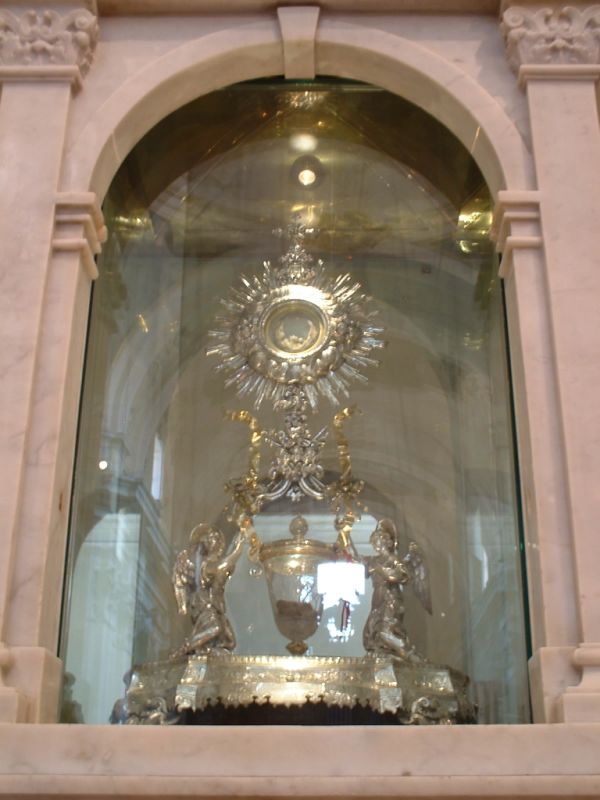
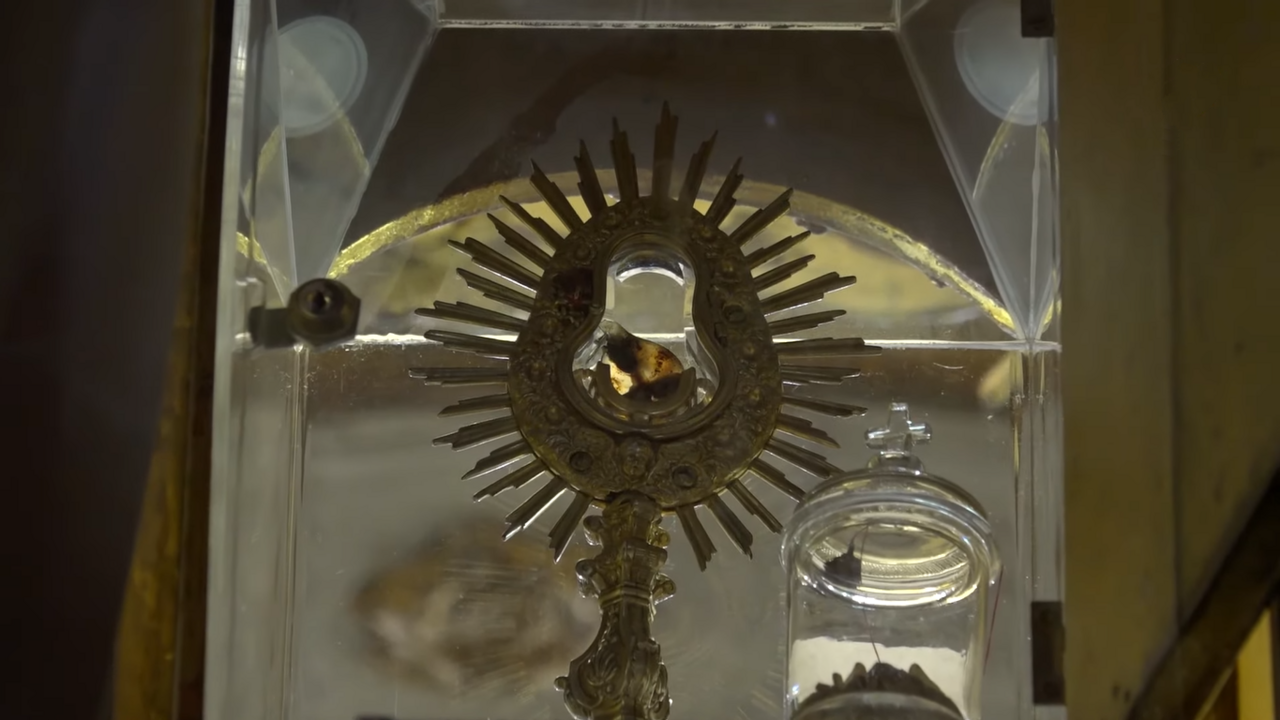
In 1273, Ricciarella took a consecrated Host home in Lanciano in order to use it to restore peace in her marriage. When she heated the Host on a brick, blood emerged. She hid the objects until, seven years later, she confessed her deed to the Augustinian Giacomo Diotallevi. He recovered the relics and brought them to Offida in 1280. This event, preserved in local tradition, established the veneration there of the Holy Cross and the Eucharistic miracle.
The local account attests that the stolen Host took on the form of flesh and blood when heated. The Host, cloth, and brick were initially hidden and transferred to Offida after Ricciarella's confession.
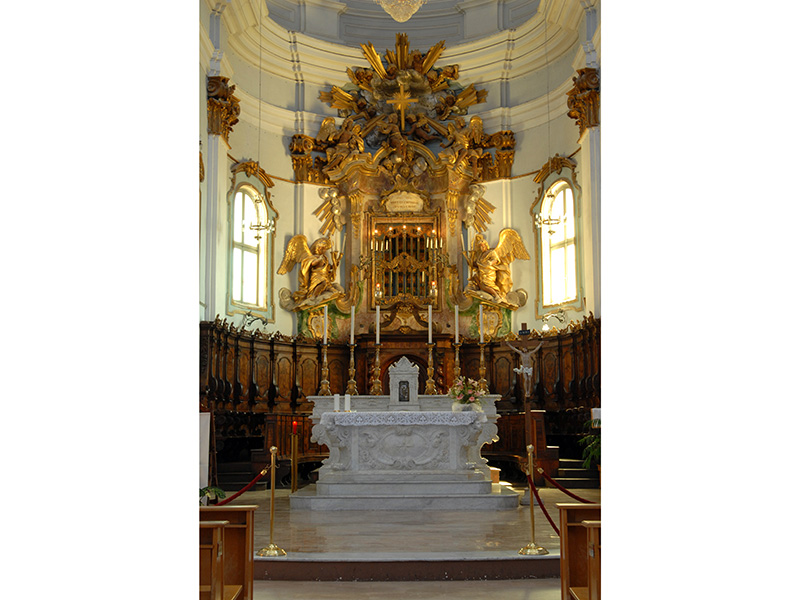
Further original photographs from the publisher
Ricciarella Heats the Host
The local account names Ricciarella and her husband, Giacomo Stasio. Because her marriage had broken down, Ricciarella allowed herself to be persuaded to use a consecrated Host for a love spell. She brought the Host home and heated it on a brick. Blood emerged. Frightened, she wrapped and hid the Host together with the cloth and the brick. Her attempt to use the sacrament for her own purpose had confronted her with its holiness.[1]
After Seven Years, What Was Hidden Comes to Light
The event remained hidden for seven years. In 1280, Ricciarella confessed to the Augustinian Fra Giacomo Diotallevi what she had done and seen. He recovered the objects and brought them to Offida. The confession marks the story's turning point: the secret sacrilege became a publicly preserved testimony. Giacomo is the named intermediary between Ricciarella's own observation, the recovery, and later ecclesiastical veneration.[1]
Host, Cloth, and Brick in Sant’Agostino
The relics associated with the event are preserved in Sant’Agostino. Their presentation in connection with the Holy Cross points to Christ's Passion. The different objects each have their own role: the Host as the center of the event, the brick as the heated surface, and the cloth as a wrapping and bearer of traces. Any material examination must therefore specify which object, and which part of it, was examined.[1][2]
A Miracle Shapes the Town
The municipal account refers to town statutes, feast days, and the fair associated with the celebration of the Holy Cross. Veneration thus acquired a public and lasting form. It shaped worship, pilgrimage, and civic life. This documented reception complements the account of the private beginning. The later social and economic consequences belong to the history of its influence; by themselves, they explain neither the discovery nor Ricciarella's confession.[1]
Offida and the Earlier Miracle of Lanciano
The beginning in Lanciano must not cause confusion. The earlier tissue miracle of Lanciano and the event of 1273 involve different people, different relics, and a different historical course. Odoardo Linoli's study, published in 1971, concerns the earlier relics of Lanciano, not the objects in Offida. Offida has its own historical evidence and its own history of custody. A modern material analysis of its relics is not documented in the sources consulted here.[1][2]
Truth Leads to Reconciliation
Ricciarella's path leads from the desire to control another person to the acknowledgment of her own guilt. Confession brings what was hidden to light and opens the way to conversion. The Eucharist is Christ's free gift; it cannot be made into a means of manipulation. The cross above the relics places reconciliation in its true context: the Lord gives himself and frees human beings for truthful love.[1][2]
Witnesses & Investigators
The unfolding story
- Event in Lanciano
The Host takes on the form of flesh and blood when heated; Ricciarella hides the objects.[1]
- Confession and Transfer
Giacomo Diotallevi brings the objects to Offida.[1]
- Veneration of the Cross
Relics and the town's festival regulations become connected.[1]
- Shrine of Sant’Agostino
The town presents the site as a diocesan shrine.[1]
Ecclesiastical assessment
Sant’Agostino is listed as the diocesan shrine of the Eucharistic miracle. Veneration of the relics is connected with their transfer in 1280 and the public celebration of the Holy Cross.
Objections & Answers
How should additional accounts of a reverent animal be assessed?
The tradition also contains an account of an animal that showed reverence at the hidden site. Such additional details must be examined in light of their earliest attestation, the observers named, and the dependence of the different versions on one another. A vivid motif proves neither invention nor historical certainty. The core of the event presented here is the theft, the transformation of the Host, Ricciarella's confession, and the recovery and transfer. The particular source basis of a supplementary episode must remain distinct alongside this core.[1]
Do Linoli's investigations also apply to Offida?
No. They apply to the samples Linoli took from the earlier miracle of Lanciano. A shared place of origin does not transfer laboratory results to the relics of Offida. This is not an objection to Offida but a necessary attribution: each object is examined through its own testimony. For Offida, this consists first of the local account, the custody of the relics, and the ecclesiastical and civic history of veneration. Further statements about blood components or tissue require their own documented findings.[1][2]
Meaning for faith
Offida preserves testimony to a Eucharistic miracle whose path leads from Ricciarella's hidden sacrilege through her confession to public veneration. The named participants, the objects handed down, and the Church's reception give the case its concrete form. Its message is conversion and reconciliation before Christ, who gives himself.[1][2]
How Eucharistic Miracles Are Examined
Securing the account of events, identifying the material, and reading the Church's judgment precisely.
Methods of examination and ecclesiastical procedure →Sources & Evidence
Information on accessibility and scope helps you assess the evidence for yourself.
- [1] Santuario Diocesano del Miracolo Eucaristico
Local institutional account; not direct medieval eyewitness testimony.
Open source · comune.offida.ap.it ↗ - [2] Il Miracolo Eucaristico di Offida
Secondary exhibition; papal documents are mentioned there, but are not presented here as having been consulted in full.
Open source · miracolieucaristici.com ↗