On the evening of January 17, 1871, the Mother of God appeared to four children above the village of Pontmain. France was at war; families feared for their relatives. While parish priest Michel Guérin prayed with the villagers, the children read the message on a banner: to pray perseveringly and trust that God would hear them. Eugène and Joseph Barbedette, Françoise Richer, and Jeanne-Marie Lebossé attest to the event. Following investigation, Bishop Casimir Wicart expressly recognized the apparition on February 2, 1872. Pontmain became a place of hope and intercession.
The Mother of God appeared in the sky above Pontmain to Eugène and Joseph Barbedette and to Françoise Richer and Jeanne-Marie Lebossé. The children read a message of prayer on a banner. The parish priest and assembled adults prayed with them and observed their reactions.
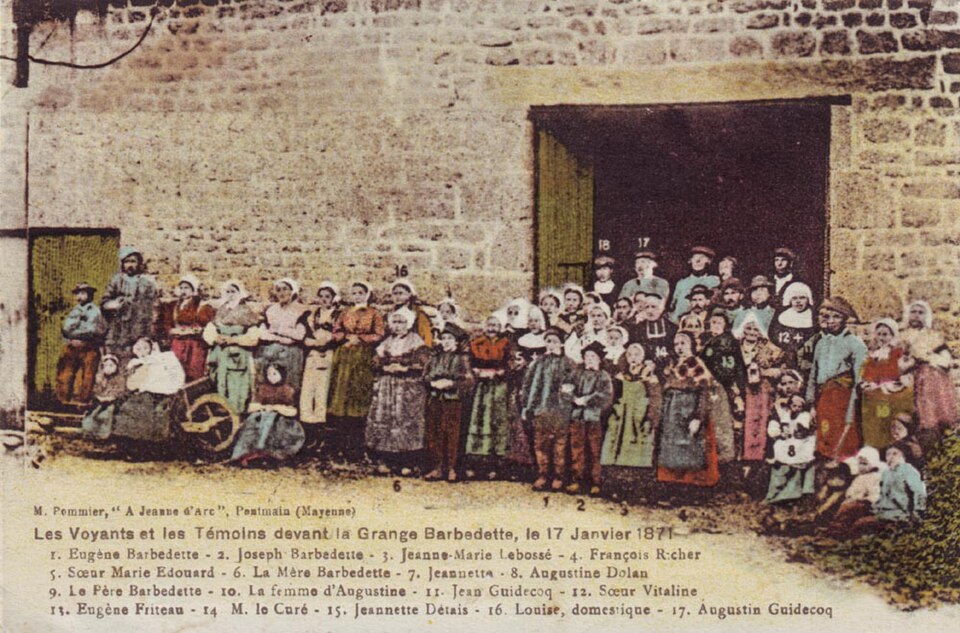
The Apparition above the Barn
The shrine preserves the account of the four children. Brothers Eugène and Joseph Barbedette were helping their father in the barn when Eugène looked outside. Above the house opposite, he saw a woman in a star-covered robe. Joseph saw her too; later, Françoise Richer and Jeanne-Marie Lebossé attested to the same apparition. Parish priest Michel Guérin joined them, and the villagers gathered to pray. Mary did not speak audibly. Before the children's eyes, a readable message formed, calling for prayer and trust that God would hear them.[1]
Hope amid War
The war of 1870/71 was drawing threateningly close to Pontmain. The inhabitants feared for the village and their conscripted relatives. Into this fear came the call to pray. As the community stood together, the Mother of God appeared to the children as a source of maternal help. The message of prayer gave the distressed population a definite support: God hears the pleas of his children. Later remembrance of rescue and peace therefore remained closely connected to that evening. The community answered its distress with shared prayer and hope.[2]
The Message: Pray and Trust
The banner directed the children and the praying community toward God's hearing of their prayers. They were to continue praying and trust in the Son. The Mother of God appears here as an intercessor: she leads people to Christ and strengthens them in entrusting their distress to him. The evening's consolation and exhortation belong together. Hope for help should grow into a persevering life of prayer. Pontmain thus remains understandable beyond the wartime situation of the time: those who fall into fear may turn to God and hold fast to their hope.[1][2]
The Place of the Event
The barn, rectory, and church locate the evening of the apparition within a village community that can still be understood today. Local documentation presents these buildings and the paths between them. The witnesses' details thus become spatially clear: where the children looked from, where the adults gathered, and how the priest joined them. The surviving places supplement the written tradition. The apparition itself is attested by the children's testimony; local history helps place their statements in the specific surroundings of January 17, 1871.[3]
Questioning and Explicit Recognition
The evening of the apparition was investigated by the Church. The archival inventory names the questioning records and supplementary inquiries; the responsible Church thus engaged with named individuals and verifiable statements. On February 2, 1872, Bishop Casimir Wicart published his favorable pastoral decree. He expressly recognized the apparition to the children named in it. This specific decision supports the veneration of Pontmain. The surviving records also allow further study of the details of the proceedings and investigation of the original statements.[4][1]
The Weight of the Children's Testimonies
Pontmain has a precisely identified day, a particular place, four children known by name, and an expressly favorable episcopal judgment. These foundations support trust in the apparition. The adults did not see Mary themselves; they accompanied the children, heard their descriptions, and prayed with them. This very distinction is preserved in the tradition and was known to the ecclesiastical investigation. The testimony was therefore examined within its actual scope. Recognition rests on the credibility of those involved and the context of the event.[1][4]
Witnesses & Investigators
Eugène and Joseph Barbedette
Child witnesses
First bearers of the apparition account.[1]
Françoise Richer and Jeanne-Marie Lebossé
Further child witnesses
Named in the episcopal judgment.[1]
Michel Guérin
Parish priest
Led the common prayer and accompanied the children and village community. He observed the children but did not see the apparition himself.[1]
The unfolding story
Ecclesiastical assessment
Bishop Casimir Wicart of Laval recognized the apparition to the children named in the pastoral decree on February 2, 1872. The judgment does not mean comprehensive confirmation of all later military or political interpretations.
Objections & Answers
Does the Adults' Not Seeing Mary Refute the Apparition?
No. The testimony expressly identifies the four children as seers. The adults heard their descriptions, saw their reactions, and prayed with them. The adults' not seeing therefore does not contradict the recorded sequence. The ecclesiastical investigation knew this distinction and nevertheless reached a favorable judgment. For credibility, the children's statements and adults' observations must be examined within their actual scope. The possibility of mutual influence is a specific question for investigation; by itself, it is not evidence that the testimony was false.[1][4]
How Is Pontmain Connected with Protection from the War?
The population understood rescue and peace as an answer to prayer and thanked the Mother of God for her help. This interpretation of faith stands in the context of the evening of the apparition and its message. A complete military-historical demonstration would additionally have to examine orders, situation reports, and the course of operations; such an assessment is not presented here. God's help can also be realized through human decisions. The recognized core of Pontmain remains the apparition with its call to prayer. The question of individual military causes overturns neither the children's testimony nor the explicit ecclesiastical judgment.[2][3]
Meaning for faith
Pontmain is an expressly recognized Marian apparition with named witnesses and an early ecclesiastical investigation. Amid the fear of war, the Mother of God led the community to persevering prayer. Her call to trust remains the center of the shrine.[1][2]
How Apparitions and Private Revelations Are Examined
Testimony, messages, spiritual fruits, and ecclesiastical decisions.
Methods of examination and ecclesiastical procedure →Sources & Evidence
Information on accessibility and scope helps you assess the evidence for yourself.
- [1] L’histoireOpen source · sanctuaire-pontmain.fr ↗
- [2] Notre-Dame de PontmainOpen source · seldelaterre.fr ↗
- [3] Histoire de Pontmain – L’apparition marialeOpen source · pontmain.fr ↗
- [4] Archives de l’Église de France, Bulletin 39
Archival reference, not a substitute for a complete edition of all witness statements.
Open source · aaef-asso.fr ↗