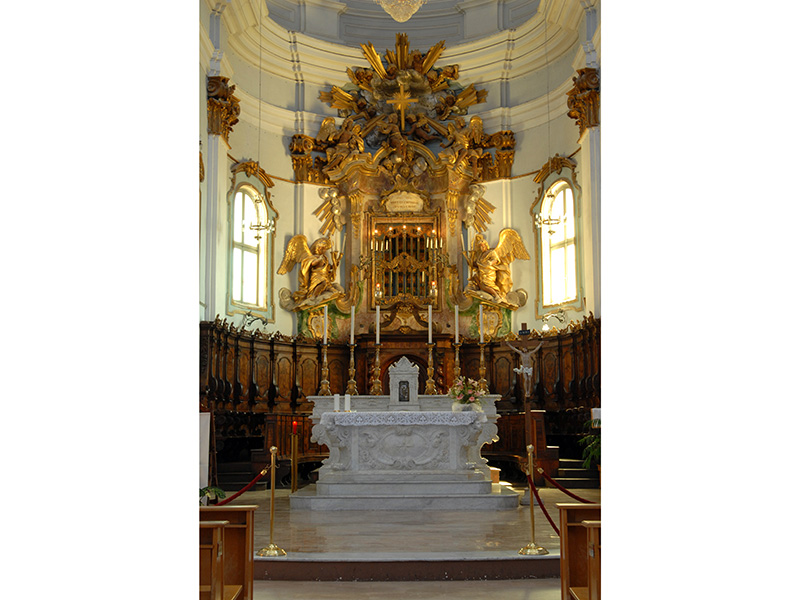
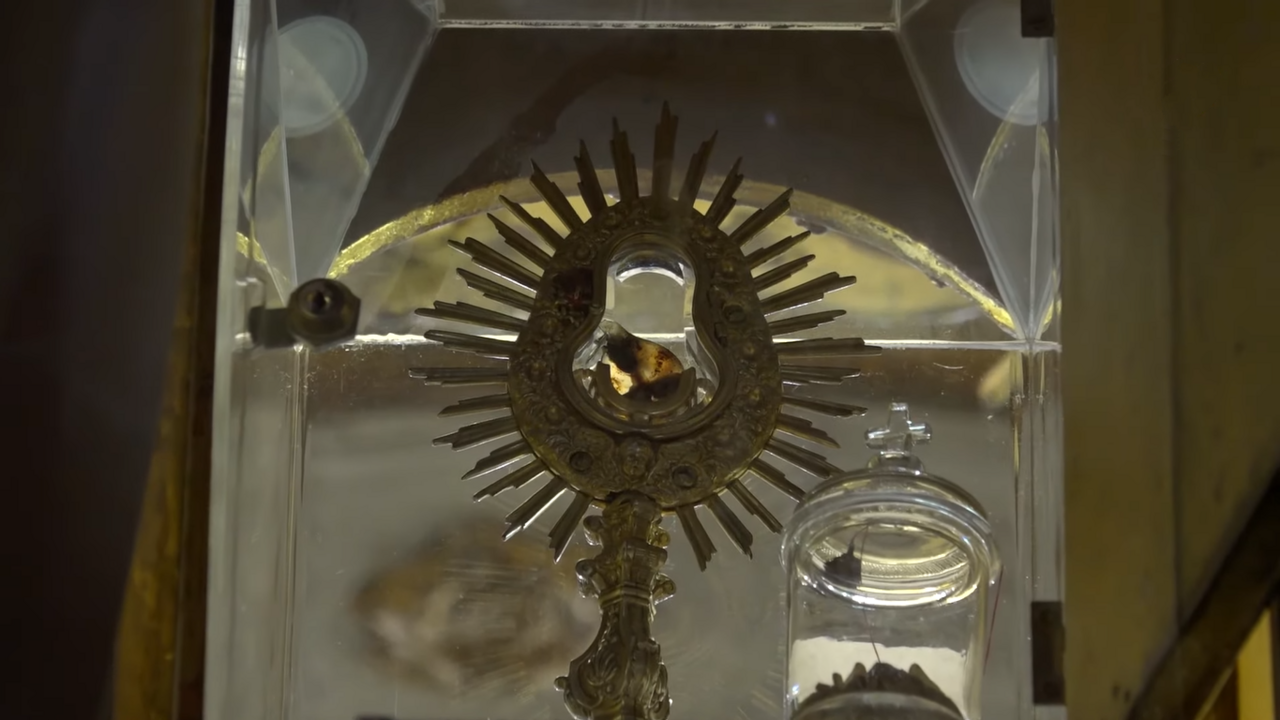
A woman in Santarém, distressed by her marriage, took a consecrated Host home for a magical purpose. According to the locally preserved account, blood appeared on its wrapping; at night, light shone from its hiding place. The woman confessed to her husband and the parish priest what had happened. The Host was returned to the church and venerated thereafter. The shrine in Santo Estêvão has preserved this memory since the Middle Ages; its episcopal statutes of 2024 place prayer, the sacraments, and careful custody at the center.
Local tradition attests to a bleeding Host that had previously been stolen and a light from its hiding place. The event led to confession and the return of the Blessed Sacrament to the church.
Blood and Light Lead to Confession
The account preserved in Santarém begins with a woman who sought outside advice in her marital distress. She took a consecrated Host for the spell she hoped would help her. Blood appeared on its wrapping. At home, she hid the Blessed Sacrament; during the night, light emerged from the hiding place. The woman revealed what had happened to her husband, and the parish priest was informed. The Host was returned to the church. The course of the miracle thus leads from secret theft through confession to public adoration.[1]
The Event in the Thirteenth Century
The episcopal statutes place the origin in the thirteenth century. The national heritage inventory records differing historical dates, including 1247 and 1266. The jubilee celebration of 1997 mentioned in the statutes also belongs to the history of commemoration. The differing numbers concern precise dating. The account therefore uses the century as a common chronological framework and identifies individual years according to their respective traditions.[2][3]
Santo Estêvão as the Home of Veneration
The Church of Santo Estêvão has several historical construction phases. The heritage inventory distinguishes its medieval origin, its significant Renaissance design, and later furnishings. These changes show how the shrine was renewed over generations. At the same time, the place of veneration remained rooted in the town's history. Architectural history and the custody of the relic must each be investigated in their own right and complement the account of the origin.[2]
The Church's Statutes of 2024
Bishop José Traquina approved the statutes on October 31, 2024. They define the shrine as a place of prayer, welcome for pilgrims, and a deeper Eucharistic life. Preserving its documentary holdings is also explicitly among its responsibilities. Care for the Blessed Sacrament, celebration of the sacraments, and stewardship of its written history are thus entrusted to a shared ecclesiastical responsibility.[3]
The Evidence Through Which the Case Is Known
For Santarém, the institutional presentation of the local miracle account, the national heritage inventory, and the current episcopal statutes are available. They provide access to the historical site, its veneration, and the Church's reception. A complete medieval dossier of examinations or a current published material report was not found in these sources. Further biological details would need to be established by their own investigations. The particular strength of this case lies in its Portuguese pilgrimage history and the custody of the Blessed Sacrament regulated by the Church.[1][2][3]
Conversion Instead of Control Over the Sacred
The woman sought a solution to her distress through an action that misused the sacrament. The miracle led her out of concealment and into truth. Christ is not a means of controlling a spouse. He calls the person herself to conversion and reconciliation. The Host's return to the church makes this response visible: private control becomes public adoration; the secret attempt becomes a confession before God.[1][3]
Witnesses & Investigators
The unfolding story
- Tradition of the Origin
The theft and return of the Host are placed in this period.[3]
- Architectural Redesign
The present church receives significant Renaissance features.[2]
- Memorial Chapel
A chapel marks the woman's traditionally identified home.[1]
- Elevation to a Shrine
The episcopal statutes recall this step.[3]
- New Statutes
Bishop Traquina regulates responsibilities and duties.[3]
Ecclesiastical assessment
The statutes approved in 2024 confirm Santarém as a Eucharistic shrine and define its responsibilities for prayer, sacramental life, welcoming pilgrims, and preserving relics and documents.
Objections & Answers
Do differing dates make the event implausible?
They limit the certainty of an exact year but do not, in themselves, refute the event reported. Historical tradition can preserve an event and its lasting veneration even when the precise chronology is transmitted inconsistently. For Santarém, the evidence must therefore be read according to its respective purpose: the statutes name the thirteenth century; the heritage inventory documents different dates. Centuries of veneration are not negated because their beginning cannot be fixed to a single undisputed day.[2][3]
Are the 2024 statutes new laboratory evidence?
The statutes are a genuine episcopal confirmation and regulation of the shrine. They define its ecclesiastical standing, responsibilities, and spiritual orientation. By their nature, they are neither a new material analysis nor an edition of medieval examinations. This distinction does not diminish their importance: veneration is under the diocesan bishop's responsibility and is directed toward prayer and the sacraments. The explicitly required care for documents also establishes a foundation for further exploration of the history.[3]
Meaning for faith
Santarém preserves the Eucharistic miracle as a call to conversion and adoration. The account of blood and light leads to the return of the Blessed Sacrament to the church. The shrine, which remains under episcopal regulation, keeps alive this connection between miracle, confession, and Eucharistic life.[1][3]
How Eucharistic Miracles Are Examined
Securing the account of events, identifying the material, and reading the Church's judgment precisely.
Methods of examination and ecclesiastical procedure →Sources & Evidence
Information on accessibility and scope helps you assess the evidence for yourself.
- [1] A lenda do Santíssimo Milagre
Institutional cultural presentation, not direct medieval testimony.
Open source · visitportugal.com ↗ - [2] Igreja de Santo Estêvão (Santo Milagre)
Records the differing old dates and architectural history.
Open source · imovel.patrimoniocultural.gov.pt ↗ - [3] Decreto e Estatutos do Santuário do Santíssimo Milagre de Santarém
Primary present-day statutes of the shrine.
Open source · diocese-santarem.pt ↗