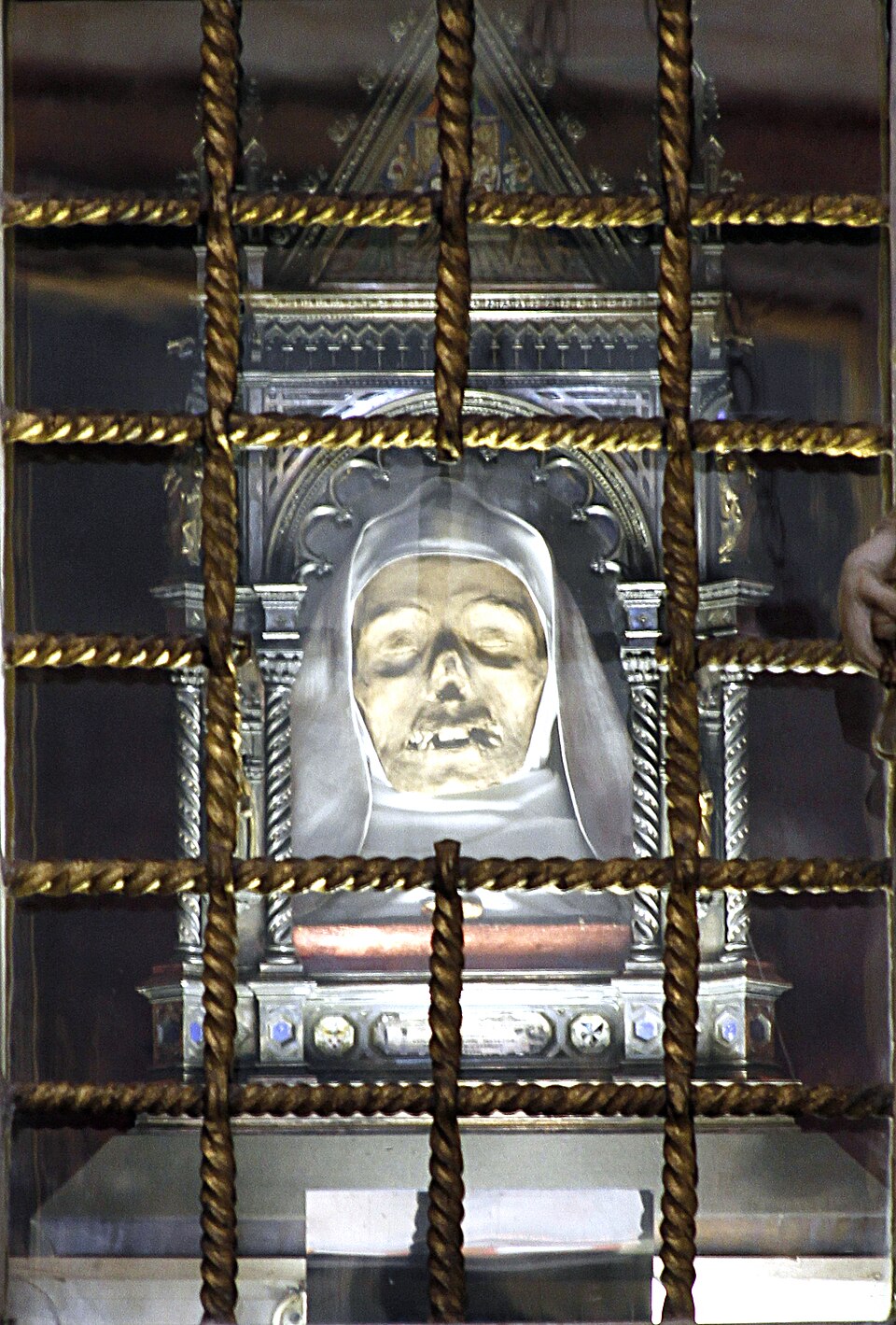
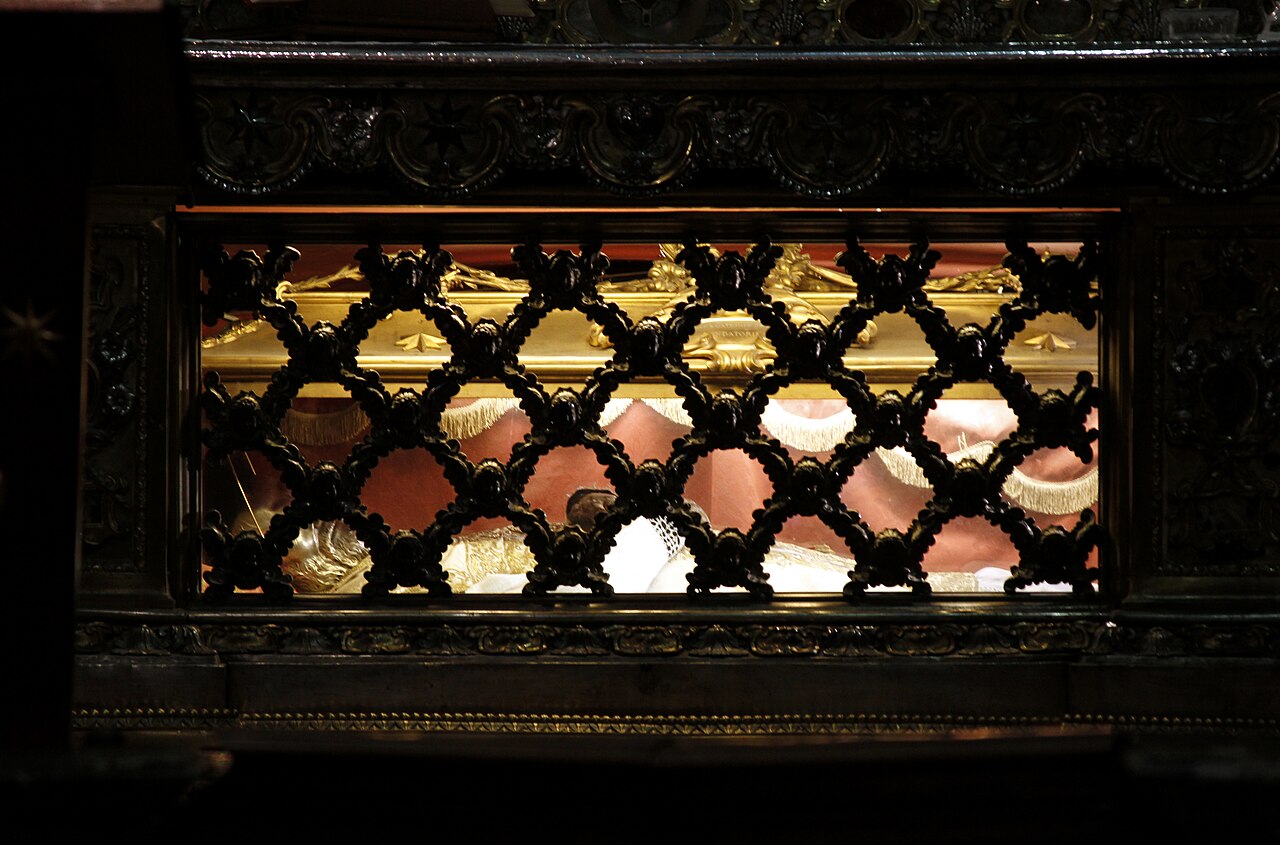
In the Book of Her Life, Teresa of Ávila attests to a special grace of divine love: an angel appeared with a golden, fiery point and pierced her heart to its innermost depths. The experience filled her with intense pain and, at the same time, a love for God from which she did not wish to be released. Teresa herself describes how spirit and body shared in it. She submitted her experiences to spiritual advisers for examination and carried their fruits into the reform of Carmel. The Church venerates the transverberation as a special grace in the saint's life; it is commemorated liturgically in Carmel.
Teresa herself describes the appearance of an angel who pierced her heart with a fiery golden point. She received a burning love for God and intense spiritual pain in which the body also shared considerably.
The Angel with the Fiery Point
In chapter 29 of the Book of Her Life, Teresa gives her own testimony. Beside her, she saw a small, very beautiful angel. In his hand he held a golden point with fire upon it. Teresa felt this point pierce her heart and her innermost being. When it was withdrawn, she remained filled with an extraordinarily powerful love for God. She describes this experience amid her explanations of different forms of spiritual perception. The angel's form was perceptible to her; she explicitly distinguishes this from purely intellectual perceptions, which she also knew. Her account thus preserves the personal sequence and the nature of the grace received.[1]
Penetrated by God's Love
Teresa describes the pain as great and at the same time accompanied by such sweetness that she did not wish to be freed from it. At that moment, love for God surpassed everything created. She explains that the pain was spiritual but that the body shared strongly in it. This description of her own gives the word transverberation its meaning: divine love penetrated her to the center of her person. For her, the experience was neither a merely chosen expression nor a mood produced by an act of will. She received it and experienced its effect with soul and body.[1]
A Recurring Grace
Teresa speaks of repetitions and states that came and passed again. The associated raptures also occurred in the presence of others. She was embarrassed that people noticed them; she did not seek publicity. The transverberation is usually placed in the period of her life around 1560. At this point, the Book of Her Life gives no established single day or exact time. The later feast commemorates the grace as a whole. For its history, Teresa's own account remains decisive: it describes a recurring experience and reveals its effects in the saint's life.[1][2]
Active Love Grows from Prayer
The love of which Teresa speaks remained effective in her life. Her path led through prayer and inner struggles to foundations, community life, and practical responsibility. Grace made her willing to follow God's will amid hardship. Precisely this connection belongs to the meaning of the transverberation: God takes hold of the center of the person and opens her to her task. Teresa's testimony describes both the intensity of the encounter and the necessity of spiritual discernment. Her reforming work shows how the love she received shaped action and service to the Church beyond the extraordinary moment.[1]
Teresa Submits Her Experiences for Examination
Teresa wrote her autobiography in the context of spiritual direction. She speaks openly of fears of deception and conversations with confessors. In the following chapter, she describes how Peter of Alcántara assessed her spiritual path and brought her relief. Examination thus belonged to her own response to grace. She asked about conformity with the faith, humility, obedience, and lasting fruits. This attitude supports the credibility of her personal testimony. The intensity she experienced was placed within a longer spiritual journey and assessed together with experienced advisers.[1]
Veneration in Carmel and in the Church
Teresa's holy life, her reform of Carmel, and her teaching on prayer form the context in which the Church receives the transverberation. She was canonized in 1622. In Carmel, the piercing of the heart is celebrated liturgically as a special grace of divine love. Its commemoration leads to contemplation of a love that takes hold of the whole person and opens her to God's will. It invites the faithful to grow in prayer and service. Veneration of this grace rests on Teresa's own testimony and its reception within her life as honored by the Church.[2][3]
The Heart Relic in Alba de Tormes
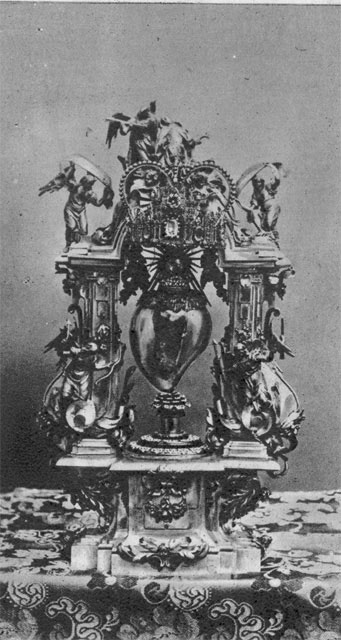
Teresa's heart is venerated in Alba de Tormes and associated with her special grace of love. The most important source for the transverberation remains the Book of Her Life. It describes the spiritual experience with strong bodily participation. Anyone asking further about anatomical changes needs the documentation of the organ's removal, preservation, and examination. The form, age, and cause of a particular scar cannot be read from her personal testimony alone. The heart relic is a bodily connection to the saint and her life; a separate medical finding would need to be assessed through its own records.[1][3]
Witnesses & Investigators
Teresa of Jesus
Recipient and author
Describes the encounter with the angel, the pain, and the divine love received in chapter 29 of the Book of Her Life.[1]
Peter of Alcántara
Spiritual adviser
Examined and accompanied Teresa's spiritual journey; she herself reports the relief brought by his judgment.[1]
The unfolding story
- Birth in Ávila
Teresa is born in Castile.[2]
- The Grace of Transverberation
The piercing of the heart is usually placed in this period of her life.[1][3]
- Autobiography
Teresa records her experiences and their spiritual examination in writing.[1]
- Death in Alba de Tormes
Teresa dies; her heart is later venerated as a relic.[2]
- Canonization
The Church raises Teresa to the honor of the altars.[2]
Ecclesiastical assessment
The transverberation belongs to Saint Teresa's recognized spiritual tradition and is commemorated liturgically in Carmel. This reception is not equivalent to modern medical proof of heart damage caused by a material arrow.
Objections & Answers
Is Teresa merely describing strong feelings?
Teresa explicitly distinguishes between a received experience and an image she produced herself. The grace did not come at her choosing; she describes its course, recurrence, and lasting effects. Her language is figurative but serves to communicate an event experienced as real. Spiritual discernment and the fruits of her holy life accompany it. This connection supports the Church's appreciation. Teresa calls the pain spiritual, with strong bodily participation. Her testimony should therefore be read with its own precision, without reducing it to a mood or reinterpreting it as an undocumented mechanical injury.[1]
What evidential force does the heart relic possess?
The relic connects veneration bodily with Teresa and her life. A particular anatomical change would require separate documentation of removal, preservation, and examination findings. Even a securely described finding would initially establish a bodily change; its cause and timing would require further data. Recognition of the special grace of love rests above all on Teresa's own testimony, its spiritual examination, and the fruits of her life. The heart relic points to this reality. It need not prove alone what is understood through the entire spiritual and biographical context.[1][3]
Meaning for faith
Teresa's transverberation is accessible through her own detailed testimony. Spiritual discernment, her holy life, and ecclesiastical veneration provide good reasons to recognize in it a special grace of God. The piercing of the heart leads to the center of her teaching: allowing oneself to be loved by God and acting in that love.[1][2]
How Miracles in the Lives of the Saints Are Examined
Stigmata, bilocation, and material changes require different examinations.
Methods of examination and ecclesiastical procedure →Sources & Evidence
Information on accessibility and scope helps you assess the evidence for yourself.
- [1] The Life of St. Teresa of Jesus
Public-domain edition of the autobiographical primary text; section numbering differs from modern editions.
Open source · gutenberg.org ↗ - [2] St. Teresa of Jesus
Historical overview; not a current medical assessment.
Open source · newadvent.org ↗ - [3] The Transverberation of St. Teresa of Jesus
Explanation of the feast and mystical grace from within the order.
Open source · ocdfriarsvocation.org ↗