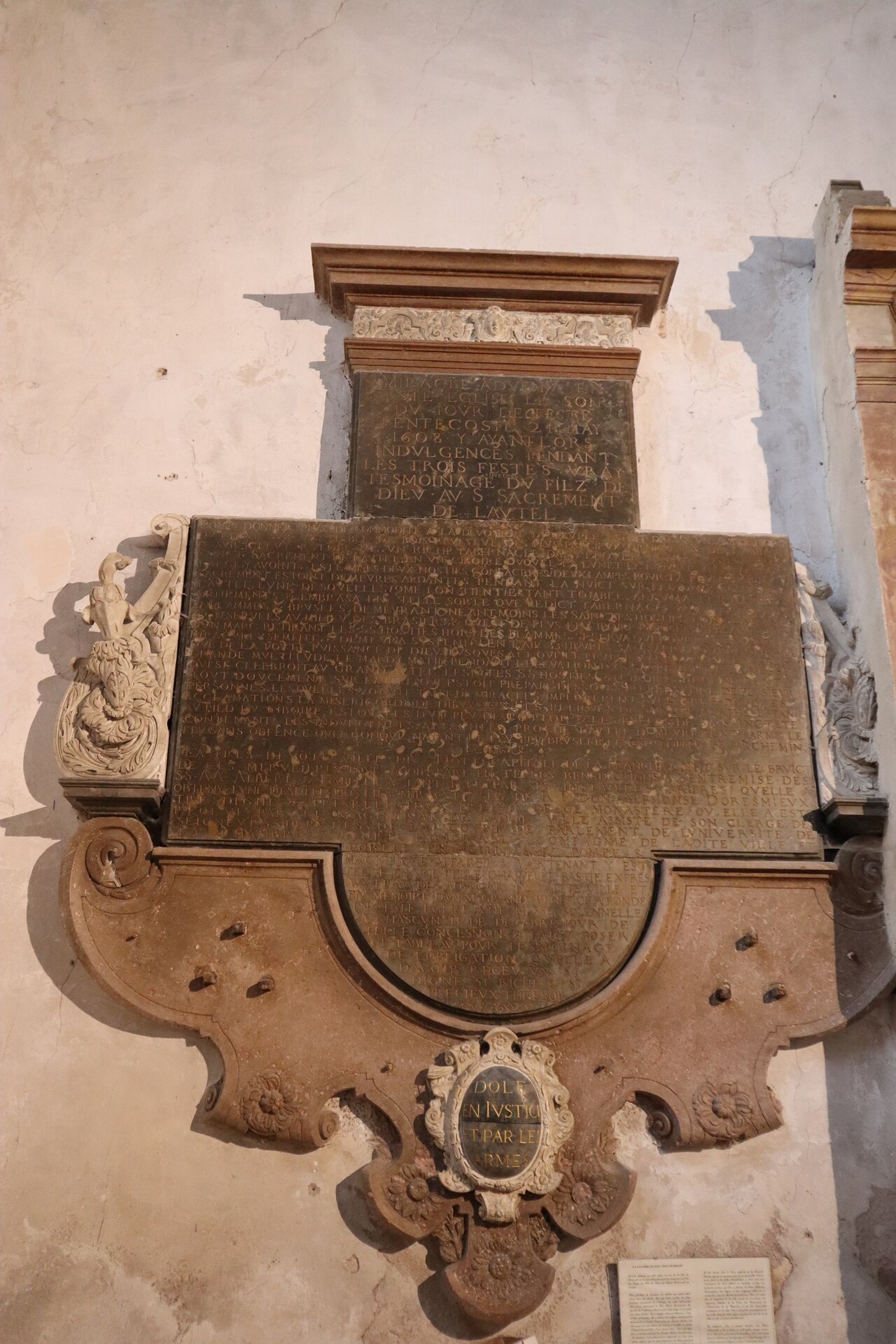
In March 1345, a seriously ill man received Holy Communion in a house on the Kalverstraat. When he vomited afterward, the contents were placed in the fire. A woman found the Host intact within it. This testimony preserved by the Church gave rise to a major pilgrimage. Its memory survived the Reformation and prohibitions and continues to this day in the Silent Procession: the faithful walk in prayer through the city at night and venerate Christ in the Eucharist.
The Amsterdam miracle account attests that the Host brought up by a sick man remained intact in the fire. Its return to the church and subsequent veneration established the pilgrimage.

Communion for the Sick on the Kalverstraat
Ecclesiastical tradition leads to a house on the Kalverstraat in March 1345. A seriously ill man received Holy Communion but had to vomit afterward. The contents were placed in the fire. When a woman looked later, she found the Host intact within it. The Blessed Sacrament was brought back to the church. Its preservation amid the fire became the starting point for a veneration that extended far beyond the house and the city. The sources agree on the month and year; individual days are transmitted differently.[1][2]
Amsterdam Becomes a Pilgrimage Destination
The city archive describes Amsterdam's development into an international pilgrimage site. Accommodation, commerce, and markets came with the pilgrims. Eucharistic commemoration thus also shaped public life and the city's history. These consequences show the reach of the veneration. At the same time, early testimony is decisive for assessing the original event; the later benefits of pilgrimage do not in themselves determine a judgment about its beginning.[2]
Memory Survives Prohibitions and Upheavals
After the Reformation, conditions changed for the old place of veneration and for public Catholic processions. Nevertheless, its memory survived. It later found a distinctive expression in the Silent Procession: a Eucharistic pilgrimage through the city. The Archdiocese of Utrecht still explicitly identifies it as an ecclesiastical pilgrimage. Veneration thus connects the medieval event with the present prayer of the faithful.[2][3]
Comparing Municipal and Ecclesiastical Sources
Charles Caspers and Peter Jan Margry have devoted an extensive historical study to the pilgrimage. Their work examines texts, rites, confessional conflicts, and the public significance of the veneration. The bibliographic record is available through the Meertens Institute or KNAW; the monograph is not treated here as having been evaluated in full. This research complements ecclesiastical sources and the city archive. It studies the historical form of the veneration; an explanation of its social forms is not, by itself, a refutation of the attested miracle in the fire.[4]
A Public Witness in Silence
The Silent Procession joins the walk through the city with prayer and recollection. In it, the memory of the miracle takes a restrained but visible form. The faithful respond to Christ's presence by making pilgrimage together and venerating him in the Eucharist. The constancy of this prayer shows how deeply the sacramental miracle has entered the city's history of faith. The silence of the night creates space for adoration and personal conversion.[3][4]
Christ Remains Close to the Sick
The beginning is marked by illness and human helplessness. Through his weakness, the sick man loses neither his dignity nor his place in the Church. The miraculous preservation of the Host directs attention to Christ's faithfulness precisely in this distress. It leads to care in handling the Blessed Sacrament and loving accompaniment of the sick. Amsterdam's commemoration connects adoration of the Lord with service to those to whom he comes in Communion for the sick.[1][3]
Witnesses & Investigators
The sick man and the woman at the hearth
Participants and observers in the miracle account
The sick man received Communion; the woman found the Host intact in the fire.[1]
Charles Caspers and Peter Jan Margry
Historians of the pilgrimage
Explore the sources, religious practice, and eventful history of the veneration.[4]
The unfolding story
- Tradition of the Origin
The sign is associated with Communion for a sick person.[1]
- Pilgrimage City
Amsterdam becomes a major pilgrimage site.[2]
- Reformation in Amsterdam
The public conditions of veneration change.[2]
- Silent Procession
- Ecclesiastical Pilgrimage
The archdiocese documents the continuing event.[3]
Ecclesiastical assessment
The Church continues to commemorate the sacramental miracle in the Silent Procession and in Eucharistic pilgrimages. Municipal archives, ecclesiastical sources, and historical research provide access to its long history.
Objections & Answers
Does economic benefit explain the origin of the pilgrimage?
It explains certain later consequences, but not the origin by itself. The fact that pilgrims needed accommodation and markets does not prove that the miracle had previously been invented. Such a thesis would need to be supported by concrete sources concerning its origin, participants, and intentions. Conversely, economic and political interests belong to the actual history of its influence and must be examined. The question of origin remains distinct: what was attested, when was it recorded, and how was the Blessed Sacrament subsequently venerated?[2][4]
What significance does the enduring pilgrimage have for the early event?
It attests to the persistent reception and transmission of Eucharistic memory. This is historically and spiritually significant and opens access to texts, places, and traditional practices. A present-day pilgrimage route, however, is not a retrospective fire test of the event of 1345. Its basis lies in the preserved historical tradition; its fruit is present-day adoration. Both levels belong together without their different forms of testimony needing to be confused.[3][4]
Meaning for faith
The sacramental miracle of Amsterdam led from Communion for a sick person to far-reaching Eucharistic veneration. The traditional finding of the intact Host and the pilgrimage still alive today belong together in this history. In the Silent Procession, the faithful respond to Christ's faithfulness with adoration and a public witness of faith.[1][3][4]
How Eucharistic Miracles Are Examined
Securing the account of events, identifying the material, and reading the Church's judgment precisely.
Methods of examination and ecclesiastical procedure →Sources & Evidence
Information on accessibility and scope helps you assess the evidence for yourself.
- [1] Het Mirakel van Amsterdam
Search-index content accessible; direct retrieval intermittently blocked with 403.
Open source · stille-omgang.nl ↗ - [2] 1345 Mirakel van Amsterdam
Municipal historical account with economic and confessional contexts.
Open source · amsterdam.nl ↗ - [3] Amsterdam (Stille Omgang)
Confirms present-day ecclesiastical pilgrimage practice.
Open source · aartsbisdom.nl ↗ - [4] Het Mirakel van Amsterdam: Biografie van een betwiste devotie
Bibliographic record of the research monograph; not presented as a book consulted in full.
Open source · pure.knaw.nl ↗