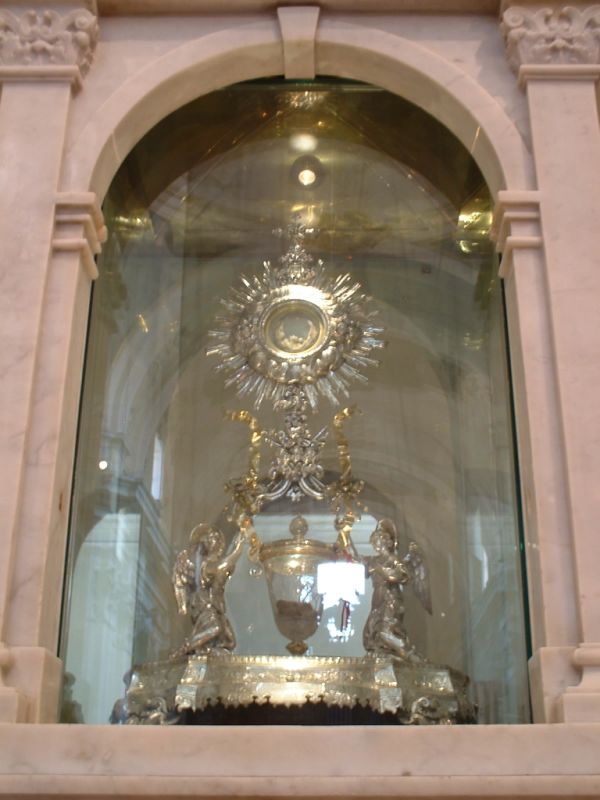
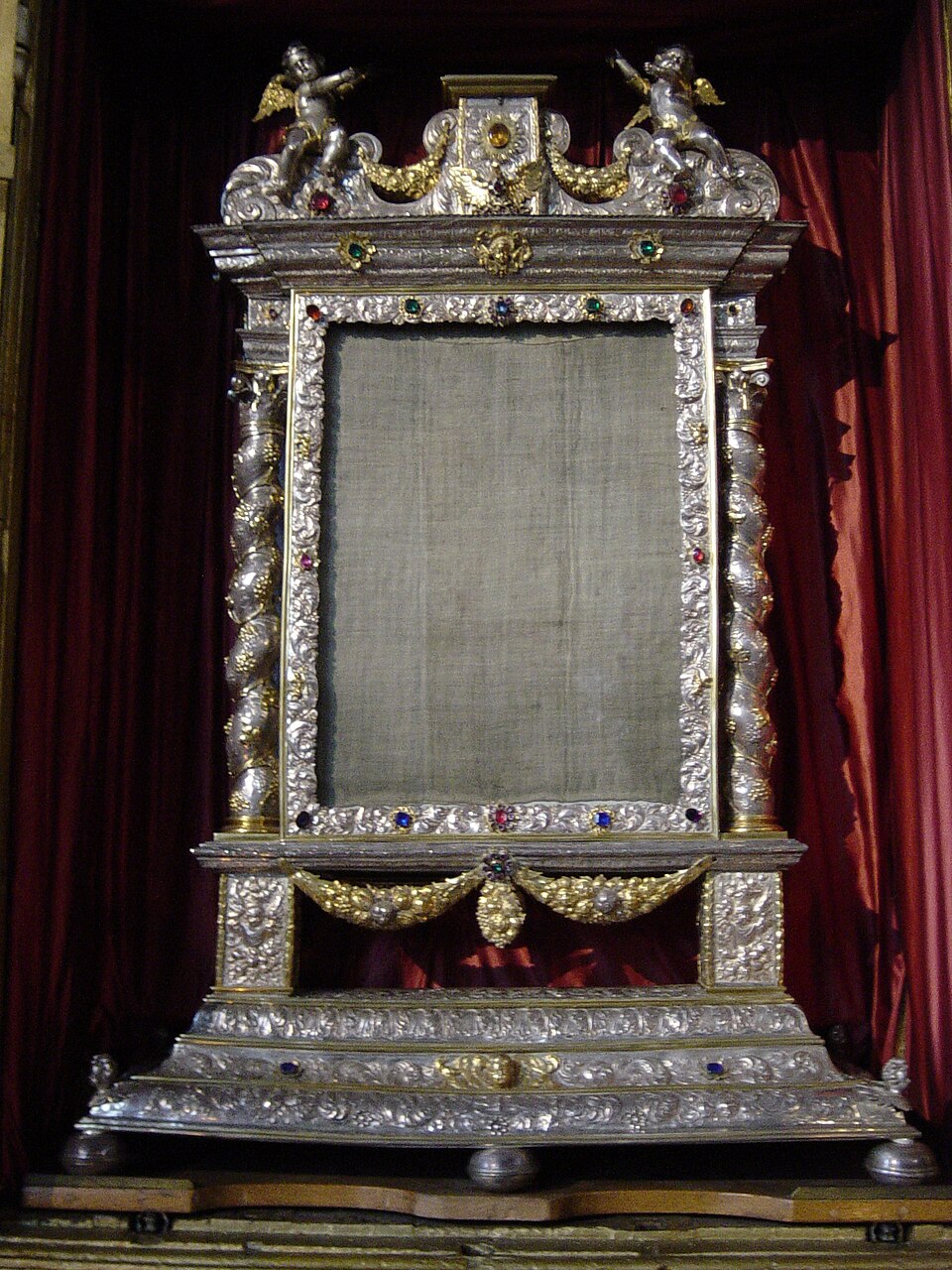
The Eucharistic miracle whose corporal is still venerated in Orvieto occurred in Santa Cristina at Bolsena: during Mass, drops of blood emerged from the Host and stained the linen cloth. The priest's journey to Urban IV, the solemn transfer, and the surviving relics connect the two cities. The medieval testimonies, introduction of the feast of Corpus Christi, and documented examination of the cloth in 2015 belong to the historical picture.
Ecclesiastical tradition connects the bloodstains on the corporal with the consecrated Host of a Mass in Bolsena. The sign led the doubting priest to certainty about Christ's presence in the Eucharist.
The Doubting Priest's Mass
A priest from the region north of the Alps made a pilgrimage to Rome in 1263; local sources also give 1264. He was troubled by the question of whether Christ is truly present under the species of bread and wine after consecration. He sought strengthening at the Apostles' tombs. On the way, he stopped in Bolsena and celebrated Holy Mass in the shrine of the martyr Christina.[5]
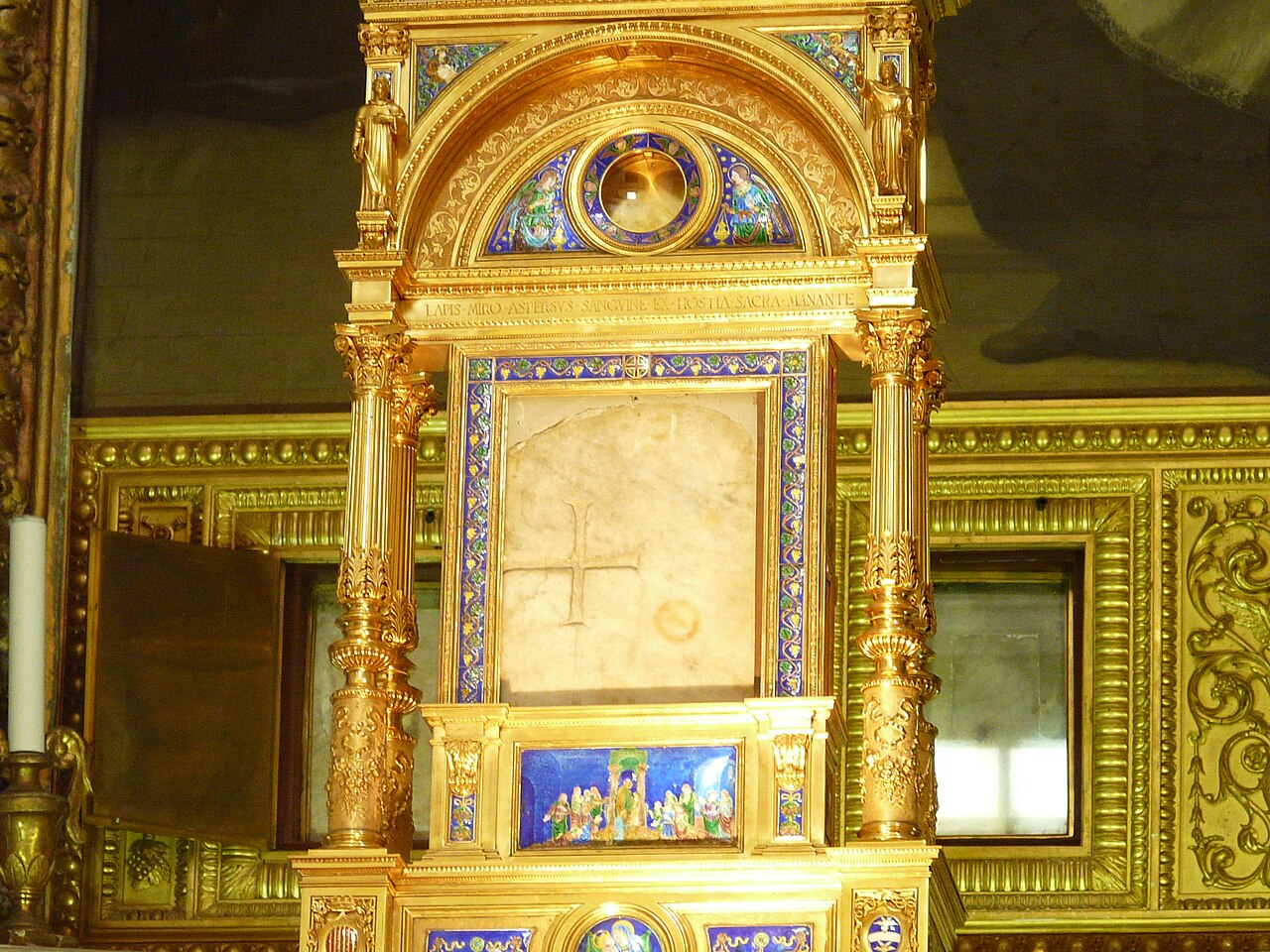
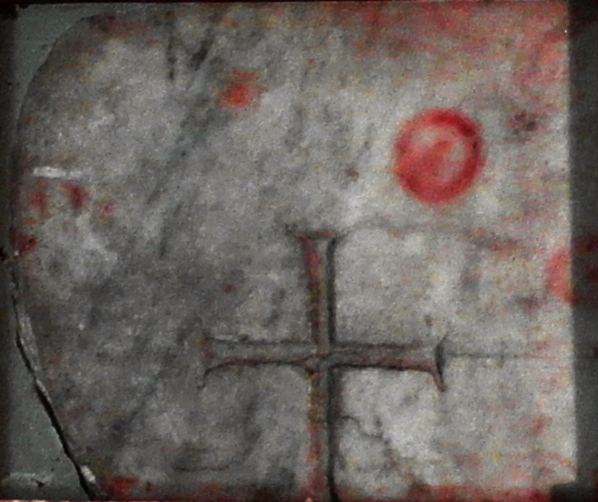
As he held the Host over the chalice at the consecration, he saw blood emerge. Drops fell onto the corporal, the linen cloth on which chalice and Host rest during Mass. Shaken, the priest interrupted the celebration, wrapped the sacred species in the cloth, and brought them to the sacristy. Further drops fell onto the stone floor and steps at the altar along the way. The tradition thus preserves two related material testimonies: the linen and the stained marble stones. The miracle answered the priest's doubt and led him to confess Christ's real presence in the Eucharist.[4]
Urban IV and the Journey to Orvieto
The priest sought out Pope Urban IV in nearby Orvieto and told him what had happened. Urban instructed the bishop to fetch the Host and corporal from Santa Cristina. The Orvieto frescoes show the individual stages: the priest's report, the papal instruction, reception at the altar, and procession to Orvieto. At the bridge over the Rio Chiaro, the Pope came to meet the procession. In the city, he showed the sign to the assembled faithful. This sequence is already recorded in the pictorial program of the 14th century.[8]
The detailed local account names Bishop Giacomo. It also describes canons and other witnesses accompanying the priest to the Pope. No list naming these Mass attendees is preserved there. The corporal came to Orvieto; the marble stones remained in Bolsena. Anyone visiting both shrines therefore encounters different parts of the same tradition.[4][5]
The Medieval Testimonies and the Priest's Name
The basilica dates the earliest literary and pictorial testimonies to the early 14th century. It names the Orvieto chronicle concerning the Corpus Domini miracle, followed by Pietro de' Natali's Cathalogus of 1369–1372 and the papal bull Quamvis cum of 1377. The detailed stone inscriptions visible today date from the late 16th and early 17th centuries and draw on older texts. Today's account summarizes this ecclesiastical tradition; it is not a questioning record taken on the day of the Mass.[4]
The familiar name Peter of Prague belongs to the later identification of the priest. The basilica expressly distinguishes it from the older descriptions as a German, Bohemian, or Teutonic priest. A historically documented Prague cleric named Pietro did indeed travel to Urban's court. That he was also the celebrant at Bolsena remains an attribution, not an identity secured by his own testimony to the miracle. The sequence of events therefore does not depend on this identification by name.[7]
What Survives in Bolsena and Orvieto
In Orvieto Cathedral, the corporal is kept in the chapel built for it. Ugolino di Prete Ilario and his collaborators painted the story of the miracle and other Eucharistic scenes there. Ugolino di Vieri's precious reliquary of 1338 is now in the cathedral museum in the Libreria Albèri. Cloth, medieval shrine, and chapel are thus three distinct surviving objects. The cathedral administration describes their locations and history.[1]
In Santa Cristina, the Cappella Nuova preserves four stained marble pieces: three in a gilded wooden frame, the fourth in a reliquary made by Maurizio Ravelli in 1940. The stones were transferred to the new chapel on October 6, 1704. The altar there thus preserves the memory of the path from the place of consecration to the sacristy.[5]
Examination and Restoration of the Corporal in 2015
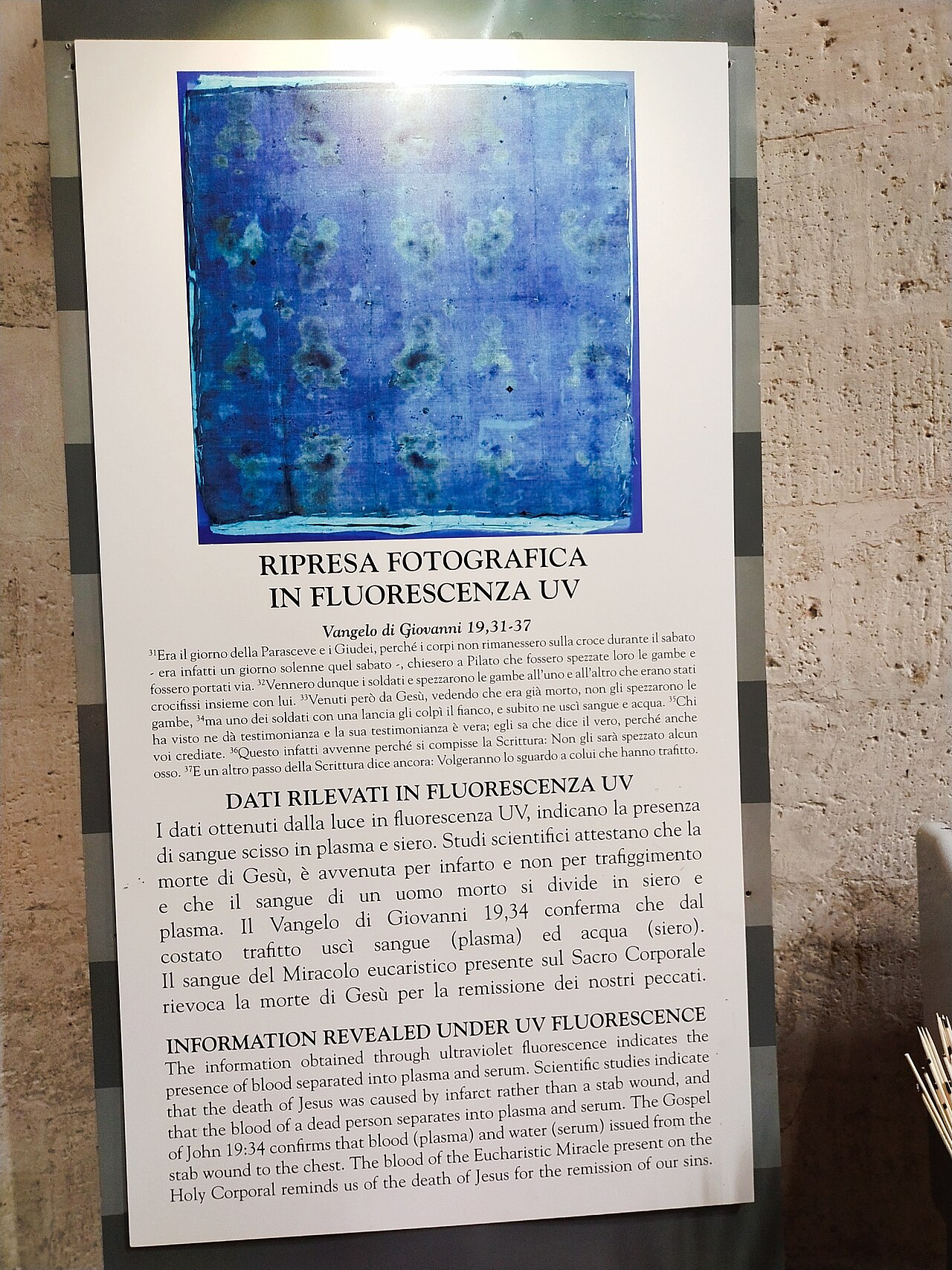
Textile conservator Ester Giovacchini examined the corporal on February 5, 2015, and worked on it from February 23 to March 27 on behalf of Bishop Benedetto Tuzia and cathedral chapter president Fr. Stefano Puri. Massimo Roncella photographed it in visible light and under UV excitation. Giovacchini described twenty areas formed by folds and corresponding traces on different layers of the cloth. She described the deposits as blood with plasma and serum components. In her reconstruction, four related fragments yielded an original cloth measuring approximately 71.5 × 77.5 centimeters; the visible mounted area measured 48.5 × 51.5 centimeters. Comparisons with photographs from 1978 also showed fiber damage.[6]
This is a specific conservation examination of a surviving object. The publicly reproduced report describes material condition, folds, and distribution of traces. It contains, however, no documented molecular determination of blood species, blood group, or DNA, and no dating of when the traces were deposited. The photographs alone therefore cannot identify either the person from whom blood came or the moment of its appearance. Such a further statement requires other investigations.[6]
Corpus Christi: The Sign and the Earlier Movement for the Feast
In 1264, Urban IV introduced the feast of Corpus Christi for the Church through Transiturus de hoc mundo. The bull grounds it in the institution of the Eucharist, Christ's abiding presence, and the desire for a special solemn annual commemoration. It specifies the Thursday after the Sunday following Pentecost. It is not an investigative report on Bolsena; its own reasoning is sacramental and liturgical. The Latin text and an Italian translation are accessible on Santa Cristina's website.[9]
The earlier history leads to Liège and Juliana of Cornillon. Even before Bolsena, she advocated a special feast of the Eucharist. Jacques Pantaléon, the future Urban IV, knew of this concern from his time in the Liège area. Benedict XVI presented this connection alongside Bolsena and recalled the liturgical texts of Thomas Aquinas. Veneration of the corporal thus stands within an already developed Eucharistic devotion.[2]
The Sign Points to Christ in Every Mass
In his Orvieto homily of June 17, 1990, John Paul II led from the corporal to the Eucharist itself: to real communion with the Body and Blood of Christ. He also distinguished the cathedral's building history from the special purpose of the Chapel of the Corporal. At the center of the shrine stands the Lord who gives himself in the Mass. The priest of Bolsena finds an answer to his doubt; the pilgrim is led to adoration and reception of the sacrament.[3]
Witnesses & Investigators
The Priest Later Called Peter of Prague
Celebrant of the Mass
Older local sources identify his origin; the personal name belongs to the later identification.[7]
Urban IV
Recipient of the report and initiator of the transfer
The medieval pictorial testimonies show his reception of the corporal.[8]
Giacomo, Bishop of Orvieto
Papal delegate
The basilica names him as responsible for examination and transfer.[4]
Ester Giovacchini
Textile conservator
Responsible for the conservation examination of 2015.[6]
The unfolding story
- The Mass in Santa Cristina
Chronological placement of the miracle in local tradition.[5]
- Corpus Christi
Urban IV issues Transiturus de hoc mundo.[9]
- The Reliquary
Ugolino di Vieri creates the surviving shrine.[1]
- Chapel of the Corporal
The frescoes preserve a detailed sequence of the transfer.[8]
- The Stones in Bolsena
Transfer of the marble pieces to the Cappella Nuova.[5]
- Textile Conservation
Giovacchini examines and restores the corporal.[6]
Ecclesiastical assessment
The corporal is venerated in Orvieto Cathedral, and the stained marble stones in Santa Cristina at Bolsena. Popes have repeatedly honored the pilgrimage and its Eucharistic significance.
Objections & Answers
Does the Name Peter of Prague Itself Establish the Priest's Identity?
No. A documented person and a later tradition of a name do not yet establish an unambiguous identification. What would be decisive is a document connecting that very priest with the Mass. The uncertainty concerns the name; it is not independent counterevidence against the reported event.[7]
Can a Red Stain by Itself Prove a Eucharistic Miracle?
No. A color does not explain its origin. Historical assessment also requires the cloth's provenance, tradition, and custody; a scientific statement would require appropriate material analyses. A natural explanation would also have to be demonstrated on the specific object. A merely conceivable mechanism is not yet a finding.[6]
Does Juliana's Earlier Advocacy Contradict the Connection between Bolsena and Corpus Christi?
No. A feast can have a long prehistory and be further shaped by a later sign. The bull names its theological foundation; Bolsena belongs to the history of its veneration. Both can be presented together without making the miracle the sole cause of the feast's introduction.[2][9]
Meaning for faith
Bolsena leads from a priest's doubt to veneration of Christ in the Eucharist. The corporal in Orvieto, the stones in Santa Cristina, and the medieval testimonies make the history traceable in specific places. Conservation findings supplement this picture; the spiritual center remains the Lord's presence in the sacrament.[1][3][5]
How Eucharistic Miracles Are Examined
Securing the account of events, identifying the material, and reading the Church's judgment precisely.
Methods of examination and ecclesiastical procedure →Sources & Evidence
Information on accessibility and scope helps you assess the evidence for yourself.
- [1] La Cappella del Corporale
Official cathedral administration; current location of the corporal, reliquary, and chapel.
Open source · duomodiorvieto.it ↗ - [2] General Audience: Saint Juliana of Liège
Papal account of the prehistory of the feast of Corpus Christi.
Open source · vatican.va ↗ - [3] Celebrazione Eucaristica del Corpus Domini nel Duomo di Orvieto
Primary source for the papal Eucharistic interpretation.
Open source · vatican.va ↗ - [4] Il Miracolo Eucaristico di Bolsena
Official synthesis from the shrine; not a complete facsimile of the medieval records.
Open source · basilicasantacristina.it ↗ - [5] Cappella Nuova del Miracolo
Page updated January 7, 2025.
Open source · basilicasantacristina.it ↗ - [6] Il restauro del Sacro Corporale del Miracolo di Bolsena
Primary statement by an investigator in a contemporary press report; not a complete laboratory record.
Open source · iltamtam.it ↗ - [7] Pietro di Praga
Article signed by Carlo Tatta; website publication by Fr. Miloslav Chrast. Updated February 13, 2025.
Open source · basilicasantacristina.it ↗ - [8] Il Miracolo in arte
Reproductions and inscriptions of medieval material sources; the present condition of the frescoes reflects later restorations.
Open source · basilicasantacristina.it ↗ - [9] Transiturus de hoc mundo
Primary text of the bull establishing the feast; Italian translation following Ezio Franceschini, Studi Eucaristici, 1966, pp. 313–317. Transmitted versions and dates must be distinguished in a critical edition.
Open source · basilicasantacristina.it ↗