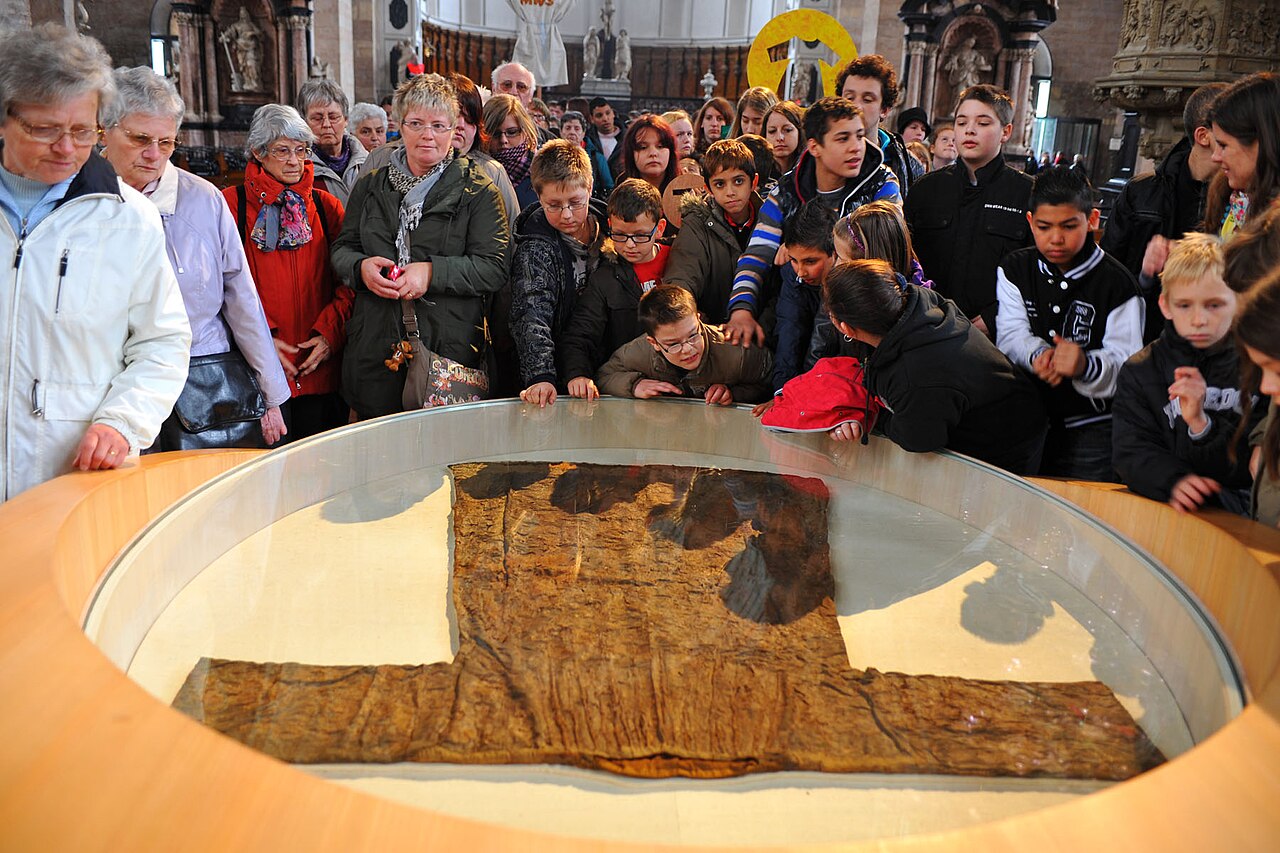
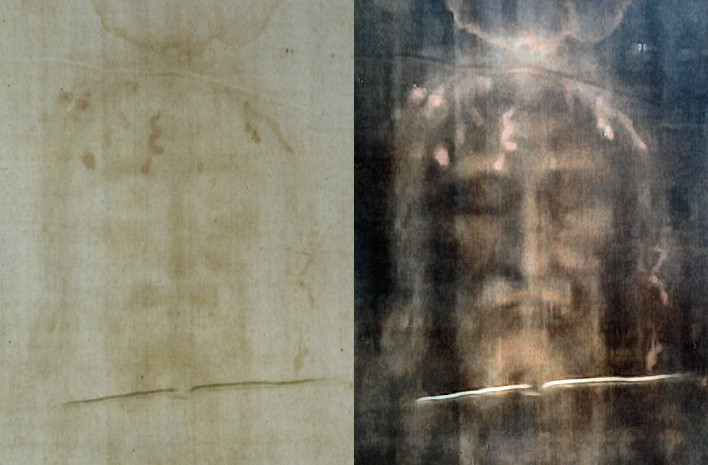
In Argenteuil near Paris, an old woolen garment is venerated as Christ's tunic. Its fragments bear traces of an eventful history: hidden storage, medieval pilgrimage, rescue during the French Revolution, and careful restoration. The shrine connects the tradition with examinations of fabric, bloodstains, and pollen. Solemn public displays continue into the present; the tunic was shown publicly again in 2025. At the center stands remembrance of Christ's bodily self-giving and the undivided garment beneath the cross.
According to local tradition, the woolen garment is the tunic Jesus wore during his Passion and for which the soldiers cast lots after the crucifixion. The case for authenticity connects this tradition with the examined features of the fabric and stains.
The Tunic and Its Biblical Point of Reference
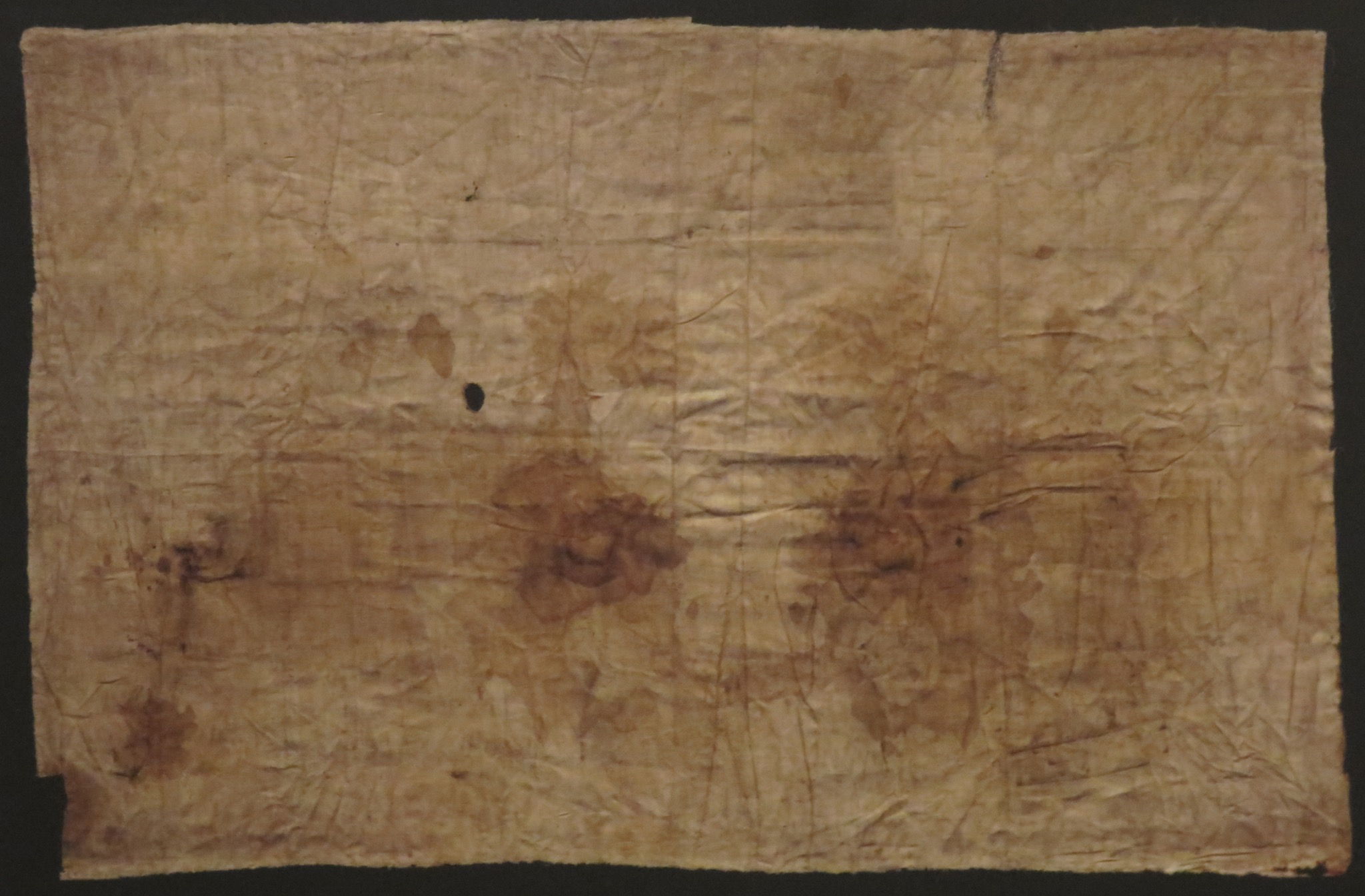
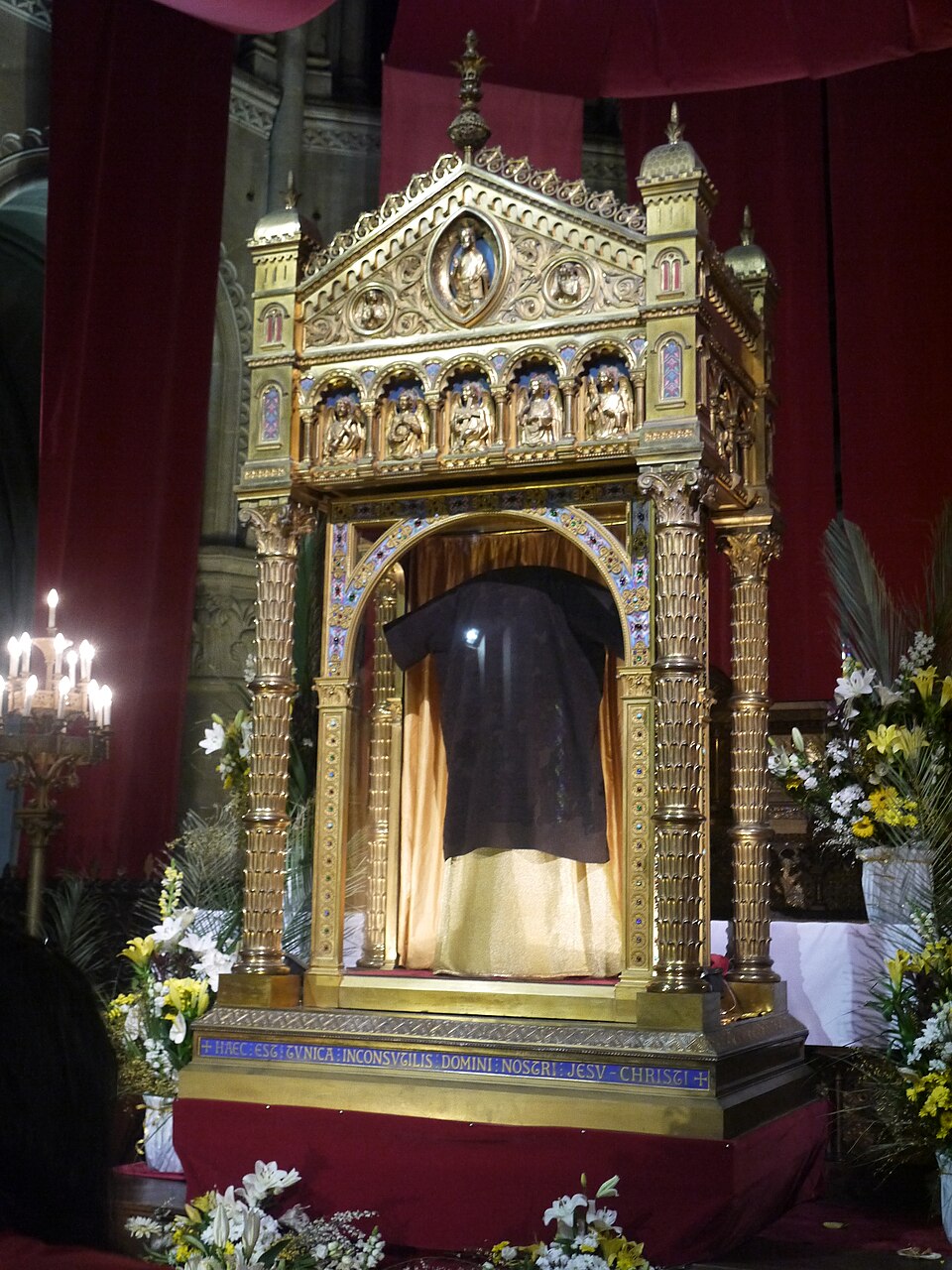
The relic of Argenteuil is a damaged woolen garment whose surviving parts are now assembled on a protective backing. It is venerated as Christ's tunic in the Basilica of Saint-Denys. It thus belongs to a different context of use from the large Shroud of Turin and the head cloth of Oviedo: it recalls the clothing Jesus wore during his Passion.[1][5]
John distinguishes the divided clothing from the continuously woven tunic for which the soldiers cast lots. This garment remains undivided. The account connects Jesus' humiliation beneath the cross with the fulfillment of Scripture and forms the biblical center of veneration in Argenteuil.[5]
Irene, Charlemagne, and the Public Display of 1156
Local tradition connects the tunic with Empress Irene, Charlemagne, and his daughter Theodrada at the convent of Argenteuil. In this tradition, the garment travels from the eastern Mediterranean to the Carolingian Frankish realm. A tangible medieval stage is the public display of 1156: Archbishop Hugh of Rouen showed the relic in the presence of King Louis VII and many faithful. Public veneration thus has a long local history.[1]
Rescue, Fragments, and Restoration
During the French Revolution, parish priest François Ozet had the garment divided into several pieces to protect it from destruction. Parts were hidden or entrusted to others. Not all returned after the Revolution. The historical society of Sucy also examines Ozet's later work there and the tradition of a smaller fragment. These events explain the losses visible today and the need to bring the surviving parts together.[4]
In preparation for the public display of 2016, the deteriorated supporting fabric was replaced. The individual fragments received a new backing. The conservation work preserves the old material and makes its garment shape easier to recognize again; the added backing remains distinguishable from the relic fragments as protection and display support.[1]
Fabric, Bloodstains, and Pollen in the Case for Authenticity
In 2016, then rector Guy-Emmanuel Cariot explained the grounds of his confidence. He connected the traditional history with manufacture classified as ancient and Near Eastern, blood and pollen findings, and comparisons with the other Passion cloths. The shrine thus brings together several kinds of observation: the fabric's composition, traces of its use, and possible contacts with other material.[3]
The appeal of this approach lies in the overall picture. A suitable weave gains additional weight when it can be connected with a traceable history and specific signs of use. Comparative research therefore asks how the features relate and how well they fit together with the garment's traditional use.[2][3]
The Public Display as an Invitation to Christ's Passion
The tunic was publicly displayed in Argenteuil from Good Friday, April 18, to May 11, 2025. The Diocese of Pontoise invited people to the jubilee display; the relic was unfolded from its protected storage for the occasion. Prayer and liturgy connect contemplation of the garment with Christ's self-giving. The ancient veneration thus remains part of local ecclesial life.[6]
Christ's Self-Giving and the Unity of the Church
John describes the Passion as real humiliation and at the same time as Jesus' voluntary self-giving. The Lord is stripped of his clothes; his path remains determined by love and the fulfillment of Scripture. Contemplation of the tunic leads to this concrete, bodily aspect of redemption. The vulnerable fabric can focus attention on what Christ takes upon himself for humanity.[5]
Saint Cyprian interpreted the undivided garment as a sign of the Church's unity given from above. This early interpretation also gives veneration in Argenteuil a spiritual direction: fidelity to truth, love for Christ, and the plea for the healing of divisions in the Church. In prayer before the tunic, remembrance of the Passion and concern for the Church's communion meet.[7]
Witnesses & Investigators
François Ozet
Historical custodian during the Revolution
Preserved parts of the garment during the Revolution and thus shaped its subsequent history of fragmentation and preservation.[4]
Guy-Emmanuel Cariot
Rector and defender of authenticity
Summarized the tradition and the arguments from fabric, blood, and pollen for the tunic's origin in 2016.[3]
Diocese of Pontoise
Ecclesiastical responsibility for the public display
Responsible for the public displays and documents the exhibition of 2025 with its liturgical setting.[6]
The unfolding story
- Transfer to Argenteuil
Local tradition connects Irene, Charlemagne, and Theodrada with the tunic's journey to Argenteuil.[1]
- Solemn Public Display
The shrine's history names Hugh of Rouen and Louis VII as participants in the public exhibition.[1]
- Division and Rescue
Ozet protects parts of the garment; not all can be reunited after the Revolution.[4]
- Radiocarbon Measurement
The ecclesiastical documentation reports an early medieval age for the sample.[2]
- Renewed Supporting Fabric
The fragile fragments are conserved for a new public display.[1]
- Jubilee Public Display
The Diocese of Pontoise invites people to public veneration.[6]
Ecclesiastical assessment
The Diocese of Pontoise is responsible for veneration and solemn public displays. The tunic is preserved in the Basilica of Saint-Denys as a relic of the Passion.
Radiocarbon Dating and Its Examination
The official press dossier of 2016 reports an age in the 6th to 7th century for a sample examined in 2004. This result does not agree with manufacture during Jesus' lifetime. The custodians point to changing preservation conditions, including temporary burial, and call for an examination of possible influences.[2]
Sample location, cleaning, measurements, and uncertainties are decisive for a technical assessment. What is available here is an ecclesiastical summary, not a complete laboratory report. An explanation through foreign carbon would have to show the type and quantity of material remaining after pretreatment and its effect on the result. The garment's eventful history alone does not yet provide this quantitative explanation.[2][3]
Objections & Answers
How far do the arguments from provenance and traces reach?
The Carolingian connection with Irene, Charlemagne, and Theodrada survives as local tradition; the early chain of ownership has gaps. John 19 names no later place of preservation. The reported material features also have differing scopes: a weave can be used over a long period, pollen can be deposited later, and the same blood group does not identify an individual. Cariot's interview is direct testimony to the case for authenticity; technical examination requires the underlying investigation records.[1][2][3][5]
How can Argenteuil and Trier be compared?
Both places connect their veneration with Christ's garment. What must be compared is the specific textile material and the respective claim: a garment, a fragment, a later supporting garment, or a contact relic. Such distinctions can explain an apparent contradiction but do not yet establish a proven common origin. Ecclesiastical veneration at both places requires no fixed judgment on every reconstruction. The garment's original form and journey remain questions for historical investigation.[5][2]
Does possible contamination already refute the C14 measurement?
Possible contamination is a legitimate line of investigation. To refute a particular measurement, its extent in the dated sample would have to be demonstrated. This requires complete records and, if appropriate, suitable repeat samples. Until then, the reported early medieval result and the objections relating to it must continue to be examined together. The diocese is responsible for veneration; this practice does not replace scientific identification of the original wearer.[2][3][6]
Meaning for faith
Argenteuil preserves an ancient Passion tradition in a visibly fragile and carefully conserved garment. The story of its rescue, research into its traces, and continuing pilgrimage give the relic a distinctive character. Veneration leads to Christ's self-giving and the plea to preserve the unity of his Church in truth and love.[1][2][5][7]
How Relics Are Examined
Tracing provenance, material, age, and ecclesiastical custody.
Methods of examination and ecclesiastical procedure →Sources & Evidence
Information on accessibility and scope helps you assess the evidence for yourself.
- [1] The Tunic: History, Examinations, and Restoration
Official account of its own tradition; earliest provenance and promotional scientific claims not independently confirmed.
Open source · saintetunique.com ↗ - [2] Dossier de presse: Ostension de la Sainte Tunique
Contains the summary of the C14 dating; not a complete laboratory report. The PDF gives 530–640, while the later website gives 530–650; only the century interval is therefore stated here.
Open source · saintetunique.com ↗ - [3] La Tunique d’Argenteuil: Interview with Guy-Emmanuel Cariot
Primary testimony to the rector's argument, not itself a new laboratory study.
Open source · saintetunique.com ↗ - [4] Les aventures sucyciennes d’une mini-relique
Local historical investigation with illustrations and archival references concerning the fragments' history.
Open source · shas.fr ↗ - [5] Gospel According to John
Biblical account; names no later place of preservation of the tunic.
Open source · vatican.va ↗ - [6] Ostension de la Sainte Tunique 2025
Primary evidence for the ecclesiastical event.
Open source · catholique95.fr ↗ - [7] De catholicae ecclesiae unitate
Public-domain patristic primary text on the symbolism of the undivided garment.
Open source · newadvent.org ↗