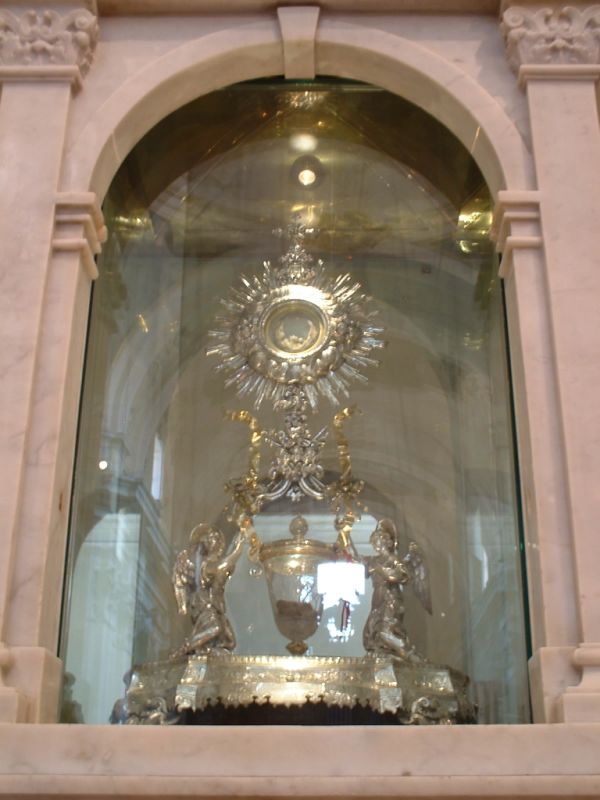
On October 12, 2008, a consecrated Host fell to the floor in Sokółka. It was reverently placed in water. A week later, Sister Julia Dubowska discovered an intensely red area. The subsequent examination produced a remarkable finding: two pathologists independently assessed the material as heart muscle or as most closely corresponding to that tissue. The ecclesiastical commission confirmed that the sample came from the preserved Host and found no indications of outside interference. It has been publicly venerated since 2011.
A red area developed on the Host kept in water. According to the specialist assessments, the examined sample showed tissue structures corresponding to heart muscle or resembling it most closely among bodily tissues.
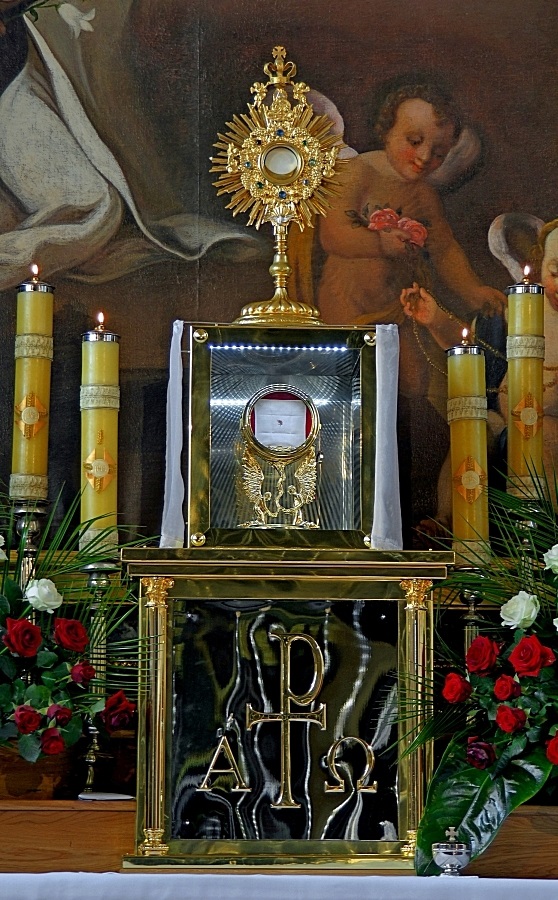
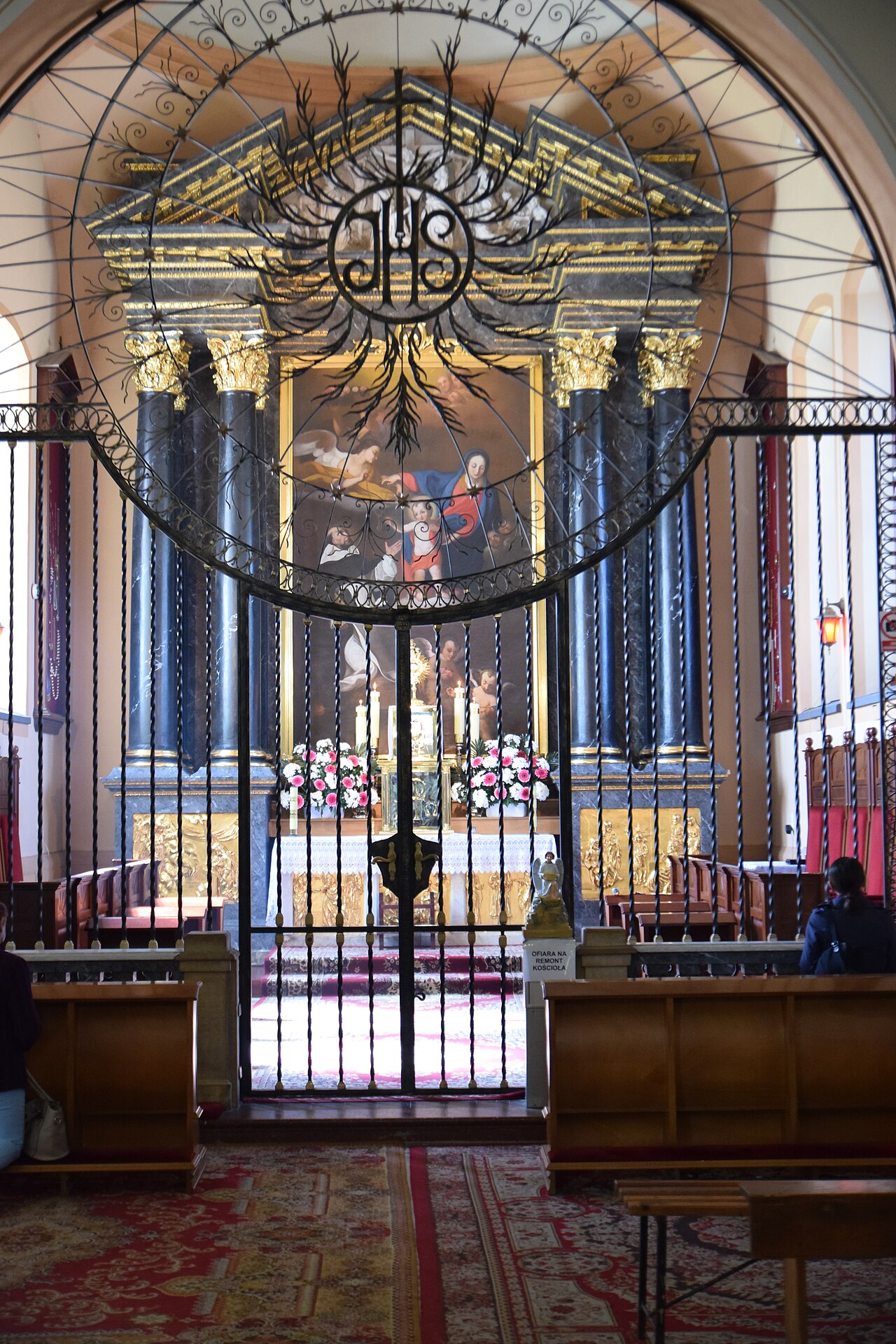
Further original photographs from the publisher
The Discovery in the Sacristy
The shrine documents the sequence with the names of those involved: on October 12, 2008, a Host fell to the floor during Communion. It was placed in water and later kept locked away. On October 19, the sacristan, Sister Julia Dubowska, noticed an intensely red area. She informed parish priest Stanisław Gniedziejko; other clergy were brought in. The careful preservation of the Blessed Sacrament had led to a discovery that was now investigated thoroughly.[2]
The Commission Secures Testimony and Sample Provenance
Archbishop Edward Ozorowski appointed a commission. It questioned witnesses, examined the specialist reports, and traced the storage. Its result was published on October 14, 2009: the sample examined came from the same Host that had been brought from the sacristy to the chapel; no indications of outside interference were found. Alongside the tissue finding thus stands an explicit examination of the link between sample and Host. This very link gives the result its weight for the events in Sokółka.[1]
Two Independent Specialist Assessments
Maria Sobaniec-Łotowska and Stanisław Sulkowski, specialists from the Medical University of Białystok, examined the material independently. The shrine's account reports a close connection between bread structure and tissue and describes the latter as human heart muscle with changes associated with an agonal state. According to the same source, the complete documentation is held by the curia. There are thus named investigators, an identified object of examination, and deposited records.[3]
The official communiqué reproduces the finding with its specialist gradation: the material indicated heart muscle or most closely resembled it among bodily tissues. This is a positive tissue assessment and goes substantially beyond establishing a red color. The complete laboratory report is not published in the sources examined here. The further statement concerning an agonal state comes from the shrine's summary; personal identification cannot be inferred from it. The work of the two university members represents their professional judgment, not a declaration by every institution within their university.[1][3]
The Host Is Publicly Venerated
On October 2, 2011, the Host was solemnly transferred to the church for public veneration. The ecclesiastical examination was thus followed by a specific liturgical decision. As recently as October 4, 2026, Archbishop Józef Guzdek presided over the diocesan Eucharistic Day in Sokółka. He connected veneration of Christ with willingness to make one's own life a gift for others. The shrine is permanently integrated into the archdiocese's Eucharistic life.[2][4]
Reverence for the Hidden Lord
The starting point was a Host that had fallen accidentally. Its holiness existed before the visible change: the Church guarded it because Christ is present in the sacrament. The extraordinary event directs attention to this presence and calls people from indifference to reverence and adoration. Those who make a pilgrimage to Sokółka therefore encounter a call to Holy Mass, confession, and love of Christ. The particular finding deepens attentiveness to the gift the Lord gives his Church in every celebration of the Eucharist.[1][4]
Witnesses & Investigators
Sister Julia Dubowska
Sacristan and direct observer
Discovered the red area on October 19, 2008, and informed the parish priest.[2]
Maria Sobaniec-Łotowska and Stanisław Sulkowski
Specialist pathology assessors
Assessed the sample independently; the discovery on the Host preceded their investigations.[3]
Edward Ozorowski
Archbishop of Białystok
Appointed the ecclesiastical commission to examine testimonies, storage, and expert reports.[1]
The unfolding story
- Beginning
The fallen Host is kept in water.[1]
- Red Area
Sister Julia discovers the striking change.[2]
- Sampling
Material is taken for assessment.[1]
- Communiqué
The curia publishes its assessment.[1]
- Public Veneration
The Host is solemnly transferred to the church.[2]
- Eucharistic Day
The archdiocese celebrates at the shrine.[4]
Ecclesiastical assessment
In 2009, the curia declared that the event did not contradict the faith but confirmed it. In 2011, the Host was transferred for public veneration; the archdiocese continues to foster this veneration today.
Does a Red Discoloration Explain the Whole Finding?
Microorganisms can produce red pigments on organic material; this is experimentally established. The general possibility, however, initially explains a color. It does not already explain the tissue structures described by two pathologists. Reducing Sokółka to a red stain leaves the decisive finding and examination of sample provenance out of account. A complete specialist comparison would require the original preparations, controls, and investigative records. The pigment study mentioned here did not examine the Host of Sokółka and therefore does not constitute a refutation of its tissue finding.[5][1]
Objections & Answers
How Independent Were the Investigations?
The curia and shrine expressly state that the two pathologists reached their judgments independently. This information deserves attention: the finding rests on two specialist assessments. It must be distinguished from additional independently organized sampling or replication in further laboratories; such steps are not documented in the accessible summaries. This does not constitute counterevidence. It describes the scope of the documented investigation. A researcher's personal faith likewise does not invalidate microscopic observations. Preparations, method, and documented result matter for their substantive assessment.[1][3]
Was It Merely a Pious Interpretation of a Stain?
Two specific facts stand against that: the ecclesiastical commission examined the witness statements and sample provenance; two pathologists assessed its tissue structure. An explanation considering only color fails to do justice to this documentation. The complete report would allow further specialist verification. Its lack of public accessibility is a limit to one's own insight, not evidence of an error. A reasoned positive assessment must consider together the named witnesses, the convergent direction of the reports, and the episcopal decision.[1][3]
Meaning for faith
Sokółka combines named observers, examined sample provenance, two independently delivered specialist judgments, and explicit ecclesiastical acceptance. These specific testimonies establish the case's weight. The shrine leads from the visible change to adoration of Christ, whose presence in the Blessed Sacrament it attests.[1][3][4]
How Eucharistic Miracles Are Examined
Securing the account of events, identifying the material, and reading the Church's judgment precisely.
Methods of examination and ecclesiastical procedure →Sources & Evidence
Information on accessibility and scope helps you assess the evidence for yourself.
- [1] Komunikat Kurii Metropolitarnej
Official communiqué with a brief account of the pathological results.
Open source · sokolka.archibial.pl ↗ - [2] Historia wydarzenia Eucharystycznego
Ecclesiastical reconstruction with named participants.
Open source · sokolka.archibial.pl ↗ - [3] Cząstka Ciała Pańskiego
The complete original records are described as deposited with the curia; only the summary was consulted here.
Open source · sokolka.archibial.pl ↗ - [4] Archidiecezjalny Dzień Eucharystii w Sokółce
Documents current ecclesiastical veneration and pastoral orientation.
Open source · archibial.pl ↗ - [5] Prodigiosin pigment of Serratia marcescens is associated with increased biomass production
General experimental research; not an investigation of Sokółka.
Open source · pubmed.ncbi.nlm.nih.gov ↗