Source-led study within World Religions: chronology, primary evidence and explicit objections.
START HERE · FOR THE SEARCHER
What does “Revelation, Prophecy and Miracle” teach, and can it lead the person to the final truth about God and salvation?
This study begins with the tradition’s own texts and categories. It then tests the claim by reason and history before comparing its promised liberation or salvation with creation, revelation, Christ and eternal communion with God.
1 · UNDERSTAND
What is this teaching?
Criteria for distinguishing divine speech from insight, charisma, legend and political authority. A credible revelation must be worthy of God, coherent with truths already known, publicly identifiable through prophecy and miracle, and transmitted by witnesses and an authority capable of preserving its content.
2 · WHY IT MATTERS
Why does it affect your final end?
Religions make incompatible claims about ultimate reality, the person, worship and salvation. Sincerity deserves respect, but it cannot make contradictions true.
3 · WHERE THE EVIDENCE LEADS
Where does the evidence lead?
Catholic faith rests upon God who reveals and upon motives of credibility proportioned to human reason. The Resurrection is the supreme sign because it vindicates Christ’s person and mission, while the apostolic Church preserves the revelation rather than replacing it. A claimant to revelation bears a burden proportionate to the authority demanded. Prophecy and miracle must be public, intelligible and connected to a doctrine worthy of God; private conviction, literary beauty or later institutional success cannot serve as their own divine authentication.
READ IN THIS ORDER
Understand the teachingIdentify what it says about ultimate reality, the person, suffering, worship, death and salvation.
Examine the evidenceDistinguish ancient source, later development, philosophical claim and devotional practice.
Ask whether the promise is completeSee whether the path preserves personal identity, moral responsibility and reconciliation with the Creator.
OPTIONALSource notes and argument map · Revelation, Prophecy and Miracle
This optional layer verifies the conclusion instead of merely repeating it. It identifies the controlling terms, dates the decisive witnesses, links the primary texts and states which premise the strongest contrary case must deny.
TERMS AND SCOPE
What signs make a claim of revelation credible without making faith a blind leap?
A credible revelation must be worthy of God, coherent with truths already known, publicly identifiable through prophecy and miracle, and transmitted by witnesses and an authority capable of preserving its content.
The historical sequence behind Revelation, Prophecy and Miracle
2000–500 BC Covenants, Vedic corpora and ancient cultic worlds The biblical patriarchal and Mosaic history, the long formation of Vedic traditions, and the temple cultures of the ancient Near East must be placed in their own chronologies. 600 BC–700 AD Axial schools, Christ and the rise of Islam Greek philosophy, the classical Upanishads, Buddhism, the prophetic tradition, the Incarnation and the early Islamic movement present radically different accounts of God, world, man and salvation.
The routes below lead to the primary texts, official sources and Katholon readers required to verify the claims made about Revelation, Prophecy and Miracle. They also place the dossier within a chain of adjacent questions so that no conclusion is detached from the evidence that qualifies it.
The replies concerning Revelation, Prophecy and Miracle do not answer weaker substitutes. Each objection is stated in a form an informed adherent could recognize before the premise or distinction on which the answer turns is identified.
Claim to test. What does “Revelation, Prophecy and Miracle” teach, and can it lead the person to the final truth about God and salvation?
Why it matters. Religions make incompatible claims about ultimate reality, the person, worship and salvation. Sincerity deserves respect, but it cannot make contradictions true.
Evidence-bearing step. The routes below lead to the primary texts, official sources and Katholon readers required to verify the claims made about Revelation, Prophecy and Miracle. They also place the dossier within a chain of adjacent questions so that no conclusion is detached from the evidence that qualifies it.
Conclusion reached. Catholic faith rests upon God who reveals and upon motives of credibility proportioned to human reason. The Resurrection is the supreme sign because it vindicates Christ’s person and mission, while the apostolic Church preserves the revelation rather than replacing it.
Degree of certainty. Keep demonstrative conclusions, historical probability, textual interpretation and Catholic doctrinal judgement distinct. The page states each conclusion only at the level warranted by its premises and sources.
Start with the question
What signs make a claim of revelation credible without making faith a blind leap?
A credible revelation must be worthy of God, coherent with truths already known, publicly identifiable through prophecy and miracle, and transmitted by witnesses and an authority capable of preserving its content.
A credible revelation must be worthy of God, coherent with truths already known, publicly identifiable through prophecy and miracle, and transmitted by witnesses and an authority capable of preserving its content.
The argument turns first upon possibility of revelation and prophetic claim. If God is intelligent and free, communication with rational creatures is possible. Revelation does not violate reason; it gives truths and a saving purpose that reason could not discover or secure by its own power. A prophet does more than teach wisdom. He speaks in God’s name, binds conscience and often locates his message within an existing covenant. The claim requires signs and moral credibility proportionate to its authority.
The remaining evidence—miracle as sign, prediction and fulfilment, public and esoteric revelation, and transmission and authority—must be read in chronological order. The Catholic conclusion follows only after the tradition’s own texts, schools and institutions have been identified, and after the philosophical premises at issue have been stated rather than assumed.
Historical setting
The historical sequence behind Revelation, Prophecy and Miracle
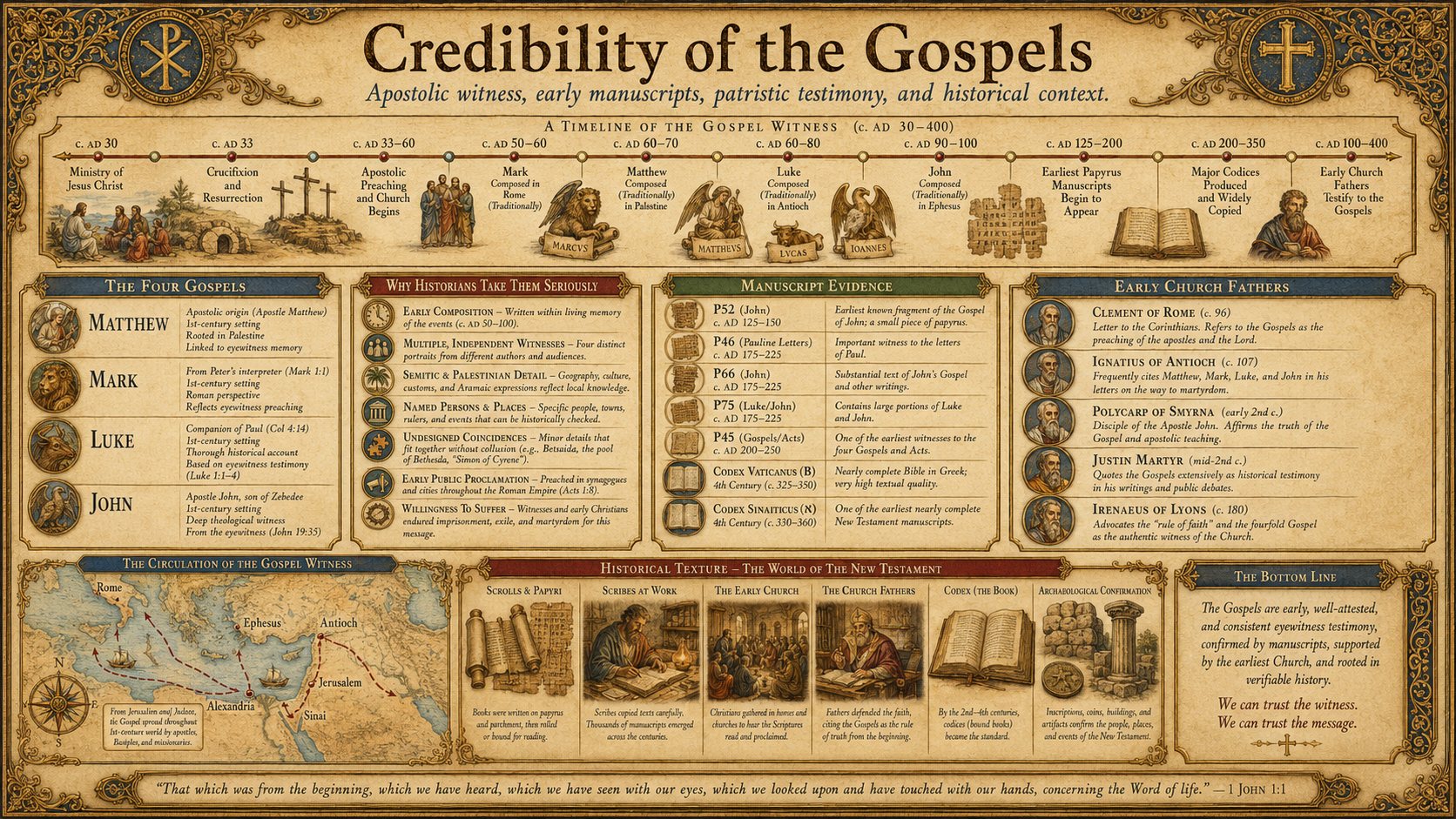
The sources relevant to revelation, prophecy and miracle belong to different periods and institutions. The sequence below prevents a late synthesis from being read back into an earlier witness.
Human communities everywhere distinguish sacred and profane, honour the dead, bind conduct to transcendent order and ask about origin and destiny. Similarity does not prove identity, but it establishes that religion is not a late eccentricity added to an otherwise self-explanatory humanity.
c. 2000–500 BC
Covenants, Vedic corpora and ancient cultic worlds
The biblical patriarchal and Mosaic history, the long formation of Vedic traditions, and the temple cultures of the ancient Near East must be placed in their own chronologies. Later comparison must not compress many centuries into one undifferentiated “ancient wisdom”.
c. 600 BC–700 AD
Axial schools, Christ and the rise of Islam
Greek philosophy, the classical Upanishads, Buddhism, the prophetic tradition, the Incarnation and the early Islamic movement present radically different accounts of God, world, man and salvation. Their proximity in textbooks must never conceal the incompatibility of central claims.
Modern period
Global contact, historical criticism and pluralism
Colonial encounter, translation, archaeology, comparative philology and modern migration made traditions newly visible to one another. The resulting scholarship corrected many caricatures, while philosophical pluralism sometimes drew the unwarranted conclusion that contradiction itself had ceased to matter.
Plain language
Key words in ordinary language
Before arguing about revelation, prophecy and miracle, the principal terms must be used in the sense given by the relevant texts and schools. A definition identifies the claim; it does not settle it.
The definitions used in the question of Revelation, Prophecy and Miracle are deliberately limited. They prevent equivocation while leaving the historical and metaphysical case to the sections that follow.
Where a term changes meaning between the schools or periods relevant to Revelation, Prophecy and Miracle, the dossier names the difference instead of forcing every witness into one modern definition.
Religion
A stable ordering of belief, worship, moral obligation and communal life toward what is held to be ultimate or sacred; the term must be used analogically because traditions organize these elements differently.
Revelation
A communication in which God makes known truths and a saving purpose not reached by unaided inquiry alone. A human insight, mythic symbol or meditative discovery is not automatically revelation in this strict sense.
Fulfilment
The reception and completion of a genuine preparation in a later divine act. Fulfilment confirms what was true, corrects what was distorted and surpasses what remained incomplete; it is neither simple destruction nor equal parallelism.
Religious pluralism
The empirical fact that many religions exist must be distinguished from the theory that contradictory religions are equally true or independently salvific.
Public evidence
What the evidence shows
Each movement in the study of revelation, prophecy and miracle joins a textual witness to its historical setting and doctrinal consequence. None is treated as an isolated quotation capable of carrying the entire argument.
Evidence 01
Possibility of revelation
What signs make a claim of revelation credible without making faith a blind leap?
If God is intelligent and free, communication with rational creatures is possible. Revelation does not violate reason; it gives truths and a saving purpose that reason could not discover or secure by its own power. This evidence fixes the point of departure and prevents a later summary from being mistaken for the earliest witness.
Evidence 02
Prophetic claim
What signs make a claim of revelation credible without making faith a blind leap?
A prophet does more than teach wisdom. He speaks in God’s name, binds conscience and often locates his message within an existing covenant. The claim requires signs and moral credibility proportionate to its authority. Its significance becomes clear only when wording, ritual setting and institutional reception are considered together.
Evidence 03
Miracle as sign
What signs make a claim of revelation credible without making faith a blind leap?
A miracle is not merely an unexplained event. It is an extraordinary effect whose context and intelligible relation to a divine message identify it as a sign. Investigation must exclude fraud, legend and premature appeal to gaps in science. The point does not by itself decide the whole controversy, but it narrows the possible explanations and excludes several popular caricatures.
Evidence 04
Prediction and fulfilment
What signs make a claim of revelation credible without making faith a blind leap?
Prophecy can involve future events, but biblical fulfilment also gathers typology, covenant and patterns of divine action. Vague predictions retrofitted after the event do not carry the same weight as specific and textually prior witness. Here chronology matters: a later school may develop an earlier insight, yet it may not silently be projected back into sources that use different categories.
Evidence 05
Public and esoteric revelation
What signs make a claim of revelation credible without making faith a blind leap?
The biblical and apostolic economy unfolds through public acts, communities and texts. Secret knowledge available only to initiates lacks the ordinary means by which a universal saving claim can be examined and preserved. The comparison with Catholic doctrine must therefore address the proposition actually asserted, not a modernized version chosen because it is easier to reconcile.
Evidence 06
Transmission and authority
What signs make a claim of revelation credible without making faith a blind leap?
A revelation without identifiable witnesses, canon or interpretive community is vulnerable to indefinite reinvention. Catholic credibility therefore joins miracle and prophecy to apostolic testimony and the visible Church. Taken with the preceding evidence, this final layer shows where historical description ends and metaphysical or theological judgement must begin.
The Catholic answer
What the Catholic faith affirms—and why
Catholic faith rests upon God who reveals and upon motives of credibility proportioned to human reason. The Resurrection is the supreme sign because it vindicates Christ’s person and mission, while the apostolic Church preserves the revelation rather than replacing it.
The comparison begins from truths already established by reason: reality is intelligible, contradiction cannot be true in the same respect, moral obligation is not created by appetite, and contingent being requires a first principle. A religious claim may deepen these truths, but it cannot reverse them without forfeiting intelligibility.
The Church recognizes rays of truth, moral seriousness and providential preparation outside her visible bounds. Recognition is not relativism. Whatever is true has one divine source; whatever contradicts the revealed identity of God, the Incarnation or the saving work of Christ cannot be received as a parallel completion.
Christ is not placed at the end of a neutral catalogue as one option among many. His public life, death and resurrection are historical claims; his apostolic Church makes a visible claim of authority; and the credibility of these claims must be judged by evidence rather than by a prior rule that excludes unique revelation.
A claimant to revelation bears a burden proportionate to the authority demanded. Prophecy and miracle must be public, intelligible and connected to a doctrine worthy of God; private conviction, literary beauty or later institutional success cannot serve as their own divine authentication.
The appropriate response to revelation, prophecy and miracle is neither contempt nor vague admiration. It is accurate quotation, patient distinction, positive proof of the Catholic position and an invitation to the fullness of truth and sacramental life in Christ.
Why the conclusion follows
Why the conclusion follows
The evidence concerning Revelation, Prophecy and Miracle is now rendered as explicit inferences. Formalization does not replace the sources; it shows exactly where agreement, denial or a scholastic distinction is required.
1
Argument from coherent truth
Major. If a determinate claim concerning revelation, prophecy and miracle contradicts a truth established by reason or by reliable public evidence, both claims cannot be true in the same respect.
Minor. A universal divine message should be marked by signs proportionate to divine authority.
Therefore. Private intensity or literary beauty alone cannot establish that God has spoken.
Limit of the inference. The inference concerns the proposition examined in this study, not every practice, adherent or moral insight associated with revelation, prophecy and miracle.
2
Argument from historical priority
Major. When an interpretation of revelation, prophecy and miracle contradicts earlier and multiply attested sources, the later corrective claim bears a proportionately greater evidential burden.
Minor. Christian apostolic sources are early, multiple and embedded in communities that suffered for their witness.
Therefore. Later contradictory revelations must explain and outweigh this prior evidence.
Limit of the inference. Chronological priority alone does not establish the truth of revelation, prophecy and miracle; it prevents a later assertion from serving as its own proof against an earlier witness.
3
Argument from adequate salvation
Major. An account of revelation, prophecy and miracle can function as a sufficient path of salvation only if it diagnoses the real human predicament and preserves every genuine good of the person while healing the evil that disorders him.
Minor. Man’s deepest disorder includes guilt and death, not ignorance alone.
Therefore. The Resurrection and sacramental economy directly answer this predicament.
Limit of the inference. This comparison concerns the objective adequacy of the claims surrounding revelation, prophecy and miracle; it is not a judgement about the subjective guilt or final destiny of an individual adherent.
Questions answered
The strongest objections answered
The replies concerning Revelation, Prophecy and Miracle do not answer weaker substitutes. Each objection is stated in a form an informed adherent could recognize before the premise or distinction on which the answer turns is identified.
1
Miracles are impossible because laws of nature are exceptionless
Any miracle report is therefore mistaken.
Open reply
Objection stated at full strength. Laws describe regular created powers under specified conditions; they do not prove that the creator cannot produce an effect beyond those powers. The historical question remains whether a particular event occurred.
Catholic reply. Do not infer miracle from ignorance, but do not define it away by assuming metaphysical naturalism.
Necessary distinction. Distinguish methodological regularity from the metaphysical claim that no transcendent cause exists.
2
Competing miracle reports cancel one another
Every religion has wonders, so none identifies truth.
Open reply
Objection stated at full strength. Reports vary greatly in date, evidence, doctrinal context and type. Contradictory claims require discrimination, not a rule that every witness has equal weight.
Catholic reply. The Resurrection is examined as a specific public claim, not accepted because wonders are common.
Necessary distinction. Distinguish a reported marvel, providential answer, preternatural event and miracle confirming doctrine.
3
Comparison already privileges Christianity
A Christian framework decides the result before the evidence is heard.
Open reply
Objection stated at full strength. A Christian framework decides the result before the evidence is heard.
Catholic reply. Every inquiry uses standards. The relevant question is whether the standards—non-contradiction, historical sequence, textual evidence and adequate causality—are rationally defensible and applied consistently, including to Christian claims.
Necessary distinction. A confessional conclusion is not the same as a circular method. The Catholic case must still establish its premises and permit its sources to be examined.
4
All traditions are culturally conditioned
Historical conditioning makes universal truth claims impossible.
Open reply
Objection stated at full strength. Historical conditioning makes universal truth claims impossible.
Catholic reply. Language, ritual and concepts are historically embodied, but the proposition that all truth is culturally relative would itself claim trans-cultural validity. Historical study limits hasty inference; it does not abolish reality.
Necessary distinction. Distinguish the contingent form in which a truth is expressed from the truth or falsity of what the expression asserts.
Check the evidence
Sources for checking the conclusion
The routes below lead to the primary texts, official sources and Katholon readers required to verify the claims made about Revelation, Prophecy and Miracle. They also place the dossier within a chain of adjacent questions so that no conclusion is detached from the evidence that qualifies it.
Dei Filius
The nature, transmission and completion of revelation.
Revelation, Prophecy and Miracle cannot be judged in isolation. Its full meaning depends upon neighbouring questions of authority, the human person, salvation and the historical claim of Christ. The related studys continue one ordered inquiry rather than supplying optional background.
Catholic faith rests upon God who reveals and upon motives of credibility proportioned to human reason. The Resurrection is the supreme sign because it vindicates Christ’s person and mission, while the apostolic Church preserves the revelation rather than replacing it. A claimant to revelation bears a burden proportionate to the authority demanded. Prophecy and miracle must be public, intelligible and connected to a doctrine worthy of God; private conviction, literary beauty or later institutional success cannot serve as their own divine authentication.
This judgement concerns propositions and evidence, not the human worth of every person who holds them. Truth, personal culpability and pastoral charity must be distinguished without treating contradictory claims as equally true.