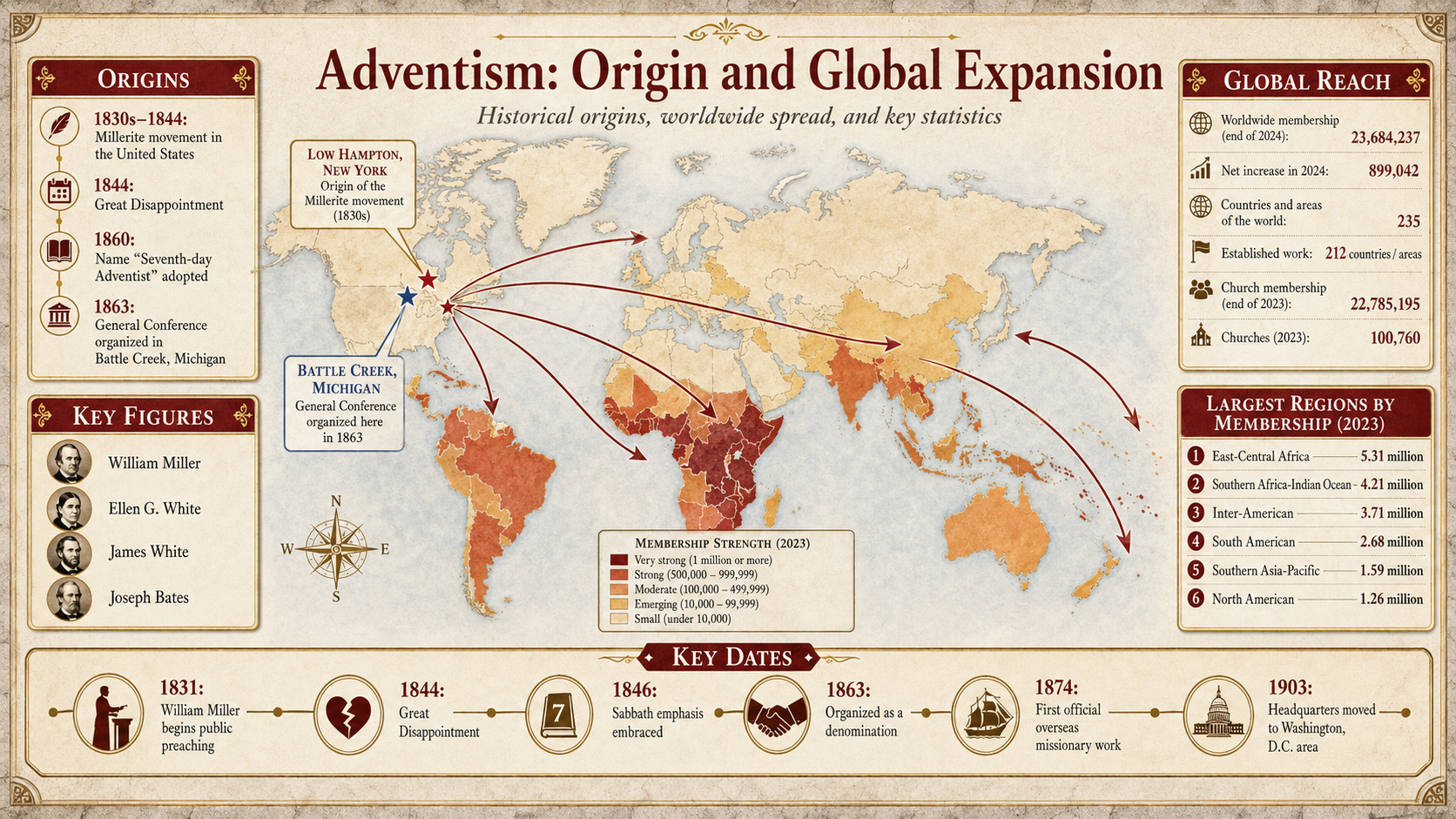
Founder
Adventism has several formative figures. Catholic analysis does not reduce the movement to one personality, but the founder question remains decisive because public revelation is closed, apostolic mission is not self-created, and the Church cannot be refounded by a private visionary, preacher or publishing network.
William Miller: calculation without apostolic office
William Miller was the indispensable precursor. He did not found the later denomination in its final form, but without his chronological preaching there is no Great Disappointment, and without the Great Disappointment there is no Adventist sanctuary doctrine in its later form. Miller's role reveals the root problem: a private exegete, without apostolic office, can gather a movement around a prophetic calculation.
Adventist:Miller was a sincere Bible student who revived expectation of Christ's coming.
Catholic:Sincerity is not disputed. The Catholic point is formal: no man receives authority to bind the Church by private calculation. Christ did not leave His flock to date-setting movements, but to apostles and their successors teaching the deposit of faith.
Thomistic principle: Authority is a formal cause in public religion. Without lawful mission, doctrine remains private opinion even when preached with zeal.
Sources: Romans 10:15; 2 Timothy 1:13-14; Titus 1:5; Matthew 28:18-20; Acts 1:7.
Argument in full
William Miller: calculation without apostolic office has to be judged by the Catholic tests of mission, doctrine and continuity. A founder may be personally sincere and still lack the authority to found a rule of faith against the Church already existing from the apostles. Catholic analysis therefore does not begin by attacking motives; it asks what office was received, from whom it was received, and whether the doctrine taught can be traced to the apostolic deposit.
A popular comparison helps: a man may study medicine passionately, read many medical books and help many sick people, but that does not make him the college of physicians, nor does it authorise him to rewrite the constitution of medicine. In the same way, a biblical lecturer or visionary can exhort, warn and influence, but cannot become the formal interpreter of the universal Church unless he or she stands within the authority Christ gave to the apostles and their successors.
This matters because Adventism often treats nineteenth-century founders as if they merely recovered forgotten Bible truth. The Catholic reply is that the alleged recovery condemns the whole intervening visible Church as defective in essential obedience. Such a claim needs more than intensity, visions, charts or moral seriousness; it requires apostolic authority.
The issue is not whether a founder was energetic, persuasive or personally devout. The issue is whether that founder received apostolic mission. Catholic theology judges religious founders by their relation to the deposit of faith, not by the force of their personality.
Authority tested by mission
The founders must be judged by Catholic criteria of mission, not by charisma alone. A person may be sincere, learned, zealous and morally serious, yet still lack authority to bind the universal Church. The apostolic office is received, not self-generated; it is transmitted, not inferred from charts, visions or persuasive preaching.
Private influence versus public rule
Catholic theology can admit that private warnings or exhortations may awaken consciences. What it cannot admit is a new interpretive authority that practically determines the meaning of Scripture against the Church’s continuous public faith. If a visionary or lecturer becomes the key without which the Bible is allegedly misunderstood, that figure is functioning as more than a private witness.
Dialogue use
Ask: Did this founder receive apostolic ordination? Did he or she teach in communion with the bishops descending from the apostles? Did the doctrine taught belong to the public faith already worshipped in the ancient liturgy? If these answers are negative, the founder may be historically important but cannot be a rule of faith.
Thomistic synthesis
Authority is a formal cause in teaching. Materially quoting Scripture is not enough; the question is who has the office to judge, define and hand on the meaning of revelation. Without legitimate form, zeal remains private persuasion.
William Miller: calculation without apostolic office concerns authority before it concerns personality. Catholic theology can acknowledge sincerity, discipline, sacrifice and religious influence, while still asking whether the person or circle possessed public apostolic office. Private conviction cannot become a new rule of faith for the universal Church.
The practical test is simple: does the founder hand on what was received from the apostles through the visible Church, or does he become the lens through which Scripture, history and the Church are reinterpreted? If the latter occurs, the movement has acquired a functional magisterium while denying the Catholic one.
Joseph Bates, James White and doctrinal synthesis
Joseph Bates helped connect the seventh-day Sabbath to the post-1844 Adventist identity. James White helped organise, publish and stabilise the movement. Their importance is not merely biographical. They show that Adventism is a synthesis: apocalyptic chronology, Sabbath restoration, publishing activism and communal discipline. The movement did not simply continue ancient Christianity; it assembled a new doctrinal centre from Protestant materials after 1844.
Adventist:The founders followed Scripture where other churches compromised.
Catholic:A Catholic asks why the Church of martyr-bishops, Fathers, councils and ancient liturgy must be judged by nineteenth-century restorationists. The ancient Church was already visibly Christian before Adventism existed. It gathered on the Lord's Day and celebrated the Eucharist long before modern denominational disputes.
Thomistic principle: The prior has interpretive weight over the posterior when the issue is historical continuity. A later claimant must demonstrate continuity with the earlier form, not merely assert restoration after universal corruption.
Sources: Didache 14; Ignatius, Magnesians 9; Justin, First Apology 67; Acts 20:7; 1 Corinthians 16:2; Revelation 1:10.
Argument in full
Joseph Bates, James White and doctrinal synthesis has to be judged by the Catholic tests of mission, doctrine and continuity. A founder may be personally sincere and still lack the authority to found a rule of faith against the Church already existing from the apostles. Catholic analysis therefore does not begin by attacking motives; it asks what office was received, from whom it was received, and whether the doctrine taught can be traced to the apostolic deposit.
A popular comparison helps: a man may study medicine passionately, read many medical books and help many sick people, but that does not make him the college of physicians, nor does it authorise him to rewrite the constitution of medicine. In the same way, a biblical lecturer or visionary can exhort, warn and influence, but cannot become the formal interpreter of the universal Church unless he or she stands within the authority Christ gave to the apostles and their successors.
This matters because Adventism often treats nineteenth-century founders as if they merely recovered forgotten Bible truth. The Catholic reply is that the alleged recovery condemns the whole intervening visible Church as defective in essential obedience. Such a claim needs more than intensity, visions, charts or moral seriousness; it requires apostolic authority.
The issue is not whether a founder was energetic, persuasive or personally devout. The issue is whether that founder received apostolic mission. Catholic theology judges religious founders by their relation to the deposit of faith, not by the force of their personality.
Authority tested by mission
The founders must be judged by Catholic criteria of mission, not by charisma alone. A person may be sincere, learned, zealous and morally serious, yet still lack authority to bind the universal Church. The apostolic office is received, not self-generated; it is transmitted, not inferred from charts, visions or persuasive preaching.
Private influence versus public rule
Catholic theology can admit that private warnings or exhortations may awaken consciences. What it cannot admit is a new interpretive authority that practically determines the meaning of Scripture against the Church’s continuous public faith. If a visionary or lecturer becomes the key without which the Bible is allegedly misunderstood, that figure is functioning as more than a private witness.
Dialogue use
Ask: Did this founder receive apostolic ordination? Did he or she teach in communion with the bishops descending from the apostles? Did the doctrine taught belong to the public faith already worshipped in the ancient liturgy? If these answers are negative, the founder may be historically important but cannot be a rule of faith.
Thomistic synthesis
Authority is a formal cause in teaching. Materially quoting Scripture is not enough; the question is who has the office to judge, define and hand on the meaning of revelation. Without legitimate form, zeal remains private persuasion.
Joseph Bates, James White and doctrinal synthesis concerns authority before it concerns personality. Catholic theology can acknowledge sincerity, discipline, sacrifice and religious influence, while still asking whether the person or circle possessed public apostolic office. Private conviction cannot become a new rule of faith for the universal Church.
The practical test is simple: does the founder hand on what was received from the apostles through the visible Church, or does he become the lens through which Scripture, history and the Church are reinterpreted? If the latter occurs, the movement has acquired a functional magisterium while denying the Catholic one.
Ellen G. White: prophetic testimony and the Catholic test of authority
Ellen G. White is central because Adventism did not remain a loose Millerite memory. Her visions, counsels, conflict narrative, health teachings and ecclesial influence helped give the movement coherence. Adventists often say her writings are not above Scripture. The Catholic reply is that the practical function of a claimed prophet can be decisive even when formal language says Scripture is supreme.
The Catholic test is not whether a visionary uses biblical language or encourages moral seriousness. The tests are: Does she introduce a new rule of faith? Does she bind interpretation? Does she support doctrines unknown to the apostolic Church? Does her authority compensate for the absence of apostolic succession? Does the movement become unintelligible without her? If yes, the problem is structural.
Adventist:Ellen White is a prophetic messenger, not a replacement for the Bible.
Catholic:Private revelation, even when approved in Catholic life, never becomes a new public rule of faith. It cannot correct the apostolic Church, found a denomination, redefine the sanctuary, or make the remnant Church identifiable by a nineteenth-century message.
Thomistic principle: Public revelation is complete in Christ and apostolic testimony. A private illumination can move prudence and devotion; it cannot be a formal principle of dogma for the universal Church.
Sources: Hebrews 1:1-2; Jude 3; Galatians 1:8-9; 2 Thessalonians 2:15; Dei Verbum 4 and 10; Catechism of the Catholic Church 66-67.
Argument in full
Ellen G. White: prophetic testimony and the Catholic test of authority has to be judged by the Catholic tests of mission, doctrine and continuity. A founder may be personally sincere and still lack the authority to found a rule of faith against the Church already existing from the apostles. Catholic analysis therefore does not begin by attacking motives; it asks what office was received, from whom it was received, and whether the doctrine taught can be traced to the apostolic deposit.
A popular comparison helps: a man may study medicine passionately, read many medical books and help many sick people, but that does not make him the college of physicians, nor does it authorise him to rewrite the constitution of medicine. In the same way, a biblical lecturer or visionary can exhort, warn and influence, but cannot become the formal interpreter of the universal Church unless he or she stands within the authority Christ gave to the apostles and their successors.
This matters because Adventism often treats nineteenth-century founders as if they merely recovered forgotten Bible truth. The Catholic reply is that the alleged recovery condemns the whole intervening visible Church as defective in essential obedience. Such a claim needs more than intensity, visions, charts or moral seriousness; it requires apostolic authority.
Authority is not an ornament added after doctrine. It is the public form by which doctrine is preserved, judged and handed on. Without apostolic succession and a visible teaching office, every appeal to the Bible finally depends on private selection.
The issue is not whether a founder was energetic, persuasive or personally devout. The issue is whether that founder received apostolic mission. Catholic theology judges religious founders by their relation to the deposit of faith, not by the force of their personality.
Authority tested by mission
The founders must be judged by Catholic criteria of mission, not by charisma alone. A person may be sincere, learned, zealous and morally serious, yet still lack authority to bind the universal Church. The apostolic office is received, not self-generated; it is transmitted, not inferred from charts, visions or persuasive preaching.
Private influence versus public rule
Catholic theology can admit that private warnings or exhortations may awaken consciences. What it cannot admit is a new interpretive authority that practically determines the meaning of Scripture against the Church’s continuous public faith. If a visionary or lecturer becomes the key without which the Bible is allegedly misunderstood, that figure is functioning as more than a private witness.
Dialogue use
Ask: Did this founder receive apostolic ordination? Did he or she teach in communion with the bishops descending from the apostles? Did the doctrine taught belong to the public faith already worshipped in the ancient liturgy? If these answers are negative, the founder may be historically important but cannot be a rule of faith.
Thomistic synthesis
Authority is a formal cause in teaching. Materially quoting Scripture is not enough; the question is who has the office to judge, define and hand on the meaning of revelation. Without legitimate form, zeal remains private persuasion.
Ellen G. White: prophetic testimony and the Catholic test of authority concerns authority before it concerns personality. Catholic theology can acknowledge sincerity, discipline, sacrifice and religious influence, while still asking whether the person or circle possessed public apostolic office. Private conviction cannot become a new rule of faith for the universal Church.
The practical test is simple: does the founder hand on what was received from the apostles through the visible Church, or does he become the lens through which Scripture, history and the Church are reinterpreted? If the latter occurs, the movement has acquired a functional magisterium while denying the Catholic one.
Private revelation versus the deposit of faith
Catholic theology distinguishes public revelation from private revelation. Public revelation is the once-for-all revelation of God in Christ, handed on through the apostles. Private revelation may call people to repentance, prayer or prudence, but it never becomes a new article of faith and never judges the apostolic Church from outside.
This distinction exposes a difficulty in Adventist self-understanding. If Ellen White is merely devotional, Adventism loses one of its stabilising interpretive authorities. If she is doctrinally indispensable, then Adventism has acquired a post-apostolic prophetic organ that functions as a rule of faith.
Adventist:God can raise prophets after the apostles.
Catholic:God can give charisms, but no post-apostolic prophet can create a new public economy of doctrine. A prophet within the Church calls back to the apostolic faith; he does not found a body against the apostolic Church.
Thomistic principle: A secondary instrument cannot become the principal rule. Grace perfects and serves the order Christ instituted; it does not abolish the visible apostolic structure.
Sources: 1 Corinthians 12; Ephesians 2:20; 1 John 4:1; Jude 3; CCC 66-67.
Argument in full
Private revelation versus the deposit of faith has to be judged by the Catholic tests of mission, doctrine and continuity. A founder may be personally sincere and still lack the authority to found a rule of faith against the Church already existing from the apostles. Catholic analysis therefore does not begin by attacking motives; it asks what office was received, from whom it was received, and whether the doctrine taught can be traced to the apostolic deposit.
A popular comparison helps: a man may study medicine passionately, read many medical books and help many sick people, but that does not make him the college of physicians, nor does it authorise him to rewrite the constitution of medicine. In the same way, a biblical lecturer or visionary can exhort, warn and influence, but cannot become the formal interpreter of the universal Church unless he or she stands within the authority Christ gave to the apostles and their successors.
This matters because Adventism often treats nineteenth-century founders as if they merely recovered forgotten Bible truth. The Catholic reply is that the alleged recovery condemns the whole intervening visible Church as defective in essential obedience. Such a claim needs more than intensity, visions, charts or moral seriousness; it requires apostolic authority.
The issue is not whether a founder was energetic, persuasive or personally devout. The issue is whether that founder received apostolic mission. Catholic theology judges religious founders by their relation to the deposit of faith, not by the force of their personality.
Authority tested by mission
The founders must be judged by Catholic criteria of mission, not by charisma alone. A person may be sincere, learned, zealous and morally serious, yet still lack authority to bind the universal Church. The apostolic office is received, not self-generated; it is transmitted, not inferred from charts, visions or persuasive preaching.
Private influence versus public rule
Catholic theology can admit that private warnings or exhortations may awaken consciences. What it cannot admit is a new interpretive authority that practically determines the meaning of Scripture against the Church’s continuous public faith. If a visionary or lecturer becomes the key without which the Bible is allegedly misunderstood, that figure is functioning as more than a private witness.
Dialogue use
Ask: Did this founder receive apostolic ordination? Did he or she teach in communion with the bishops descending from the apostles? Did the doctrine taught belong to the public faith already worshipped in the ancient liturgy? If these answers are negative, the founder may be historically important but cannot be a rule of faith.
Thomistic synthesis
Authority is a formal cause in teaching. Materially quoting Scripture is not enough; the question is who has the office to judge, define and hand on the meaning of revelation. Without legitimate form, zeal remains private persuasion.
Private revelation versus the deposit of faith concerns authority before it concerns personality. Catholic theology can acknowledge sincerity, discipline, sacrifice and religious influence, while still asking whether the person or circle possessed public apostolic office. Private conviction cannot become a new rule of faith for the universal Church.
The practical test is simple: does the founder hand on what was received from the apostles through the visible Church, or does he become the lens through which Scripture, history and the Church are reinterpreted? If the latter occurs, the movement has acquired a functional magisterium while denying the Catholic one.
Apostolic succession: the missing formal link
The deepest founder problem is not psychological but ecclesiological. Adventism lacks apostolic succession. It has ministers, elders, administrators and teachers, but not bishops in historical sacramental continuity with the apostles. Therefore it cannot claim the same formal continuity as the Catholic Church or the ancient episcopal communions.
Catholic argument here is simple: if Christ founded a visible Church with apostolic ministry, then a nineteenth-century body without that succession cannot be the restored original Church. If apostolic succession is unnecessary, then the structure seen in the ancient Church becomes accidental. Adventism must then explain why the early post-apostolic Church is already so unlike Adventism.
Argument in full
Apostolic succession: the missing formal link has to be judged by the Catholic tests of mission, doctrine and continuity. A founder may be personally sincere and still lack the authority to found a rule of faith against the Church already existing from the apostles. Catholic analysis therefore does not begin by attacking motives; it asks what office was received, from whom it was received, and whether the doctrine taught can be traced to the apostolic deposit.
A popular comparison helps: a man may study medicine passionately, read many medical books and help many sick people, but that does not make him the college of physicians, nor does it authorise him to rewrite the constitution of medicine. In the same way, a biblical lecturer or visionary can exhort, warn and influence, but cannot become the formal interpreter of the universal Church unless he or she stands within the authority Christ gave to the apostles and their successors.
This matters because Adventism often treats nineteenth-century founders as if they merely recovered forgotten Bible truth. The Catholic reply is that the alleged recovery condemns the whole intervening visible Church as defective in essential obedience. Such a claim needs more than intensity, visions, charts or moral seriousness; it requires apostolic authority.
Authority is not an ornament added after doctrine. It is the public form by which doctrine is preserved, judged and handed on. Without apostolic succession and a visible teaching office, every appeal to the Bible finally depends on private selection.
The issue is not whether a founder was energetic, persuasive or personally devout. The issue is whether that founder received apostolic mission. Catholic theology judges religious founders by their relation to the deposit of faith, not by the force of their personality.
Authority tested by mission
The founders must be judged by Catholic criteria of mission, not by charisma alone. A person may be sincere, learned, zealous and morally serious, yet still lack authority to bind the universal Church. The apostolic office is received, not self-generated; it is transmitted, not inferred from charts, visions or persuasive preaching.
Private influence versus public rule
Catholic theology can admit that private warnings or exhortations may awaken consciences. What it cannot admit is a new interpretive authority that practically determines the meaning of Scripture against the Church’s continuous public faith. If a visionary or lecturer becomes the key without which the Bible is allegedly misunderstood, that figure is functioning as more than a private witness.
Dialogue use
Ask: Did this founder receive apostolic ordination? Did he or she teach in communion with the bishops descending from the apostles? Did the doctrine taught belong to the public faith already worshipped in the ancient liturgy? If these answers are negative, the founder may be historically important but cannot be a rule of faith.
Thomistic synthesis
Authority is a formal cause in teaching. Materially quoting Scripture is not enough; the question is who has the office to judge, define and hand on the meaning of revelation. Without legitimate form, zeal remains private persuasion.
Apostolic succession: the missing formal link concerns authority before it concerns personality. Catholic theology can acknowledge sincerity, discipline, sacrifice and religious influence, while still asking whether the person or circle possessed public apostolic office. Private conviction cannot become a new rule of faith for the universal Church.
The practical test is simple: does the founder hand on what was received from the apostles through the visible Church, or does he become the lens through which Scripture, history and the Church are reinterpreted? If the latter occurs, the movement has acquired a functional magisterium while denying the Catholic one.
Four Catholic tests for restorationist founders
Mission. A public teacher of the Church must be sent. In Scripture, mission is visible: Christ sends apostles, apostles appoint ministers, and churches are ordered by recognisable authority. Private conviction alone does not create ecclesial office.
Continuity. A founder must either stand inside the apostolic Church as reformer or stand outside as creator of a new body. Adventist founders stand outside Catholic apostolic succession. Their authority is therefore charismatic, exegetical and organisational, not apostolic in the Catholic sense.
Worship. The ancient Church is Eucharistic. Any restoration that does not restore sacrifice of the Mass, sacramental priesthood and episcopal unity fails at the level of cult. A church is not only a doctrine-list; it is worshipping body.
Rule of faith. A founder who makes Scripture readable only through his or her crisis-narrative has become more than a witness. The founder becomes a lens. Catholic doctrine cannot accept a nineteenth-century lens as the rule by which the ancient Church is judged.
Adventist:God uses humble instruments outside corrupt structures.
Catholic:God can use anyone for partial goods. But public authority to define the Church's faith comes through the apostolic mission Christ established, not through self-validating restoration.
Thomistic principle: Charism and office are distinct. A charism can assist; office governs publicly. Confusing them turns private impulse into public law.
Sources: Romans 10:15; Acts 14:23; Titus 1:5; 2 Timothy 2:2; Luke 10:16.
Argument in full
Four Catholic tests for restorationist founders has to be judged by the Catholic tests of mission, doctrine and continuity. A founder may be personally sincere and still lack the authority to found a rule of faith against the Church already existing from the apostles. Catholic analysis therefore does not begin by attacking motives; it asks what office was received, from whom it was received, and whether the doctrine taught can be traced to the apostolic deposit.
A popular comparison helps: a man may study medicine passionately, read many medical books and help many sick people, but that does not make him the college of physicians, nor does it authorise him to rewrite the constitution of medicine. In the same way, a biblical lecturer or visionary can exhort, warn and influence, but cannot become the formal interpreter of the universal Church unless he or she stands within the authority Christ gave to the apostles and their successors.
This matters because Adventism often treats nineteenth-century founders as if they merely recovered forgotten Bible truth. The Catholic reply is that the alleged recovery condemns the whole intervening visible Church as defective in essential obedience. Such a claim needs more than intensity, visions, charts or moral seriousness; it requires apostolic authority.
The issue is not whether a founder was energetic, persuasive or personally devout. The issue is whether that founder received apostolic mission. Catholic theology judges religious founders by their relation to the deposit of faith, not by the force of their personality.
Authority tested by mission
The founders must be judged by Catholic criteria of mission, not by charisma alone. A person may be sincere, learned, zealous and morally serious, yet still lack authority to bind the universal Church. The apostolic office is received, not self-generated; it is transmitted, not inferred from charts, visions or persuasive preaching.
Private influence versus public rule
Catholic theology can admit that private warnings or exhortations may awaken consciences. What it cannot admit is a new interpretive authority that practically determines the meaning of Scripture against the Church’s continuous public faith. If a visionary or lecturer becomes the key without which the Bible is allegedly misunderstood, that figure is functioning as more than a private witness.
Dialogue use
Ask: Did this founder receive apostolic ordination? Did he or she teach in communion with the bishops descending from the apostles? Did the doctrine taught belong to the public faith already worshipped in the ancient liturgy? If these answers are negative, the founder may be historically important but cannot be a rule of faith.
Thomistic synthesis
Authority is a formal cause in teaching. Materially quoting Scripture is not enough; the question is who has the office to judge, define and hand on the meaning of revelation. Without legitimate form, zeal remains private persuasion.
Four Catholic tests for restorationist founders concerns authority before it concerns personality. Catholic theology can acknowledge sincerity, discipline, sacrifice and religious influence, while still asking whether the person or circle possessed public apostolic office. Private conviction cannot become a new rule of faith for the universal Church.
The practical test is simple: does the founder hand on what was received from the apostles through the visible Church, or does he become the lens through which Scripture, history and the Church are reinterpreted? If the latter occurs, the movement has acquired a functional magisterium while denying the Catholic one.
Ellen White's functional authority
The important question is not only what Adventists formally say about Ellen White. The important question is what her writings do. They shape the reading of history, identify the conflict between Sabbath and Sunday, intensify anti-Roman interpretation, support health and lifestyle norms, and stabilise the movement after disappointment. That is functional authority.
A Catholic can acknowledge that many religious writers influence their communities. The difference is that Catholic spiritual writers remain subject to the public rule of faith. Their visions, counsels and devotions do not create dogma. In Adventism, however, Ellen White's role is tied to doctrines that distinguish the denomination from the older Christian world. Her authority is therefore not merely ornamental.
Adventist:Her writings are a lesser light leading to the greater light.
Catholic:If the lesser light determines how the greater light is read on decisive doctrines, it functions as a doctrinal lens. A lens can rule without being called equal.
Thomistic principle: Formal causality is known by effect. If a source consistently determines interpretation, it has formal authority in practice.
Sources: 1 John 4:1; Galatians 1:8-9; Jude 3; CCC 66-67.
Argument in full
Ellen White's functional authority has to be judged by the Catholic tests of mission, doctrine and continuity. A founder may be personally sincere and still lack the authority to found a rule of faith against the Church already existing from the apostles. Catholic analysis therefore does not begin by attacking motives; it asks what office was received, from whom it was received, and whether the doctrine taught can be traced to the apostolic deposit.
A popular comparison helps: a man may study medicine passionately, read many medical books and help many sick people, but that does not make him the college of physicians, nor does it authorise him to rewrite the constitution of medicine. In the same way, a biblical lecturer or visionary can exhort, warn and influence, but cannot become the formal interpreter of the universal Church unless he or she stands within the authority Christ gave to the apostles and their successors.
This matters because Adventism often treats nineteenth-century founders as if they merely recovered forgotten Bible truth. The Catholic reply is that the alleged recovery condemns the whole intervening visible Church as defective in essential obedience. Such a claim needs more than intensity, visions, charts or moral seriousness; it requires apostolic authority.
Authority is not an ornament added after doctrine. It is the public form by which doctrine is preserved, judged and handed on. Without apostolic succession and a visible teaching office, every appeal to the Bible finally depends on private selection.
The issue is not whether a founder was energetic, persuasive or personally devout. The issue is whether that founder received apostolic mission. Catholic theology judges religious founders by their relation to the deposit of faith, not by the force of their personality.
Authority tested by mission
The founders must be judged by Catholic criteria of mission, not by charisma alone. A person may be sincere, learned, zealous and morally serious, yet still lack authority to bind the universal Church. The apostolic office is received, not self-generated; it is transmitted, not inferred from charts, visions or persuasive preaching.
Private influence versus public rule
Catholic theology can admit that private warnings or exhortations may awaken consciences. What it cannot admit is a new interpretive authority that practically determines the meaning of Scripture against the Church’s continuous public faith. If a visionary or lecturer becomes the key without which the Bible is allegedly misunderstood, that figure is functioning as more than a private witness.
Dialogue use
Ask: Did this founder receive apostolic ordination? Did he or she teach in communion with the bishops descending from the apostles? Did the doctrine taught belong to the public faith already worshipped in the ancient liturgy? If these answers are negative, the founder may be historically important but cannot be a rule of faith.
Thomistic synthesis
Authority is a formal cause in teaching. Materially quoting Scripture is not enough; the question is who has the office to judge, define and hand on the meaning of revelation. Without legitimate form, zeal remains private persuasion.
Ellen White's functional authority concerns authority before it concerns personality. Catholic theology can acknowledge sincerity, discipline, sacrifice and religious influence, while still asking whether the person or circle possessed public apostolic office. Private conviction cannot become a new rule of faith for the universal Church.
The practical test is simple: does the founder hand on what was received from the apostles through the visible Church, or does he become the lens through which Scripture, history and the Church are reinterpreted? If the latter occurs, the movement has acquired a functional magisterium while denying the Catholic one.
Doctrine
This tab treats Adventist doctrine as a system. Catholic refutation does not isolate prooftexts. It asks what each doctrine presupposes about covenant, authority, sacrifice, sacrament, anthropology, judgement, signs and the visible Church.
Scripture, Tradition and Church authority
Adventism speaks in a Protestant register: Scripture is the only creed, and the Bible is treated as sufficient without a living infallible Church. Yet the canon of Scripture, the rule of baptism, Sunday assembly, Trinitarian terminology and the rejection of many heresies were historically received through the Church's living tradition before any nineteenth-century denomination existed.
Adventist:The Bible alone is safe; tradition corrupts.
Catholic:The Bible itself never teaches that the Bible alone, abstracted from apostolic Tradition and Church authority, is the formal rule of faith. Paul commands believers to hold traditions delivered orally and by letter. The Church is called the pillar and ground of truth.
Thomistic principle: A written instrument requires a rule of interpretation and a lawful custodian. Material sufficiency of Scripture does not abolish the formal need for the Church that identifies, guards and authentically interprets the apostolic deposit.
Sources: 2 Thessalonians 2:15; 1 Timothy 3:15; 2 Timothy 1:13-14; Acts 15; John 21:25; Dei Verbum 9-10.
Argument in full
The doctrinal issue in Scripture, Tradition and Church authority is not solved by quoting one text in isolation. Adventist argumentation often turns a biblical phrase into a complete system before asking how the apostles, the liturgy, the Fathers and the Church received that phrase. Catholic theology reads the same Scripture inside the whole economy of creation, covenant, Incarnation, sacrifice, Church and final judgement.
The controlling distinction is between the moral substance of a command and its ceremonial, judicial or covenantal determination. What belongs to natural law remains; what belongs to the pedagogy and signs of the Old Covenant is fulfilled in Christ. This is why Catholic theology can defend the Decalogue, the Lord's Day, grace, sacraments and ecclesial authority without accepting the Adventist claim that the Church must return to Mosaic sign-forms.
In debate this should be made concrete. Ask what the doctrine does to Christ's finished work, to the apostolic Church, to the sacraments and to visible authority. A doctrine that requires the Church to have lost its public form for centuries is not a harmless emphasis; it is a rival account of providence.
Authority is not an ornament added after doctrine. It is the public form by which doctrine is preserved, judged and handed on. Without apostolic succession and a visible teaching office, every appeal to the Bible finally depends on private selection.
Doctrinal architecture
This doctrine must be judged not by a single proof-text but by the whole architecture it creates. Does it magnify Christ’s completed work or move the decisive key to a later denominational system? Does it preserve the apostolic Church or imply that the visible Church failed in essentials? Does it deepen sacramental worship or flatten the Church into a Bible-study association with selected boundary markers?
Covenant and fulfilment
The Catholic method distinguishes moral substance from covenantal sign-form. Creation, law, temple, priesthood, sacrifice, prophecy and rest all point beyond themselves to Christ. Therefore fulfilment does not mean abolition into emptiness; it means elevation into the reality signified. Adventist argument often fails by treating fulfilment as if it were betrayal.
Dialogue use
When an Adventist says, “Where is the verse that changed this?”, answer: “The New Covenant is not a memo changing an office schedule; it is the death, Resurrection, priesthood and Church of Christ. We read each command according to that fulfilled form.” This keeps the debate from being trapped at the level of isolated imperatives.
Thomistic synthesis
The end determines the use of the sign. A sign that once marked Israel’s covenant can be fulfilled when the reality arrives. The Church does not despise the sign; she obeys the reality to which the sign was ordered.
Scripture, Tradition and Church authority cannot be judged by one proof-text alone. A Catholic reading asks for the whole form of doctrine: Scripture, apostolic Tradition, sacramental worship, conciliar reception and the unity of faith. Adventist doctrine often takes a biblical word and gives it a system-function that the apostolic Church never gave it.
The decisive question is therefore formal. What role does this doctrine play inside the whole economy of salvation? Does it clarify Christ, Church, sacrament and final beatitude, or does it create a boundary marker around a later restorationist identity? Catholic theology accepts biblical language but refuses a later system when the system changes the proportion of the faith.
Sabbath and Lord's Day: complete New Testament map
The Sabbath question must not be reduced to a counting exercise in which every occurrence of the word Sabbath is treated as a command for Christians after the Resurrection. The New Testament uses Sabbath language in several distinct settings: Christ living inside Israel before Easter, Christ revealing Himself as Lord of the Sabbath, apostolic mission in synagogues, Pauline judgement against being condemned over Sabbaths, and finally the first-day/Lord’s-Day line of Resurrection, assembly and breaking of bread.
The Catholic position is therefore not that God’s commandment is ignored. The moral substance remains: God is to be worshipped, time is to be consecrated, man is not to be swallowed by servile labour, and society must leave room for divine worship. What changes is the covenantal sign-form. The seventh-day Sabbath belonged to Sinai as the sign of Israel; the Lord’s Day belongs to the New Covenant as the day of the Resurrection, Eucharistic assembly and new creation.
Adventist:The seventh day is the Sabbath. If the commandment names the seventh day, every Christian must keep that day. Sunday is therefore human tradition.
Catholic:The commandment contains moral matter and covenantal determination. The moral matter remains; the Old Covenant sign is fulfilled in Christ. The Church does not move a merely human holiday. She receives the apostolic rhythm of Resurrection, Lord’s Day and Eucharistic assembly.
I. All Sabbath passages in the New Testament, with visible text and Catholic commentary
The following list deliberately keeps the Sabbatical texts together before treating the first day. This prevents confusion: Jesus in the synagogue, Paul in synagogue mission and Paul’s theological judgement in Colossians do not all have the same doctrinal force.
I.1. Jesus in Nazareth: synagogue on the Sabbath
Luke 4:16
Textstelle: Jesus comes to Nazareth, where He had been brought up; according to His custom He enters the synagogue on the Sabbath day and rises to read from the prophet Isaiah.
I.2. Jesus teaches in Capharnaum on the Sabbath
Mark 1:21Luke 4:31
Textstelle: The evangelists say that Jesus enters Capharnaum and teaches in the synagogue on the Sabbath; the people are astonished because His doctrine is with authority.
I.3. The disciples pluck ears of grain on the Sabbath
Matthew 12:1-8Mark 2:23-28Luke 6:1-5
Textstelle: The disciples pluck grain; the Pharisees accuse them. Jesus answers from David, the priests in the temple, mercy rather than sacrifice, and declares: “The Sabbath was made for man, and not man for the Sabbath”; “the Son of man is Lord also of the Sabbath.”
I.4. The man with the withered hand
Matthew 12:9-14Mark 3:1-6Luke 6:6-11
Textstelle: In the synagogue a man has a withered hand. Jesus asks whether it is lawful on the Sabbath to do good or evil, to save life or destroy. He heals, and His opponents take counsel against Him.
I.5. The healing at Bethesda
John 5:9-18
Textstelle: The healed man takes up his bed and walks; John notes that it was the Sabbath. Jesus answers the controversy: “My Father worketh until now; and I work.” His opponents understand the claim as making Himself equal to God.
I.6. Jesus teaches in His own country on the Sabbath
Mark 6:2
Textstelle: When the Sabbath comes, Jesus begins to teach in the synagogue, and many are astonished at His wisdom and mighty works.
I.7. Circumcision and healing on the Sabbath
John 7:22-24
Textstelle: Jesus argues that circumcision can be performed on the Sabbath so that the law of Moses is not broken; therefore His opponents should not be angry that He made a whole man sound on the Sabbath.
I.8. The bent woman set free on the Sabbath
Luke 13:10-17
Textstelle: Jesus teaches in a synagogue on the Sabbath and heals a woman bound for eighteen years. He answers that even an ox or ass is loosed on the Sabbath and asks whether a daughter of Abraham should not be loosed from Satan’s bond on that day.
I.9. The man with dropsy
Luke 14:1-6
Textstelle: At the house of a ruler of the Pharisees, Jesus asks whether it is lawful to heal on the Sabbath. He heals the man and appeals to the common act of rescuing an animal from a pit.
I.10. The man born blind
John 9:14-16
Textstelle: John states that it was the Sabbath when Jesus made clay and opened the blind man’s eyes. Some Pharisees say He is not from God because He does not keep the Sabbath; others ask how a sinner could do such signs.
I.11. Flight not in winter or on the Sabbath
Matthew 24:20
Textstelle: In the discourse concerning Jerusalem, Jesus tells the disciples to pray that their flight not be in winter or on the Sabbath.
I.12. Burial of Christ and Sabbath rest
Luke 23:54-56John 19:31
Textstelle: The evangelists state that the preparation day was ending and the Sabbath was beginning. The women rested according to the commandment, and John notes that the Sabbath was a great day.
I.13. A Sabbath day’s journey
Acts 1:12
Textstelle: The apostles return from the Mount of Olives to Jerusalem, a distance described as a Sabbath day’s journey.
I.14. Paul and Barnabas in Pisidian Antioch
Acts 13:14-16
Textstelle: Paul and Barnabas enter the synagogue on the Sabbath. After the reading of the Law and the Prophets, the rulers invite a word of exhortation, and Paul preaches Christ.
I.15. The prophets read every Sabbath
Acts 13:27
Textstelle: Paul says that the inhabitants of Jerusalem did not know Christ, nor the voices of the prophets which are read every Sabbath, and so fulfilled them by condemning Him.
I.16. The following Sabbath: almost the whole city
Acts 13:42-44
Textstelle: After Paul’s preaching, they ask that these words be spoken again the next Sabbath; on the following Sabbath almost the whole city comes together to hear the word of God.
I.17. Moses read every Sabbath
Acts 15:21
Textstelle: At the Council of Jerusalem it is said that Moses has from ancient generations those who preach him in every city, being read in the synagogues every Sabbath.
I.18. The Sabbath prayer place at Philippi
Acts 16:13
Textstelle: On the Sabbath Paul goes outside the gate by a river where prayer is supposed to be; he sits and speaks to the women gathered there.
I.19. Three Sabbaths in Thessalonica
Acts 17:2
Textstelle: According to his custom Paul enters the synagogue and for three Sabbaths reasons with them from the Scriptures, explaining that the Christ had to suffer and rise.
I.20. Every Sabbath in Corinth
Acts 18:4
Textstelle: Paul reasons in the synagogue every Sabbath and persuades Jews and Greeks.
I.21. Let no one judge you regarding Sabbaths
Colossians 2:16-17
Textstelle: Paul commands: let no one judge you in food or drink, or in respect of a festival, new moon or Sabbaths; these are a shadow of things to come, but the body is Christ.
I.22. God rested on the seventh day
Hebrews 4:4
Textstelle: Hebrews recalls that God rested on the seventh day from all His works.
I.23. A sabbatismos remains
Hebrews 4:9
Textstelle: Hebrews says that a sabbath-rest remains for the people of God.
I.24. Entering God’s rest
Hebrews 4:10-11
Textstelle: The one who enters God’s rest also rests from his works, as God did from His. Therefore believers must strive to enter that rest.
II.1. After the Sabbath, the first day begins
Matthew 28:1
Textstelle: After the Sabbath, as the first day of the week dawns, the women come to see the sepulchre.
II.2. Very early on the first day
Mark 16:1-2
Textstelle: When the Sabbath is past, the women bring spices; very early on the first day of the week they come to the tomb.
II.3. The first day and the empty tomb
Luke 24:1
Textstelle: On the first day of the week, very early in the morning, the women come to the sepulchre with the spices they had prepared.
II.4. Mary Magdalene at the tomb
John 20:1
Textstelle: On the first day of the week, while it is still dark, Mary Magdalene comes to the sepulchre and sees the stone taken away.
II.5. The risen Lord appears to the gathered disciples
John 20:19
Textstelle: On the evening of that first day of the week, the doors being shut, Jesus comes and stands in the midst of the disciples and says: Peace be to you.
II.6. After eight days: Thomas present
John 20:26
Textstelle: After eight days the disciples are again within, and Thomas is with them; Jesus comes and stands in their midst.
II.7. The first day and the breaking of bread
Acts 20:7
Textstelle: On the first day of the week, when the disciples are assembled to break bread, Paul speaks to them and continues his discourse.
II.8. The weekly first-day collection
1 Corinthians 16:2
Textstelle: Paul directs that on the first day of the week each one lay aside and store up what he is able, so that collections need not be made when Paul comes.
II.9. The Lord’s Day
Revelation 1:10
Textstelle: John says: “I was in the Spirit on the Lord’s Day.” The Greek expression is kyriakē hēmera, the day belonging to the Lord.
II. Patristic reception of the Lord’s Day
The Fathers do not create a pagan Sunday in the Middle Ages. They witness that Christians gathered on the Lord’s Day for Eucharistic worship, confession, thanksgiving and the public life of the Church. Didache 14 joins the Lord’s Day with breaking bread and pure sacrifice; Ignatius contrasts living according to the Lord’s Day with Judaizing oldness; Justin describes the Sunday assembly with readings, prayer, Eucharist and collection; Laodicea later disciplines Judaizing rest as incompatible with the Church’s public order.
Thomistic conclusion: The moral end remains; the positive ceremonial sign is fulfilled. Law is understood by matter, form, author, covenant and final cause. The Lord’s Day is not betrayal of the commandment; it is the commandment read in the form of the Resurrection.
Law, nature, ceremony and covenant
Adventist polemic often collapses three distinctions: natural moral law, divine positive law and ceremonial covenantal sign. Catholic theology keeps them distinct. The Decalogue contains moral precepts, but not every historical determination attached to Israel's covenant has the same immutability. The Sabbath command includes moral matter: worship, rest, gratitude, liberation from slavery to work. It also includes a positive ceremonial determination: the seventh day as sign of the Mosaic covenant.
The same principle explains circumcision, Passover and temple sacrifice. They are commanded by God; yet in Christ their covenantal form is fulfilled, not continued as binding Mosaic observance. The New Covenant does not become lawless. It receives a higher form: baptism, Eucharist, apostolic ministry, Lord's Day and the law written by the Spirit.
Adventist:If God wrote it with His finger, man cannot alter it.
Catholic:God also commanded circumcision and sacrifice, yet the apostles did not bind Gentiles to circumcision and temple sacrifice. The question is not whether God commanded the Sabbath, but what kind of precept it is in relation to Christ's fulfilment.
Thomistic principle: The mutability of a precept follows its object. What belongs to natural moral order is immutable; what belongs to a temporary sign-order can cease when its finis is fulfilled.
Sources: Acts 15; Galatians 4:9-11; Colossians 2:16-17; Hebrews 7-10; CCC 2056-2072; Thomas Aquinas, Summa Theologiae I-II, q.100 and q.103.
Argument in full
The doctrinal issue in Law, nature, ceremony and covenant is not solved by quoting one text in isolation. Adventist argumentation often turns a biblical phrase into a complete system before asking how the apostles, the liturgy, the Fathers and the Church received that phrase. Catholic theology reads the same Scripture inside the whole economy of creation, covenant, Incarnation, sacrifice, Church and final judgement.
The controlling distinction is between the moral substance of a command and its ceremonial, judicial or covenantal determination. What belongs to natural law remains; what belongs to the pedagogy and signs of the Old Covenant is fulfilled in Christ. This is why Catholic theology can defend the Decalogue, the Lord's Day, grace, sacraments and ecclesial authority without accepting the Adventist claim that the Church must return to Mosaic sign-forms.
In debate this should be made concrete. Ask what the doctrine does to Christ's finished work, to the apostolic Church, to the sacraments and to visible authority. A doctrine that requires the Church to have lost its public form for centuries is not a harmless emphasis; it is a rival account of providence.
Doctrinal architecture
This doctrine must be judged not by a single proof-text but by the whole architecture it creates. Does it magnify Christ’s completed work or move the decisive key to a later denominational system? Does it preserve the apostolic Church or imply that the visible Church failed in essentials? Does it deepen sacramental worship or flatten the Church into a Bible-study association with selected boundary markers?
Covenant and fulfilment
The Catholic method distinguishes moral substance from covenantal sign-form. Creation, law, temple, priesthood, sacrifice, prophecy and rest all point beyond themselves to Christ. Therefore fulfilment does not mean abolition into emptiness; it means elevation into the reality signified. Adventist argument often fails by treating fulfilment as if it were betrayal.
Dialogue use
When an Adventist says, “Where is the verse that changed this?”, answer: “The New Covenant is not a memo changing an office schedule; it is the death, Resurrection, priesthood and Church of Christ. We read each command according to that fulfilled form.” This keeps the debate from being trapped at the level of isolated imperatives.
Thomistic synthesis
The end determines the use of the sign. A sign that once marked Israel’s covenant can be fulfilled when the reality arrives. The Church does not despise the sign; she obeys the reality to which the sign was ordered.
Law, nature, ceremony and covenant cannot be judged by one proof-text alone. A Catholic reading asks for the whole form of doctrine: Scripture, apostolic Tradition, sacramental worship, conciliar reception and the unity of faith. Adventist doctrine often takes a biblical word and gives it a system-function that the apostolic Church never gave it.
The decisive question is therefore formal. What role does this doctrine play inside the whole economy of salvation? Does it clarify Christ, Church, sacrament and final beatitude, or does it create a boundary marker around a later restorationist identity? Catholic theology accepts biblical language but refuses a later system when the system changes the proportion of the faith.
1844, heavenly sanctuary and investigative judgement
The Adventist sanctuary doctrine claims that Christ entered a final phase of heavenly ministry in 1844, involving an investigative judgement. Catholic theology confesses Christ's heavenly priesthood, but it refuses to make 1844 a new dogmatic hinge. Hebrews speaks of Christ entering once for all by His blood, appearing before God for us, and perfecting the sanctified by one offering. The heavenly priesthood is real; the Adventist chronology is not apostolic.
The Catholic also distinguishes judgement in God's knowledge from judgement manifested to creatures. God does not need investigation to know who is His. A judgement can be declared, manifested and executed; it cannot imply ignorance in God. Any doctrine that sounds as if God must examine records to discover facts needs careful correction.
Adventist:The investigative judgement vindicates God's justice before the universe.
Catholic:Catholic doctrine already teaches judgement, manifestation of justice, particular judgement and final judgement. It does not need an 1844 phase unknown to the apostles. Christ's priestly work is not incomplete until a Millerite date is reinterpreted.
Thomistic principle: In God, knowledge is not discursive investigation. Divine judgement is an act of wisdom and justice; temporal manifestation is for creatures, not for God's acquisition of knowledge.
Sources: Hebrews 9:11-12, 24-28; Hebrews 10:11-14; 2 Corinthians 5:10; Romans 2:6-16; Matthew 25; Daniel 8:14.
Argument in full
The investigative judgement is difficult for ordinary readers because it sounds like a heavenly courtroom hidden from view. The plain Catholic objection is this: Hebrews does not teach that Christ waited until 1844 to enter a final sanctuary phase. It teaches that by His own blood He entered the heavenly sanctuary and obtained eternal redemption. The centre is the Cross and the once-for-all priestly work of Christ, not a nineteenth-century calendar key.
The pastoral problem is also serious. If believers are taught that their cases are being investigated in a special end-time phase beginning in 1844, assurance is subtly moved from Christ's accomplished sacrifice to a denominational timeline. Catholic theology certainly teaches judgement, purification and accountability, but it does not place the decisive structure of Christ's priesthood under a date discovered after a failed prediction.
In conversation, ask the simple question: “Where do the apostles teach that 1844 is necessary for understanding Christ's ministry?” If the answer depends on Daniel calculations reconstructed after disappointment, then the doctrine is not apostolic dogma but post-event denominational architecture.
Doctrinal architecture
This doctrine must be judged not by a single proof-text but by the whole architecture it creates. Does it magnify Christ’s completed work or move the decisive key to a later denominational system? Does it preserve the apostolic Church or imply that the visible Church failed in essentials? Does it deepen sacramental worship or flatten the Church into a Bible-study association with selected boundary markers?
Covenant and fulfilment
The Catholic method distinguishes moral substance from covenantal sign-form. Creation, law, temple, priesthood, sacrifice, prophecy and rest all point beyond themselves to Christ. Therefore fulfilment does not mean abolition into emptiness; it means elevation into the reality signified. Adventist argument often fails by treating fulfilment as if it were betrayal.
Dialogue use
When an Adventist says, “Where is the verse that changed this?”, answer: “The New Covenant is not a memo changing an office schedule; it is the death, Resurrection, priesthood and Church of Christ. We read each command according to that fulfilled form.” This keeps the debate from being trapped at the level of isolated imperatives.
Thomistic synthesis
The end determines the use of the sign. A sign that once marked Israel’s covenant can be fulfilled when the reality arrives. The Church does not despise the sign; she obeys the reality to which the sign was ordered.
1844, heavenly sanctuary and investigative judgement cannot be judged by one proof-text alone. A Catholic reading asks for the whole form of doctrine: Scripture, apostolic Tradition, sacramental worship, conciliar reception and the unity of faith. Adventist doctrine often takes a biblical word and gives it a system-function that the apostolic Church never gave it.
The decisive question is therefore formal. What role does this doctrine play inside the whole economy of salvation? Does it clarify Christ, Church, sacrament and final beatitude, or does it create a boundary marker around a later restorationist identity? Catholic theology accepts biblical language but refuses a later system when the system changes the proportion of the faith.
Judgement, records and divine knowledge
Scripture uses books, records and courtroom images. Catholic theology receives those images without making God a learner. God knows all things eternally. The judgement manifests justice, orders reward and punishment, vindicates grace and exposes truth before creatures. It is not an investigation by which God moves from ignorance to knowledge.
This distinction matters because Adventist language can sound as if the heavenly court must examine data before the destiny of the dead is settled. Catholic doctrine has no need for that. The particular judgement follows death; the final judgement manifests God's justice publicly. Christ is judge because He is Son of Man and Lord, not because a hidden nineteenth-century phase began after 1844.
Adventist:The judgement is not for God to learn, but to vindicate His justice.
Catholic:That point is closer to Catholic doctrine, but it removes the need for Adventism's distinctive chronology. The Church already teaches manifestation of judgement without making 1844 a new phase of Christ's priesthood.
Thomistic principle: Divine knowledge is eternal and simple. Temporal judgement is an effect in creatures and in the order of manifestation, not a change in God.
Sources: Psalm 139; Daniel 7:10; Matthew 25:31-46; John 5:22-29; Romans 2:6-16; 2 Corinthians 5:10; Revelation 20:12.
Argument in full
The doctrinal issue in Judgement, records and divine knowledge is not solved by quoting one text in isolation. Adventist argumentation often turns a biblical phrase into a complete system before asking how the apostles, the liturgy, the Fathers and the Church received that phrase. Catholic theology reads the same Scripture inside the whole economy of creation, covenant, Incarnation, sacrifice, Church and final judgement.
The controlling distinction is between the moral substance of a command and its ceremonial, judicial or covenantal determination. What belongs to natural law remains; what belongs to the pedagogy and signs of the Old Covenant is fulfilled in Christ. This is why Catholic theology can defend the Decalogue, the Lord's Day, grace, sacraments and ecclesial authority without accepting the Adventist claim that the Church must return to Mosaic sign-forms.
In debate this should be made concrete. Ask what the doctrine does to Christ's finished work, to the apostolic Church, to the sacraments and to visible authority. A doctrine that requires the Church to have lost its public form for centuries is not a harmless emphasis; it is a rival account of providence.
Doctrinal architecture
This doctrine must be judged not by a single proof-text but by the whole architecture it creates. Does it magnify Christ’s completed work or move the decisive key to a later denominational system? Does it preserve the apostolic Church or imply that the visible Church failed in essentials? Does it deepen sacramental worship or flatten the Church into a Bible-study association with selected boundary markers?
Covenant and fulfilment
The Catholic method distinguishes moral substance from covenantal sign-form. Creation, law, temple, priesthood, sacrifice, prophecy and rest all point beyond themselves to Christ. Therefore fulfilment does not mean abolition into emptiness; it means elevation into the reality signified. Adventist argument often fails by treating fulfilment as if it were betrayal.
Dialogue use
When an Adventist says, “Where is the verse that changed this?”, answer: “The New Covenant is not a memo changing an office schedule; it is the death, Resurrection, priesthood and Church of Christ. We read each command according to that fulfilled form.” This keeps the debate from being trapped at the level of isolated imperatives.
Thomistic synthesis
The end determines the use of the sign. A sign that once marked Israel’s covenant can be fulfilled when the reality arrives. The Church does not despise the sign; she obeys the reality to which the sign was ordered.
Judgement, records and divine knowledge cannot be judged by one proof-text alone. A Catholic reading asks for the whole form of doctrine: Scripture, apostolic Tradition, sacramental worship, conciliar reception and the unity of faith. Adventist doctrine often takes a biblical word and gives it a system-function that the apostolic Church never gave it.
The decisive question is therefore formal. What role does this doctrine play inside the whole economy of salvation? Does it clarify Christ, Church, sacrament and final beatitude, or does it create a boundary marker around a later restorationist identity? Catholic theology accepts biblical language but refuses a later system when the system changes the proportion of the faith.
Sanctuary typology: from shadow to sacrament
The sanctuary is a real biblical type. The Catholic does not deny tabernacle, priesthood, blood, altar, veil, ark or heavenly fulfilment. He insists that their fulfilment is Christ and His Church, not an Adventist chronology. The tabernacle points to the Incarnation, the Cross, the heavenly intercession of Christ, and the sacramental worship of the Church. The veil is opened by Christ's death; access to the Father is given through His blood; the Eucharist is the New Covenant sacrificial memorial.
Adventism often moves from sanctuary typology to a specialised eschatological system. Catholic typology moves from sign to reality: Christ the priest, Christ the victim, Christ the temple, Christ the altar, Christ the mediator, Christ present sacramentally in His Church. The heavenly sanctuary is not denied; it is integrated into a fuller sacramental theology.
Adventist:The earthly sanctuary shows the pattern of Christ's heavenly ministry.
Catholic:Yes, but the apostolic conclusion is the finality of Christ's offering and the opening of access to God, not a delayed 1844 investigative transition. The type is fulfilled by Christ's Paschal mystery.
Thomistic principle: A type is ordered to its antitype. Once the antitype is present, the type is interpreted by the reality, not by a later system imposed on the type.
Sources: Exodus 25-40; Leviticus 16; John 2:19-21; Hebrews 8-10; Revelation 5; Revelation 8:3-4.
Argument in full
Catholics can affirm the heavenly sanctuary language of Hebrews without accepting the Adventist system. Hebrews teaches that earthly priesthood and tabernacle were shadows and that Christ is the true High Priest. But the movement is from shadow to fulfilment, from repeated sacrifices to the once-for-all sacrifice, from earthly sign to heavenly reality. It is not an invitation to construct a new chronological phase beginning in 1844.
The danger is to treat typology as if it were a mechanical code. In Catholic reading, type and fulfilment are governed by Christ. The Day of Atonement, priestly entrance, blood, altar and sanctuary are fulfilled in the incarnate Son who offers Himself and intercedes eternally. The typology magnifies the Cross; it does not relocate the decisive meaning of the Cross to a hidden nineteenth-century transition.
A good teaching image would show the tabernacle as shadow, the Cross as fulfilment, the heavenly intercession as the living application of that one sacrifice, and the Eucharist as sacramental participation in it. That makes the Catholic account visible and prevents the Adventist sanctuary chart from controlling the imagination.
Doctrinal architecture
This doctrine must be judged not by a single proof-text but by the whole architecture it creates. Does it magnify Christ’s completed work or move the decisive key to a later denominational system? Does it preserve the apostolic Church or imply that the visible Church failed in essentials? Does it deepen sacramental worship or flatten the Church into a Bible-study association with selected boundary markers?
Covenant and fulfilment
The Catholic method distinguishes moral substance from covenantal sign-form. Creation, law, temple, priesthood, sacrifice, prophecy and rest all point beyond themselves to Christ. Therefore fulfilment does not mean abolition into emptiness; it means elevation into the reality signified. Adventist argument often fails by treating fulfilment as if it were betrayal.
Dialogue use
When an Adventist says, “Where is the verse that changed this?”, answer: “The New Covenant is not a memo changing an office schedule; it is the death, Resurrection, priesthood and Church of Christ. We read each command according to that fulfilled form.” This keeps the debate from being trapped at the level of isolated imperatives.
Thomistic synthesis
The end determines the use of the sign. A sign that once marked Israel’s covenant can be fulfilled when the reality arrives. The Church does not despise the sign; she obeys the reality to which the sign was ordered.
Sanctuary typology: from shadow to sacrament cannot be judged by one proof-text alone. A Catholic reading asks for the whole form of doctrine: Scripture, apostolic Tradition, sacramental worship, conciliar reception and the unity of faith. Adventist doctrine often takes a biblical word and gives it a system-function that the apostolic Church never gave it.
The decisive question is therefore formal. What role does this doctrine play inside the whole economy of salvation? Does it clarify Christ, Church, sacrament and final beatitude, or does it create a boundary marker around a later restorationist identity? Catholic theology accepts biblical language but refuses a later system when the system changes the proportion of the faith.
Great Controversy and Remnant Church
The Great Controversy narrative gives Adventism a total historical drama: Christ and Satan, truth and deception, remnant and Babylon, Sabbath and Sunday. The Catholic accepts spiritual warfare but rejects the polemical reduction of Catholic history to Babylonian corruption. The Church has sinners, crises and abuses; nevertheless Christ preserves His visible Church in faith and sacrament.
The remnant in Scripture is not a permission to invent a new Church after the supposed apostasy of the apostolic body. In the Old Testament, the remnant remains inside God's covenant people. In the New Testament, fidelity is found within the one Body, not by founding a counter-Church against apostolic succession.
Adventist:The remnant keeps the commandments and has prophetic testimony.
Catholic:The Catholic Church keeps the commandments in their New Covenant form and possesses apostolic testimony in Scripture and Tradition. A later group cannot make itself the remnant by selecting one Mosaic sign and attaching it to a new prophet.
Thomistic principle: A part can be called remnant only in relation to the whole from which it remains. It cannot be a new species that denies the form of the original whole.
Sources: Revelation 12:17; Revelation 14:12; Romans 11; Matthew 16:18; Matthew 28:20; Ephesians 4:4-6.
Argument in full
The remnant argument sounds powerful because it uses biblical language of fidelity. Adventist preaching often says: the remnant keeps the commandments, refuses Babylon, and stands firm when the world compromises. At the emotional level this is persuasive, because every serious Christian wants to be faithful when others fall away. The Catholic answer must therefore begin by agreeing with the good desire: God does preserve a faithful people, and the Church must resist idolatry, worldliness and false worship.
But the word “remnant” does not mean a new denomination that appears after eighteen centuries and declares the ancient apostolic Church to be Babylon. In Scripture a remnant is what remains of the same people under judgement and purification. It is continuity through trial, not a new body without the same visible form. If a royal house survives catastrophe, the remnant is not a stranger who later claims the name while rejecting the family line; it is the surviving continuity of that house. Applied to the Church, the remnant must remain connected to the apostolic body Christ founded.
This is where the Babylon accusation becomes self-destructive. If the Catholic Church is Babylon in the Adventist sense, then the Church that preserved the canon, defended the Trinity and Incarnation, baptised nations, celebrated the Eucharist and transmitted the Scriptures was not merely morally wounded; it was fundamentally apostate. But then one must explain how Christ's promise that the gates of hell would not prevail, His promise to remain with His Church until the end, and Paul's description of one body and one faith survived in any visible, public and sacramental way.
Doctrinal architecture
This doctrine must be judged not by a single proof-text but by the whole architecture it creates. Does it magnify Christ’s completed work or move the decisive key to a later denominational system? Does it preserve the apostolic Church or imply that the visible Church failed in essentials? Does it deepen sacramental worship or flatten the Church into a Bible-study association with selected boundary markers?
Covenant and fulfilment
The Catholic method distinguishes moral substance from covenantal sign-form. Creation, law, temple, priesthood, sacrifice, prophecy and rest all point beyond themselves to Christ. Therefore fulfilment does not mean abolition into emptiness; it means elevation into the reality signified. Adventist argument often fails by treating fulfilment as if it were betrayal.
Dialogue use
When an Adventist says, “Where is the verse that changed this?”, answer: “The New Covenant is not a memo changing an office schedule; it is the death, Resurrection, priesthood and Church of Christ. We read each command according to that fulfilled form.” This keeps the debate from being trapped at the level of isolated imperatives.
Thomistic synthesis
The end determines the use of the sign. A sign that once marked Israel’s covenant can be fulfilled when the reality arrives. The Church does not despise the sign; she obeys the reality to which the sign was ordered.
Great Controversy and Remnant Church cannot be judged by one proof-text alone. A Catholic reading asks for the whole form of doctrine: Scripture, apostolic Tradition, sacramental worship, conciliar reception and the unity of faith. Adventist doctrine often takes a biblical word and gives it a system-function that the apostolic Church never gave it.
The decisive question is therefore formal. What role does this doctrine play inside the whole economy of salvation? Does it clarify Christ, Church, sacrament and final beatitude, or does it create a boundary marker around a later restorationist identity? Catholic theology accepts biblical language but refuses a later system when the system changes the proportion of the faith.
Soul sleep, death and annihilationism
Adventism commonly teaches that the dead are unconscious until the resurrection and that the wicked are finally destroyed rather than eternally punished. Catholic doctrine distinguishes bodily death from the continued existence of the rational soul. The person awaits resurrection; the soul does not lapse into non-being or mere unconsciousness. Scripture speaks of being with Christ after death, the souls under the altar, Moses and Elijah appearing with Christ, and the communion of heavenly worship.
Annihilationism also weakens the full seriousness of final separation from God. Catholic doctrine does not turn hell into a bodily torture fantasy; it teaches definitive self-exclusion from communion with God, with real punishment. The immortality of the soul is not independent divinity; it is a created participation sustained by God.
Adventist:Only God has immortality; the dead sleep.
Catholic:Only God has immortality by essence. Creatures can have immortality by participation and gift. Biblical sleep language often refers to bodily death and awaiting resurrection, not the extinction or unconscious suspension of the soul.
Thomistic principle: Participation does not equal identity. A creature can receive a property from God without possessing it as God possesses it essentially.
Sources: Luke 16:19-31; Luke 23:43; Philippians 1:23; 2 Corinthians 5:8; Revelation 6:9-11; Matthew 25:46; CCC 1020-1060.
Argument in full
Adventists often say that “soul sleep” protects the Resurrection. Catholics answer that the Resurrection is absolutely central, but bodily resurrection does not require the soul to be unconscious or extinct. Scripture can call death sleep because the body rests and awaits resurrection, while also showing personal communion with God after death.
The thief is promised paradise, Paul desires to depart and be with Christ, Moses and Elijah appear with Christ, and the souls under the altar cry out. These texts do not abolish the final Resurrection; they show that the human person is not reduced to bodily chemistry. The separated soul awaits the resurrection of the body, and the final state remains embodied glory or embodied judgement.
The Thomistic explanation is precise but understandable: the soul is the form of the body, not a second person trapped inside it. Because the rational soul has immaterial operations, it can subsist by God's gift after bodily death. That preserves both personal continuity and the necessity of resurrection.
Doctrinal architecture
This doctrine must be judged not by a single proof-text but by the whole architecture it creates. Does it magnify Christ’s completed work or move the decisive key to a later denominational system? Does it preserve the apostolic Church or imply that the visible Church failed in essentials? Does it deepen sacramental worship or flatten the Church into a Bible-study association with selected boundary markers?
Covenant and fulfilment
The Catholic method distinguishes moral substance from covenantal sign-form. Creation, law, temple, priesthood, sacrifice, prophecy and rest all point beyond themselves to Christ. Therefore fulfilment does not mean abolition into emptiness; it means elevation into the reality signified. Adventist argument often fails by treating fulfilment as if it were betrayal.
Dialogue use
When an Adventist says, “Where is the verse that changed this?”, answer: “The New Covenant is not a memo changing an office schedule; it is the death, Resurrection, priesthood and Church of Christ. We read each command according to that fulfilled form.” This keeps the debate from being trapped at the level of isolated imperatives.
Thomistic synthesis
The end determines the use of the sign. A sign that once marked Israel’s covenant can be fulfilled when the reality arrives. The Church does not despise the sign; she obeys the reality to which the sign was ordered.
Soul sleep, death and annihilationism cannot be judged by one proof-text alone. A Catholic reading asks for the whole form of doctrine: Scripture, apostolic Tradition, sacramental worship, conciliar reception and the unity of faith. Adventist doctrine often takes a biblical word and gives it a system-function that the apostolic Church never gave it.
The decisive question is therefore formal. What role does this doctrine play inside the whole economy of salvation? Does it clarify Christ, Church, sacrament and final beatitude, or does it create a boundary marker around a later restorationist identity? Catholic theology accepts biblical language but refuses a later system when the system changes the proportion of the faith.
Anthropology: body, soul and resurrection
Catholic anthropology does not despise the body. Resurrection is essential. Man is not an angel trapped in flesh. Yet the soul is the substantial form of the body and can subsist after bodily death because intellectual operation is not reducible to matter. This philosophical point harmonises with Scripture's language of communion with Christ after death.
The sleep metaphor remains valid for the body and for the visible condition of the dead. Christians speak of cemeteries as sleeping places because bodies await resurrection. But metaphor must not be pressed against texts where the departed are with Christ, cry out under the altar, appear in glory or belong to the heavenly assembly.
Adventist:The Hebrew view is holistic; Greek immortality corrupted Christianity.
Catholic:The Catholic view is holistic because it insists on resurrection. It also recognises the soul's subsistence. This is not paganism but a reasoned account of Scripture, human nature and the intermediate state.
Thomistic principle: The soul is the form of the body, but intellectual form is not destroyed by bodily corruption. Therefore death is real separation, not annihilation of the person.
Sources: Matthew 17:1-8; Luke 23:43; Philippians 1:23; Hebrews 12:22-24; Revelation 6:9-11; Thomas Aquinas, Summa Theologiae I, q.75.
Argument in full
The doctrinal issue in Anthropology: body, soul and resurrection is not solved by quoting one text in isolation. Adventist argumentation often turns a biblical phrase into a complete system before asking how the apostles, the liturgy, the Fathers and the Church received that phrase. Catholic theology reads the same Scripture inside the whole economy of creation, covenant, Incarnation, sacrifice, Church and final judgement.
The controlling distinction is between the moral substance of a command and its ceremonial, judicial or covenantal determination. What belongs to natural law remains; what belongs to the pedagogy and signs of the Old Covenant is fulfilled in Christ. This is why Catholic theology can defend the Decalogue, the Lord's Day, grace, sacraments and ecclesial authority without accepting the Adventist claim that the Church must return to Mosaic sign-forms.
In debate this should be made concrete. Ask what the doctrine does to Christ's finished work, to the apostolic Church, to the sacraments and to visible authority. A doctrine that requires the Church to have lost its public form for centuries is not a harmless emphasis; it is a rival account of providence.
Doctrinal architecture
This doctrine must be judged not by a single proof-text but by the whole architecture it creates. Does it magnify Christ’s completed work or move the decisive key to a later denominational system? Does it preserve the apostolic Church or imply that the visible Church failed in essentials? Does it deepen sacramental worship or flatten the Church into a Bible-study association with selected boundary markers?
Covenant and fulfilment
The Catholic method distinguishes moral substance from covenantal sign-form. Creation, law, temple, priesthood, sacrifice, prophecy and rest all point beyond themselves to Christ. Therefore fulfilment does not mean abolition into emptiness; it means elevation into the reality signified. Adventist argument often fails by treating fulfilment as if it were betrayal.
Dialogue use
When an Adventist says, “Where is the verse that changed this?”, answer: “The New Covenant is not a memo changing an office schedule; it is the death, Resurrection, priesthood and Church of Christ. We read each command according to that fulfilled form.” This keeps the debate from being trapped at the level of isolated imperatives.
Thomistic synthesis
The end determines the use of the sign. A sign that once marked Israel’s covenant can be fulfilled when the reality arrives. The Church does not despise the sign; she obeys the reality to which the sign was ordered.
Anthropology: body, soul and resurrection cannot be judged by one proof-text alone. A Catholic reading asks for the whole form of doctrine: Scripture, apostolic Tradition, sacramental worship, conciliar reception and the unity of faith. Adventist doctrine often takes a biblical word and gives it a system-function that the apostolic Church never gave it.
The decisive question is therefore formal. What role does this doctrine play inside the whole economy of salvation? Does it clarify Christ, Church, sacrament and final beatitude, or does it create a boundary marker around a later restorationist identity? Catholic theology accepts biblical language but refuses a later system when the system changes the proportion of the faith.
Food laws and clean animals
Adventist practice often treats clean and unclean animals, health reform and moral discipline as a near-biblical identity marker. Catholic theology respects temperance, fasting and bodily stewardship. It rejects imposing Mosaic food categories as New Covenant law. Christ declares that what enters from outside does not defile the heart in the same covenantal way; Peter receives the vision of clean and unclean; Paul warns against food judgement as a religious boundary.
Adventist:Unclean animals were unclean before Sinai, so the distinction is permanent.
Catholic:Pre-Mosaic presence does not prove permanent ceremonial obligation. Sacrifice also predates Sinai, yet temple sacrifice is fulfilled. The apostolic question is how Christ and the Church treat food boundaries after the New Covenant is established.
Thomistic principle: A sign can exist before a covenant and still receive covenantal meaning that later ceases as obligation. The formal reason of obligation must be identified, not assumed from antiquity.
Sources: Mark 7:18-23; Acts 10-11; Romans 14; 1 Timothy 4:1-5; Colossians 2:16-23; Genesis 7:2.
Argument in full
Food-law arguments often begin with Noah, because clean and unclean animals appear before Sinai. That observation is real, but it does not prove perpetual Christian obligation. A distinction can exist before Moses and still receive its binding covenantal role in the Mosaic economy. The apostolic question is whether Gentile Christians were placed under that food boundary. Acts 15 shows that they were not.
The Catholic can respect health, temperance and discipline. A Christian may abstain from pork or other foods prudently. The error begins when prudence becomes a covenant test and when diet becomes a mark of remnant identity. Paul explicitly warns against being judged by food and against doctrines that treat created foods as religiously defiling in themselves.
The popular line is simple: eating carefully may be wise; making Mosaic food law a Christian boundary is not apostolic. The Church can bless fasting and abstinence without turning the dinner table into Sinai.
Doctrinal architecture
This doctrine must be judged not by a single proof-text but by the whole architecture it creates. Does it magnify Christ’s completed work or move the decisive key to a later denominational system? Does it preserve the apostolic Church or imply that the visible Church failed in essentials? Does it deepen sacramental worship or flatten the Church into a Bible-study association with selected boundary markers?
Covenant and fulfilment
The Catholic method distinguishes moral substance from covenantal sign-form. Creation, law, temple, priesthood, sacrifice, prophecy and rest all point beyond themselves to Christ. Therefore fulfilment does not mean abolition into emptiness; it means elevation into the reality signified. Adventist argument often fails by treating fulfilment as if it were betrayal.
Dialogue use
When an Adventist says, “Where is the verse that changed this?”, answer: “The New Covenant is not a memo changing an office schedule; it is the death, Resurrection, priesthood and Church of Christ. We read each command according to that fulfilled form.” This keeps the debate from being trapped at the level of isolated imperatives.
Thomistic synthesis
The end determines the use of the sign. A sign that once marked Israel’s covenant can be fulfilled when the reality arrives. The Church does not despise the sign; she obeys the reality to which the sign was ordered.
Food laws and clean animals cannot be judged by one proof-text alone. A Catholic reading asks for the whole form of doctrine: Scripture, apostolic Tradition, sacramental worship, conciliar reception and the unity of faith. Adventist doctrine often takes a biblical word and gives it a system-function that the apostolic Church never gave it.
The decisive question is therefore formal. What role does this doctrine play inside the whole economy of salvation? Does it clarify Christ, Church, sacrament and final beatitude, or does it create a boundary marker around a later restorationist identity? Catholic theology accepts biblical language but refuses a later system when the system changes the proportion of the faith.
Sacraments, Eucharist and sacrifice of the Mass
The Catholic critique of Adventism is sacramental. The ancient Church is baptismal, Eucharistic, episcopal and sacrificial. Adventism has ordinances and memorial language, but not the Catholic priesthood, not transubstantiation, not the Mass as the sacramental re-presentation of Calvary, and not apostolic sacramental succession.
Hebrews does not abolish liturgical sacrifice; it abolishes repeated bloody sacrifices unable to perfect. The Mass does not add a second Calvary. It makes present the one sacrifice of Christ sacramentally under the signs He instituted. A religion without the Eucharistic sacrifice is not the religion described by the early Fathers.
Adventist:The Mass contradicts the once-for-all sacrifice of Christ.
Catholic:The Mass is not another sacrifice beside Calvary. It is the sacramental presence of the same sacrifice, offered in an unbloody manner by Christ through His priestly Church. The once-for-all character is precisely why it can be made present, not repeated as a new death.
Thomistic principle: A single historical sacrifice can be present sacramentally without being multiplied numerically. Sacramental presence differs from historical repetition.
Sources: Luke 22:19-20; 1 Corinthians 10:16-21; 1 Corinthians 11:23-29; Hebrews 9-10; Malachi 1:11; Didache 14; Ignatius, Smyrnaeans 7.
Argument in full
The Eucharist is the great missing centre in much Adventist critique. If Sunday is treated merely as a calendar replacement, the Catholic answer appears weak. But the Lord's Day is the day of the risen Lord, the gathering, the breaking of bread and the Eucharistic sacrifice. The early Christian day is not a naked day; it is a liturgical act.
Catholics do not teach that Christ is sacrificed again as if Calvary were insufficient. The Mass is the sacramental making-present of the one sacrifice. The same Christ, the same offering, the same priestly act is applied in the Church under sacramental signs. This is why the altar, the Lord's Day and the priesthood belong together.
The first Christians did not gather only for a sermon about the Bible. They gathered for apostolic teaching, fellowship, breaking of bread and prayers. Justin's Sunday description is devastating against the idea that early Christianity was essentially Adventist-style Sabbath Bible study later corrupted by Rome.
Doctrinal architecture
This doctrine must be judged not by a single proof-text but by the whole architecture it creates. Does it magnify Christ’s completed work or move the decisive key to a later denominational system? Does it preserve the apostolic Church or imply that the visible Church failed in essentials? Does it deepen sacramental worship or flatten the Church into a Bible-study association with selected boundary markers?
Covenant and fulfilment
The Catholic method distinguishes moral substance from covenantal sign-form. Creation, law, temple, priesthood, sacrifice, prophecy and rest all point beyond themselves to Christ. Therefore fulfilment does not mean abolition into emptiness; it means elevation into the reality signified. Adventist argument often fails by treating fulfilment as if it were betrayal.
Dialogue use
When an Adventist says, “Where is the verse that changed this?”, answer: “The New Covenant is not a memo changing an office schedule; it is the death, Resurrection, priesthood and Church of Christ. We read each command according to that fulfilled form.” This keeps the debate from being trapped at the level of isolated imperatives.
Thomistic synthesis
The end determines the use of the sign. A sign that once marked Israel’s covenant can be fulfilled when the reality arrives. The Church does not despise the sign; she obeys the reality to which the sign was ordered.
Sacraments, Eucharist and sacrifice of the Mass cannot be judged by one proof-text alone. A Catholic reading asks for the whole form of doctrine: Scripture, apostolic Tradition, sacramental worship, conciliar reception and the unity of faith. Adventist doctrine often takes a biblical word and gives it a system-function that the apostolic Church never gave it.
The decisive question is therefore formal. What role does this doctrine play inside the whole economy of salvation? Does it clarify Christ, Church, sacrament and final beatitude, or does it create a boundary marker around a later restorationist identity? Catholic theology accepts biblical language but refuses a later system when the system changes the proportion of the faith.
Images, saints and Mary
Adventist objections to images, saints and Mary often arise from a flattened theory of mediation. Catholic theology distinguishes adoration owed to God alone, veneration of God's friends, honour given to sacred images by reference to their prototype, and Mary's unique place as Mother of God. The communion of saints is not necromancy. It is the communion of Christ's living Body across death.
Adventist:Prayer to saints and Marian devotion distract from Christ.
Catholic:True Catholic devotion is ordered to Christ. The saints are His members, Mary is His mother according to the flesh, and all intercession is subordinate participation in the one mediation of Christ.
Thomistic principle: Secondary causality does not compete with the first cause. God is glorified when His grace shines in His saints and when subordinate intercession depends wholly on Christ.
Sources: Luke 1:28, 42-48; John 2:1-11; Revelation 5:8; Revelation 6:9-11; Hebrews 12:1; 1 Timothy 2:1-5; Second Council of Nicaea.
Argument in full
The Adventist objection usually treats every religious honour as if it were worship. Catholic theology begins by distinguishing. Adoration belongs to God alone. Veneration honours God's work in His saints. Images are not gods; they are signs that direct the mind to the persons represented. This distinction is not wordplay; it is the same logic by which Scripture honours holy persons, sacred places and covenant signs without making them idols.
Mary must be explained through Christ, not as competition with Christ. Her dignity comes from the Incarnation: she is the Mother of the Lord, the woman whose consent belongs to the economy of salvation, the first and most perfect disciple. Marian honour is dangerous only if detached from Christ; rightly understood, it protects the reality that the Son of God truly became man.
The communion of saints follows from the Church as one body in Christ. Death does not cut the members of Christ off from charity. If the angels and saints in heaven are alive in God, then their prayer is not a rival mediation but a subordinate participation in the one mediation of Christ.
Doctrinal architecture
This doctrine must be judged not by a single proof-text but by the whole architecture it creates. Does it magnify Christ’s completed work or move the decisive key to a later denominational system? Does it preserve the apostolic Church or imply that the visible Church failed in essentials? Does it deepen sacramental worship or flatten the Church into a Bible-study association with selected boundary markers?
Covenant and fulfilment
The Catholic method distinguishes moral substance from covenantal sign-form. Creation, law, temple, priesthood, sacrifice, prophecy and rest all point beyond themselves to Christ. Therefore fulfilment does not mean abolition into emptiness; it means elevation into the reality signified. Adventist argument often fails by treating fulfilment as if it were betrayal.
Dialogue use
When an Adventist says, “Where is the verse that changed this?”, answer: “The New Covenant is not a memo changing an office schedule; it is the death, Resurrection, priesthood and Church of Christ. We read each command according to that fulfilled form.” This keeps the debate from being trapped at the level of isolated imperatives.
Thomistic synthesis
The end determines the use of the sign. A sign that once marked Israel’s covenant can be fulfilled when the reality arrives. The Church does not despise the sign; she obeys the reality to which the sign was ordered.
Images, saints and Mary cannot be judged by one proof-text alone. A Catholic reading asks for the whole form of doctrine: Scripture, apostolic Tradition, sacramental worship, conciliar reception and the unity of faith. Adventist doctrine often takes a biblical word and gives it a system-function that the apostolic Church never gave it.
The decisive question is therefore formal. What role does this doctrine play inside the whole economy of salvation? Does it clarify Christ, Church, sacrament and final beatitude, or does it create a boundary marker around a later restorationist identity? Catholic theology accepts biblical language but refuses a later system when the system changes the proportion of the faith.
Sabbath: moral nucleus, ceremonial determination, evangelical fulfilment
The Sabbath dispute becomes precise when analysed by matter, form and end. The matter is sacred time, worship and human rest under God. The Mosaic form is seventh-day observance as covenantal sign for Israel. The end is communion with God: creation rest, liberation from servile bondage and final entrance into divine rest.
Adventist argument often treats any change of day as abolition of the commandment. Catholic theology replies that moral substance and positive ceremonial determination are not identical. Circumcision, Passover, temple sacrifice and food boundaries were divinely commanded, yet their binding form ceased in Christ. The New Covenant is not lawless; it is fulfilled law, elevated cult and sacramental reality.
The Lord's Day is rooted in the Resurrection, not in imperial convenience. Christ rises on the first day, appears to the gathered disciples on the first day, appears again after eight days, the disciples gather to break bread on the first day, Paul gives first-day instruction for collections, and John speaks of the Lord's Day. The Fathers then show the Church living that pattern.
Adventist:No verse says the Sabbath was changed to Sunday.
Catholic:No verse gives the Protestant canon-table or the formula of Scripture alone either. Apostolic Christianity is known through Scripture inside apostolic Tradition. The Lord's Day is visible in the apostolic and sub-apostolic life of the Church.
Thomistic principle: Law is ordered to end. When the end is fulfilled in a higher covenantal sign, the lower sign ceases as obligation without denying the lawgiver.
Sources: John 20:19, 26; Acts 20:7; 1 Corinthians 16:2; Revelation 1:10; Colossians 2:16-17; Thomas Aquinas, ST I-II, q.100 and q.103.
Argument in full
The doctrinal issue in Sabbath: moral nucleus, ceremonial determination, evangelical fulfilment is not solved by quoting one text in isolation. Adventist argumentation often turns a biblical phrase into a complete system before asking how the apostles, the liturgy, the Fathers and the Church received that phrase. Catholic theology reads the same Scripture inside the whole economy of creation, covenant, Incarnation, sacrifice, Church and final judgement.
The controlling distinction is between the moral substance of a command and its ceremonial, judicial or covenantal determination. What belongs to natural law remains; what belongs to the pedagogy and signs of the Old Covenant is fulfilled in Christ. This is why Catholic theology can defend the Decalogue, the Lord's Day, grace, sacraments and ecclesial authority without accepting the Adventist claim that the Church must return to Mosaic sign-forms.
In debate this should be made concrete. Ask what the doctrine does to Christ's finished work, to the apostolic Church, to the sacraments and to visible authority. A doctrine that requires the Church to have lost its public form for centuries is not a harmless emphasis; it is a rival account of providence.
The distinction between synagogue mission and Eucharistic assembly is crucial. Paul enters synagogues on the Sabbath to preach to Jews and God-fearers; the Christian breaking of bread is explicitly attached to the first day in Acts 20:7 and received by the early Church as Lord's Day worship.
Doctrinal architecture
This doctrine must be judged not by a single proof-text but by the whole architecture it creates. Does it magnify Christ’s completed work or move the decisive key to a later denominational system? Does it preserve the apostolic Church or imply that the visible Church failed in essentials? Does it deepen sacramental worship or flatten the Church into a Bible-study association with selected boundary markers?
Covenant and fulfilment
The Catholic method distinguishes moral substance from covenantal sign-form. Creation, law, temple, priesthood, sacrifice, prophecy and rest all point beyond themselves to Christ. Therefore fulfilment does not mean abolition into emptiness; it means elevation into the reality signified. Adventist argument often fails by treating fulfilment as if it were betrayal.
Dialogue use
When an Adventist says, “Where is the verse that changed this?”, answer: “The New Covenant is not a memo changing an office schedule; it is the death, Resurrection, priesthood and Church of Christ. We read each command according to that fulfilled form.” This keeps the debate from being trapped at the level of isolated imperatives.
Thomistic synthesis
The end determines the use of the sign. A sign that once marked Israel’s covenant can be fulfilled when the reality arrives. The Church does not despise the sign; she obeys the reality to which the sign was ordered.
Sabbath: moral nucleus, ceremonial determination, evangelical fulfilment cannot be judged by one proof-text alone. A Catholic reading asks for the whole form of doctrine: Scripture, apostolic Tradition, sacramental worship, conciliar reception and the unity of faith. Adventist doctrine often takes a biblical word and gives it a system-function that the apostolic Church never gave it.
The decisive question is therefore formal. What role does this doctrine play inside the whole economy of salvation? Does it clarify Christ, Church, sacrament and final beatitude, or does it create a boundary marker around a later restorationist identity? Catholic theology accepts biblical language but refuses a later system when the system changes the proportion of the faith.
Acts: synagogue Sabbaths are mission-field, not Eucharistic law
Paul's Sabbath synagogue preaching in Acts is often used as if it proved Christian Sabbath obligation. The narrative itself shows missionary order. Paul goes first to Jews and God-fearers because they know the Scriptures, gather publicly and can hear the Gospel from Moses and the Prophets. The Sabbath supplies audience and occasion.
The Eucharistic sign is elsewhere: the disciples gather on the first day to break bread. That phrase is not a synagogue lecture but Christian assembly. Therefore Acts actually supports a distinction: Sabbath as Jewish missionary context, first day as Christian Eucharistic gathering. Catholic interpretation reads both facts without collapsing them.
Adventist:Paul reasoned every Sabbath, so the apostolic Church kept Sabbath.
Catholic:Paul also circumcised Timothy for mission but fought compulsory circumcision for Gentiles. A missionary accommodation is not a universal cultic law.
Thomistic principle: The same material act can have different formal reasons. Preaching in a synagogue on Sabbath is not formally identical to binding the Church to Sabbath as worship law.
Sources: Acts 13:14-44; Acts 16:13; Acts 17:2; Acts 18:4; Acts 20:7; Galatians 2; Colossians 2:16-17.
Argument in full
The doctrinal issue in Acts: synagogue Sabbaths are mission-field, not Eucharistic law is not solved by quoting one text in isolation. Adventist argumentation often turns a biblical phrase into a complete system before asking how the apostles, the liturgy, the Fathers and the Church received that phrase. Catholic theology reads the same Scripture inside the whole economy of creation, covenant, Incarnation, sacrifice, Church and final judgement.
The controlling distinction is between the moral substance of a command and its ceremonial, judicial or covenantal determination. What belongs to natural law remains; what belongs to the pedagogy and signs of the Old Covenant is fulfilled in Christ. This is why Catholic theology can defend the Decalogue, the Lord's Day, grace, sacraments and ecclesial authority without accepting the Adventist claim that the Church must return to Mosaic sign-forms.
In debate this should be made concrete. Ask what the doctrine does to Christ's finished work, to the apostolic Church, to the sacraments and to visible authority. A doctrine that requires the Church to have lost its public form for centuries is not a harmless emphasis; it is a rival account of providence.
The distinction between synagogue mission and Eucharistic assembly is crucial. Paul enters synagogues on the Sabbath to preach to Jews and God-fearers; the Christian breaking of bread is explicitly attached to the first day in Acts 20:7 and received by the early Church as Lord's Day worship.
The Eucharist changes the whole debate because the Lord's Day is not merely a calendar claim. It is the day of the risen Lord and of the sacramental participation in His one sacrifice.
Doctrinal architecture
This doctrine must be judged not by a single proof-text but by the whole architecture it creates. Does it magnify Christ’s completed work or move the decisive key to a later denominational system? Does it preserve the apostolic Church or imply that the visible Church failed in essentials? Does it deepen sacramental worship or flatten the Church into a Bible-study association with selected boundary markers?
Covenant and fulfilment
The Catholic method distinguishes moral substance from covenantal sign-form. Creation, law, temple, priesthood, sacrifice, prophecy and rest all point beyond themselves to Christ. Therefore fulfilment does not mean abolition into emptiness; it means elevation into the reality signified. Adventist argument often fails by treating fulfilment as if it were betrayal.
Dialogue use
When an Adventist says, “Where is the verse that changed this?”, answer: “The New Covenant is not a memo changing an office schedule; it is the death, Resurrection, priesthood and Church of Christ. We read each command according to that fulfilled form.” This keeps the debate from being trapped at the level of isolated imperatives.
Thomistic synthesis
The end determines the use of the sign. A sign that once marked Israel’s covenant can be fulfilled when the reality arrives. The Church does not despise the sign; she obeys the reality to which the sign was ordered.
Acts: synagogue Sabbaths are mission-field, not Eucharistic law cannot be judged by one proof-text alone. A Catholic reading asks for the whole form of doctrine: Scripture, apostolic Tradition, sacramental worship, conciliar reception and the unity of faith. Adventist doctrine often takes a biblical word and gives it a system-function that the apostolic Church never gave it.
The decisive question is therefore formal. What role does this doctrine play inside the whole economy of salvation? Does it clarify Christ, Church, sacrament and final beatitude, or does it create a boundary marker around a later restorationist identity? Catholic theology accepts biblical language but refuses a later system when the system changes the proportion of the faith.
Images, saints and Mary: secondary causality against flat mediation
Adventist suspicion of Catholic devotion often presupposes a flat account of mediation: if Christ mediates, no one else can intercede; if God is honoured, no creature can be venerated; if Scripture commands worship of God, sacred images must be idolatrous. Catholic theology answers with participation. Creatures can share in God's work without becoming rivals to God.
Every Christian who prays for another already practises subordinate intercession. The heavenly saints do the same in perfection. Sacred images do not receive divine worship; honour passes to the prototype. Mary is not a goddess or a parallel redeemer. She is the Mother of God incarnate, the highest fruit of grace, and the sign that redemption does not bypass created cooperation but perfects it.
Adventist:Christ alone is mediator.
Catholic:Christ alone is mediator by nature and redemption. Christians still intercede for one another by participation. Heavenly intercession does not compete with Christ; it depends entirely on Him.
Thomistic principle: The first cause gives dignity to secondary causes. Participation manifests divine primacy; it does not divide it.
Sources: 1 Timothy 2:1-5; Revelation 5:8; Hebrews 12:1; Luke 1:28-48; John 2:1-11; Second Council of Nicaea.
Argument in full
The Adventist objection usually treats every religious honour as if it were worship. Catholic theology begins by distinguishing. Adoration belongs to God alone. Veneration honours God's work in His saints. Images are not gods; they are signs that direct the mind to the persons represented. This distinction is not wordplay; it is the same logic by which Scripture honours holy persons, sacred places and covenant signs without making them idols.
Mary must be explained through Christ, not as competition with Christ. Her dignity comes from the Incarnation: she is the Mother of the Lord, the woman whose consent belongs to the economy of salvation, the first and most perfect disciple. Marian honour is dangerous only if detached from Christ; rightly understood, it protects the reality that the Son of God truly became man.
The communion of saints follows from the Church as one body in Christ. Death does not cut the members of Christ off from charity. If the angels and saints in heaven are alive in God, then their prayer is not a rival mediation but a subordinate participation in the one mediation of Christ.
Doctrinal architecture
This doctrine must be judged not by a single proof-text but by the whole architecture it creates. Does it magnify Christ’s completed work or move the decisive key to a later denominational system? Does it preserve the apostolic Church or imply that the visible Church failed in essentials? Does it deepen sacramental worship or flatten the Church into a Bible-study association with selected boundary markers?
Covenant and fulfilment
The Catholic method distinguishes moral substance from covenantal sign-form. Creation, law, temple, priesthood, sacrifice, prophecy and rest all point beyond themselves to Christ. Therefore fulfilment does not mean abolition into emptiness; it means elevation into the reality signified. Adventist argument often fails by treating fulfilment as if it were betrayal.
Dialogue use
When an Adventist says, “Where is the verse that changed this?”, answer: “The New Covenant is not a memo changing an office schedule; it is the death, Resurrection, priesthood and Church of Christ. We read each command according to that fulfilled form.” This keeps the debate from being trapped at the level of isolated imperatives.
Thomistic synthesis
The end determines the use of the sign. A sign that once marked Israel’s covenant can be fulfilled when the reality arrives. The Church does not despise the sign; she obeys the reality to which the sign was ordered.
Images, saints and Mary: secondary causality against flat mediation cannot be judged by one proof-text alone. A Catholic reading asks for the whole form of doctrine: Scripture, apostolic Tradition, sacramental worship, conciliar reception and the unity of faith. Adventist doctrine often takes a biblical word and gives it a system-function that the apostolic Church never gave it.
The decisive question is therefore formal. What role does this doctrine play inside the whole economy of salvation? Does it clarify Christ, Church, sacrament and final beatitude, or does it create a boundary marker around a later restorationist identity? Catholic theology accepts biblical language but refuses a later system when the system changes the proportion of the faith.
Writings
This tab concerns the way Adventism uses texts: Scripture, Ellen White, prophetic charts, conflict narratives and denominational explanations. Catholic critique does not reject Scripture; it rejects a source order in which Scripture is detached from the Church that canonised, transmitted, preached and liturgically lived it.
Bible use and proof-texting
Adventist argument frequently moves by accumulation of texts: Sabbath texts, judgement texts, commandment texts, remnant texts, sanctuary texts. A Catholic answer must slow the argument down and ask about genre, covenant, audience, fulfilment, ecclesial reception and the hierarchy of truths.
Proof-texting is especially dangerous when Old Covenant sign texts are transferred directly into the New Covenant without asking how Christ, the apostles and the early Church received them. The Bible is not a pile of detachable sentences. It is one economy of revelation fulfilled in Christ and entrusted to the Church.
Adventist:Catholics evade plain Bible texts by appealing to tradition.
Catholic:Catholics read the Bible in the whole economy of revelation. Plainness is not the same as isolation. The devil can quote Scripture; the Church must interpret Scripture according to Christ, apostolic faith and the whole canon.
Thomistic principle: The intelligibility of a part depends on the whole. A text is materially present on the page, but its formal sense is known through context, end and authoritative rule.
Sources: Luke 24:27; Acts 8:30-35; 2 Peter 3:16; 2 Thessalonians 2:15; Acts 15.
Argument in full
Bible use and proof-texting belongs to the question of sources. Adventism says that Scripture is supreme, yet its actual doctrinal shape is strongly governed by a nineteenth-century narrative of prophecy, sanctuary, remnant identity and end-time conflict. Catholic critique therefore asks not only what verses are quoted, but what interpretive authority arranges those verses into a binding system.
The Church received the apostolic books, read them in the liturgy, defended them against heresy and handed them on as a canon. A movement that depends on that canon while rejecting the Church that preserved and recognised it cannot simply say “Bible alone” as if the Bible arrived without an ecclesial body.
The practical rule is this: every quotation must be returned to its literary context, every doctrine to its apostolic reception, and every claim of authority to its visible source. That method is calmer and stronger than trading proof-texts.
Source order
The problem of writings is the problem of authority. Adventism can say that the Bible is supreme, but its distinctive structure is not produced by the Bible read in isolation. It is produced by a particular history, a particular apocalyptic narrative, and a particular set of interpretive authorities that tell the reader which texts control the system.
Canon and reception
The Catholic reader should insist that Scripture was received, copied, read, defended and canonically recognised within the Church. A movement that uses the canon against the Church must explain why the Church was trustworthy enough to transmit the Bible but not trustworthy enough to teach the faith, celebrate the Eucharist or preserve apostolic worship.
Dialogue use
Ask the Adventist to separate the biblical text from the denominational lens. Which doctrines can be shown plainly from apostolic preaching and early Christian worship, and which require nineteenth-century narrative keys? The answer often reveals the hidden dependence on extra-biblical authority.
Thomistic synthesis
Material possession of texts is not the same as formal possession of the rule of faith. The same words can be arranged into incompatible systems. The Church’s living tradition is not a rival text but the public form by which the apostolic text is received and confessed.
Bible use and proof-texting must be treated at the level of source-order. The issue is not whether Adventists quote Scripture, but whether Scripture is being read inside the rule of apostolic faith or through a later interpretive grid. Every community has a tradition; the honest question is whether that tradition is apostolic and public or recent and denominational.
Catholic criticism therefore asks the reader to notice hidden authorities: the canon already received from the ancient Church, the inherited Protestant suspicion of Rome, the Millerite date-problem, Ellen White’s practical interpretive authority and the Great Controversy framework. These elements shape the reading before the individual proof-text is ever cited.
Ellen White's writings as interpretive authority
Even when Adventists deny that Ellen White is a doctrinal source equal to Scripture, her writings often supply the narrative grammar by which Scripture is read: the great controversy, Sabbath test, remnant consciousness, health reform, last-day conflict and the interpretation of 1844. Function can be stronger than formula. A text can be called secondary while operating as the lens.
Adventist:Ellen White points to Scripture; she does not replace it.
Catholic:If her writings are removable, Adventism must be able to establish its distinctive system without them. If they are not removable, they function as a post-apostolic doctrinal lens. Catholic theology cannot accept such a lens as a rule for the universal Church.
Thomistic principle: An instrumental rule that always determines conclusions becomes formally regulative. Naming it secondary does not remove its formal effect.
Sources: 1 John 4:1; Galatians 1:8-9; Jude 3; CCC 66-67; Adventist statements on the gift of prophecy.
Argument in full
Ellen White should not be answered merely with mockery. The stronger Catholic answer is formal: what place do her writings actually occupy? If they function as the lens through which Daniel, Revelation, Sabbath, remnant, health, sanctuary and end-time identity are read, then they operate as more than private devotional encouragement. They become a governing authority inside the system.
Catholic theology has room for private revelation, but private revelation never becomes a new rule of faith for the universal Church. Even approved private revelations are judged by the apostolic deposit; they do not judge the deposit. Therefore the question is not whether Ellen White wrote pious sentences, but whether her authority changes the doctrinal structure of Christianity.
The Catholic can ask calmly: “Could Adventism remain Adventism if Ellen White's interpretive authority were removed?” If the answer is no, then the system is not simply Bible-only. It is Bible as arranged through a post-apostolic prophetic authority.
Source order
The problem of writings is the problem of authority. Adventism can say that the Bible is supreme, but its distinctive structure is not produced by the Bible read in isolation. It is produced by a particular history, a particular apocalyptic narrative, and a particular set of interpretive authorities that tell the reader which texts control the system.
Canon and reception
The Catholic reader should insist that Scripture was received, copied, read, defended and canonically recognised within the Church. A movement that uses the canon against the Church must explain why the Church was trustworthy enough to transmit the Bible but not trustworthy enough to teach the faith, celebrate the Eucharist or preserve apostolic worship.
Dialogue use
Ask the Adventist to separate the biblical text from the denominational lens. Which doctrines can be shown plainly from apostolic preaching and early Christian worship, and which require nineteenth-century narrative keys? The answer often reveals the hidden dependence on extra-biblical authority.
Thomistic synthesis
Material possession of texts is not the same as formal possession of the rule of faith. The same words can be arranged into incompatible systems. The Church’s living tradition is not a rival text but the public form by which the apostolic text is received and confessed.
Ellen White's writings as interpretive authority must be treated at the level of source-order. The issue is not whether Adventists quote Scripture, but whether Scripture is being read inside the rule of apostolic faith or through a later interpretive grid. Every community has a tradition; the honest question is whether that tradition is apostolic and public or recent and denominational.
Catholic criticism therefore asks the reader to notice hidden authorities: the canon already received from the ancient Church, the inherited Protestant suspicion of Rome, the Millerite date-problem, Ellen White’s practical interpretive authority and the Great Controversy framework. These elements shape the reading before the individual proof-text is ever cited.
The Great Controversy narrative
The Great Controversy narrative is powerful because it tells believers where they stand in history. Rome becomes the persecuting power, Sunday becomes the false sign, Sabbath becomes the remnant sign, and the final crisis becomes a test of denominational identity. Catholic critique must expose the narrative structure, not merely answer isolated accusations.
The Catholic alternative is not naive triumphalism. The Church has endured corruption, bad clergy, political entanglement and persecution both suffered and inflicted by sinful members. But sin in members is not defection of the Church's form. The Church remains Christ's visible body because her indefectibility rests on Christ, not on the moral perfection of every historical actor.
Adventist:History shows Rome corrupted Christianity.
Catholic:History shows sinners in the Church and grave scandals. It does not show that Christ's Church disappeared until a nineteenth-century movement restored it. The Fathers, councils, martyrs and liturgies are not Adventist; they are visibly catholic in sacrament, hierarchy and worship.
Thomistic principle: Accidental corruption does not destroy substantial form unless the form itself is lost. Catholic indefectibility concerns the Church's essential constitution and faith, not the impeccability of every officeholder.
Sources: Matthew 16:18; Matthew 28:20; 1 Timothy 3:15; Augustine against Donatism; Vincent of Lerins, Commonitorium.
Argument in full
The remnant argument sounds powerful because it uses biblical language of fidelity. Adventist preaching often says: the remnant keeps the commandments, refuses Babylon, and stands firm when the world compromises. At the emotional level this is persuasive, because every serious Christian wants to be faithful when others fall away. The Catholic answer must therefore begin by agreeing with the good desire: God does preserve a faithful people, and the Church must resist idolatry, worldliness and false worship.
But the word “remnant” does not mean a new denomination that appears after eighteen centuries and declares the ancient apostolic Church to be Babylon. In Scripture a remnant is what remains of the same people under judgement and purification. It is continuity through trial, not a new body without the same visible form. If a royal house survives catastrophe, the remnant is not a stranger who later claims the name while rejecting the family line; it is the surviving continuity of that house. Applied to the Church, the remnant must remain connected to the apostolic body Christ founded.
This is where the Babylon accusation becomes self-destructive. If the Catholic Church is Babylon in the Adventist sense, then the Church that preserved the canon, defended the Trinity and Incarnation, baptised nations, celebrated the Eucharist and transmitted the Scriptures was not merely morally wounded; it was fundamentally apostate. But then one must explain how Christ's promise that the gates of hell would not prevail, His promise to remain with His Church until the end, and Paul's description of one body and one faith survived in any visible, public and sacramental way.
Source order
The problem of writings is the problem of authority. Adventism can say that the Bible is supreme, but its distinctive structure is not produced by the Bible read in isolation. It is produced by a particular history, a particular apocalyptic narrative, and a particular set of interpretive authorities that tell the reader which texts control the system.
Canon and reception
The Catholic reader should insist that Scripture was received, copied, read, defended and canonically recognised within the Church. A movement that uses the canon against the Church must explain why the Church was trustworthy enough to transmit the Bible but not trustworthy enough to teach the faith, celebrate the Eucharist or preserve apostolic worship.
Dialogue use
Ask the Adventist to separate the biblical text from the denominational lens. Which doctrines can be shown plainly from apostolic preaching and early Christian worship, and which require nineteenth-century narrative keys? The answer often reveals the hidden dependence on extra-biblical authority.
Thomistic synthesis
Material possession of texts is not the same as formal possession of the rule of faith. The same words can be arranged into incompatible systems. The Church’s living tradition is not a rival text but the public form by which the apostolic text is received and confessed.
The Great Controversy narrative must be treated at the level of source-order. The issue is not whether Adventists quote Scripture, but whether Scripture is being read inside the rule of apostolic faith or through a later interpretive grid. Every community has a tradition; the honest question is whether that tradition is apostolic and public or recent and denominational.
Catholic criticism therefore asks the reader to notice hidden authorities: the canon already received from the ancient Church, the inherited Protestant suspicion of Rome, the Millerite date-problem, Ellen White’s practical interpretive authority and the Great Controversy framework. These elements shape the reading before the individual proof-text is ever cited.
Catholic source order for debate
A serious Catholic-Adventist debate must use ordered sources. First, Scripture in canonical and covenantal context. Second, apostolic Tradition and early liturgical practice. Third, the Fathers and councils as witnesses to reception. Fourth, the magisterium as living judge. Fifth, theological reason, especially distinctions of matter and form, nature and grace, moral and ceremonial law, sign and thing signified.
| Source level | Catholic use | Adventist pressure point |
|---|
| Scripture | Read as one economy fulfilled in Christ. | Prooftexts must face covenantal fulfilment. |
| Tradition | Apostolic handing-on, not human folklore. | Sola Scriptura cannot explain canon and early worship. |
| Fathers | Witnesses to early reception. | They show Sunday Eucharist, bishops and sacramental realism. |
| Councils | Public judgements of the Church. | A restorationist body lacks comparable continuity. |
| Liturgy | The Church's prayed doctrine. | Ancient worship is Eucharistic and Lord's-Day centred. |
Argument in full
This is the root argument. Adventism quotes the Bible against Catholic authority, but the Bible itself comes to the reader through the Church's apostolic life, canon, liturgy and tradition. The question is not whether Scripture is inspired. Catholics affirm that absolutely. The question is whether Christ left Scripture as an orphaned text, or Scripture within a visible teaching Church.
Acts 15 shows the Church settling a doctrinal crisis by apostolic council, not by every believer privately assembling proof-texts. Paul calls the Church the pillar and bulwark of truth. He commands believers to hold traditions received by word and letter. Therefore “Bible versus Church” is not a biblical opposition; it is a later Protestant frame inherited and intensified by Adventism.
The plain challenge is this: if the Catholic Church is not the visible apostolic Church, where is that Church in history with her bishops, sacraments, unity, canon and public teaching office? A theory that preserves a Bible while dissolving the body that handed it on is not biblical enough.
Source order
The problem of writings is the problem of authority. Adventism can say that the Bible is supreme, but its distinctive structure is not produced by the Bible read in isolation. It is produced by a particular history, a particular apocalyptic narrative, and a particular set of interpretive authorities that tell the reader which texts control the system.
Canon and reception
The Catholic reader should insist that Scripture was received, copied, read, defended and canonically recognised within the Church. A movement that uses the canon against the Church must explain why the Church was trustworthy enough to transmit the Bible but not trustworthy enough to teach the faith, celebrate the Eucharist or preserve apostolic worship.
Dialogue use
Ask the Adventist to separate the biblical text from the denominational lens. Which doctrines can be shown plainly from apostolic preaching and early Christian worship, and which require nineteenth-century narrative keys? The answer often reveals the hidden dependence on extra-biblical authority.
Thomistic synthesis
Material possession of texts is not the same as formal possession of the rule of faith. The same words can be arranged into incompatible systems. The Church’s living tradition is not a rival text but the public form by which the apostolic text is received and confessed.
Catholic source order for debate must be treated at the level of source-order. The issue is not whether Adventists quote Scripture, but whether Scripture is being read inside the rule of apostolic faith or through a later interpretive grid. Every community has a tradition; the honest question is whether that tradition is apostolic and public or recent and denominational.
Catholic criticism therefore asks the reader to notice hidden authorities: the canon already received from the ancient Church, the inherited Protestant suspicion of Rome, the Millerite date-problem, Ellen White’s practical interpretive authority and the Great Controversy framework. These elements shape the reading before the individual proof-text is ever cited.
The canon problem for Adventist sola scriptura
Adventism uses a canon of Scripture that was not delivered as a printed table by the apostles. The Church recognised, preserved and publicly received the canon through apostolic Tradition, liturgical use and ecclesial judgement. Therefore the Adventist appeal to the Bible already depends on a Church act that cannot be established by Scripture alone in the strict Protestant sense.
This does not place the Church above God's Word. It identifies the Church as the servant, witness and custodian of the Word. The Catholic point is formal: an infallible book-list requires more than private feeling. Without a public ecclesial principle, the canon becomes a fallible collection attached to an allegedly infallible book.
Adventist:Scripture authenticates itself to the faithful.
Catholic:Scripture bears divine authority, but public certainty about the canon required the Church's recognition. Private recognition cannot bind all Christians against dispute.
Thomistic principle: A public rule requires a public principle of determination. Otherwise the rule is materially present but formally disputed.
Sources: 1 Timothy 3:15; 2 Thessalonians 2:15; councils of Hippo and Carthage; Council of Trent.
Argument in full
This is the root argument. Adventism quotes the Bible against Catholic authority, but the Bible itself comes to the reader through the Church's apostolic life, canon, liturgy and tradition. The question is not whether Scripture is inspired. Catholics affirm that absolutely. The question is whether Christ left Scripture as an orphaned text, or Scripture within a visible teaching Church.
Acts 15 shows the Church settling a doctrinal crisis by apostolic council, not by every believer privately assembling proof-texts. Paul calls the Church the pillar and bulwark of truth. He commands believers to hold traditions received by word and letter. Therefore “Bible versus Church” is not a biblical opposition; it is a later Protestant frame inherited and intensified by Adventism.
The plain challenge is this: if the Catholic Church is not the visible apostolic Church, where is that Church in history with her bishops, sacraments, unity, canon and public teaching office? A theory that preserves a Bible while dissolving the body that handed it on is not biblical enough.
Source order
The problem of writings is the problem of authority. Adventism can say that the Bible is supreme, but its distinctive structure is not produced by the Bible read in isolation. It is produced by a particular history, a particular apocalyptic narrative, and a particular set of interpretive authorities that tell the reader which texts control the system.
Canon and reception
The Catholic reader should insist that Scripture was received, copied, read, defended and canonically recognised within the Church. A movement that uses the canon against the Church must explain why the Church was trustworthy enough to transmit the Bible but not trustworthy enough to teach the faith, celebrate the Eucharist or preserve apostolic worship.
Dialogue use
Ask the Adventist to separate the biblical text from the denominational lens. Which doctrines can be shown plainly from apostolic preaching and early Christian worship, and which require nineteenth-century narrative keys? The answer often reveals the hidden dependence on extra-biblical authority.
Thomistic synthesis
Material possession of texts is not the same as formal possession of the rule of faith. The same words can be arranged into incompatible systems. The Church’s living tradition is not a rival text but the public form by which the apostolic text is received and confessed.
The canon problem for Adventist sola scriptura must be treated at the level of source-order. The issue is not whether Adventists quote Scripture, but whether Scripture is being read inside the rule of apostolic faith or through a later interpretive grid. Every community has a tradition; the honest question is whether that tradition is apostolic and public or recent and denominational.
Catholic criticism therefore asks the reader to notice hidden authorities: the canon already received from the ancient Church, the inherited Protestant suspicion of Rome, the Millerite date-problem, Ellen White’s practical interpretive authority and the Great Controversy framework. These elements shape the reading before the individual proof-text is ever cited.
Reading the Fathers without selectivity
Adventist polemic can sometimes use patristic quotations when a Father attacks moral laxity, idolatry, luxury or abuse. Catholic theology has no problem with such rebukes. The Fathers were often severe. But their ecclesial world must be read whole: bishops, Eucharist, baptismal regeneration, Sunday assembly, martyr cult, penitential discipline and visible unity.
On the Sabbath and Lord's Day, the patristic line is not Adventist. The Didache speaks of Lord's-Day Eucharistic gathering. Ignatius contrasts the old Sabbath with the Lord's Day. Justin describes Sunday liturgy. Tertullian witnesses Christian Sunday practice. Laodicea rejects Judaizing Sabbath rest. This is not a Church that forgot its worship overnight. It is a Church living the Resurrection.
Adventist:The Fathers are not inspired and can be wrong.
Catholic:They are not Scripture, but they are historical witnesses. If early Christian practice is consistently non-Adventist, the restorationist must explain why the apostolic faith is absent from the closest public witnesses.
Thomistic principle: Convergent testimony near the source has historical force, especially when it concerns public worship rather than private speculation.
Sources: Didache 14; Ignatius, Magnesians 9; Justin, First Apology 67; Tertullian, De Corona; Laodicea Canon 29.
Argument in full
Reading the Fathers without selectivity belongs to the question of sources. Adventism says that Scripture is supreme, yet its actual doctrinal shape is strongly governed by a nineteenth-century narrative of prophecy, sanctuary, remnant identity and end-time conflict. Catholic critique therefore asks not only what verses are quoted, but what interpretive authority arranges those verses into a binding system.
The Church received the apostolic books, read them in the liturgy, defended them against heresy and handed them on as a canon. A movement that depends on that canon while rejecting the Church that preserved and recognised it cannot simply say “Bible alone” as if the Bible arrived without an ecclesial body.
The practical rule is this: every quotation must be returned to its literary context, every doctrine to its apostolic reception, and every claim of authority to its visible source. That method is calmer and stronger than trading proof-texts.
Source order
The problem of writings is the problem of authority. Adventism can say that the Bible is supreme, but its distinctive structure is not produced by the Bible read in isolation. It is produced by a particular history, a particular apocalyptic narrative, and a particular set of interpretive authorities that tell the reader which texts control the system.
Canon and reception
The Catholic reader should insist that Scripture was received, copied, read, defended and canonically recognised within the Church. A movement that uses the canon against the Church must explain why the Church was trustworthy enough to transmit the Bible but not trustworthy enough to teach the faith, celebrate the Eucharist or preserve apostolic worship.
Dialogue use
Ask the Adventist to separate the biblical text from the denominational lens. Which doctrines can be shown plainly from apostolic preaching and early Christian worship, and which require nineteenth-century narrative keys? The answer often reveals the hidden dependence on extra-biblical authority.
Thomistic synthesis
Material possession of texts is not the same as formal possession of the rule of faith. The same words can be arranged into incompatible systems. The Church’s living tradition is not a rival text but the public form by which the apostolic text is received and confessed.
Reading the Fathers without selectivity must be treated at the level of source-order. The issue is not whether Adventists quote Scripture, but whether Scripture is being read inside the rule of apostolic faith or through a later interpretive grid. Every community has a tradition; the honest question is whether that tradition is apostolic and public or recent and denominational.
Catholic criticism therefore asks the reader to notice hidden authorities: the canon already received from the ancient Church, the inherited Protestant suspicion of Rome, the Millerite date-problem, Ellen White’s practical interpretive authority and the Great Controversy framework. These elements shape the reading before the individual proof-text is ever cited.
Catholic Refutation
This tab is written in direct dialogue form. Each objection is answered at the level of Scripture, covenant, sacrament, authority and first principles. The point is not to win by rhetoric, but to show where Adventist claims depend on restorationist assumptions that Catholic doctrine cannot grant.
Argumentarium I: Sabbath, Sunday and the Lord's Day
The Adventist challenge is often phrased as a trap: “Where did God change the Sabbath from Saturday to Sunday?” The Catholic answer does not accept the trap as stated. The question is not whether the Old Covenant Sabbath was renamed by administrative decree. The question is whether the moral command to worship God and consecrate time remains under the covenantal sign of Sinai, or whether it is fulfilled in the day of the Resurrection, the apostolic assembly, the breaking of bread and the Lord’s Day.
Adventist:The seventh day is the Sabbath. God wrote it in the Decalogue. Sunday is not commanded in Scripture; therefore Sunday observance is human tradition.
Catholic:The Decalogue contains moral substance: worship God, consecrate time, rest from servile absorption and order society toward divine worship. But the seventh-day determination is also a covenantal sign of Israel under Moses. Christ is Lord of the Sabbath, fulfils the shadows, rises on the first day, appears to the gathered apostolic Church on the first day and the apostolic community breaks bread on the first day. The Church does not deny the commandment; she receives its New Covenant fulfilment.
Adventist:Paul went to synagogue on the Sabbath. Acts proves that the apostles kept the Sabbath.
Catholic:Acts proves that Paul preached where Jews and God-fearers were already assembled. In Pisidian Antioch, Philippi, Thessalonica and Corinth, the Sabbath is a mission-field. It is not presented as the Eucharistic law of the Church. The same Paul warns that no one may judge Christians concerning Sabbaths, because these belong to shadow in relation to Christ.
Adventist:Hebrews says a sabbatismos remains for the people of God.
Catholic:Hebrews interprets Sabbath teleologically. The argument is not: keep the Mosaic calendar. The argument is: enter God’s rest by faith and perseverance, because Christ has opened the heavenly way. The rest remains as grace, worship and final beatitude, not as an Adventist boundary marker.
The seed is not destroyed when the flower appears. The moral seed is that man owes God worship and sacred rest. The Old Covenant sign-form was the seventh-day sign given to Israel. In Christ, the decisive covenantal act is not only the Exodus from Egypt but the Resurrection from the dead. Therefore the Christian week gathers around the Lord’s Day, not because the Church despises the commandment, but because the commandment reaches its Christian form in Christ.
All passages used in the argument, not merely references
I.1. Jesus in Nazareth: synagogue on the Sabbath
Luke 4:16
Textstelle: Jesus comes to Nazareth, where He had been brought up; according to His custom He enters the synagogue on the Sabbath day and rises to read from the prophet Isaiah.
I.2. Jesus teaches in Capharnaum on the Sabbath
Mark 1:21Luke 4:31
Textstelle: The evangelists say that Jesus enters Capharnaum and teaches in the synagogue on the Sabbath; the people are astonished because His doctrine is with authority.
I.3. The disciples pluck ears of grain on the Sabbath
Matthew 12:1-8Mark 2:23-28Luke 6:1-5
Textstelle: The disciples pluck grain; the Pharisees accuse them. Jesus answers from David, the priests in the temple, mercy rather than sacrifice, and declares: “The Sabbath was made for man, and not man for the Sabbath”; “the Son of man is Lord also of the Sabbath.”
I.4. The man with the withered hand
Matthew 12:9-14Mark 3:1-6Luke 6:6-11
Textstelle: In the synagogue a man has a withered hand. Jesus asks whether it is lawful on the Sabbath to do good or evil, to save life or destroy. He heals, and His opponents take counsel against Him.
I.5. The healing at Bethesda
John 5:9-18
Textstelle: The healed man takes up his bed and walks; John notes that it was the Sabbath. Jesus answers the controversy: “My Father worketh until now; and I work.” His opponents understand the claim as making Himself equal to God.
I.6. Jesus teaches in His own country on the Sabbath
Mark 6:2
Textstelle: When the Sabbath comes, Jesus begins to teach in the synagogue, and many are astonished at His wisdom and mighty works.
I.7. Circumcision and healing on the Sabbath
John 7:22-24
Textstelle: Jesus argues that circumcision can be performed on the Sabbath so that the law of Moses is not broken; therefore His opponents should not be angry that He made a whole man sound on the Sabbath.
I.8. The bent woman set free on the Sabbath
Luke 13:10-17
Textstelle: Jesus teaches in a synagogue on the Sabbath and heals a woman bound for eighteen years. He answers that even an ox or ass is loosed on the Sabbath and asks whether a daughter of Abraham should not be loosed from Satan’s bond on that day.
I.9. The man with dropsy
Luke 14:1-6
Textstelle: At the house of a ruler of the Pharisees, Jesus asks whether it is lawful to heal on the Sabbath. He heals the man and appeals to the common act of rescuing an animal from a pit.
I.10. The man born blind
John 9:14-16
Textstelle: John states that it was the Sabbath when Jesus made clay and opened the blind man’s eyes. Some Pharisees say He is not from God because He does not keep the Sabbath; others ask how a sinner could do such signs.
I.11. Flight not in winter or on the Sabbath
Matthew 24:20
Textstelle: In the discourse concerning Jerusalem, Jesus tells the disciples to pray that their flight not be in winter or on the Sabbath.
I.12. Burial of Christ and Sabbath rest
Luke 23:54-56John 19:31
Textstelle: The evangelists state that the preparation day was ending and the Sabbath was beginning. The women rested according to the commandment, and John notes that the Sabbath was a great day.
I.13. A Sabbath day’s journey
Acts 1:12
Textstelle: The apostles return from the Mount of Olives to Jerusalem, a distance described as a Sabbath day’s journey.
I.14. Paul and Barnabas in Pisidian Antioch
Acts 13:14-16
Textstelle: Paul and Barnabas enter the synagogue on the Sabbath. After the reading of the Law and the Prophets, the rulers invite a word of exhortation, and Paul preaches Christ.
I.15. The prophets read every Sabbath
Acts 13:27
Textstelle: Paul says that the inhabitants of Jerusalem did not know Christ, nor the voices of the prophets which are read every Sabbath, and so fulfilled them by condemning Him.
I.16. The following Sabbath: almost the whole city
Acts 13:42-44
Textstelle: After Paul’s preaching, they ask that these words be spoken again the next Sabbath; on the following Sabbath almost the whole city comes together to hear the word of God.
I.17. Moses read every Sabbath
Acts 15:21
Textstelle: At the Council of Jerusalem it is said that Moses has from ancient generations those who preach him in every city, being read in the synagogues every Sabbath.
I.18. The Sabbath prayer place at Philippi
Acts 16:13
Textstelle: On the Sabbath Paul goes outside the gate by a river where prayer is supposed to be; he sits and speaks to the women gathered there.
I.19. Three Sabbaths in Thessalonica
Acts 17:2
Textstelle: According to his custom Paul enters the synagogue and for three Sabbaths reasons with them from the Scriptures, explaining that the Christ had to suffer and rise.
I.20. Every Sabbath in Corinth
Acts 18:4
Textstelle: Paul reasons in the synagogue every Sabbath and persuades Jews and Greeks.
I.21. Let no one judge you regarding Sabbaths
Colossians 2:16-17
Textstelle: Paul commands: let no one judge you in food or drink, or in respect of a festival, new moon or Sabbaths; these are a shadow of things to come, but the body is Christ.
I.22. God rested on the seventh day
Hebrews 4:4
Textstelle: Hebrews recalls that God rested on the seventh day from all His works.
I.23. A sabbatismos remains
Hebrews 4:9
Textstelle: Hebrews says that a sabbath-rest remains for the people of God.
I.24. Entering God’s rest
Hebrews 4:10-11
Textstelle: The one who enters God’s rest also rests from his works, as God did from His. Therefore believers must strive to enter that rest.
II.1. After the Sabbath, the first day begins
Matthew 28:1
Textstelle: After the Sabbath, as the first day of the week dawns, the women come to see the sepulchre.
II.2. Very early on the first day
Mark 16:1-2
Textstelle: When the Sabbath is past, the women bring spices; very early on the first day of the week they come to the tomb.
II.3. The first day and the empty tomb
Luke 24:1
Textstelle: On the first day of the week, very early in the morning, the women come to the sepulchre with the spices they had prepared.
II.4. Mary Magdalene at the tomb
John 20:1
Textstelle: On the first day of the week, while it is still dark, Mary Magdalene comes to the sepulchre and sees the stone taken away.
II.5. The risen Lord appears to the gathered disciples
John 20:19
Textstelle: On the evening of that first day of the week, the doors being shut, Jesus comes and stands in the midst of the disciples and says: Peace be to you.
II.6. After eight days: Thomas present
John 20:26
Textstelle: After eight days the disciples are again within, and Thomas is with them; Jesus comes and stands in their midst.
II.7. The first day and the breaking of bread
Acts 20:7
Textstelle: On the first day of the week, when the disciples are assembled to break bread, Paul speaks to them and continues his discourse.
II.8. The weekly first-day collection
1 Corinthians 16:2
Textstelle: Paul directs that on the first day of the week each one lay aside and store up what he is able, so that collections need not be made when Paul comes.
II.9. The Lord’s Day
Revelation 1:10
Textstelle: John says: “I was in the Spirit on the Lord’s Day.” The Greek expression is kyriakē hēmera, the day belonging to the Lord.
The debate formulation is simple: do not show only that the word Sabbath appears. Show where the apostles command Gentile Christians to keep the seventh day as the end-time test, and then explain why Paul says not to let anyone judge Christians regarding Sabbaths. The ordered reading shows that the Sabbath appears in different roles, while the first day appears in connection with Resurrection, assembly, bread-breaking, collection and the Lord’s Day.
Thomistic principle: The moral end remains; the positive covenantal sign can be fulfilled. A law is not understood merely by its material wording but by its formal reason, author, covenantal order and final cause.
Argumentarium II: Investigative judgement
Adventist:Daniel 8:14 foretells the cleansing of the sanctuary beginning in 1844.
Catholic:The apostolic preaching never makes 1844 a dogmatic hinge. Hebrews presents Christ's entrance and priestly offering as already accomplished. Daniel must be interpreted within the whole canon, not as a rescue device for a failed Millerite date.
Thomistic principle: A doctrine cannot take its formal necessity from an extrinsic failed prediction. Its necessity must arise from revelation itself.
Sources: Daniel 8:14; Hebrews 1:3; 6:19-20; 9:11-28; 10:11-14; Acts 1:7.
Argument in full
The investigative judgement is difficult for ordinary readers because it sounds like a heavenly courtroom hidden from view. The plain Catholic objection is this: Hebrews does not teach that Christ waited until 1844 to enter a final sanctuary phase. It teaches that by His own blood He entered the heavenly sanctuary and obtained eternal redemption. The centre is the Cross and the once-for-all priestly work of Christ, not a nineteenth-century calendar key.
The pastoral problem is also serious. If believers are taught that their cases are being investigated in a special end-time phase beginning in 1844, assurance is subtly moved from Christ's accomplished sacrifice to a denominational timeline. Catholic theology certainly teaches judgement, purification and accountability, but it does not place the decisive structure of Christ's priesthood under a date discovered after a failed prediction.
In conversation, ask the simple question: “Where do the apostles teach that 1844 is necessary for understanding Christ's ministry?” If the answer depends on Daniel calculations reconstructed after disappointment, then the doctrine is not apostolic dogma but post-event denominational architecture.
Why the doctrine must be tested
The investigative judgement is not a minor Adventist detail. It is the theological mechanism by which 1844 is saved from collapse and made central to Christ’s heavenly ministry. Therefore the Catholic question is not merely whether judgement exists. Of course judgement exists. The question is whether Scripture teaches a special post-1844 heavenly phase necessary for the Gospel.
Hebrews against delayed access
Hebrews presents Christ as having entered the heavenly sanctuary by His own blood and as having obtained eternal redemption. The accent is completion, efficacy and priestly perfection. The Adventist model risks making the believer look past the Cross to a later calendar phase as the decisive interpretive key. Catholic theology refuses that displacement.
Pastoral danger
A believer can be quietly moved from confidence in Christ’s finished sacrifice to anxiety about an invisible case-review attached to denominational chronology. Catholic doctrine teaches judgement, purification and accountability, but it grounds hope in Christ’s accomplished offering, sacramental grace and final mercy, not in a nineteenth-century calculation.
Debate formulation
Ask: “Where did Peter, Paul or John teach that Christian doctrine depends on 1844?” If the answer requires a chain of Daniel calculations reconstructed after disappointment, then the doctrine is not apostolic proclamation but denominational architecture.
Thomistic conclusion
A doctrine cannot receive its necessity from the need to rescue a failed expectation. Its formal necessity must arise from revelation itself as received by the Church.
Argumentarium II: Investigative judgement is not a detachable debating point. It belongs to the larger question of Church, covenant, sacrament, authority and final end. A Catholic answer should therefore avoid merely trading verses and should expose the principle that makes the Adventist conclusion appear necessary.
The direct apologetic method is to grant the true fragment, place it in the whole, and then show where the Adventist system exceeds the fragment. Scripture is not weakened by this; it is rescued from being made to serve a nineteenth-century reconstruction against the visible apostolic Church.
Argumentarium III: Heavenly sanctuary and Hebrews
Adventist:Hebrews teaches a heavenly sanctuary, so Adventist sanctuary doctrine is biblical.
Catholic:Catholics confess the heavenly sanctuary and Christ's heavenly priesthood. The dispute is the Adventist chronology and investigative phase. Hebrews argues for the superiority, finality and present efficacy of Christ's sacrifice, not a nineteenth-century transition.
Thomistic principle: Agreement on material terms does not prove agreement on formal doctrine. 'Heavenly sanctuary' in Hebrews and '1844 investigative judgement' are not identical.
Sources: Hebrews 8-10; Revelation 11:19; CCC on Christ's priesthood and heavenly intercession.
Argument in full
Catholics can affirm the heavenly sanctuary language of Hebrews without accepting the Adventist system. Hebrews teaches that earthly priesthood and tabernacle were shadows and that Christ is the true High Priest. But the movement is from shadow to fulfilment, from repeated sacrifices to the once-for-all sacrifice, from earthly sign to heavenly reality. It is not an invitation to construct a new chronological phase beginning in 1844.
The danger is to treat typology as if it were a mechanical code. In Catholic reading, type and fulfilment are governed by Christ. The Day of Atonement, priestly entrance, blood, altar and sanctuary are fulfilled in the incarnate Son who offers Himself and intercedes eternally. The typology magnifies the Cross; it does not relocate the decisive meaning of the Cross to a hidden nineteenth-century transition.
A good teaching image would show the tabernacle as shadow, the Cross as fulfilment, the heavenly intercession as the living application of that one sacrifice, and the Eucharist as sacramental participation in it. That makes the Catholic account visible and prevents the Adventist sanctuary chart from controlling the imagination.
Sanctuary fulfilled in Christ
The sanctuary is real biblical typology. The Catholic does not deny temple, priesthood, altar, blood, veil or heavenly intercession. The disagreement is over fulfilment. Hebrews teaches that the old sanctuary is shadow and copy, while Christ is the high priest who enters the true sanctuary with His own blood. The movement is not from one earthly calendar puzzle to another heavenly timetable, but from sign to reality.
Once-for-all and sacramental presence
Catholic doctrine holds together two truths that Adventist polemic often separates: Christ’s sacrifice is once for all, and that same sacrifice is made sacramentally present in the Eucharist. The Mass does not compete with the heavenly priesthood; it participates in the one priesthood of Christ. The altar on earth is not a rival sanctuary but the sacramental presence of the one sacrifice.
Debate formulation
Ask whether the sanctuary doctrine leads the soul more directly to Christ’s accomplished sacrifice or to a denominational timetable. If the timetable becomes necessary to understand Christ’s ministry, then typology has been captured by a system alien to Hebrews.
Thomistic conclusion
The sign is perfected when it gives way to the thing signified. The temple is fulfilled in Christ, and Christ’s priesthood is communicated sacramentally in the Church, not postponed into a hidden phase discovered after 1844.
Argumentarium III: Heavenly sanctuary and Hebrews is not a detachable debating point. It belongs to the larger question of Church, covenant, sacrament, authority and final end. A Catholic answer should therefore avoid merely trading verses and should expose the principle that makes the Adventist conclusion appear necessary.
The direct apologetic method is to grant the true fragment, place it in the whole, and then show where the Adventist system exceeds the fragment. Scripture is not weakened by this; it is rescued from being made to serve a nineteenth-century reconstruction against the visible apostolic Church.
Argumentarium IV: Ellen White and authority
Adventist:Ellen White is a prophetic messenger whose writings point to Scripture.
Catholic:A claimed prophet after the apostles may exhort, but cannot become a doctrinal lens for the universal Church. If Adventism needs Ellen White to cohere, then it uses a post-apostolic authority to define the meaning of Scripture against the apostolic Church.
Thomistic principle: A subordinate instrument cannot become a formal rule of faith. Public revelation is complete; private revelation is not constitutive of dogma.
Sources: Hebrews 1:1-2; Jude 3; Galatians 1:8-9; CCC 66-67; Dei Verbum 4.
Argument in full
Ellen White should not be answered merely with mockery. The stronger Catholic answer is formal: what place do her writings actually occupy? If they function as the lens through which Daniel, Revelation, Sabbath, remnant, health, sanctuary and end-time identity are read, then they operate as more than private devotional encouragement. They become a governing authority inside the system.
Catholic theology has room for private revelation, but private revelation never becomes a new rule of faith for the universal Church. Even approved private revelations are judged by the apostolic deposit; they do not judge the deposit. Therefore the question is not whether Ellen White wrote pious sentences, but whether her authority changes the doctrinal structure of Christianity.
The Catholic can ask calmly: “Could Adventism remain Adventism if Ellen White's interpretive authority were removed?” If the answer is no, then the system is not simply Bible-only. It is Bible as arranged through a post-apostolic prophetic authority.
Argument developed
The objection must be answered at the level of consequences. If the Adventist claim is true, then the Catholic Church is not merely wrong on one disputed practice; the visible Church that carried Scripture, creed, sacrament and mission across the centuries becomes fundamentally suspect. That is an enormous claim and cannot be established by a handful of verses detached from apostolic continuity.
Pastoral translation
Put it plainly for a normal reader: Christ did not leave the world with a puzzle book and no authorised household. He founded a Church, gave apostolic authority, promised His presence and made the Church the pillar and ground of truth. Any system that requires this visible household to have become Babylon must explain why Christ’s promises did not fail.
Dialogue use
A strong Catholic answer is calm but relentless: “Show me this doctrine in the apostles, in the early liturgy, in the Fathers, in the sacramental life and in visible succession. If it appears only after a restorationist crisis, it may be a denominational conclusion, but it is not the faith once delivered.”
Thomistic synthesis
The form of the Church is prior to private reconstruction. Scripture belongs to the Church as to the living body that received it. A conclusion that destroys the body while borrowing its book is formally unstable.
Argumentarium IV: Ellen White and authority is not a detachable debating point. It belongs to the larger question of Church, covenant, sacrament, authority and final end. A Catholic answer should therefore avoid merely trading verses and should expose the principle that makes the Adventist conclusion appear necessary.
The direct apologetic method is to grant the true fragment, place it in the whole, and then show where the Adventist system exceeds the fragment. Scripture is not weakened by this; it is rescued from being made to serve a nineteenth-century reconstruction against the visible apostolic Church.
Argumentarium V: Remnant Church and Babylon accusation
The remnant argument is emotionally powerful because it speaks the language of courage: a small faithful people remains when the world compromises. Catholic theology does not mock that desire. Scripture really does speak about a remnant; God really preserves the faithful; and the Church really must resist idolatry, worldliness and false worship. The question is what remnant means.
Adventist:The remnant keeps God’s commandments, rejects Babylon and stands with the final faithful people described in Revelation.
Catholic:A biblical remnant is not a new body that appears centuries later without the same visible form. A remnant is what remains of the same covenant people through judgement and trial. Therefore the Christian remnant must be continuous with the apostolic Church Christ founded: apostolic faith, apostolic ministry, sacraments, unity and public authority.
A simple image makes the point clear. If a royal house survives exile, the remnant is the surviving line of that house, not a stranger who appears later, rejects the family line and claims to be the true remnant because he studies the old documents. If a vine is pruned, the living remnant is the same vine purified, not a detached branch planted centuries later with no organic continuity. Scripture’s remnant language presupposes identity through trial. It does not mean a Restorationist denomination can reject the ancient Church and then claim to be what remains of it.
The Babylon accusation makes the Adventist claim self-destructive. If the Catholic Church is Babylon in the strong Adventist sense, then the Church that carried the Scriptures, defended the Trinity and Incarnation, baptised nations, guarded the sacraments and preserved Christian worship must have fundamentally failed. But if that Church fundamentally failed, then Christ’s promises to His Church become unreliable. If the gates of hell prevailed, if Christ was not with His Church until the consummation of the world, if the apostolic body disappeared into Babylon, then the Adventist must explain why the New Testament promises were not emptied of visible meaning.
This does not mean that every Catholic in history was holy, or that every churchman acted well. Catholic theology has no need to deny sin, corruption, crisis or chastisement. The decisive distinction is between moral wounds in the members and formal failure of the Church as Church. Israel could be punished and still remain Israel; Peter could sin and still be Peter; the Church can suffer terrible corruption in her members and still remain the visible apostolic Church. A remnant purifies continuity; it does not abolish continuity.
Adventist:Revelation says the remnant keeps the commandments of God and has the testimony of Jesus.
Catholic:Yes; but keeping the commandments includes remaining in the Church Christ constituted, receiving apostolic doctrine, sacramental worship and lawful authority. One cannot use Revelation to overthrow Matthew 16, Matthew 28 and Ephesians 4. The remnant of the Church must have the form of the Church.
Thomistic principle: The remnant presupposes continuity of form. What remains must remain from the same subject. A new body lacking apostolic succession, sacramental priesthood and visible continuity cannot be the remnant of the very Church it formally rejects.
Argumentarium VI: Food laws and clean animals
Adventist:Clean and unclean distinctions predate Moses, so Christians should keep them.
Catholic:The apostolic Church does not impose Mosaic food law on Gentile Christians. Health discipline is legitimate; religious boundary law is not. Christ and the apostles shift purity from food boundary to heart, faith and charity.
Thomistic principle: Antiquity alone does not determine permanence. The formal reason of obligation must be identified by covenant and end.
Sources: Mark 7:18-23; Acts 10-11; Romans 14; 1 Timothy 4:1-5; Colossians 2:16-23.
Argument in full
Food-law arguments often begin with Noah, because clean and unclean animals appear before Sinai. That observation is real, but it does not prove perpetual Christian obligation. A distinction can exist before Moses and still receive its binding covenantal role in the Mosaic economy. The apostolic question is whether Gentile Christians were placed under that food boundary. Acts 15 shows that they were not.
The Catholic can respect health, temperance and discipline. A Christian may abstain from pork or other foods prudently. The error begins when prudence becomes a covenant test and when diet becomes a mark of remnant identity. Paul explicitly warns against being judged by food and against doctrines that treat created foods as religiously defiling in themselves.
The popular line is simple: eating carefully may be wise; making Mosaic food law a Christian boundary is not apostolic. The Church can bless fasting and abstinence without turning the dinner table into Sinai.
Argument developed
The objection must be answered at the level of consequences. If the Adventist claim is true, then the Catholic Church is not merely wrong on one disputed practice; the visible Church that carried Scripture, creed, sacrament and mission across the centuries becomes fundamentally suspect. That is an enormous claim and cannot be established by a handful of verses detached from apostolic continuity.
Pastoral translation
Put it plainly for a normal reader: Christ did not leave the world with a puzzle book and no authorised household. He founded a Church, gave apostolic authority, promised His presence and made the Church the pillar and ground of truth. Any system that requires this visible household to have become Babylon must explain why Christ’s promises did not fail.
Dialogue use
A strong Catholic answer is calm but relentless: “Show me this doctrine in the apostles, in the early liturgy, in the Fathers, in the sacramental life and in visible succession. If it appears only after a restorationist crisis, it may be a denominational conclusion, but it is not the faith once delivered.”
Thomistic synthesis
The form of the Church is prior to private reconstruction. Scripture belongs to the Church as to the living body that received it. A conclusion that destroys the body while borrowing its book is formally unstable.
Argumentarium VI: Food laws and clean animals is not a detachable debating point. It belongs to the larger question of Church, covenant, sacrament, authority and final end. A Catholic answer should therefore avoid merely trading verses and should expose the principle that makes the Adventist conclusion appear necessary.
The direct apologetic method is to grant the true fragment, place it in the whole, and then show where the Adventist system exceeds the fragment. Scripture is not weakened by this; it is rescued from being made to serve a nineteenth-century reconstruction against the visible apostolic Church.
Argumentarium VII: Soul, death and immortality
Adventist:The dead sleep; immortality belongs to God alone.
Catholic:Immortality belongs to God by essence, but rational creatures can receive continued existence by participation. Scripture speaks of conscious communion with Christ after death and heavenly intercession before the resurrection.
Thomistic principle: Participation differs from essence. A creature can possess by gift what God possesses by nature.
Sources: Luke 16:19-31; Luke 23:43; Philippians 1:23; 2 Corinthians 5:8; Revelation 6:9-11.
Argument in full
Adventists often say that “soul sleep” protects the Resurrection. Catholics answer that the Resurrection is absolutely central, but bodily resurrection does not require the soul to be unconscious or extinct. Scripture can call death sleep because the body rests and awaits resurrection, while also showing personal communion with God after death.
The thief is promised paradise, Paul desires to depart and be with Christ, Moses and Elijah appear with Christ, and the souls under the altar cry out. These texts do not abolish the final Resurrection; they show that the human person is not reduced to bodily chemistry. The separated soul awaits the resurrection of the body, and the final state remains embodied glory or embodied judgement.
The Thomistic explanation is precise but understandable: the soul is the form of the body, not a second person trapped inside it. Because the rational soul has immaterial operations, it can subsist by God's gift after bodily death. That preserves both personal continuity and the necessity of resurrection.
Argument developed
The objection must be answered at the level of consequences. If the Adventist claim is true, then the Catholic Church is not merely wrong on one disputed practice; the visible Church that carried Scripture, creed, sacrament and mission across the centuries becomes fundamentally suspect. That is an enormous claim and cannot be established by a handful of verses detached from apostolic continuity.
Pastoral translation
Put it plainly for a normal reader: Christ did not leave the world with a puzzle book and no authorised household. He founded a Church, gave apostolic authority, promised His presence and made the Church the pillar and ground of truth. Any system that requires this visible household to have become Babylon must explain why Christ’s promises did not fail.
Dialogue use
A strong Catholic answer is calm but relentless: “Show me this doctrine in the apostles, in the early liturgy, in the Fathers, in the sacramental life and in visible succession. If it appears only after a restorationist crisis, it may be a denominational conclusion, but it is not the faith once delivered.”
Thomistic synthesis
The form of the Church is prior to private reconstruction. Scripture belongs to the Church as to the living body that received it. A conclusion that destroys the body while borrowing its book is formally unstable.
Argumentarium VII: Soul, death and immortality is not a detachable debating point. It belongs to the larger question of Church, covenant, sacrament, authority and final end. A Catholic answer should therefore avoid merely trading verses and should expose the principle that makes the Adventist conclusion appear necessary.
The direct apologetic method is to grant the true fragment, place it in the whole, and then show where the Adventist system exceeds the fragment. Scripture is not weakened by this; it is rescued from being made to serve a nineteenth-century reconstruction against the visible apostolic Church.
Argumentarium VIII: Annihilationism and eternal punishment
Adventist:The wicked are finally destroyed, not eternally punished.
Catholic:Scripture speaks of eternal punishment, undying worm, unquenchable fire and definitive exclusion. Catholic doctrine sees hell as final separation from God, not mere non-existence. Destruction language can indicate ruin, not annihilation of being.
Thomistic principle: Punishment belongs to a subject. If the subject simply ceases, the language of eternal punishment is emptied of its ordinary force.
Sources: Matthew 25:46; Mark 9:48; Revelation 14:11; 20:10; CCC 1033-1037.
Argument in full
Annihilationism appears merciful because it imagines evil simply ceasing. Catholic doctrine is harder, but it takes more seriously the gravity of final rejection of God. Eternal punishment is not an arbitrary torture chamber added to the Gospel; it is the terrible finality of a will fixed against the infinite good.
Scripture speaks of eternal punishment, undying worm, unquenched fire and smoke rising forever. These images must be read with theological care, but they cannot be flattened into mere non-existence without loss. The same verse that says eternal life also says eternal punishment; one cannot keep the force of the first while emptying the second.
The pastoral tone matters. This doctrine should not be used as spectacle. It should lead to conversion, fear of sin, gratitude for grace and urgency in charity. But softening it into annihilation changes the moral weight of final judgement.
Argument developed
The objection must be answered at the level of consequences. If the Adventist claim is true, then the Catholic Church is not merely wrong on one disputed practice; the visible Church that carried Scripture, creed, sacrament and mission across the centuries becomes fundamentally suspect. That is an enormous claim and cannot be established by a handful of verses detached from apostolic continuity.
Pastoral translation
Put it plainly for a normal reader: Christ did not leave the world with a puzzle book and no authorised household. He founded a Church, gave apostolic authority, promised His presence and made the Church the pillar and ground of truth. Any system that requires this visible household to have become Babylon must explain why Christ’s promises did not fail.
Dialogue use
A strong Catholic answer is calm but relentless: “Show me this doctrine in the apostles, in the early liturgy, in the Fathers, in the sacramental life and in visible succession. If it appears only after a restorationist crisis, it may be a denominational conclusion, but it is not the faith once delivered.”
Thomistic synthesis
The form of the Church is prior to private reconstruction. Scripture belongs to the Church as to the living body that received it. A conclusion that destroys the body while borrowing its book is formally unstable.
Argumentarium VIII: Annihilationism and eternal punishment is not a detachable debating point. It belongs to the larger question of Church, covenant, sacrament, authority and final end. A Catholic answer should therefore avoid merely trading verses and should expose the principle that makes the Adventist conclusion appear necessary.
The direct apologetic method is to grant the true fragment, place it in the whole, and then show where the Adventist system exceeds the fragment. Scripture is not weakened by this; it is rescued from being made to serve a nineteenth-century reconstruction against the visible apostolic Church.
Argumentarium IX: Eschatology and date logic
Adventist:Prophecy gives a timeline, and God's people must understand it.
Catholic:Christ forbids possession of times and seasons as a basis for eschatological certainty. The Church watches, prays and discerns signs without turning apocalyptic numbers into denominational foundations.
Thomistic principle: Hope is ordered to vigilance, not calculation. The moral effect of eschatology is conversion, not control of hidden chronology.
Sources: Matthew 24:36; Acts 1:7; 1 Thessalonians 5:1-11; 2 Peter 3.
Argument in full
Date logic is spiritually dangerous because it can imitate seriousness while bypassing obedience. Christ tells the Church to watch, pray and be ready; He does not give the Church a right to build identity around failed chronological prediction. The apostles turn attention away from times and seasons and toward witness, holiness and endurance.
A failed date should humble a movement. In Adventist history, the failed expectation became the seedbed for a new explanatory system. Catholic critique does not deny that God can bring good out of disappointment; it denies that disappointment can create doctrine binding the Church.
The test is apostolic simplicity: did Peter, Paul, John, Ignatius, Irenaeus or the ancient liturgy know this date-structure as necessary Christian truth? If not, it cannot be made the key to the remnant Church.
Argument developed
The objection must be answered at the level of consequences. If the Adventist claim is true, then the Catholic Church is not merely wrong on one disputed practice; the visible Church that carried Scripture, creed, sacrament and mission across the centuries becomes fundamentally suspect. That is an enormous claim and cannot be established by a handful of verses detached from apostolic continuity.
Pastoral translation
Put it plainly for a normal reader: Christ did not leave the world with a puzzle book and no authorised household. He founded a Church, gave apostolic authority, promised His presence and made the Church the pillar and ground of truth. Any system that requires this visible household to have become Babylon must explain why Christ’s promises did not fail.
Dialogue use
A strong Catholic answer is calm but relentless: “Show me this doctrine in the apostles, in the early liturgy, in the Fathers, in the sacramental life and in visible succession. If it appears only after a restorationist crisis, it may be a denominational conclusion, but it is not the faith once delivered.”
Thomistic synthesis
The form of the Church is prior to private reconstruction. Scripture belongs to the Church as to the living body that received it. A conclusion that destroys the body while borrowing its book is formally unstable.
Argumentarium IX: Eschatology and date logic is not a detachable debating point. It belongs to the larger question of Church, covenant, sacrament, authority and final end. A Catholic answer should therefore avoid merely trading verses and should expose the principle that makes the Adventist conclusion appear necessary.
The direct apologetic method is to grant the true fragment, place it in the whole, and then show where the Adventist system exceeds the fragment. Scripture is not weakened by this; it is rescued from being made to serve a nineteenth-century reconstruction against the visible apostolic Church.
Argumentarium X: Eucharist, Mass and sacrifice
Adventist:The Mass denies Christ's once-for-all sacrifice.
Catholic:The Mass is the sacramental presentation of the one sacrifice, not another crucifixion. The ancient Church's Lord's Day assembly is Eucharistic and sacrificial; Adventist memorialism is historically too thin.
Thomistic principle: Sacramental presence is not historical repetition. One cause can be applied through instituted signs without being multiplied.
Sources: Luke 22:19-20; 1 Corinthians 10:16-21; 11:23-29; Hebrews 9-10; Malachi 1:11; Didache 14; Justin, First Apology 67.
Argument in full
The Eucharist is the great missing centre in much Adventist critique. If Sunday is treated merely as a calendar replacement, the Catholic answer appears weak. But the Lord's Day is the day of the risen Lord, the gathering, the breaking of bread and the Eucharistic sacrifice. The early Christian day is not a naked day; it is a liturgical act.
Catholics do not teach that Christ is sacrificed again as if Calvary were insufficient. The Mass is the sacramental making-present of the one sacrifice. The same Christ, the same offering, the same priestly act is applied in the Church under sacramental signs. This is why the altar, the Lord's Day and the priesthood belong together.
The first Christians did not gather only for a sermon about the Bible. They gathered for apostolic teaching, fellowship, breaking of bread and prayers. Justin's Sunday description is devastating against the idea that early Christianity was essentially Adventist-style Sabbath Bible study later corrupted by Rome.
Argument developed
The objection must be answered at the level of consequences. If the Adventist claim is true, then the Catholic Church is not merely wrong on one disputed practice; the visible Church that carried Scripture, creed, sacrament and mission across the centuries becomes fundamentally suspect. That is an enormous claim and cannot be established by a handful of verses detached from apostolic continuity.
Pastoral translation
Put it plainly for a normal reader: Christ did not leave the world with a puzzle book and no authorised household. He founded a Church, gave apostolic authority, promised His presence and made the Church the pillar and ground of truth. Any system that requires this visible household to have become Babylon must explain why Christ’s promises did not fail.
Dialogue use
A strong Catholic answer is calm but relentless: “Show me this doctrine in the apostles, in the early liturgy, in the Fathers, in the sacramental life and in visible succession. If it appears only after a restorationist crisis, it may be a denominational conclusion, but it is not the faith once delivered.”
Thomistic synthesis
The form of the Church is prior to private reconstruction. Scripture belongs to the Church as to the living body that received it. A conclusion that destroys the body while borrowing its book is formally unstable.
Argumentarium X: Eucharist, Mass and sacrifice is not a detachable debating point. It belongs to the larger question of Church, covenant, sacrament, authority and final end. A Catholic answer should therefore avoid merely trading verses and should expose the principle that makes the Adventist conclusion appear necessary.
The direct apologetic method is to grant the true fragment, place it in the whole, and then show where the Adventist system exceeds the fragment. Scripture is not weakened by this; it is rescued from being made to serve a nineteenth-century reconstruction against the visible apostolic Church.
Argumentarium XI: Images, saints and Mary
Adventist:Images and prayers to saints violate God's honour.
Catholic:Adoration belongs to God alone. Veneration honours God's grace in His creatures. Asking saints to intercede is not conjuring the dead; it is communion within Christ's living Body. Mary is honoured because Christ is truly incarnate from her.
Thomistic principle: Subordinate honour terminates in the prototype and in God as first cause. Secondary intercession does not rival Christ's unique mediation.
Sources: Luke 1:28, 42-48; John 2:1-11; Hebrews 12:1; Revelation 5:8; 6:9-11; Second Council of Nicaea.
Argument in full
The Adventist objection usually treats every religious honour as if it were worship. Catholic theology begins by distinguishing. Adoration belongs to God alone. Veneration honours God's work in His saints. Images are not gods; they are signs that direct the mind to the persons represented. This distinction is not wordplay; it is the same logic by which Scripture honours holy persons, sacred places and covenant signs without making them idols.
Mary must be explained through Christ, not as competition with Christ. Her dignity comes from the Incarnation: she is the Mother of the Lord, the woman whose consent belongs to the economy of salvation, the first and most perfect disciple. Marian honour is dangerous only if detached from Christ; rightly understood, it protects the reality that the Son of God truly became man.
The communion of saints follows from the Church as one body in Christ. Death does not cut the members of Christ off from charity. If the angels and saints in heaven are alive in God, then their prayer is not a rival mediation but a subordinate participation in the one mediation of Christ.
Argument developed
The objection must be answered at the level of consequences. If the Adventist claim is true, then the Catholic Church is not merely wrong on one disputed practice; the visible Church that carried Scripture, creed, sacrament and mission across the centuries becomes fundamentally suspect. That is an enormous claim and cannot be established by a handful of verses detached from apostolic continuity.
Pastoral translation
Put it plainly for a normal reader: Christ did not leave the world with a puzzle book and no authorised household. He founded a Church, gave apostolic authority, promised His presence and made the Church the pillar and ground of truth. Any system that requires this visible household to have become Babylon must explain why Christ’s promises did not fail.
Dialogue use
A strong Catholic answer is calm but relentless: “Show me this doctrine in the apostles, in the early liturgy, in the Fathers, in the sacramental life and in visible succession. If it appears only after a restorationist crisis, it may be a denominational conclusion, but it is not the faith once delivered.”
Thomistic synthesis
The form of the Church is prior to private reconstruction. Scripture belongs to the Church as to the living body that received it. A conclusion that destroys the body while borrowing its book is formally unstable.
Argumentarium XI: Images, saints and Mary is not a detachable debating point. It belongs to the larger question of Church, covenant, sacrament, authority and final end. A Catholic answer should therefore avoid merely trading verses and should expose the principle that makes the Adventist conclusion appear necessary.
The direct apologetic method is to grant the true fragment, place it in the whole, and then show where the Adventist system exceeds the fragment. Scripture is not weakened by this; it is rescued from being made to serve a nineteenth-century reconstruction against the visible apostolic Church.
Argumentarium XII: Church authority, canon and Tradition
Adventist:Scripture alone is safe; church authority corrupts.
Catholic:Without the Church, Adventism cannot account for the canon it uses, the Trinitarian dogma it confesses, or the early Christian worship it selectively ignores. The Bible belongs to the apostolic Church, not to isolated private judgement.
Thomistic principle: The rule of faith must be proportionate to the object: a public revelation for all nations requires a visible public custodian and judge.
Sources: Matthew 16:18; 18:17; Luke 10:16; Acts 15; 1 Timothy 3:15; 2 Thessalonians 2:15.
Argument in full
This is the root argument. Adventism quotes the Bible against Catholic authority, but the Bible itself comes to the reader through the Church's apostolic life, canon, liturgy and tradition. The question is not whether Scripture is inspired. Catholics affirm that absolutely. The question is whether Christ left Scripture as an orphaned text, or Scripture within a visible teaching Church.
Acts 15 shows the Church settling a doctrinal crisis by apostolic council, not by every believer privately assembling proof-texts. Paul calls the Church the pillar and bulwark of truth. He commands believers to hold traditions received by word and letter. Therefore “Bible versus Church” is not a biblical opposition; it is a later Protestant frame inherited and intensified by Adventism.
The plain challenge is this: if the Catholic Church is not the visible apostolic Church, where is that Church in history with her bishops, sacraments, unity, canon and public teaching office? A theory that preserves a Bible while dissolving the body that handed it on is not biblical enough.
Argument developed
The objection must be answered at the level of consequences. If the Adventist claim is true, then the Catholic Church is not merely wrong on one disputed practice; the visible Church that carried Scripture, creed, sacrament and mission across the centuries becomes fundamentally suspect. That is an enormous claim and cannot be established by a handful of verses detached from apostolic continuity.
Pastoral translation
Put it plainly for a normal reader: Christ did not leave the world with a puzzle book and no authorised household. He founded a Church, gave apostolic authority, promised His presence and made the Church the pillar and ground of truth. Any system that requires this visible household to have become Babylon must explain why Christ’s promises did not fail.
Dialogue use
A strong Catholic answer is calm but relentless: “Show me this doctrine in the apostles, in the early liturgy, in the Fathers, in the sacramental life and in visible succession. If it appears only after a restorationist crisis, it may be a denominational conclusion, but it is not the faith once delivered.”
Thomistic synthesis
The form of the Church is prior to private reconstruction. Scripture belongs to the Church as to the living body that received it. A conclusion that destroys the body while borrowing its book is formally unstable.
Argumentarium XII: Church authority, canon and Tradition is not a detachable debating point. It belongs to the larger question of Church, covenant, sacrament, authority and final end. A Catholic answer should therefore avoid merely trading verses and should expose the principle that makes the Adventist conclusion appear necessary.
The direct apologetic method is to grant the true fragment, place it in the whole, and then show where the Adventist system exceeds the fragment. Scripture is not weakened by this; it is rescued from being made to serve a nineteenth-century reconstruction against the visible apostolic Church.