
Context
The Levant, pilgrimage routes, Byzantine appeals and Muslim-Christian conflict form the historical setting.
Apologetics
A sober Catholic history of crusading: pilgrimage, defense, reform, politics, sin, sanctity, failure and memory, read through primary sources rather than propaganda or romantic myth.
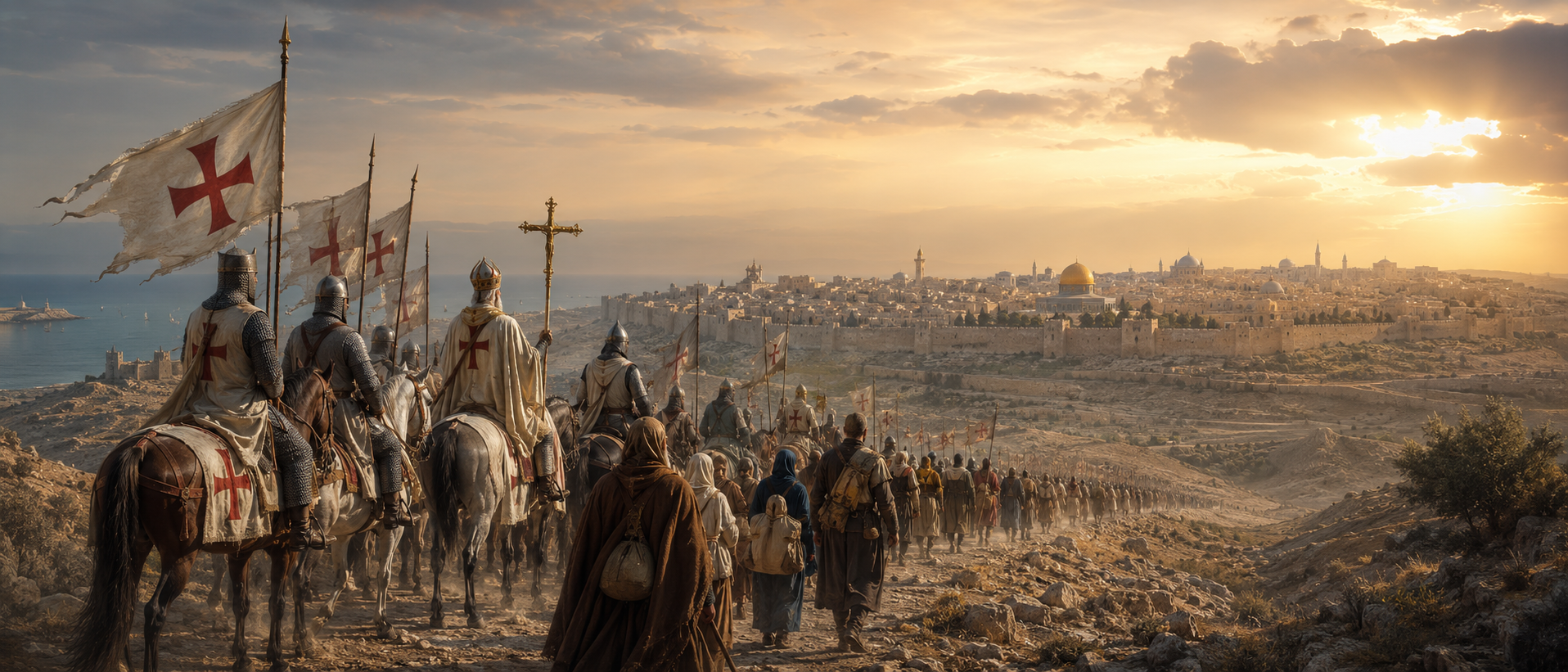
The Levant, pilgrimage routes, Byzantine appeals and Muslim-Christian conflict form the historical setting.
Historical context does not make every act just. Catholic analysis must distinguish aim, authority, conduct and abuse.
The Crusades are neither simple propaganda against the Church nor romantic myth; they are a difficult part of Christian history.
Visual study atlas
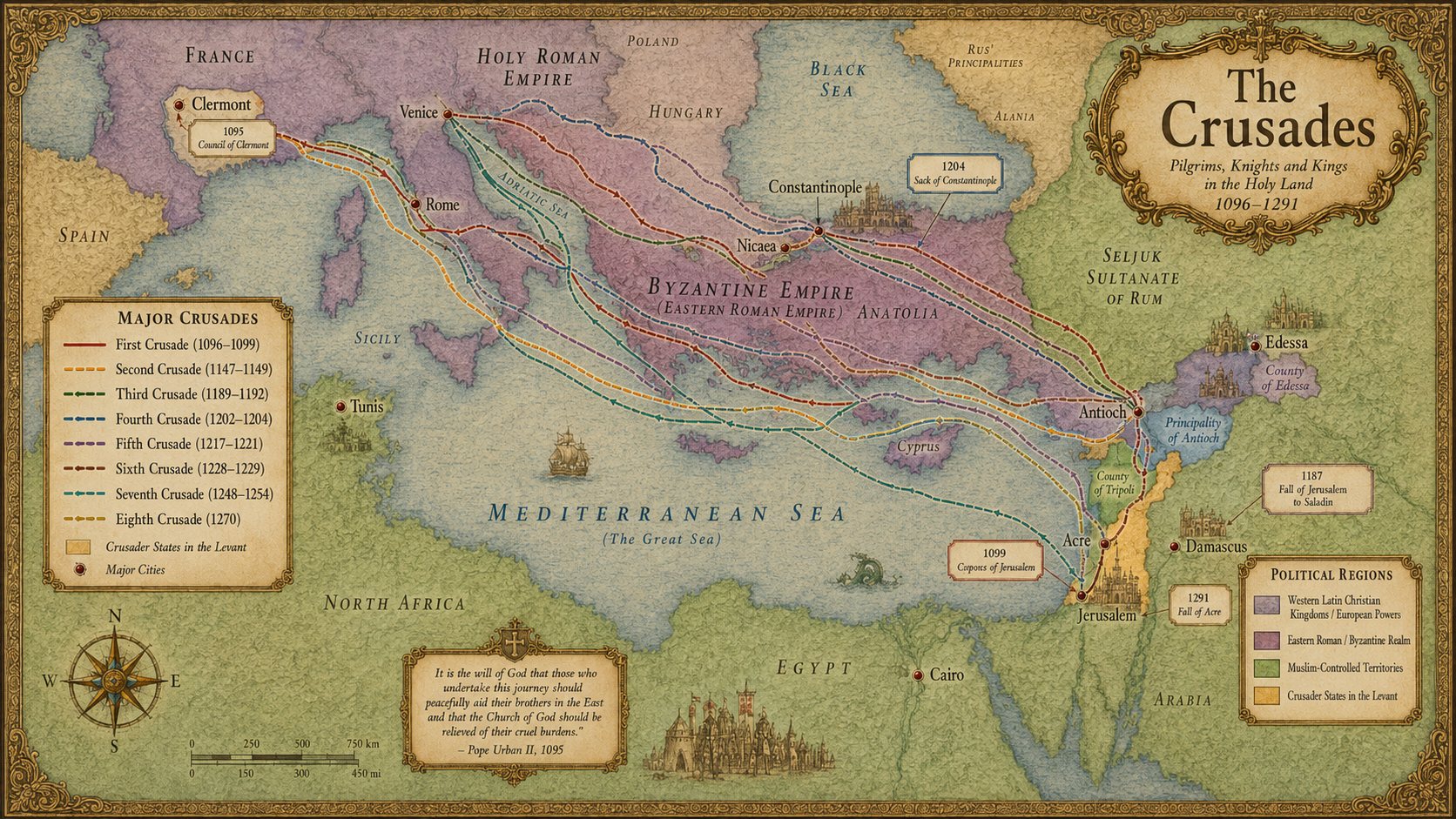
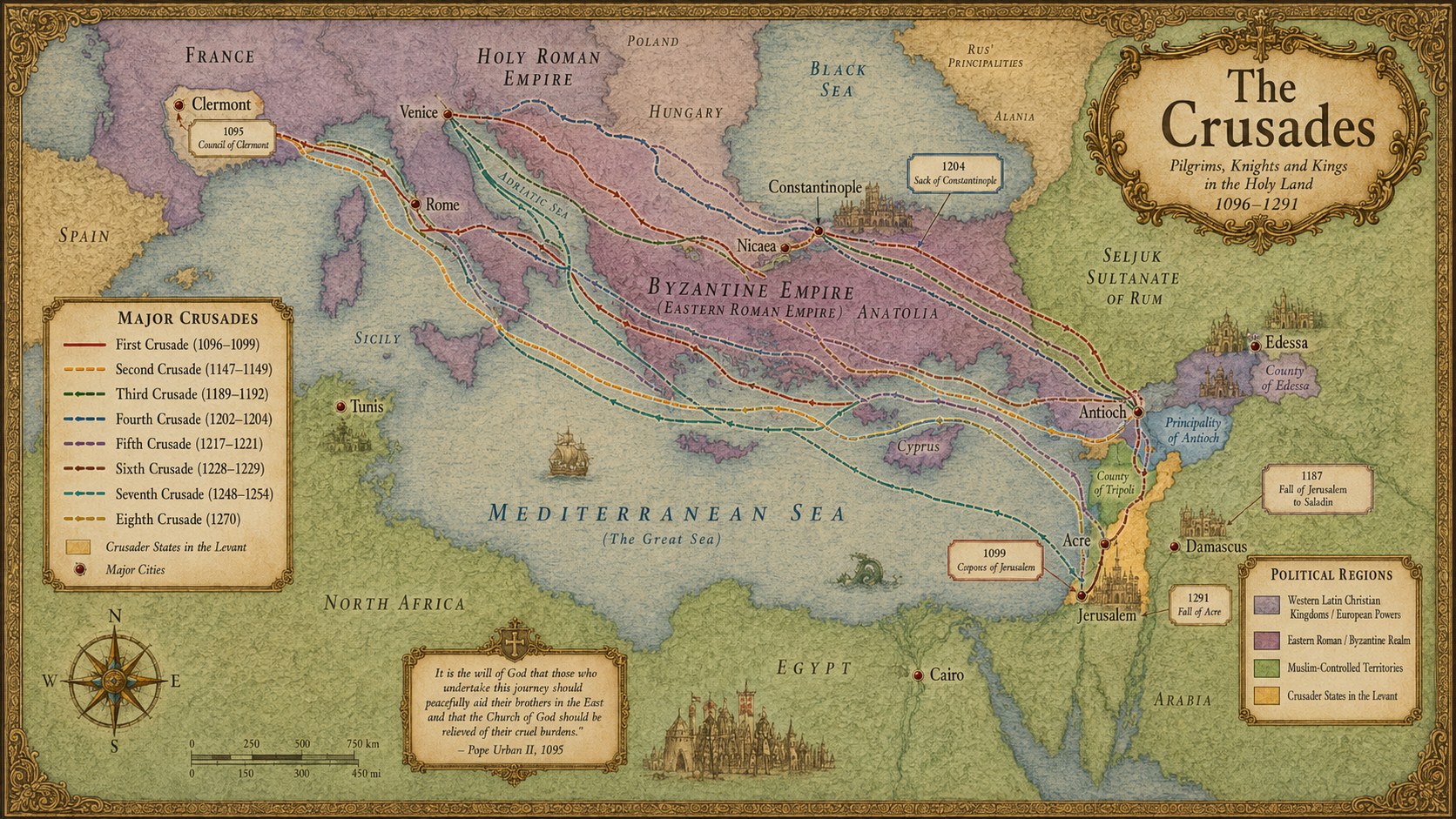
Route maps and later Ottoman-Christian turning points provide a clearer historical frame.
Visual study
Routes, cities and turning points help place the medieval armed pilgrimages into their historical geography.
Historical frame
The Crusades were not a single event, nor can they be reduced to one slogan. They were armed pilgrimages, papally authorised campaigns, vows, indulgenced penitential journeys, dynastic enterprises, naval expeditions, frontier wars, diplomatic bargains, and at times grave moral disasters. The Catholic task is not to canonise every deed or to surrender the whole history to modern caricature; it is to distinguish institution, intention, circumstance and conduct.
The background includes the long transformation of the eastern Roman world, the loss of Christian territories in Syria, Palestine, Egypt and North Africa, the vulnerability of pilgrimage routes, Byzantine appeals for military aid, the reform papacy’s attempt to discipline violence, and the medieval belief that public defence of Christendom could be bound to penance. That context explains why the movement arose; it does not excuse every massacre, political manipulation or betrayal committed under the sign of the cross.
Crusade dashboard
Jerusalem, Antioch, Alexandria and much of the old Christian Mediterranean passed under Muslim rule over the seventh and eighth centuries. Christian communities remained, but the political map of late antiquity had been permanently altered.
The Byzantine defeat at Manzikert weakened imperial control in Anatolia and intensified appeals for western military assistance. The crusading movement grew from this eastern crisis as much as from western piety.
Pope Urban II preached aid to eastern Christians and the recovery of access to the holy places. The crusade vow joined pilgrimage, penance and armed service, a combination that became one of medieval Christendom’s most powerful and dangerous institutions.
Before the main armies arrived, disorganised popular bands moved through Europe. Some committed atrocities against Jewish communities, revealing from the beginning the need to distinguish the Church’s proclaimed aim from sinful violence.
Armies led by nobles including Godfrey of Bouillon, Raymond of Toulouse, Bohemond of Taranto and others crossed to the East, endured siege, hunger and rivalry, and captured Nicaea, Antioch and finally Jerusalem.
The capture of Jerusalem created the Latin Kingdom, but the violence of the sack remains one of the great moral wounds of the crusading memory. Catholic history must remember both the recovery of the holy city and the bloodshed that accompanied it.
The Latin Kingdom of Jerusalem, the County of Edessa, the Principality of Antioch and the County of Tripoli formed a fragile network of frontier polities. They depended on castles, maritime supply, local alliances, military orders and recurring western support.
The Templars, Hospitallers and later Teutonic Knights combined religious life with military service. They guarded roads, castles, hospitals and pilgrims, but their wealth and political power also produced controversy and later reforming pressure.
Relations between Latins, Greeks, Syriac, Armenian and other Christians were mixed: alliance, misunderstanding, liturgical difference, jurisdictional conflict and shared vulnerability all existed together.
The fall of Edessa prompted preaching by Saint Bernard of Clairvaux and expeditions led by Louis VII and Conrad III. The campaign failed militarily and left deep disappointment, raising questions about leadership, planning and providence.
Saladin’s victory at Hattin and his capture of Jerusalem reshaped the entire movement. His political and military consolidation revealed how vulnerable the Latin East had become.
Richard I, Philip II and Frederick Barbarossa led the best-known western response. Jerusalem was not recovered, but coastal positions were secured and pilgrimage access was negotiated.
The Fourth Crusade was diverted first to Zara and then to Constantinople through debt, politics and Byzantine succession struggle. Its course became a catastrophe for Christian unity.
The sack of Constantinople inflicted enormous spiritual, cultural and political damage. It remains one of the gravest scandals associated with crusading and a major wound in relations between East and West.
The Latin Empire of Constantinople was unstable, and the memory of 1204 shaped Orthodox-Catholic relations for centuries. This episode demands repentance, not romanticisation.
The attack on Egypt aimed to break the strategic centre of Ayyubid power. The campaign failed at Damietta, showing again the danger of poor coordination and overconfidence.
Frederick II obtained Jerusalem by diplomacy rather than large-scale battle, but his conflict with the papacy complicated the campaign’s ecclesial meaning.
Louis IX led crusades to Egypt and Tunis. His personal piety and justice were admired, yet the military outcome was failure. The saintliness of a crusader king does not make the institution immune from tragedy.
The fall of Acre ended the main Latin mainland presence in the Holy Land. Later projects continued, but the classic Levantine crusading era had closed.
The Reconquista was not identical with the eastern crusades, but crusading privileges and rhetoric became attached to Iberian campaigns against Muslim polities. It had its own long local history, laws, alliances and religious tensions.
Crusading institutions also moved north and east, often with harsher missionary-war dynamics. These campaigns must be judged carefully because coercion and conversion cannot be confused.
From the fall of Constantinople in 1453 to Lepanto and Vienna, Latin Christendom faced a new military frontier. These later conflicts are connected to crusading memory but belong to a changed early modern world.
Modern polemics often present the Crusades as unprovoked aggression by a uniformly powerful Europe. That reading ignores the eastern crisis, pilgrimage, frontier warfare and the vulnerability of many Christian communities.
Romantic apologetics can erase sins, massacres, greed, oath-breaking and the tragedy of 1204. Catholic truthfulness cannot defend history by pretending its wounds do not exist.
The honest position is neither self-hatred nor nostalgia: read the sources, distinguish causes, judge actions morally, honour courage where real, condemn sin where clear, and place the whole episode within the larger history of Christendom.
A crusader did not merely join a military expedition. He took a vow and entered a penitential framework, normally marked by the cross, indulgence, discipline and obligation. This makes crusading both religiously intelligible and spiritually dangerous when penitential language is used to sanctify ambition.
Jerusalem was not a symbolic abstraction for medieval Christians. Pilgrimage, relics, the Holy Sepulchre and the biblical geography of salvation mattered deeply. The desire to secure access to the holy places was real, even when mixed with political motives.
The Crusades cannot be understood without Byzantine, Armenian, Syriac, Maronite and other eastern Christian realities. Latin campaigns often claimed to aid the East, but cultural ignorance and political rivalry frequently damaged that aim.
The Templars, Hospitallers and Teutonic Knights show the medieval attempt to combine religious vows, hospital service, armed protection and frontier defence. Their history includes devotion, discipline, wealth, controversy and reform.
Attacks on Jewish communities during some crusading movements were not a legitimate fruit of Christian faith. They were grave injustices that ecclesiastical authority often tried to restrain but did not always prevent.
Continue from here to Church History, Islam, Eastern rites, the Holy Mass, canon law, the lexicon entries on pilgrimage and indulgence, and the apologetics pages that distinguish historical argument from polemical caricature.
A responsible Catholic study of the Crusades should work through layered sources rather than depend on slogans. The page therefore points the reader toward Latin chronicles, Byzantine witnesses, Muslim chroniclers, papal letters, charters, archaeology, diplomatic history and modern critical scholarship. These sources often disagree, and the disagreement is part of the study.
Complete campaign corpus
The familiar sequence from the First to the Ninth Crusade is useful but incomplete. Medieval sources did not recognise one universally numbered list. This corpus therefore includes every conventional numbered expedition and the principal supplementary, regional, internal, naval and anti-Ottoman campaigns needed to understand how the institution actually developed.
A campaign belongs when papal authorisation, a crusade vow, indulgence, legal protection or the dominant source tradition places it inside crusading institutions. Ordinary wars between Christian and Muslim rulers are not automatically called crusades.
“First” through “Ninth” organises major Holy Land expeditions. It omits 1101, the Barons’ Crusade, Iberia, the Baltic, internal crusades and later holy leagues; therefore the filters below use theatre and legal type as well as number.
A defensible object, legitimate authority or penitential vow cannot sanctify massacre, forced baptism, sacrilege, broken oath, enslavement or attack on non-combatants. Each command and act is judged in its own moral species and circumstances.
The crusading movement did not begin from an empty landscape. Jerusalem, Antioch, Alexandria, Syria, Egypt and North Africa had passed from Christian imperial rule to successive Muslim regimes; Christian communities endured under varying legal and fiscal conditions, while pilgrimage continued with periods of access and danger. In the eleventh century Byzantine contraction in Anatolia, especially after Manzikert, and Emperor Alexios I’s request for western aid met a papacy already attempting to discipline knightly violence and attach armed service to penance.
The first movement of 1096 reveals the danger of crusading language detached from command, logistics and moral discipline. Some groups travelled toward Constantinople and were destroyed in Anatolia. Others attacked Jewish communities in Speyer, Worms, Mainz and elsewhere. Bishops and civic authorities sometimes sheltered the victims, but protection failed catastrophically in several cities.
Four principal aristocratic armies crossed Byzantium, swore disputed forms of agreement to Alexios I, and moved through Nicaea, Dorylaeum and Antioch. The conquest of Jerusalem in July 1099 fulfilled the central objective but was accompanied by a massacre whose extent and rhetoric must be reconstructed critically from Latin, Muslim and Jewish witnesses.
Several large western armies followed the First Crusade but divided their routes and pursued ambitious operations in Anatolia. They suffered severe defeats against mobile Turkish forces. Survivors reached the Levant and contributed personnel, but the expedition demonstrated that 1099 could not be mechanically repeated.
Sigurd’s fleet travelled through the Atlantic and Mediterranean, fought in Iberian and island theatres, visited Jerusalem and assisted Baldwin I in the capture of Sidon. The expedition shows the geographic reach of crusading devotion and the importance of naval power before the great fleets of the later twelfth century.
A large Venetian fleet defeated a Fatimid naval force and helped take Tyre. The resulting agreements reveal how devotional and military objectives coexisted with commercial privileges. That mixture should neither be concealed nor treated as proof that religious motives were unreal.
The first crusade proclaimed directly by a papal bull and preached across kingdoms ended in failure. German and French armies were badly damaged in Anatolia; the decision to attack Damascus alienated a former counterweight to Zengid power and collapsed after only days. The result provoked theological shock and recrimination.
The campaign widened crusading beyond Jerusalem. Military pressure, tribute, dynastic expansion and missionary purpose were inseparable. Baptism imposed under immediate force raises a problem distinct from later pastoral conversion, and the durability of results varied greatly.
The Third Crusade mobilised three major monarchies. Frederick Barbarossa died in Cilicia, and much of his army dissolved. The siege of Acre ended in 1191; Richard I then won at Arsuf and secured the coast but judged an assault on Jerusalem strategically unsustainable. Diplomacy produced a truce and pilgrim access.
Henry VI’s death disrupted a still-formidable mobilisation. German contingents reached the Levant, captured Beirut and assisted territorial consolidation before news of the emperor’s death and political uncertainty drew leaders home.
Debt to Venice, the attack on Christian Zara, a claimant’s promises, Byzantine civil strife and escalating mistrust transformed the expedition. Innocent III prohibited attacks on Christians except under narrowly argued conditions and condemned the sack. In April 1204 Constantinople was captured, looted and subjected to violence and sacrilege; a Latin Empire followed.
A campaign against a Christian society introduced crusading privileges into an internal ecclesial and dynastic conflict. The massacre at Béziers, the disputed saying attributed to Arnaud Amalric, the rise of Simon de Montfort and the intervention of the French crown show how doctrinal, feudal and territorial aims became entangled.
The familiar story of thousands of small children marching to the sea and being sold into slavery is a composite formed from sparse contemporary notices and later elaboration. Participants were probably mixed groups of youths, adolescents and poor people; the Latin term pueri can carry social as well as strictly age-specific meaning.
After an inconclusive phase in Palestine, the army besieged Damietta and captured it in 1219. Muslim peace offers reportedly included Jerusalem under conditions, but crusader leadership rejected or mishandled them. An advance toward Cairo was trapped by Nile flooding and Ayyubid forces, forcing surrender and evacuation.
Frederick II sailed after repeated delay and excommunication. His treaty with al-Kamil restored Jerusalem, Bethlehem and a corridor to the coast for a limited term while leaving the Temple Mount under Muslim administration. Frederick crowned himself in Jerusalem amid ecclesiastical conflict.
Although less famous than the numbered crusades, the Barons’ Crusade obtained extensive territorial concessions through a mixture of military pressure and diplomacy. A rash engagement at Gaza caused severe losses, but later negotiations recovered Jerusalem and significant Galilean territory for a time.
Louis IX organised an unusually well-financed royal expedition. Damietta fell rapidly in 1249, but the army stalled near Mansurah. Robert of Artois’s premature attack ended disastrously; disease, supply failure and Mamluk resistance led to Louis’s capture. Ransomed, he spent years strengthening the Latin East rather than returning immediately.
The decision to attack Tunis remains debated. The army landed in summer heat, disease spread, and Louis IX died near Carthage. Charles of Anjou negotiated a treaty securing commercial and political concessions before the expedition withdrew.
Edward reached Acre with limited forces and pursued raids, diplomacy and a possible Mongol alliance. An assassin wounded him, and a truce with Baibars followed. The expedition could not reverse the Mamluk strategic ascendancy.
Tripoli fell in 1289. In 1291 a large Mamluk army besieged Acre, whose fragmented government, rival quarters and military orders struggled to coordinate. The city was stormed in May; surviving mainland positions were evacuated or lost.
“Reconquista” describes many centuries, not one continuous national campaign. Papal crusading forms entered Iberian warfare at different moments; local alliances frequently crossed religious lines. Barbastro, Lisbon, Las Navas de Tolosa and Granada belong to distinct contexts and should not be collapsed into one moral narrative.
The northern theatre comprised several wars rather than one expedition. Missionary foundations and martyrdom coexisted with coercive conquest and corporate territorial power. Conflicts against Orthodox Christians also reveal how crusading categories could be redirected by political rivalry.
The expedition displays the most controversial extension of crusading into papal-dynastic politics. A French army invaded Catalonia but suffered disease, supply failure and defeat; Philip III died during the retreat.
A Christian league captured the harbour and lower city of Smyrna in 1344 but could not control the citadel. The death of leaders in a surprise attack and the difficulty of maintaining a distant enclave limited the enterprise.
The army captured and looted Alexandria but withdrew within days rather than holding the city. The raid caused extensive killing, enslavement and destruction; its tactical success did not become a viable strategy.
A large chivalric force besieged Mahdia but could not force its capitulation. Heat, disease, supply difficulties and effective defence produced a negotiated withdrawal.
A multinational army advanced along the Danube but suffered from divided command and overconfident tactics. At Nicopolis the French vanguard attacked before coordination with Hungarian forces; Ottoman reserves and Serbian troops reversed early gains. Many prisoners were killed after the battle.
Repeated crusading armies were defeated by mobile wagon tactics, internal disunity and strong Czech mobilisation. The wars cannot be reduced either to pure national liberation or to an uncomplicated campaign against doctrinal error; Eucharistic, ecclesiological, social and dynastic questions intersected.
Initial operations encouraged a negotiated truce. The subsequent decision to renew war despite oath and treaty controversies culminated at Varna, where the young king’s charge failed and he was killed. Cesarini also died during the retreat.
Papal preaching, Hunyadi’s military organisation and Capistrano’s popular mobilisation combined in the relief of Belgrade. The defenders broke the siege and wounded Mehmed II, delaying Ottoman advance into Hungary for decades.
Ottoman forces took Otranto in 1480. Contemporary evidence records killings and enslavement; the precise circumstances of the celebrated martyrs require careful use of early testimonies and later hagiographic development. A Christian coalition retook the city after Mehmed II’s death changed Ottoman priorities.
The naval battle of Lepanto on 7 October 1571 destroyed or captured much of the Ottoman fleet and freed many Christian galley slaves. The strategic consequences were real but limited: Cyprus was not recovered, and Ottoman naval capacity was rebuilt. Catholic memory associated the victory with the Rosary and the feast later known as Our Lady of the Rosary.
The orders were not simply medieval armies wearing religious symbols. They possessed rules, liturgy, property networks, hospitals, commanderies and transregional finance. Their military role varied by time and place. The suppression of the Templars, the Hospitaller states on Rhodes and Malta, and the Teutonic territorial order require separate histories.
Eastern Christians were guides, allies, subjects, negotiators, clergy, merchants, rivals and victims. Armenian support aided the First Crusade, Byzantine strategy shaped every land expedition, and indigenous churches lived under both Muslim and Latin rulers. Latin ecclesiastical structures sometimes cooperated with, sometimes subordinated, and sometimes misunderstood eastern traditions.
The Rhineland massacres of 1096 are the most notorious episode, but later preachings and expeditions could also create danger. Popes and bishops reiterated protective principles and at times intervened effectively; at other times political and ecclesiastical protection was inadequate. Hebrew chronicles preserve theological interpretation, names and communal memory unavailable from Latin accounts alone.
A crusader normally took a vow, assumed the cross, obtained defined protections and entered a penitential economy connected to indulgence. Preaching, commutation, redemption, taxation and privileges developed over centuries. The institution was never static, and abuses of money or political extension do not erase the underlying distinction between sacramental absolution, indulgence and military service.
Crusaders diverted from the Atlantic route joined a long siege and negotiated capitulation. The aftermath included violence and breaches of discipline recorded even by a participant sympathetic to the enterprise.
A decade of sieges and negotiated surrenders ended with Granada’s capitulation. The terms protected religion, property and law, but subsequent policy moved toward coercion, revolt, forced conversion and eventually expulsion. The war and the later breach of settlement are distinct phases.
Research laboratory
The word “crusade” covers different theatres, vows, legal forms and political circumstances. The modules below separate institution, campaign, conduct and reception so that neither romantic defence nor a black legend can replace evidence.
Begin with pilgrimage, Byzantine appeals, Seljuk expansion, eastern Christian communities and papal reform. No later campaign should be read backwards into this setting.
Open dossierDetermine the penitential and juridical form from papal letters, preaching witnesses, charters and canon law rather than from a modern slogan.
First CrusadeRoutes, siege conditions, alliances, command, logistics and local communities explain what an army actually did; religious purpose does not make every means just.
Latin EastByzantine cooperation, rivalry and memory are essential, especially for the diversion to Zara and Constantinople in 1204.
Fourth CrusadeRhineland violence, conquest, government and coexistence require Hebrew and Arabic witnesses alongside Latin narratives.
Jewish-Christian historySeparate the possible justice of defence or aid from massacre, broken oath, sacrilege, coercion or political diversion committed by identifiable agents.
Full assessmentPenitential vow, defence, pilgrimage, dynastic strategy, debt, commerce and personal ambition may coexist in one expedition. The justice of a stated end does not sanctify massacre, broken oath, sacrilege or coercion; every moral judgement is attached to a concrete command and act.
Comparative atlas
Who preached or authorised the expedition, under what document, and did commanders remain within the terms of that authority?
What did participants promise? Distinguish sacramental absolution, penitential satisfaction, indulgence, legal privilege and propaganda.
Map not only armies but Greek, Armenian, Syriac, Maronite, Muslim, Jewish and Latin communities already living in the contested region.
Routes, food, shipping, disease, siege technology and rival councils often explain outcomes more directly than slogans.
Treaties, truces, prisoner exchanges, dynastic bargains and cross-confessional alliances were normal parts of medieval warfare.
Examine sieges, surrender terms, prisoners, civilians, sacred places, forced conversion and plunder separately from the stated cause.
Latin, Byzantine, Arabic, Syriac, Armenian and Hebrew witnesses report different facts and moral worlds. No single archive is sufficient.
Later chivalric romance, Protestant polemic, nationalism, colonial analogy and modern apologetics may reshape the evidence.
Source architecture
Papal bulls, conciliar decrees, vows, privileges, treaties and charters establish what authorities formally intended and required. They do not prove that armies obeyed.
Chronicles, letters and chansons preserve observation mixed with self-defence, theology and literary convention. Identify whether the writer was present and when the text was composed.
Byzantine, Arabic, Syriac, Armenian and Hebrew sources reveal events and experiences hidden by Latin narratives, but they too have genres and political contexts.
Fortifications, coins, seals, settlement archaeology, ship records and landscape studies test claims made by narrative texts.
Preaching, liturgy, canon law, criticism by saints, papal correction and later theological judgment show that “the Church’s view” was not reducible to one chronicler.
Begin with Jonathan Riley-Smith, Jean Richard, Joshua Prawer, Christopher Tyerman, Thomas Asbridge, Benjamin Kedar and specialist regional studies; compare methods rather than selecting only agreeable conclusions.