
Sacerdotium Novi Testamenti · In persona Christi · Psalmorum ministerium
New Testament Priesthood
This page stands between the Holy Mass and the wider history of Catholic rites because the priesthood is the living hinge that joins them. The sacrifice of the altar does not remain an abstract doctrine. Christ wills to make His saving work sacramentally present in His Church through ordained ministers who act under Him and from Him. The priest therefore belongs to the inner structure of Catholic worship: altar, sacrifice, sacred doctrine, absolution, blessing, sanctification and continual prayer.
The New Testament priesthood must be read in continuity with the Old Covenant and in fulfilment within Christ. The old sanctuary, priestly garments, incense, bread of offering, sacrificial blood and temple prayer were not accidental religious ornaments. They were pedagogical figures preparing the people of God for the eternal Priest who would offer Himself, institute the Eucharistic sacrifice, sanctify His Church and continue His work through a ministerial priesthood until the end of time.
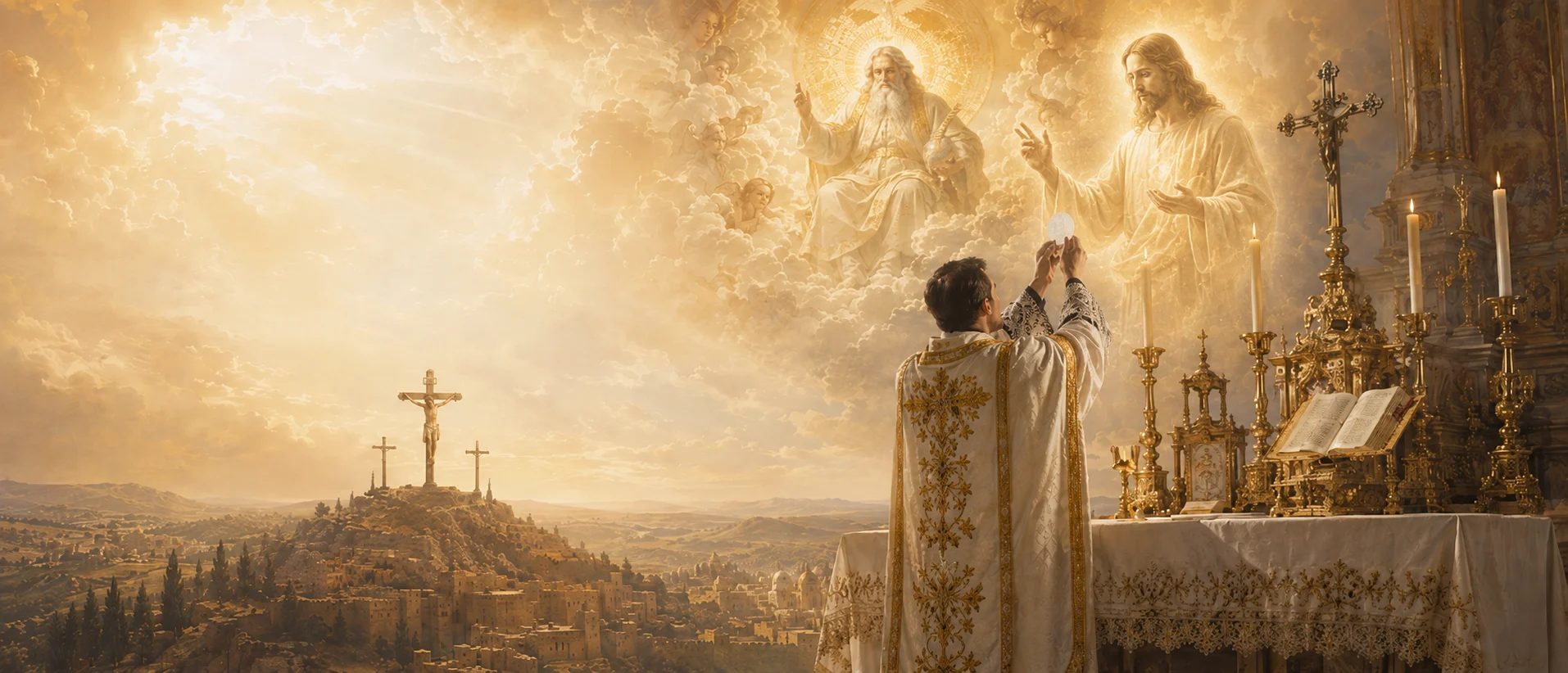
Old Covenant figures and their fulfilment in Christ
The Old Testament priesthood prepared the way for Christ through temple worship, sacrifice, vesture, incense, blessing and the sanctification of sacred time. Aaron and his sons were clothed for glory and for beauty. The high priest bore signs of mediation, memory and consecration. Bread, incense, sacrificial blood and intercession stood at the heart of the sanctuary. These were not empty antiquarian details. They formed a typological pedagogy by which God instructed Israel to await the definitive priesthood.
Christ fulfils this preparation perfectly. He is Priest forever according to the order of Melchizedek; He offers not the blood of animals but His own Blood; He enters not merely an earthly sanctuary but the heavenly holy place; and He establishes the Eucharistic sacrifice at the Last Supper in anticipation of Calvary. The ordained priest participates in this fulfilment ministerially. He does not repeat the shadows, but serves the sacramental manifestation of the reality to which the shadows pointed.
The ministerial priesthood of the New Covenant
Catholic teaching distinguishes the universal priesthood of the faithful from the ministerial priesthood conferred through Holy Orders. All the baptised are called to offer spiritual sacrifices, to pray, to bear witness and to live as members of Christ. Yet not all receive the sacramental power to consecrate the Eucharist, absolve sins, bless in the Church’s name, preach with official mission, anoint the sick or govern a flock as sacred pastors. The ministerial priesthood is therefore not an ornament added by later ecclesiastical convenience. It belongs to the visible economy of redemption established by Christ.
This priesthood is entirely dependent on Christ the High Priest. The priest does not become another redeemer beside Him. He does not possess an autonomous sacred power detached from Christ. Rather, by ordination he is configured to Christ in such a way that Christ chooses to act through him in sacramental ministry. For that reason Catholic tradition speaks of the priest as acting in persona Christi at the altar and in the principal sacramental acts of his office. The priest is an instrument, a minister, a steward of mysteries—never the master of them.
Christological centre
The meaning of the priesthood begins and ends in Christ, who is Priest, Victim and Mediator.
Sacrificial centre
The supreme priestly act is the offering of the Eucharistic sacrifice, which sacramentally makes present Calvary.
Ecclesial centre
The priest serves not himself but the Church, dispensing doctrine, sacraments and blessings for the salvation of souls.
Definitions, distinctions and first principles
Priesthood
A stable sacred office ordered to divine worship, sacrificial mediation and the sanctification of the people of God.
Holy Orders
The sacrament by which bishops, priests and deacons receive sacramental character and ecclesial mission for ministry.
In persona Christi
The priest acts as a sacramental minister through whom Christ Himself performs sacred actions, especially in the Eucharist.
Ministerial and common priesthood
The faithful share in Christ through baptism, but the ordained priest shares in a distinct ministerial mode ordered to the service of the Body.
These distinctions protect two truths at once: first, that Christ alone is the source of grace and the unique Redeemer; second, that Christ truly willed to govern His Church through visible sacramental ministry. When either truth is denied, the Catholic understanding collapses. If one denies Christ’s uniqueness, the priest is exaggerated into an independent sacred source. If one denies the real ministerial office, the priesthood is reduced to a mere presidency over the assembly. Catholic doctrine avoids both extremes by rooting everything in Christ and in His institution.
The altar, the sacrifice and the priestly act
The supreme act of priestly ministry is the Eucharistic sacrifice. The priest does not come to the altar as a lecturer or observer. He comes as a consecrated minister of sacrifice. At the consecration he does not merely narrate what Christ once said. He speaks Christ’s words sacramentally so that the Lord may make present His Body and Blood under the species of bread and wine. This is why the Mass is the summit of priestly life. Everything else in priestly ministry either flows from it or returns to it: preaching prepares souls for grace, confession restores them, catechesis forms them, and prayer surrounds them, but the altar remains the centre.
From this centre the whole priestly office becomes intelligible. The priest blesses because sacred worship is ordered to sanctification. He hears confessions because sacrifice and reconciliation belong together. He anoints the sick because Christ heals the whole man. He teaches because the liturgy and sacraments presuppose truth. The priest is therefore not simply a ritual technician. He is a steward whose interior life must correspond to the mysteries he touches.
Sacred clothing, vesture and visible consecration
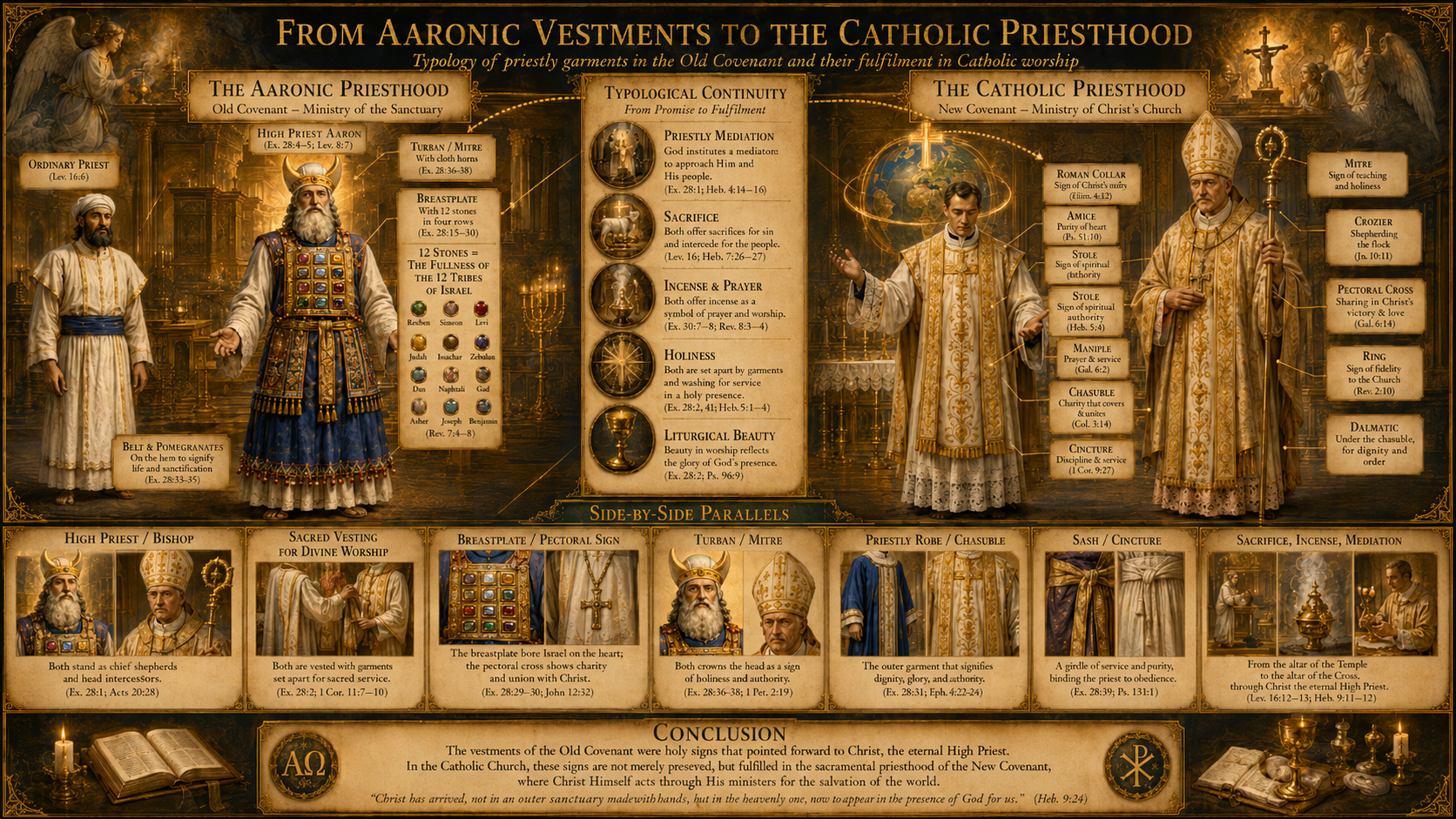
Priestly clothing belongs to the theological language of worship. In the Old Covenant, sacred garments visibly set apart the priestly office. In the Church this logic continues in fulfilled form. The priest vests not because the liturgy is theatre, but because the liturgy is sacred action. Vestments teach by sight that worship is ordered, objective and consecrated. The amice speaks of spiritual protection, the alb of purity, the cincture of discipline and readiness, the stole of authority and yoke, and the chasuble of charity and sacrificial service. Even when different rites express these truths with different garments, the principle remains the same: sacred office is manifested outwardly because it is real inwardly.
The theology of vesture also protects continuity. The Church does not treat the Old Covenant as meaningless decoration, nor does she merely preserve it unchanged. She receives the priestly pedagogy and reinterprets it christologically. Hence the parallel between the ancient signs and Catholic worship is not accidental. The high priest’s garments, the mitre-like head coverings, the breastplate and memorial signs, the girdle, the robe and the logic of holiness all find a higher fulfilment in the sacramental priesthood of the Church.
This visible consecration extends to priestly discipline and life. Celibacy in the Latin Church, reverence for blessed hands, the centrality of the altar, the use of sacred vessels and the careful custody of the sanctuary all spring from one instinct: the priest belongs to holy things because Christ has set him apart for holy service.
The Psalms and the continual prayer of the priest
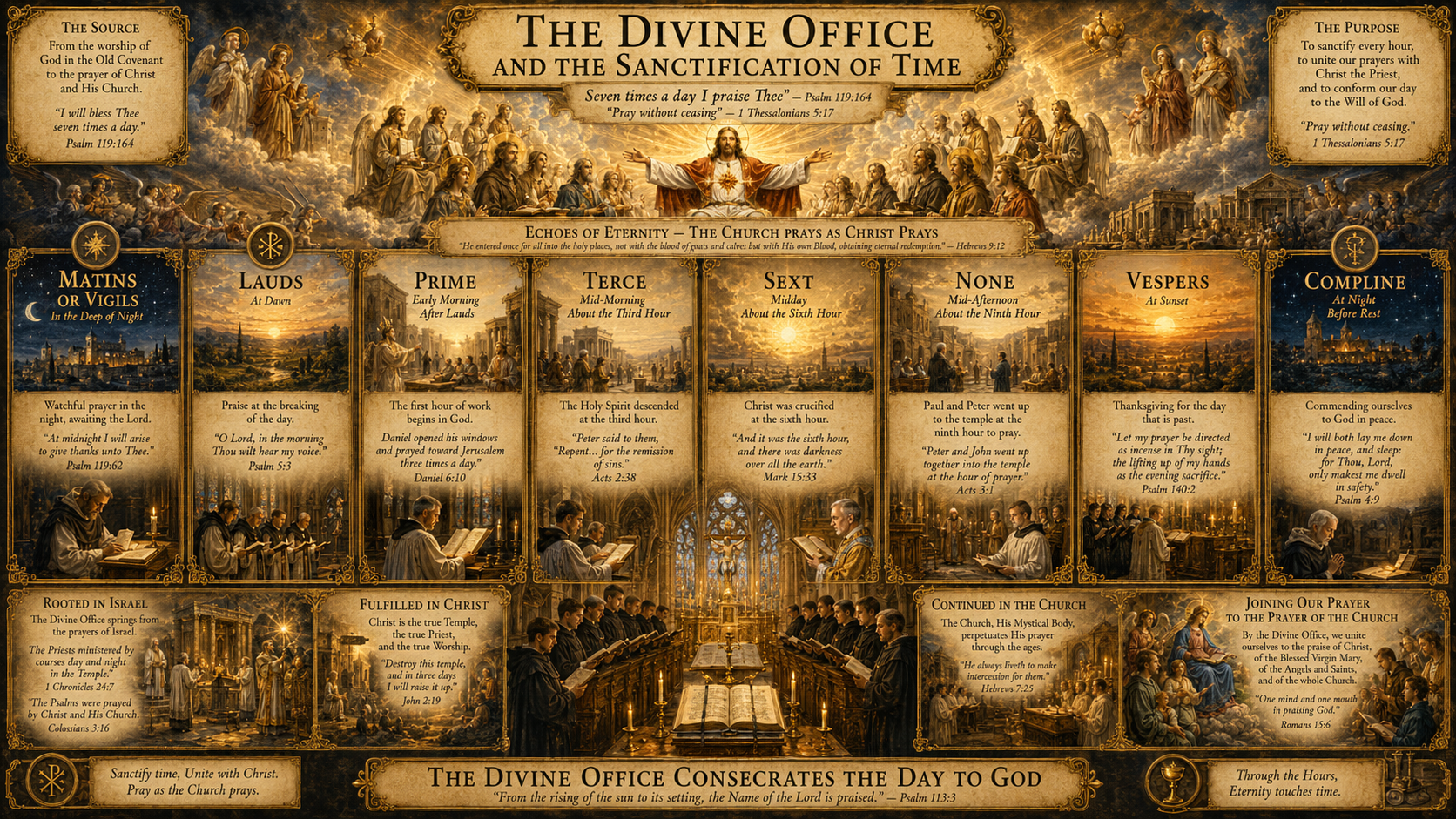
A principal priestly work is continual prayer. The priest’s office is not exhausted by the celebration of Mass. He also sanctifies time by praying the Divine Office, above all through the Psalms. This is one of the deepest continuities between the ancient temple order and Catholic worship. Israel knew sacred hours, psalmody and the offering of prayer before God. The Church receives and transfigures this inheritance. Matins, Lauds, Prime, Terce, Sext, None, Vespers and Compline—or their corresponding canonical hours in approved breviaries—mark the day with praise, repentance, supplication and thanksgiving.
When the priest prays the Psalms, he does not act merely as a private individual reciting favourite devotions. He prays in the name of the Church and with the voice of the Church. The Psalter forms his heart, extends the liturgical spirit beyond the altar, and keeps priestly life ordered to God even outside sacramental action. The Office therefore belongs to the internal shape of the priesthood. The one who offers sacrifice also offers praise; the one who stands at the altar also stands watch in prayer.
For this reason the breviary is not an accidental appendix to Catholic life. It is one of the chief priestly duties. Through the sanctification of the hours, the priest unites heaven and earth in praise, intercedes for souls, remembers the saints, carries Scripture on his lips and consecrates the very rhythm of the day to God.
High points of Catholic priestly theology
Several truths should remain fixed in the mind of the reader. First, the priesthood is sacrificial in centre: it is ordered above all to the Eucharistic offering. Second, it is christological in source: every grace and authority flows from Christ the High Priest. Third, it is ecclesial in exercise: the priest serves the Church and does not own the mysteries. Fourth, it is ascetical in life: prayer, purity, obedience and reverence are not optional ornaments but fitting responses to holy things. Fifth, it is historical in continuity: the forms of Catholic priesthood stand in organic relation to biblical worship and to the liturgical inheritance of the Church.
Seen in this light, the New Testament priesthood is not a late medieval invention, nor a pragmatic community role, nor a merely sociological leadership office. It is the sacramental continuation of Christ’s pastoral and sacrificial ministry in His Church. Through it He teaches, forgives, feeds, blesses and sanctifies until the heavenly liturgy is fully revealed.