The 24 Catholic Churches and their liturgical rites
The Catholic Church is one communion in faith, sacraments and apostolic hierarchy. That unity does not erase the historical forms by which the mysteries are celebrated. The Latin Church and the Eastern Catholic Churches preserve distinct liturgical families, spiritual patrimonies, languages, calendars, disciplines and forms of sacred art while remaining one Catholic communion.
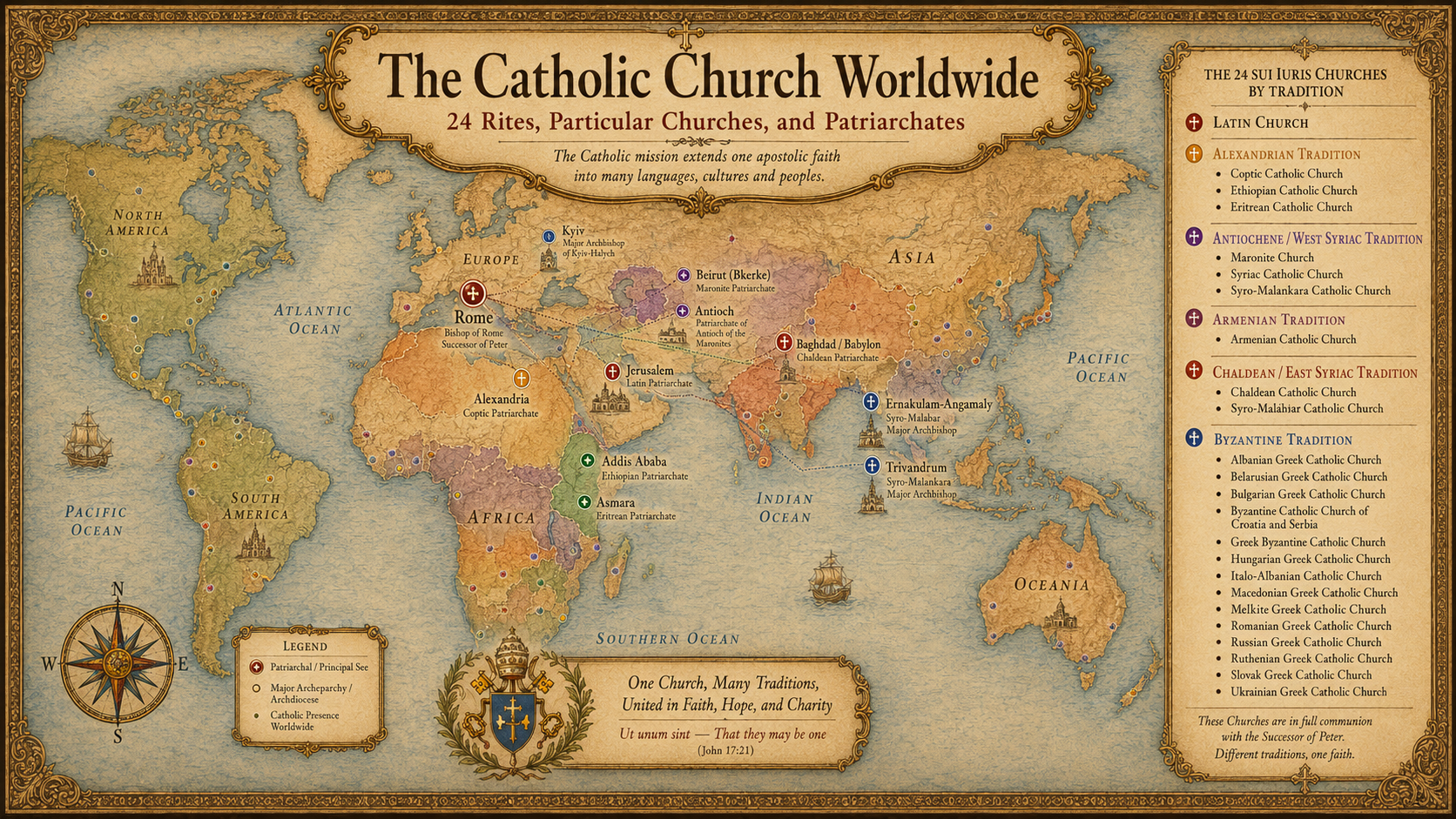
This page gives a clean geographic and doctrinal introduction to the principal Catholic ritual families, their patriarchal and major archiepiscopal centres, and the twenty-four Catholic Churches in communion with Rome.
A rite is not a costume placed over doctrine after the fact. It is a received ecclesial form in which the Church prays, sacrifices, blesses, sings, fasts, hears Scripture, celebrates the mysteries and hands down a spiritual inheritance. A particular Church is not simply a national group or an aesthetic preference; it is a concrete Catholic Church with its own hierarchy, faithful, discipline and liturgical patrimony.
Catholic unity is therefore neither flat uniformity nor doctrinal fragmentation. Uniformity would erase saints, languages, histories, monastic schools, calendars and legitimate spiritual patrimonies. Fragmentation would falsely treat visible difference as if it meant different faiths. Catholic communion holds both together: one apostolic faith, one sacramental life, one visible communion, and many venerable ways of expressing worship.
The six families below give the reader the first map: Latin, Byzantine, Alexandrian, West Syriac, Armenian and East Syriac. Each family contains either one Church or several Catholic particular Churches. The dashboard is arranged so that the family is chosen on the left, while the upper tabs open the overview, history and liturgical character of the selected family.
The Catholic Church worldwide: rites, particular Churches and patriarchates. The map offers a geographic introduction to the principal sees, patriarchates and historical distribution of the major Catholic ritual families.
Historical bridge
From apostolic worship to ritual families
The Catholic rites did not begin as competing liturgical projects. They grew from the apostolic Church as the same Eucharistic faith entered Jerusalem, Antioch, Alexandria, Rome, Edessa, Armenia, Constantinople and the lands reached by later missions. Language, chant, ceremonial, vesture and calendar developed differently, while the sacramental centre remained one: baptism into Christ, apostolic ministry, Eucharistic sacrifice and communion in the one faith.
One source, many legitimate forms
The earliest Church already possessed ordered worship: the reading of Scripture, apostolic preaching, prayers, baptism, the breaking of bread, laying on of hands, fasting and the appointment of ministers. As the Church took root in different patriarchal centres, the same apostolic substance assumed stable local expression. The Roman, Alexandrian, Antiochene, Armenian, East Syriac, West Syriac and Byzantine worlds became liturgical homes in which doctrine, prayer, ascetic life and ecclesial discipline grew together.
This history explains why the Church can guard unity without flattening all worship into one cultural form. A rite is not a private taste. It is a received ecclesial grammar: a way of praying, confessing, fasting, blessing, reading Scripture, venerating saints and approaching the altar.
What must remain common
the same apostolic faith and creed;
the same sacramental reality, especially the Eucharist;
valid apostolic ministry and hierarchy;
communion with the Catholic Church;
reverence for Scripture, Tradition and the saints;
a liturgical life ordered to sanctification, not spectacle.
The differences therefore illuminate Catholicity. They are not proof of doctrinal fragmentation, but signs that the one Church can become truly at home among many peoples without ceasing to be one.
Dashboard
Study one ritual family at a time
The left column selects the ritual family. The upper tabs then open the overview, history and liturgical character of the chosen family. In this way, the page remains structured and readable: the family is chosen first, and the kind of study second.
Latin
The Latin family is the Western or Roman liturgical inheritance of the Catholic Church. It is carried principally by the Latin Church, the largest of the Catholic particular Churches. To say that the Latin family is “Roman” does not mean that it is merely local to the city of Rome; rather, it means that the Roman Church became the principal centre from which a Western liturgical culture spread through Europe and then through the wider Catholic world.
Its visible marks include sobriety of ceremonial, juridical precision, an altar-centred sacrificial consciousness, the prominence of the Roman Canon in classical usage, a strong calendar of saints, Latin liturgical memory, and the organic formation of rites, devotions and sacramentals around the Eucharistic sacrifice. Gregorian chant, the Roman Breviary, the Roman Pontifical and the Roman Missal belong to this inheritance and helped shape the language of Latin Catholic worship for centuries.
Latin Church
Principal liturgical form: the Roman Rite
Historic Western usages and local Latin patrimonies where preserved by legitimate law and custom
The Latin family is therefore not a mere “style” of worship. It is a full spiritual, canonical and sacramental civilisation in which doctrine, liturgy, monastic life, sacred learning, architecture, hymnody and devotion grew together in continuity.
History of the Latin family
The Latin family developed in the West as the Roman Church became a principal centre of ecclesial life, pilgrimage and doctrinal witness. Early Christian worship in Rome received its form from apostolic preaching, martyr memory, house-church assembly, and the gradual emergence of a stable liturgical year. Over time, the city’s stational liturgy, the cult of the martyrs, the ordering of readings and chants, and the solemnity of papal and presbyteral worship gave the Roman tradition a recognisable face.
As the Gospel spread through the western provinces of the former empire, the Roman liturgical inheritance encountered local churches in Gaul, Spain, North Africa, the British Isles and the German lands. There were local usages and families, yet the prestige of the Roman See and the need for doctrinal and sacramental unity led to a progressively stronger Romanisation of the West. Carolingian reform, medieval monastic culture, cathedral chapters, universities, canon law and the later standardisation of books all contributed to the Roman family’s historical consolidation.
The Latin family also passed through crisis and purification: persecution, political collapse, heresy, schism, the Gregorian reform, the mendicant renewal, the Council of Trent and worldwide missionary expansion. Through all of this, the West preserved the same fundamental conviction: that the Church gathers at the altar for the one sacrifice of Christ, and that liturgical form must protect the dogmatic content of worship. In this sense, the history of the Latin family is inseparable from the history of papal primacy, martyrdom, theology, canon law and missionary civilisation.
Rite character
The characteristic genius of the Latin family lies in clarity, restraint, sacrificial focus and disciplined articulation. Roman liturgy tends to speak with gravity rather than prolixity. Its prayers are often compact yet dense. It loves order, hierarchy, precision of rubrics, and the careful distinction of offices. This does not mean emotional coldness; rather, it means that the rite communicates sacred mystery through proportion, solemnity and internal coherence.
The altar stands at the centre. The vocabulary of offering, propitiation, purification, priesthood and real presence is not secondary but constitutive. Chant serves text; ceremonial serves sacrifice; architecture frames the sanctuary; vesture manifests sacred office. Even silence is active in the Latin family: it is a liturgical instrument of awe, recollection and adoration.
The Latin family also gives a large place to Eucharistic devotion beyond Mass, to the ordered sanctification of time in the Divine Office, and to the cult of saints as living witnesses integrated into the Church’s public prayer. Its liturgical character is therefore both Roman and universal: disciplined in form, sacrificial in centre, contemplative in tone, and expansive in missionary fruitfulness.
Byzantine
The Byzantine family is the Constantinopolitan liturgical inheritance shared by a large number of Eastern Catholic particular Churches. Although these Churches differ historically and nationally, they participate in a common liturgical world formed by the rites of Constantinople, the great liturgical synthesis of the Christian East, and the theology of worship as a participation in the heavenly liturgy.
This family is marked by iconography, solemn chant, litanies, repeated invocations, the iconostasis, processional entrances, a vivid sense of the heavenly court, and a strong emphasis on divine glory. The Divine Liturgy is not approached merely as a didactic service or communal meal; it is perceived as entrance into the worship of the risen Lord amid angels and saints. Light, incense, vesture and chant are woven together to manifest the transfiguring beauty of grace.
Albanian Greek Catholic Church
Belarusian Greek Catholic Church
Bulgarian Greek Catholic Church
Byzantine Catholic Church of Croatia and Serbia
Greek Byzantine Catholic Church
Hungarian Greek Catholic Church
Italo-Albanian Catholic Church
Macedonian Greek Catholic Church
Melkite Greek Catholic Church
Romanian Greek Catholic Church
Russian Greek Catholic Church
Ruthenian Greek Catholic Church
Slovak Greek Catholic Church
Ukrainian Greek Catholic Church
History of the Byzantine family
The Byzantine family emerged from the ecclesial life of Constantinople, the “New Rome,” where imperial, monastic and cathedral influences combined into a powerful liturgical synthesis. Earlier Antiochene and Cappadocian currents, the theological legacy of the ecumenical councils, and the devotional life of monasteries all helped shape the rites that later came to be known as Byzantine. The family matured through the work of hierarchs, hymnographers, iconographers and monks, who gradually formed a liturgical civilisation rich in feasts, cycles of prayer and poetic theology.
From Constantinople the rite spread widely through the Balkans, the Slavic world, the eastern Mediterranean and beyond. Political change, missionary expansion, monastic influence, the translation of texts into Slavonic and other languages, and later communion movements with Rome led to the formation of multiple Byzantine Catholic Churches. Some of these Churches carry memories of persecution, suppression or diaspora; others preserve ancient local Christian cultures that received the Byzantine form and made it their own.
The history of the Byzantine family is therefore a history of reception, translation and survival. It is one of the clearest examples of how a single liturgical family can unite many peoples without destroying their particular ecclesial identities. Its Catholic expression shows that fidelity to eastern worship and communion with Rome are not contradictory realities but can stand together within one Church.
Rite character
The Byzantine family is characterised by doxology, iconography and the felt nearness of heaven. The sanctuary is revealed and veiled; the clergy pass through holy doors; the people sing responses; incense and light are used with ceremonial amplitude. The faithful often stand through the liturgy, not as spectators, but as a royal priestly people participating in praise. The texts are richly biblical and theological, and hymnody often carries dogmatic teaching in poetic form.
Its spiritual accent is not less sacrificial than the Latin tradition, but it often expresses sacrifice through glorification, manifestation and divine beauty. Christ the High Priest, the Lamb, the Pantocrator and the coming Kingdom are central motifs. Feasts, fasts and the Hours are deeply integrated, and the icon is not mere decoration but a liturgical witness to the Incarnation and the communion of saints.
For this reason, the Byzantine family is often described as a liturgy of heavenly splendour. Yet the splendour is not ornamental excess. It is ordered theology: a sacramental pedagogy by which the Church teaches that earthly worship opens onto the eternal liturgy before the throne of God.
Alexandrian
The Alexandrian family preserves the Christian inheritance of Egypt and the Horn of Africa. In Catholic communion it is represented by Churches whose liturgical life draws from Coptic and Ge’ez traditions, monastic severity, a strong scriptural imagination and a highly marked ascetical rhythm. This family stands close to the great monastic sources of Christian antiquity and bears the memory of desert holiness, penitential discipline and intense biblical symbolism.
Coptic Catholic Church
Eritrean Catholic Church
Ethiopian Catholic Church
The Alexandrian family is especially valuable for showing how liturgy can preserve not only forms of Eucharistic worship, but an entire ascetical atmosphere: fasting, vigils, sacred chant, symbolic colour, local calendars, and a strong continuity between Church prayer and monastic practice.
History of the Alexandrian family
Alexandria was one of the great centres of early Christianity. Its theological school, biblical exegesis, patriarchal authority and missionary reach gave it immense importance in late antiquity. Egyptian Christian worship developed in dialogue with the Scriptures, local custom, cathedral life and above all monasticism. The desert fathers did not stand outside liturgy; they helped shape the spirit in which it was lived. Their influence left durable marks on prayer, fasting, psalmody and the sense of purity before the mysteries.
As Christianity spread southward and eastward, the Alexandrian inheritance generated forms of worship associated with Coptic and later Ge’ez language traditions. Political division, doctrinal conflict, foreign domination and the hardship of surviving as Christian minorities all affected the outward history of the family. Yet the Church’s liturgy remained a bearer of memory and identity. Catholic communities in this family continue that inheritance while living in full communion with Rome.
The story of the Alexandrian family is therefore one of continuity under pressure. It demonstrates how liturgy preserves a people’s confession of faith, even when political and social circumstances are unstable. To study Alexandria is to study the bond between worship, doctrine, asceticism and martyrial endurance.
Rite character
The character of the Alexandrian family is biblical, ascetical and monastic. It emphasises solemn prayer, strong fasting, reverence before the holy, and a vivid awareness of salvation history. Its language of worship often feels ancient and thick with symbolic density. Sanctuary forms, vesture, music and the use of processional and ritual actions all reveal a tradition that sees liturgy not as casual assembly but as entrance into holy mystery.
Monastic culture leaves a particular mark: prayer is disciplined, penitence is taken seriously, and sacred time is carefully structured. The rite also preserves a strong sense of ecclesial memory through feasts, saints and local Christian history. The faithful encounter the mysteries through a style of worship that is at once majestic and austere, beautiful and severe.
In short, the Alexandrian family’s liturgical character could be described as desert sobriety clothed in symbolic richness: a liturgy born from Scripture, guarded by monks, and offered as a witness to the holiness of God.
West Syriac
The West Syriac family, here taken together with the Maronite inheritance, descends from the Christian world of Antioch and Syriac-speaking Christianity. It preserves a strongly Semitic texture of prayer, a poetic and symbolic language, venerable anaphoras, and a marked love of biblical imagery. Its Catholic expression includes Churches that differ in history but share deep affinities in liturgical ethos.
Maronite Church
Syriac Catholic Church
Syro-Malankara Catholic Church
Compared with more juridically defined traditions, the West Syriac world often speaks through poetry, typology and the language of sacred mystery. It is especially rich in epiclesis, imagery of healing and divine compassion, and the theology of the Church as a praying and suffering body awaiting glory.
History of the West Syriac family
Antioch was among the most important centres of primitive Christianity. The memory of apostolic preaching, Semitic Christian language and the meeting of biblical and Hellenic worlds all shaped its liturgical development. Over time, Syriac-speaking Christianity produced a family of rites marked by poetic texts, multiple anaphoras, monastic vitality and a deep sense of typological continuity between Scripture and liturgy.
The Maronite, Syriac Catholic and Syro-Malankara traditions each followed distinct historical paths. Some remained tied to mountain and monastic communities; others passed through periods of persecution, fragmentation or reunion. The journey of Syriac Christianity into India, and later its Catholic consolidation in specific communities, shows how far the Antiochene inheritance travelled without losing its core idiom.
The history of this family is a history of preservation through upheaval. Language, chant, vesture and sacramental usage became vehicles of endurance. Even under hardship, the liturgy continued to hold together the identity of communities whose political circumstances changed repeatedly.
Rite character
The liturgical character of the West Syriac family is poetic, symbolic and semitic in instinct. Its prayers often move through biblical images rather than scholastic definitions. There is a strong awareness of God’s majesty, human frailty, repentance and mercy. Chant carries theology; the sanctuary is treated with reverence; incense, veils and processional actions help communicate sacred separation and divine approach.
The family is especially notable for its lyrical and contemplative atmosphere. One often encounters a theology of wonder: Christ as healer, physician, bridegroom, sacrifice and mercy. The rite loves typology, linking Old Testament figures with Christ and the Church. Its feasts and commemorations are often permeated with tenderness and gravity at once.
Because of this, the West Syriac family can be described as a liturgy of sacred poetry: doctrinally firm, liturgically ancient, emotionally resonant and deeply scriptural.
Armenian
The Armenian family is represented in Catholic communion by the Armenian Catholic Church. It is neither a mere offshoot of Byzantine worship nor simply a Syriac variation. It is a distinct Christian liturgical inheritance shaped by the evangelisation of Armenia, the country’s early Christian identity, its own language and alphabet, its monastic and scholarly life, and the suffering history of the Armenian people.
Armenian Catholic Church
Its liturgy preserves an ancient dignity expressed through solemn vesture, strong use of chant, noble ceremonial, and a visible sense that worship is bound up with national Christian memory. To study the Armenian family is to see how a particular Christian people formed a fully recognisable Catholic liturgical culture without dissolving into neighbouring patterns.
History of the Armenian family
Armenia’s early Christian adoption of the faith gave the Armenian Church a singular role in Christian history. The development of its own alphabet, biblical translation, monastic literature and sacred art created the conditions for a distinct liturgical civilisation. Geography placed Armenia between larger empires and ecclesiastical spheres, yet the Armenian tradition preserved its own identity with remarkable tenacity.
Through the centuries, invasion, exile, political fragmentation and later catastrophe deeply marked Armenian ecclesial life. Liturgy became not only the place of sacramental worship but also the custodian of collective memory. Catholic Armenians carried this inheritance into communion with Rome without surrendering the essential form of their liturgical and spiritual tradition.
The Armenian family therefore offers a particularly strong example of the Church’s ability to retain a national and historical form of worship while remaining fully Catholic. It is an inheritance of memory, suffering, continuity and sacred dignity.
Rite character
The Armenian family is marked by solemnity, noble simplicity and a strong ceremonial identity. Its chant and vesture bear a recognisable profile; its sacred space and ritual actions communicate reverence and distinction. The rite is not expansive in the manner of some traditions, but it has a concentrated grandeur that gives it exceptional dignity.
There is also a deep relation between liturgy and historical memory. The Armenian Christian experience of martyrdom, exile and fidelity has left the rite with a certain gravity. The mysteries are celebrated not as abstract theology but as the life of a people redeemed and tested. Sacred beauty is therefore joined to a profound pathos of endurance.
In that sense, the Armenian family’s liturgical character may be described as luminous gravity: beautiful, precise, historically conscious and spiritually resilient.
East Syriac
The East Syriac family, also called the Chaldean or Mesopotamian tradition, preserves a liturgical inheritance associated with ancient Mesopotamia and the Christian communities of the East, including India. In Catholic communion it embraces Churches that maintain venerable Syriac sources, distinctive Eucharistic forms and a strong memory of missionary expansion along the routes leading toward Persia, Central Asia and the Malabar coast.
Chaldean Catholic Church
Syro-Malabar Catholic Church
This family is especially important because it shows how early Christianity travelled far beyond the Roman world while preserving sacramental continuity. Its liturgical books, sanctuary arrangements, texts and chant remind the reader that the Catholic Church’s history is wider than the Mediterranean alone.
History of the East Syriac family
The East Syriac inheritance grew in the Christian communities of Mesopotamia and the wider East. It developed its own liturgical language, textual traditions and ecclesial structures, while also participating in the missionary dynamism that carried Christianity far into Asia. One of the striking features of this history is its breadth: the tradition reached Persia, Central Asia and India, creating ecclesial memories that cannot be reduced to a single political centre.
The Chaldean and Syro-Malabar Churches preserve different branches of this inheritance. Their histories include missionary flourishing, periods of separation, external pressure, reform, Latin contact, reunion and the burdens of modern persecution or diaspora. Yet despite these upheavals, the East Syriac family retained its ancient core and continues to bear witness to a venerable apostolic-liturgical tradition in Catholic communion.
Its history shows that rite is not merely ceremonial detail. Rite can be the thread by which a community preserves apostolic faith across immense geographic distance and through long centuries of hardship.
Rite character
The East Syriac family has a marked sense of apostolic antiquity and missionary breadth. Its worship often conveys sobriety, symbolic density and deep continuity with the early Christian East. The sanctuary, anaphoral structure, chant and ceremonial language show a tradition that developed along its own lines and should not be read merely through Western categories.
The family’s liturgical character includes an awareness of sacred distance and holy mediation. The mysteries are approached with reverence; the rite gives generous space to solemn proclamation, ordered offering and the sanctification of the faithful through ancient forms. Where the Byzantine tradition often manifests heavenly splendour through profusion, the East Syriac tradition often communicates antiquity through reserve and stable structure.
It may therefore be described as a liturgy of apostolic endurance: ancient, missionary, deeply rooted in Syriac Christianity, and consciously ordered to the sacrifice and praise of the living God.
Doctrinal unity
How the rites express one Catholic worship
The dashboard distinguishes ritual families; this section explains the bond beneath the differences. Every legitimate Catholic rite is ordered to the worship of the Trinity through Christ, in the Holy Ghost, within the Church. The Eucharist is not one meaning in the Latin West and another in the East. The sacramental mystery is one; the liturgical language that clothes it can differ.
Faith
The rite confesses the same Trinity, Incarnation, Cross, Resurrection, Church and sacramental economy.
Sacrifice
Each family approaches the altar as the place where Christ’s saving mystery is sacramentally celebrated.
Priesthood
Bishops, priests and deacons serve the public worship of the Church, not private devotion.
Calendar
Feasts, fasts and saints teach the faithful to inhabit the whole mystery of Christ through time.
People
The faithful are formed by chant, posture, gesture, silence, icon, word and sacrament.
Latin
clarity, juridical sobriety, sacrificial precision, Gregorian memory and the Roman ordering of public worship.
Byzantine
doxology, iconography, processional splendour and a powerful sense of heavenly liturgy.
Alexandrian
desert asceticism, ancient Egyptian and Ethiopian Christian memory, dense scriptural prayer and monastic discipline.
Antiochene / West Syriac
Semitic Christian poetry, rich anaphoral traditions, deaconal chant and a dramatic sense of salvation history.
East Syriac
missionary endurance, Semitic prayer forms, ancient Mesopotamian memory and a strong theology of divine economy.
Armenian
a compact national ecclesial memory where apostolic tradition, martyrdom, chant and sacred identity are closely bound.
Visual atlas
Visual comparisons across the rites
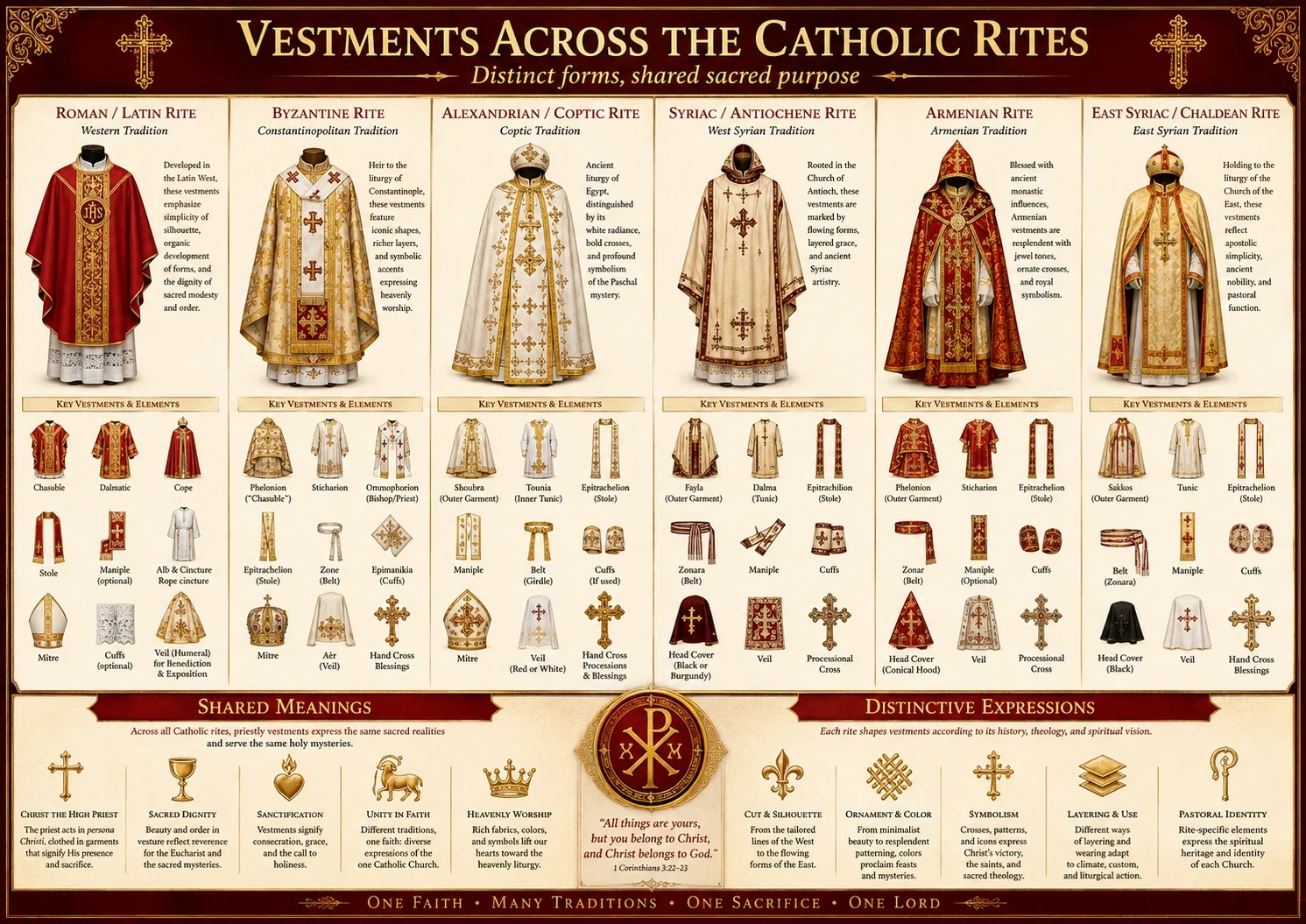
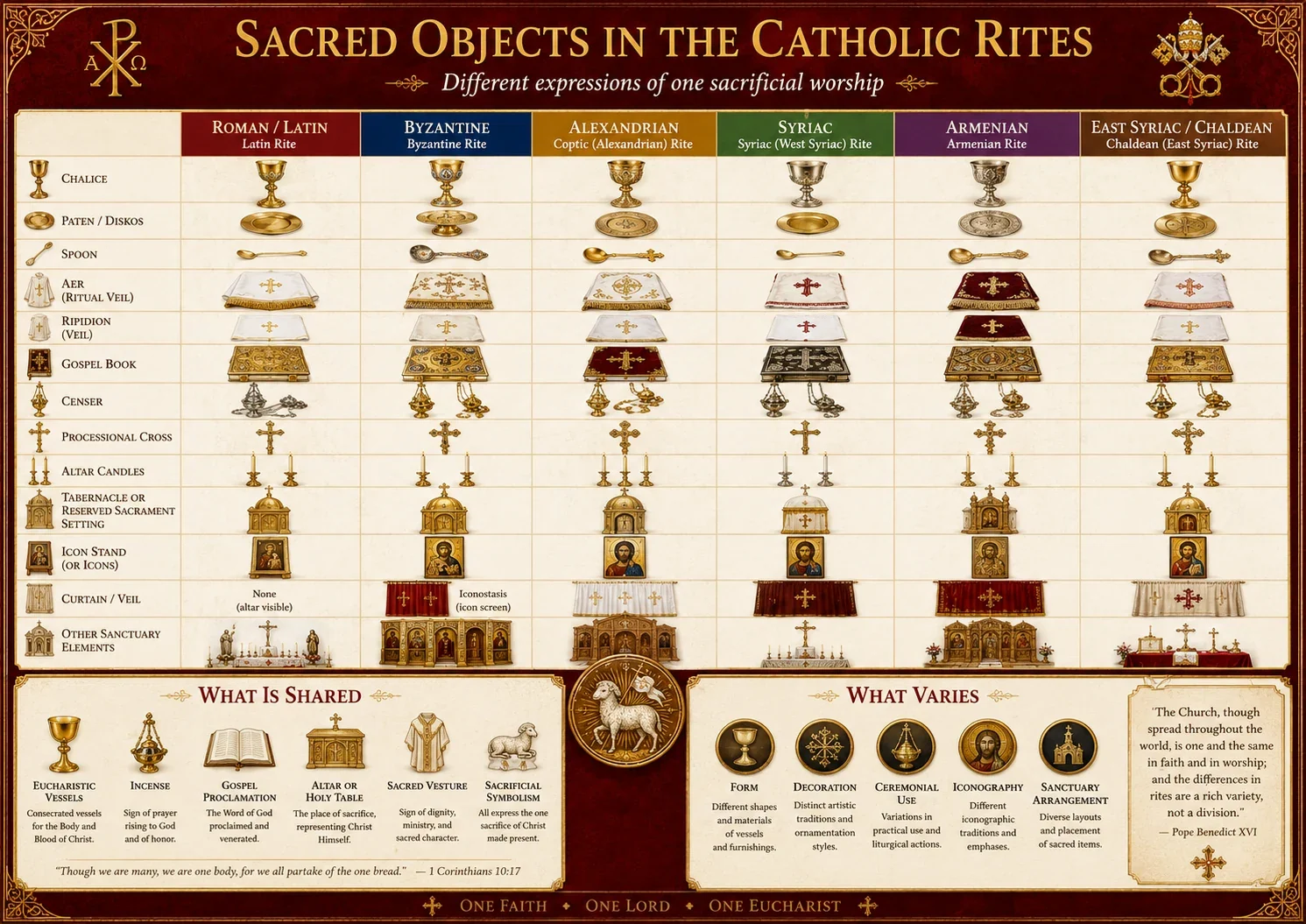
These comparative charts serve as visual companions to the dashboard. They do not replace the written explanation above; they help the eye see how different families express one Catholic worship through vesture, ceremonial language and sanctuary objects.
Vestments across the Catholic rites
Vesture visibly manifests office, sacred service, hierarchy and theological memory. The forms differ, yet each family clothes the priesthood with symbols of divine worship, sacrifice and sanctification.
Sacred objects in the Catholic rites
Chalices, censers, Gospel books, veils, sanctuary arrangements and altar furnishings vary in form while converging in purpose: the reverent celebration of the Eucharistic mysteries and the visible ordering of sacred space.
Study path
How to continue without confusion
Begin with Liturgy Overview and the biblical foundations of cult, sacrifice and sacred time.
Continue to Holy Mass to study the one sacrifice of Christ sacramentally made present.
Read New Testament Priesthood for the ministerial priesthood that serves the sacrifice of the altar.
Use Symbols of the Mass to understand gestures, sacred objects and ritual actions.
Return here to distinguish the six families and the twenty-four Catholic Churches with greater precision.
From rite to doctrine
The safest study order is not to begin by comparing external customs, but to follow the inner line: one faith, one sacrifice, one priesthood, many ecclesial forms. Read the rites together with the pages on doctrine, the Mass, priesthood, canon law and Church history so that ritual difference is never separated from Catholic communion.