Liturgy / Forms, signs and sacred actions

Forms and Symbols of the Mass

The visible forms of the Mass are not decorative additions to an otherwise invisible religion. They are the sacred language by which the Church approaches God: altar, orientation, tabernacle, veil, cross, candles, incense, processions, bodily postures, priestly gestures, silence, elevation, fraction and Communion. Each form has a place in the biblical history of worship. It begins with altars, sacrifice, priesthood, covenant, Temple and prophecy; it is fulfilled in Christ; and it opens toward the heavenly worship of the Lamb.

Forms, gestures and sacred actions of the Mass
The signs of the Mass are read through Scripture: altar, Temple, sacrifice, priesthood, Zion, Isaias, the Apocalypse and the worship of the Lamb.

Sacred grammar

Why visible form belongs to worship

Catholic worship is not a lecture surrounded by ornaments. It is public cult ordered to God. Because man is soul and body, worship must involve the whole person: the mind receives doctrine, the voice prays, the body stands, kneels, bows and keeps silence, and the hands of the priest perform actions received from the Church. A gesture in the Mass is therefore not theatrical decoration. It is doctrine enacted visibly before God.

The Bible itself teaches religion through visible forms. Sacrifice is offered on altars. Blood marks covenant. The Ark is veiled. The lamp burns before the Lord. Incense rises as prayer. Priests wash, bless, offer and enter sacred space. Israel goes up to Jerusalem in procession. The Temple is not a bare meeting room but a world of holy distinctions: court, altar, sanctuary, veil, lamp, bread, incense, chant and priesthood. The New Testament does not abolish the need for sacred form; it fulfils the figures in Christ, the true Priest and Lamb.

This page therefore reads the Mass from outside to inside. It begins with the altar and sanctuary, then proceeds to movement, postures and priestly actions. The purpose is not curiosity about details, but deeper participation: to see that the Mass is filled with biblical memory and that even the small gestures point to the one sacrifice of Christ and to the worship of heaven.

Form

Form gives worship order. It protects sacred action from improvisation and self-display. The faithful learn the faith through repeated patterns: approach, reverence, offering, adoration and reception. Without form the mind may still speak about God, but worship loses the visible discipline by which the Church receives, guards and hands on what is holy.

Symbol

A liturgical symbol points beyond itself because Scripture has already given visible things sacred meaning: altar, bread, wine, water, light, incense, veil and procession. The symbol is not a puzzle invented after the fact; it is a visible word inside the history of revelation.

Gesture

A gesture is the body confessing truth. Kneeling confesses adoration. Standing confesses readiness and honour. Genuflection confesses the Real Presence. Silence confesses mystery. The body learns to pray so that faith does not remain a thought only.

Action

Priestly actions are not private inventions. They are ordered acts within a sacrificial rite: blessing, kissing the altar, incensing, consecrating, elevating, breaking, mingling and purifying. They express that the priest handles holy things in the service of Christ, not in his own name.

I

The altar: direction, sacrifice and consecrated place

The first symbol of the Mass is the altar. It is not a stage, not a desk and not an ordinary table. In Scripture the altar is the place where man approaches God through gift, sacrifice, blessing and covenant. Abel offers from the firstlings of his flock. Noah builds an altar after the flood and offers burnt offerings. Abraham builds altars as he walks under the promise and is commanded to offer Isaac. Melchizedek, priest of the Most High, brings bread and wine and blesses Abraham. Before the Mosaic Temple exists, sacrifice is already directed toward God through a visible place of offering.

With Moses this simple altar-worship becomes ordered public cult. God commands a sanctuary, altar, priesthood, vestments, lamp, incense, sacrificial rites and sacred bread. Worship is no longer only the act of a patriarch at a particular moment; it becomes the public liturgy of a people, arranged around what God has revealed. In the Temple this order reaches its ancient height. The altar stands at the centre of Israel’s sacrificial worship, while the Holy Place and the Holy of Holies teach that God is near and yet infinitely holy.

The Christian altar receives this whole biblical history and leads it to Christ. The altar is honoured because it signifies Christ, receives the sacrificial action, and stands within the Church as the visible point toward which prayer ascends. Its consecration or blessing, its linens, its candles, its cross and the priest’s reverence teach that the Mass is not an informal gathering. It is holy worship directed to the Father through the Son in the unity of the Holy Ghost.

The altar as an ordered sacred place

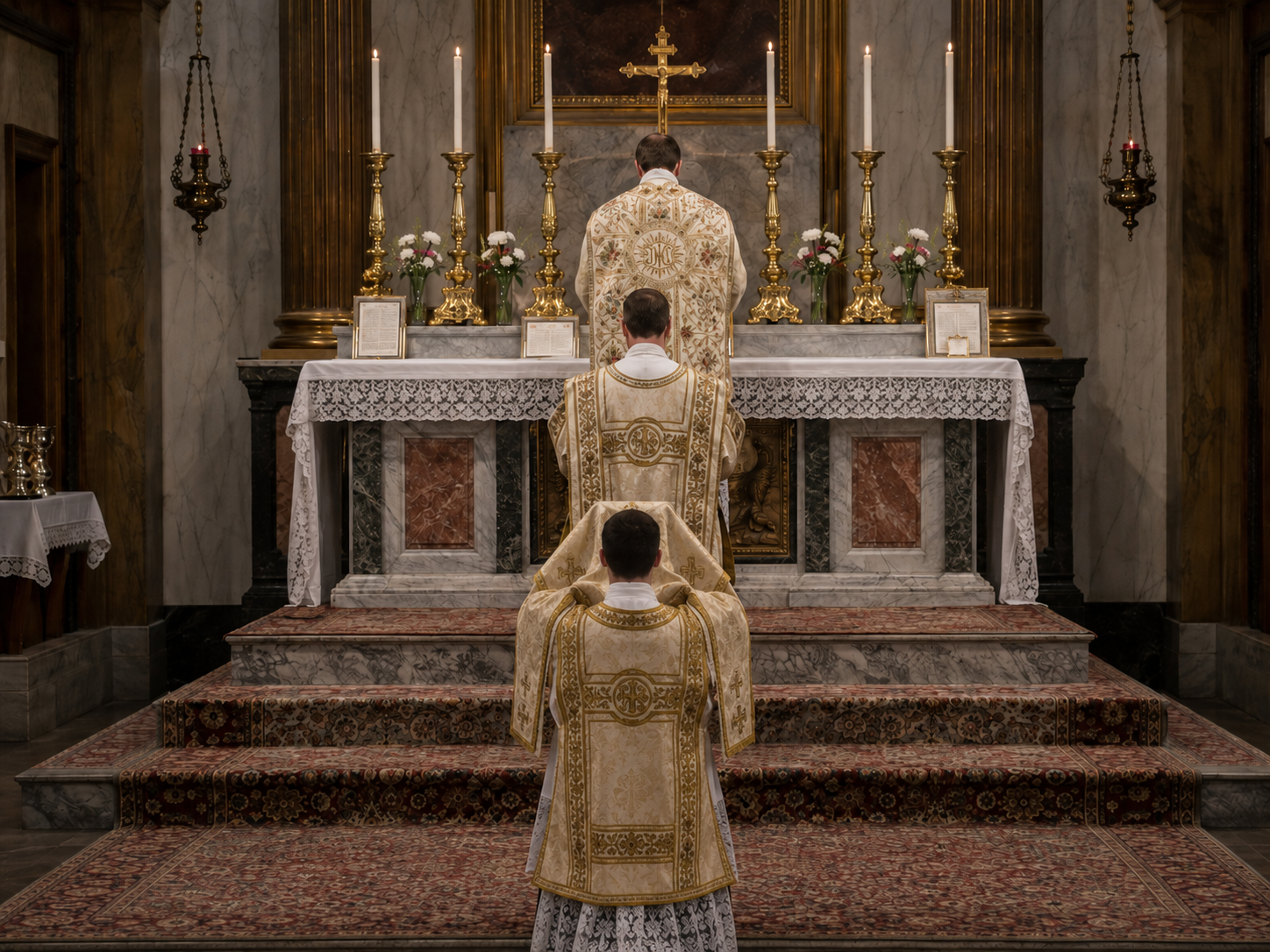
The altar is the fixed centre toward which the ministers ascend. In the solemn Roman form the order of priest, deacon and subdeacon makes visible that the liturgy is received, hierarchical and directed toward sacrifice rather than private self-expression.

Seen from the nave, the arrangement teaches direction and reverence at once: the altar is not treated as a casual table, but as the consecrated place where Christ’s sacrifice becomes sacramentally present. This ordered approach helps the reader understand orientation, sacred rank and the dignity of the altar itself.

Solemn ministers at the altar in the traditional Roman rite
Solemn order at the altarThe ascent of the sacred ministers shows hierarchy, orientation and reverence before the altar.

Patriarchal altars

Genesis shows altar-worship before Sinai: Abel’s acceptable offering, Noah’s thanksgiving after judgment, Abraham’s obedient sacrifice, and Melchizedek’s priestly blessing with bread and wine. These altars reveal that sacrifice belongs to worship before it becomes the detailed Temple rite.

The commanded altar

Exodus and Leviticus give order to sacrifice. God commands materials, rites, priests, washings, vestments and offerings. The altar is not a human invention but part of a revealed cult in which man approaches God according to divine order.

The consecrated altar

The Christian altar is set apart for God. In the traditional discipline it is blessed or consecrated, clothed, approached with reverence and kissed. This separation teaches that what is used for the sacrifice may not be treated as ordinary property.

Orientation

The altar gives worship direction. Christian prayer is not closed in on the assembly as its final horizon. It is turned toward God, toward the heavenly Jerusalem, toward Christ the rising Sun and the Lamb who receives adoration.

The altar kiss

The priest kisses the altar because the altar signifies Christ and bears the memory of the saints when relics are present. The gesture is not sentiment. It is reverence before Christ, His sacrifice and the Church made holy by union with Him.

The heavenly altar

The Apocalypse shows altar, Lamb, incense, elders and angels. The earthly altar therefore points beyond itself. It is the visible place where the Church’s worship is ordered toward the worship of heaven.

II

Tabernacle, veil, cross, candles and incense

The sanctuary is a field of biblical signs. It teaches by ordered nearness and holy distance. In the Old Testament the Ark, the Holy of Holies, the veil, the lampstand, the altar of incense and the bread of the Presence formed the sacred grammar of Israel’s worship. Nothing was arbitrary: light burned before God, incense rose before God, bread was placed before God, and the veil guarded the mystery of divine presence. These forms prepared the mind of Israel to understand that God dwells among His people but is not handled as common.

At Calvary the veil of the Temple is torn from top to bottom. The old sacrificial order has reached its fulfilment in the sacrifice of Christ. Yet the tearing of the veil does not mean that worship becomes casual or that sacred signs vanish. It means that access is opened through the Blood of Christ. The Catholic sanctuary therefore preserves reverence while confessing fulfilment. The tabernacle is not the old Holy of Holies repeated; it is the sign of Christ’s sacramental abiding. The veil no longer hides an unfulfilled promise, but guards the mystery of the Lord truly present under sacramental signs.

SignOld Testament lineFulfilment and liturgical meaning
TabernacleThe Ark and Holy of Holies teach covenant, divine presence and guarded holiness.The Eucharistic tabernacle witnesses that Christ remains with His Church. He is not merely remembered; He is adored as truly present.
Veil / velumThe Temple veil marked the boundary of the holy place; at the Passion it is torn from above.The tabernacle veil teaches both reverence and access: the mystery is hidden under sacramental signs, yet Christ has opened the way to the Father.
CrossThe lifted serpent foreshadows healing through the one lifted up.The altar cross keeps Calvary before the eyes. The Mass is not understood apart from the Crucified.
CandlesThe lampstand burns before the Lord in the sanctuary.Candles confess Christ the Light, the watchfulness of the Church and the splendour of worship offered before God.
IncenseIncense rises before the Lord; the Psalms speak of prayer rising like incense.Incensation honours altar, Gospel, gifts, priest and people as ordered to God. Apocalypse 8 shows incense with the prayers of the saints before the throne.
Sacred breadThe bread of the Presence stands before God as a perpetual sign.The Eucharistic presence is no longer only figure. The tabernacle contains the fulfilment: Christ, the living Bread come down from heaven.

The cross, candles and incense do not compete with the altar. They interpret it. The cross tells the faithful what sacrifice is present in the Mass. The candles announce that worship belongs to light, vigilance and resurrection hope. Incense marks the passage from ordinary air to prayerful offering: the sanctuary is filled with the sign of prayer rising, as in the Psalms and in the Apocalypse. The whole arrangement tells the worshipper that he has entered the grammar of Zion and the Lamb.

III

Procession: worship as pilgrimage toward God

Procession is one of the most ancient forms of sacred action because revelation itself is full of holy movement. Abraham is called out. Israel passes through the sea and journeys toward the promised land. The Ark is carried with solemnity. David dances before the Ark. The tribes ascend to Jerusalem. The Psalms of ascent give voice to a people going up to the house of the Lord. Worship is therefore not only standing in a place; it is ordered movement toward God.

In the Mass, procession teaches that the Church does not invent herself from below. She is summoned, gathered and led. The ministers approach the altar because the sacred action has a centre. The Gospel may be carried with honour because Christ speaks through the apostolic word. The offerings are brought because creation and human labour are to be set apart for God. The Communion procession shows the faithful approaching the fruit of the sacrifice, not as owners, but as beggars invited to the banquet of the Lamb.

The New Testament completes the meaning of procession. Christ enters Jerusalem as King and Victim. After the Resurrection He walks with the disciples to Emmaus and is known in the breaking of bread. The Apocalypse shows worship moving around the throne: elders, angels, incense, song and adoration before the Lamb. Catholic processions are therefore not pageantry. They are bodily theology: the Church on earth moves toward the altar because the whole Church is on pilgrimage toward the heavenly Jerusalem.

Incense, cloud and honour

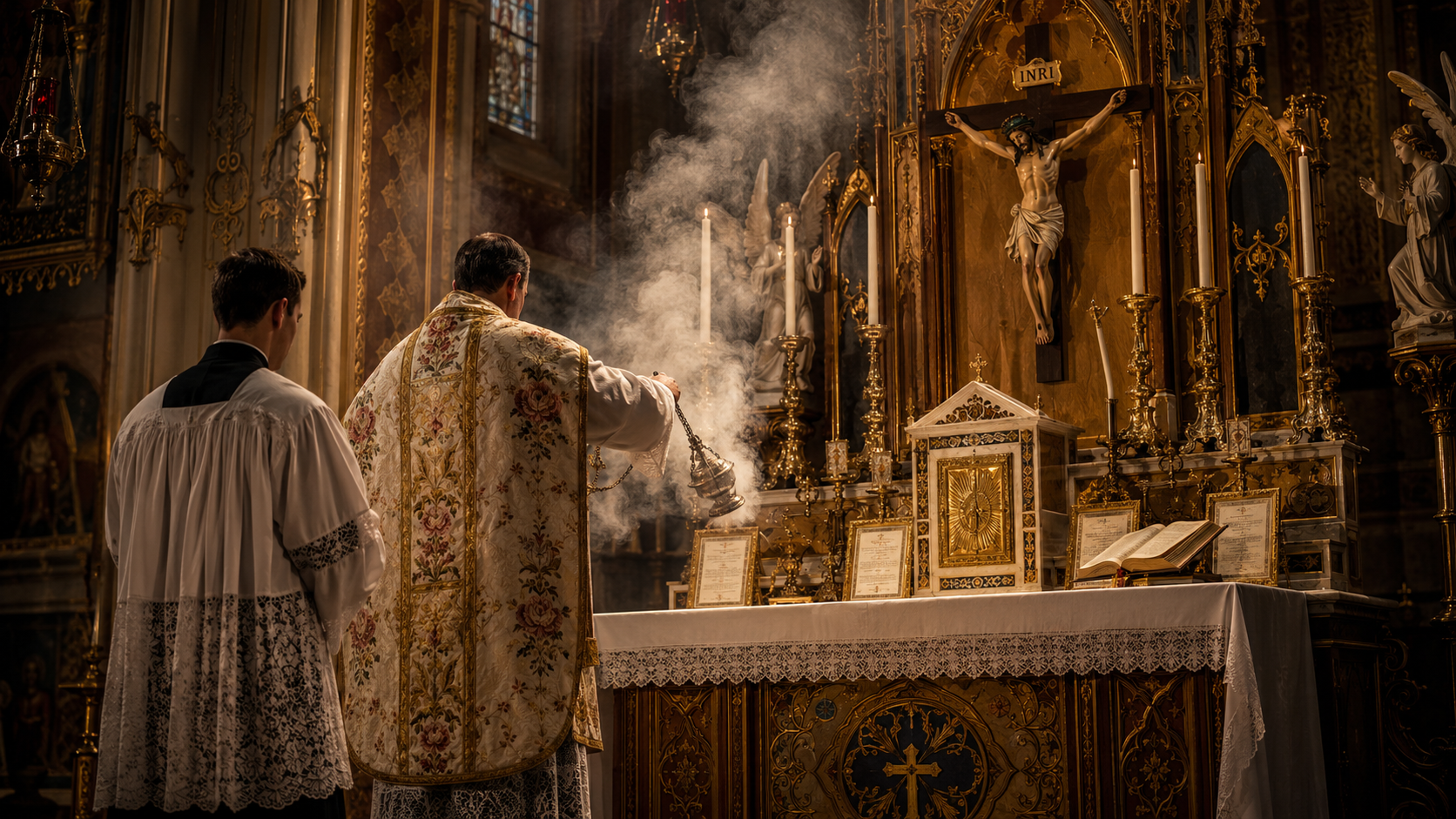
Incensation is one of the clearest sanctuary signs because it gathers several biblical meanings into one act: honour to what is consecrated, prayer rising before God and the holy cloud that surrounds the divine presence.

When the altar, cross, tabernacle or gifts are incensed, the gesture confesses that worship is offered in a sacred sphere. The sanctuary is not stripped of meaning; it is filled with ordered signs that prepare the soul for adoration.

The priest incenses the altar in the traditional Roman rite
Incensation at the altarIncense honours the altar and makes visible the biblical cloud of worship and prayer.

Entrance

The entrance movement orders the assembly toward the altar. The priest does not wander into a meeting; he approaches the holy place for an action greater than himself. The procession teaches that worship begins by being summoned and led.

Gospel

When the Gospel is carried with candles and incense, the Church confesses that Christ speaks with royal authority. The book is honoured not as paper, but as the received apostolic witness of the Lord.

Gifts

The bringing of bread and wine points to offering. What belongs to creation and human labour is placed into the hands of the Church to be ordered toward the consecratory action of Christ.

Communion

The faithful approach the altar in humility. Communion is not casual distribution; it is the reception of the Victim offered, the Bread of Life given to those called to the marriage supper of the Lamb.

IV

Postures: the body before the Lord

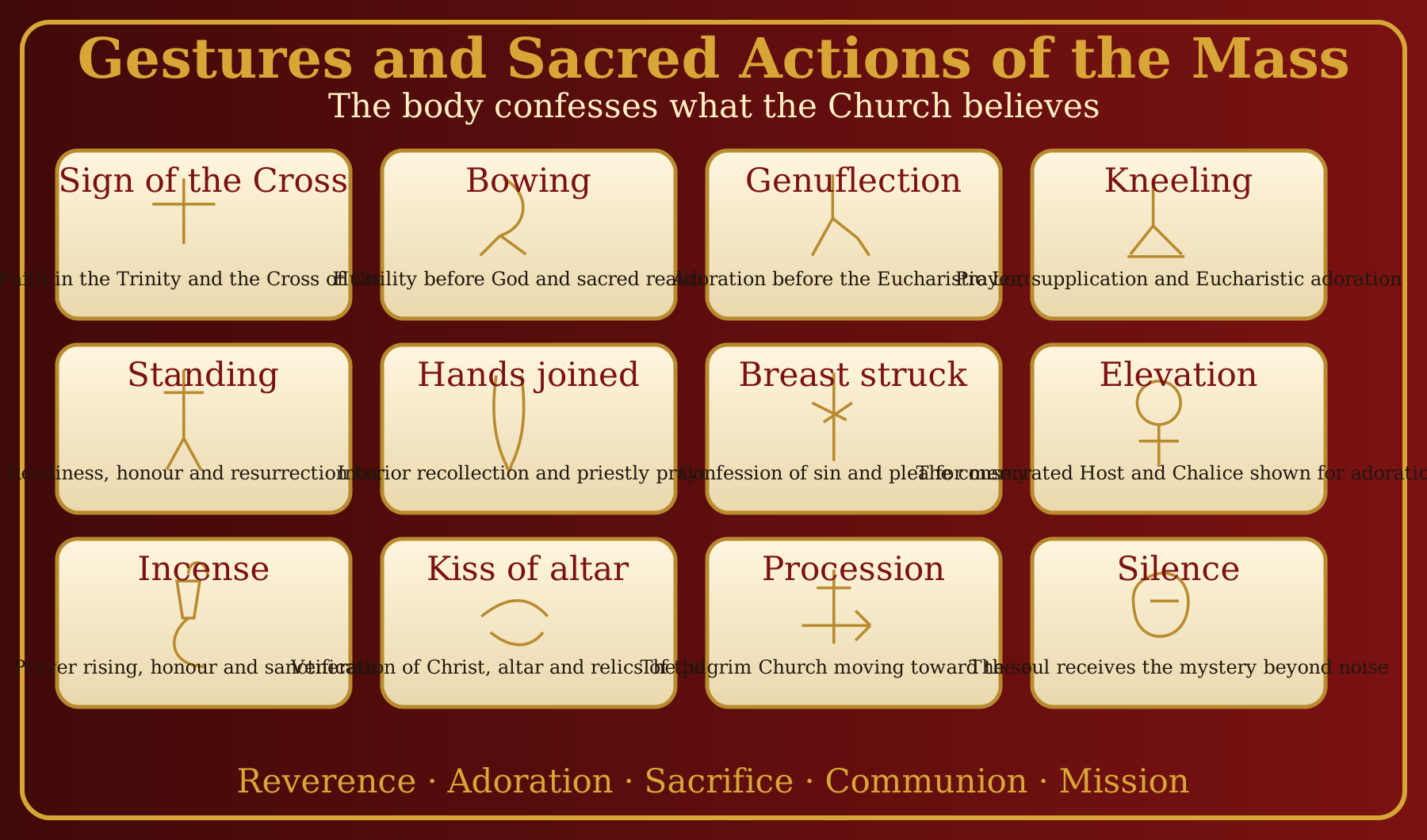
The postures of the Mass are not empty choreography. The body is the servant of the soul, and in worship it is trained to confess the truth. Scripture does not present worship as disembodied thought. Men fall on their faces before God. Priests stand to minister. Israel sits to hear instruction. The people bow, kneel, rise, sing and keep silence. In Isaias the heavenly court cries Sanctus; in the Apocalypse the elders fall down before the Lamb. The Mass receives this biblical language and orders it to Christ truly present.

1. Standing

Standing expresses readiness, praise, resurrection dignity and attentive hearing. In the Old Testament priests stand to minister before the Lord, and the people stand to receive solemn words. In the New Testament the redeemed are not slaves crushed by despair; they stand as those called into covenant. At Mass, standing for the Gospel and solemn prayer declares that the worshipper is awake before the living God, ready to hear and to obey.

2. Kneeling

Kneeling confesses adoration, humility, penance and awe. Scripture shows the knee bending before divine majesty, petition and repentance. In the Mass, kneeling reaches its highest meaning before the Eucharistic mystery: the creature falls low because the Lord of glory is present under sacramental signs. It is not weakness but truth; man receives grace on his knees.

3. Sitting

Sitting belongs to ordered instruction. Israel sits to hear the Law; the disciple sits to listen; Mary of Bethany sits at the feet of the Lord. In the Mass, sitting during readings, psalm, sermon or periods of instruction does not lessen reverence. It shows the soul being formed by the Word before it is led deeper toward offering and adoration.

4. Bowing

Bowing marks reverence before holy names, altar, Gospel, blessing and sacred persons. A bow is not theatrical politeness; it is measured honour. It teaches that holy realities are approached with restraint. The body bends because pride must be trained out of worship.

5. Genuflection

Genuflection is bodily adoration before the Lord truly present in the Blessed Sacrament. It is stronger than a simple greeting because the Eucharistic presence is not symbolic memory only. The knee bends to Christ Himself. The gesture also teaches the worshipper to recognise the tabernacle and altar as places of holy encounter.

6. Silence

Silence is not absence of prayer. It is worship purified of noise. Scripture shows silence before divine judgment and awe before the mystery of God. In the Mass, silence protects the Canon, consecration, adoration and thanksgiving from being flattened into explanation. The soul learns that the deepest realities exceed speech.

V

Priestly actions often missed from the pew

Many of the deepest signs of the Mass are performed by the priest quietly. From the back of the church they can look like small technical movements. In reality they are part of a sacrificial language. The priest kisses the altar, blesses and signs the offerings, washes his fingers, joins his fingers after the consecration, elevates the Host and Chalice, breaks the Host, mingles a particle with the Precious Blood, purifies paten and chalice, and keeps custody over the smallest particle. These actions teach that the Mass concerns the Body and Blood of the Lord, not ordinary bread and wine.

The Old Testament background is important. Holy things are separated for God. Priests are consecrated for divine service. Vessels are not common vessels. Blood, altar, incense and sacred bread are handled according to command. In the New Testament this reverence is not lowered but heightened, because the reality is greater than the figure: Christ Himself is present and offered sacramentally.

The altar kiss and reverence for the holy place

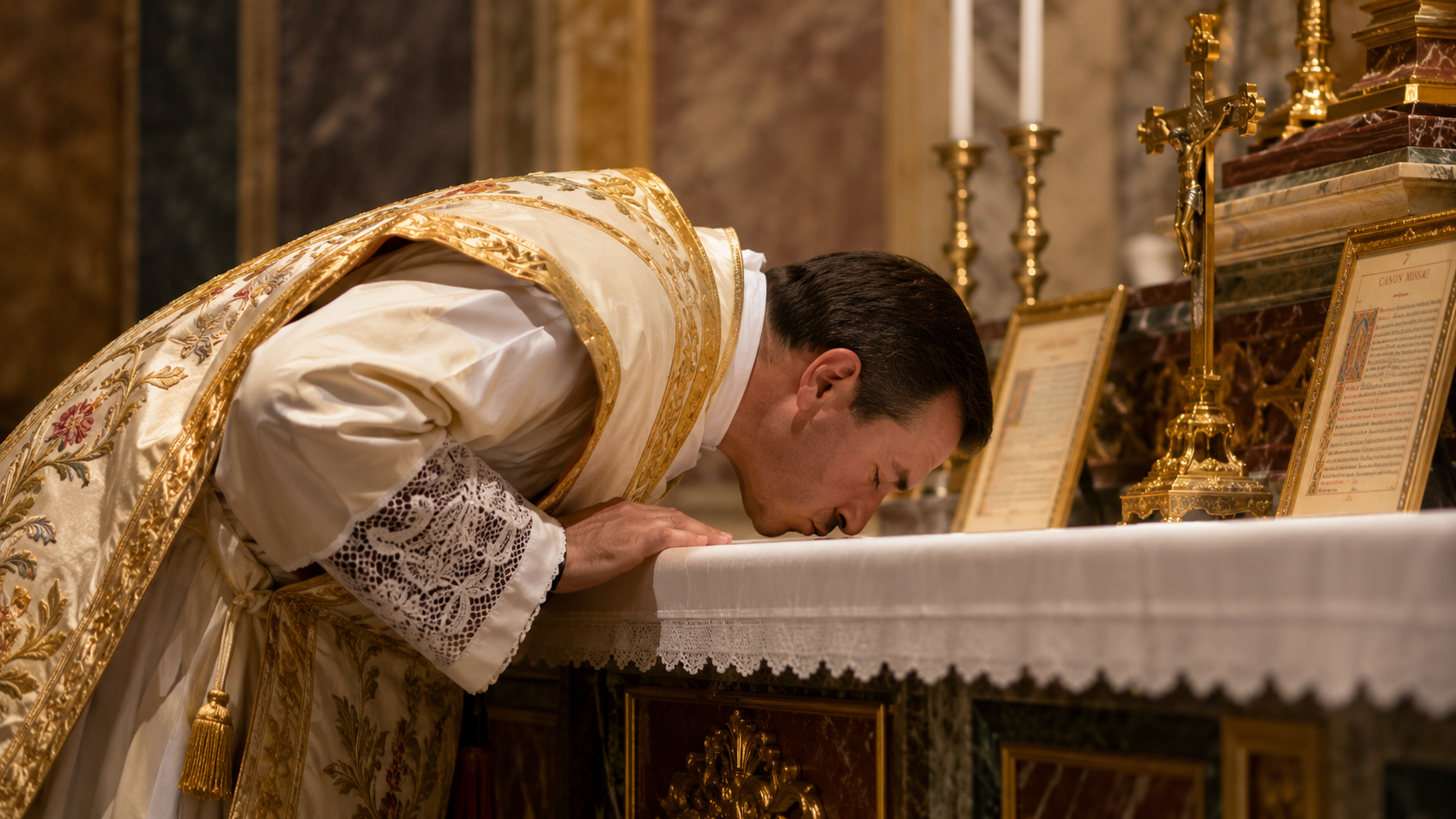
The kiss of the altar is not an ornamental courtesy. The priest bows and kisses because the altar signifies Christ and because the sacrificial place is approached with love and reverence before any further action unfolds.

This gesture also helps the faithful read the whole Mass correctly: the priest is not performing before an audience, but entering a sacred action before God.

The priest kisses the altar in the traditional Roman rite
The altar kissThe priest kisses the altar as a sign of reverence for Christ and the sacrificial place.

Offertory, oblation and the ordering of the gifts

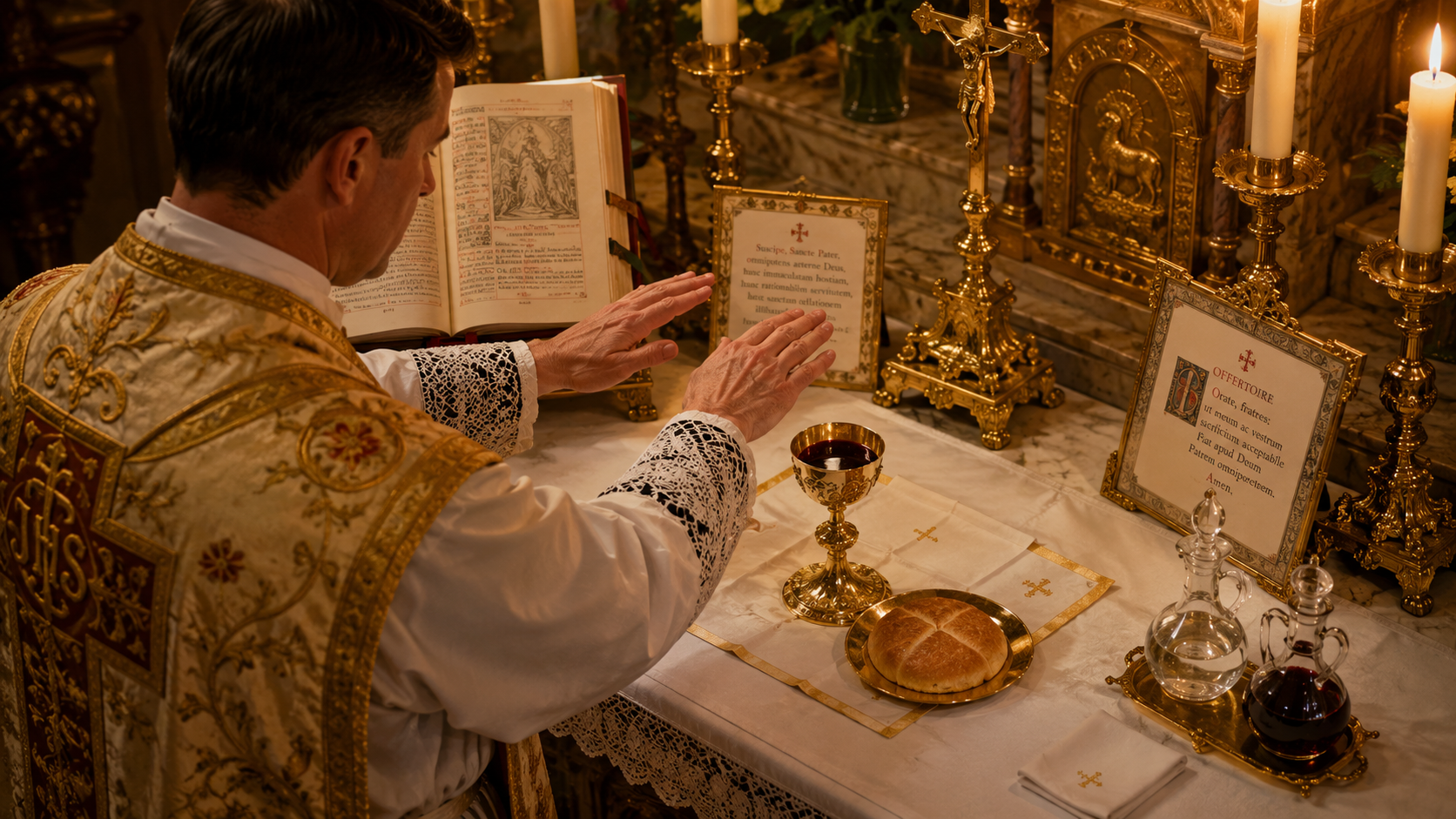
At the offertory the bread and wine are already being set apart for sacrifice. The gestures over the offerings, the placement upon the altar and the prayer of oblation all teach that these are no longer treated as merely common food set before a crowd.

This stage prepares the reader for water and wine, signs of the Cross over the gifts and the careful custody of the sacred vessels. The liturgy moves deliberately from offering toward consecration.

The offertory in the traditional Roman rite
Offertory and oblationThe bread and wine are set apart and offered to God in preparation for the Eucharistic sacrifice.

Fraction, commingling and Eucharistic reverence

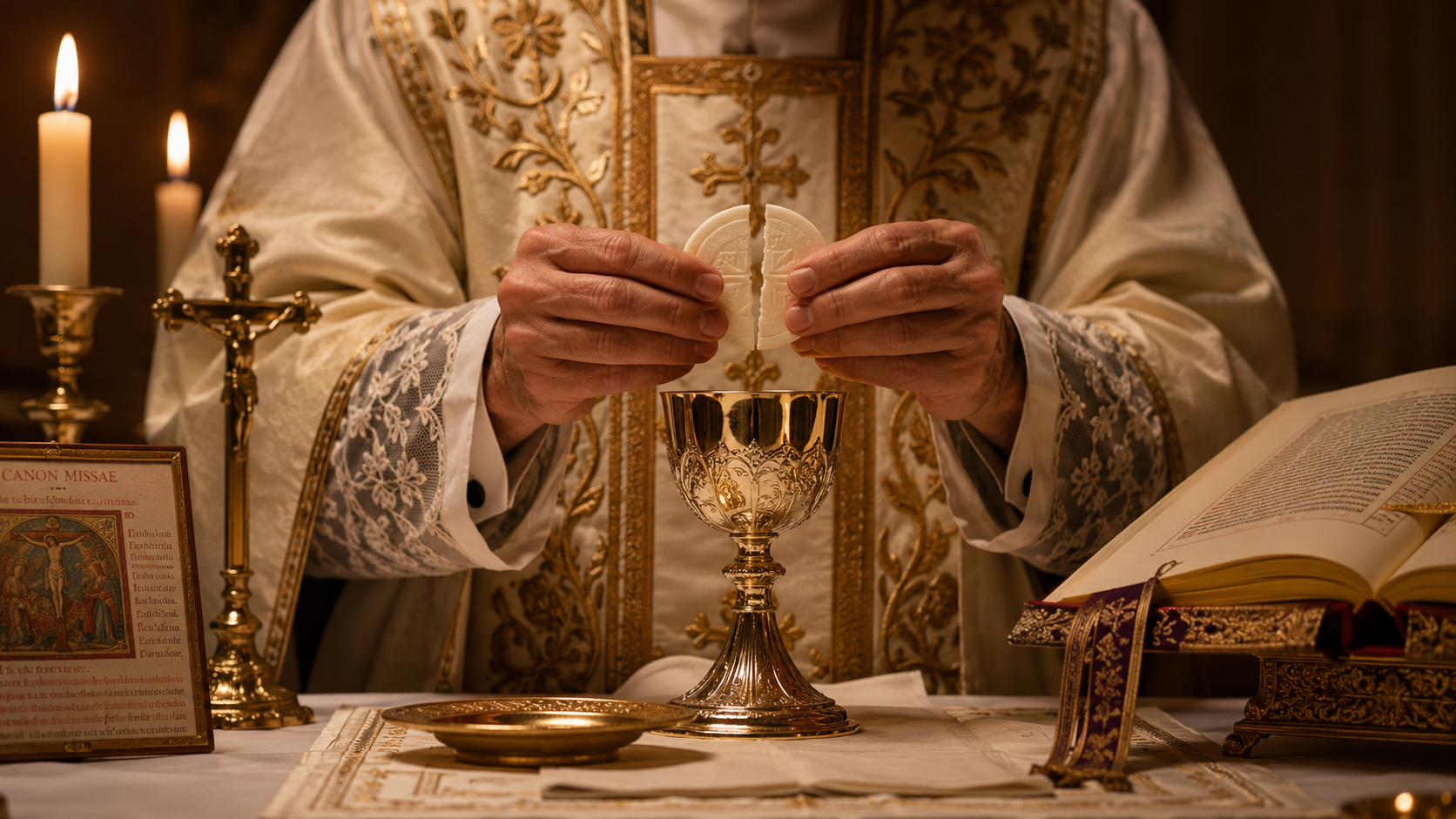
The fraction of the Host and its relation to the Chalice belong to the inner sacrificial language of the Mass. The Host is broken, yet Christ is not divided; the gesture recalls the Passion and the apostolic language of the breaking of bread.

Placed near the Chalice, the action also leads naturally to commingling and purification. Each movement teaches that the smallest particle and every Eucharistic sign is handled with exact faith in the Real Presence.

The priest breaks the Host above the Chalice in the traditional Roman rite
Fraction of the HostThe Host is broken above the Chalice as a sacrificial and Eucharistic sign that leads toward commingling and Communion.

Altar kiss

The priest kisses the altar at the beginning and at other solemn moments because the altar signifies Christ and the sacrificial place. The kiss is an act of reverence before the mystery into which the priest is about to enter. If relics are enclosed or associated with the altar, the gesture also recalls the martyrs and saints joined to the Lamb.

Signs of the Cross over the gifts

The signs of the Cross mark blessing, separation and sacred possession. Bread and wine are not treated as ordinary food once placed within the sacrificial order. The Cross claims the offerings for God because the Mass is read through Calvary. The gesture says visibly: these gifts are ordered to the sacrifice of Christ.

Veiled paten

In the solemn Roman rite the paten is borne veiled by the subdeacon until it returns to the altar. The primary liturgical meaning is reverent custody of what belongs to the sacred action. Devotional commentators have also seen in the veiled paten an image of hidden receptivity: like the humility of the Virgin at the foot of the Cross, veiled before men yet open to God.

Purification of the paten

The priest’s careful attention to the paten is first an act of Eucharistic faith: no particle may be lost or treated carelessly. The gesture teaches integrity and reverence. Pious interpretation may also see in this careful purity an echo of the immaculate vessel through whom the Word took flesh, but the liturgical foundation is reverence for the sacramental presence.

Lavabo

The washing of the fingers recalls priestly purification and Psalm 25/26: the minister approaches the altar asking for clean hands and a pure heart. The action is small, but its lesson is great: the sacred mysteries are not approached as a right of office alone, but with fear, repentance and purification.

Joined fingers

After the consecration, the traditional Roman rite keeps the priest’s thumb and forefinger joined because they have touched the consecrated Host. The gesture is practical reverence and doctrinal witness: Christ is wholly present, and every particle is guarded.

Elevation of the Host

The Host is lifted for adoration. The sign recalls the serpent lifted in the desert and Christ’s word that, when lifted up, He will draw all things to Himself. The elevation presents the sacramental Victim before the Father and before the adoring Church.

Elevation of the Chalice

The Chalice is lifted because the Blood of the Covenant is present sacramentally. The separate consecration of Body and Blood represents the sacrifice of Calvary, while the living Christ remains whole and glorious. The faithful adore, not a symbol only, but the Lord truly present.

Fraction of the Host

The breaking of the Host belongs to apostolic language: the breaking of bread. It does not divide Christ into parts, for the whole Christ is present under every part. It visibly recalls the Lamb slain, the Lord’s Passion and the sacrificial banquet given to the Church.

Water and wine

The mingling of water with wine before consecration points to the union of Christ with His people and recalls the blood and water from His opened side. The drop of water disappears into the wine, teaching that the faithful have no life apart from being taken into Christ.

Commingling

When a particle of the Host is placed into the Chalice, the sign proclaims the living unity of Christ’s Body and Blood. The sacrifice is represented by sacramental separation, yet the risen Christ is one. The sign leads from Calvary to the living Lord.

Purification

The careful purification of paten, chalice, corporal and fingers is not scruple about objects. It is faith in the Real Presence. The Church handles the sacred species with exact reverence because Christ gives Himself under sacramental signs.

Incensation

Incense honours the altar, cross, Gospel, gifts, priest and people according to their relation to the sacred action. It joins the prayer of the Church to the biblical cloud of worship and to the incense before the heavenly throne.

Sanctus

The Sanctus comes from Isaias and the worship of heaven. When the Church sings Holy, Holy, Holy, she is not filling silence with music; she is entering the angelic confession before the throne of God and the Lamb.

Bell

The bell summons attention to the holiest moments. It does not create the mystery; it alerts the senses so the faithful may adore. In a large church, where silence and distance can conceal the action, the bell serves recollection.

VI

Isaias, the Apocalypse and the worship of the Lamb

The signs of the Mass become most intelligible when read in the light of heaven. Isaias sees the Lord enthroned, the Seraphim crying Sanctus, and the prophet purified by a coal from the altar. The Apocalypse shows the Lamb standing as slain, the elders falling down, angels singing, incense rising with the prayers of the saints, and the marriage supper of the Lamb. These are not poetic decorations. They are biblical keys for understanding Catholic worship.

Standing, kneeling, bowing, silence, altar, incense, light, veils, processions and priestly actions all point beyond themselves. They train the faithful to worship with the Church on earth while being ordered toward the Church in heaven. The Mass is therefore not understood by isolating gestures as separate curiosities. The whole form is one ascent: from the visible sanctuary to the one true altar, from the earthly rite to the Lamb, from the signs of Scripture to the fulfilment in Christ.