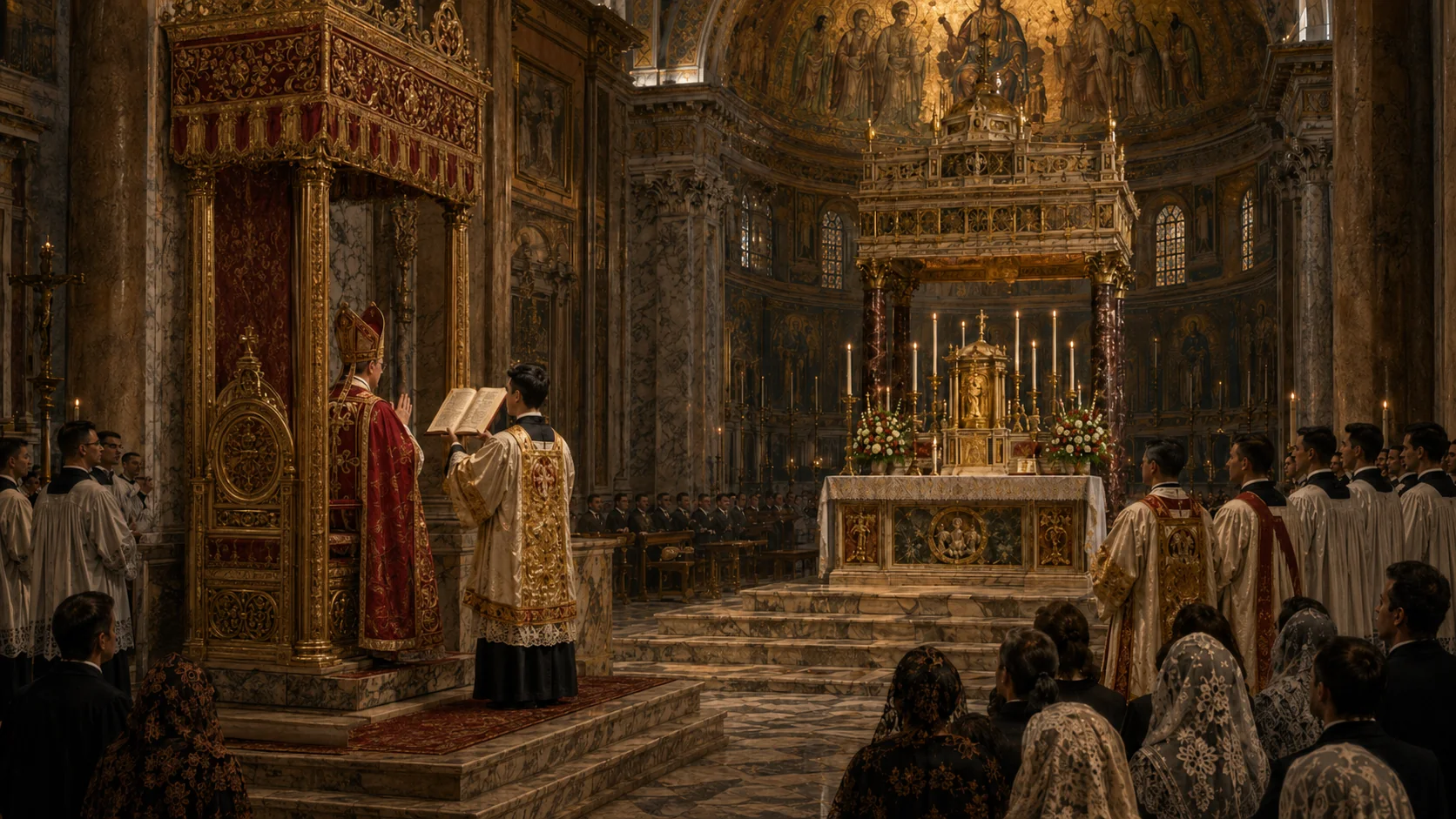
Ordo Missae
The inner order of the Mass
The order is not a sequence of unrelated parts. It is a spiritual ascent from purification to instruction, from offering to consecration, from communion to mission.
Prayers at the foot
The priest approaches the altar through humility. Psalm 42, the Confiteor and absolving prayers teach that the altar is not entered casually. Worship begins by recognising God’s holiness and man’s need for mercy.
Introit to Collect
The Introit gives the day its scriptural voice. Kyrie invokes mercy. Gloria expands praise. The Collect gathers the Church’s petition and places it before the Father through Christ.
Epistle and Gospel
The readings do not replace sacrifice; they prepare it. The Epistle, Gradual, Alleluia or Tract, Gospel and Credo teach the faith before the oblation is carried to the altar.
Offertory
The gifts are offered with sacrificial language. Bread and wine are not treated as casual food, but as gifts set apart for the mystery of the Body and Blood of Christ.
Roman Canon
The Canon is the heart of Roman liturgical prayer. Its stillness is not absence; it is concentration. It remembers the living and the dead, venerates the saints, calls down blessing, and surrounds the consecration with priestly intercession.
Consecration and elevation
At the words of Christ, the sacrifice is sacramentally present. The elevation teaches adoration: the faithful look upon the Host and the Chalice not as symbols detached from reality, but as the sacramental presence of the Lord’s Body and Blood.
Communion and thanksgiving
Communion is the fruit of sacrifice. The faithful receive not an ordinary sign, but the Lord Himself. Postcommunion prayer and the Last Gospel send the worshipper back into the world under the light of the Incarnation.