Cultus / Liturgy / Biblical Preparation

Sacred Liturgy

Before the reader studies rites, calendars, chant, rubrics or sacred gestures, one word must be understood: cultus. Sacred worship is the reverent service owed to God. It is not first a human programme, an aesthetic taste or a private religious mood. It is the creature standing before the Creator, receiving what God reveals, offering what God commands, and learning how holiness orders man, family, people and time.

This page therefore begins before the Church's public rites are treated in detail. It starts with altar and sacrifice in the first ages, follows the formation of Israel's ordered worship under Moses, reaches the Temple and the Psalms, listens to the prophets, and only then points forward to Christ and to the heavenly worship shown in the Apocalypse. The Holy Mass itself is treated on the next page.

Sacrifice and priestly worship in the Old Covenant
The altar, sacrifice and priestly worship of the Old Covenant prepare the fulfilment of divine worship in Christ.

I. Cultus

Worship before the study of rites

The word cultus means ordered reverence, service and worship. In a theological sense it names the honour given to God because He is God: Creator, Lord, Lawgiver, Redeemer and final end of man. Liturgy will later appear as public, ordered cult; but cult itself is more basic. It is the act by which man acknowledges that he does not belong to himself absolutely, that life is received, that sin requires purification, and that blessing descends from God rather than being produced by human technique.

Not every ceremony is liturgy

A community can have signs, solemnities and repeated customs without having true worship. Sacred cult is different. It is directed to God, marked by reverence, joined to truth, and shaped by the conviction that man must receive the proper way of approaching the divine. In Scripture, worship is never a merely decorative layer placed upon religion. It is the visible form taken by faith, obedience, thanksgiving, penance and covenant.

This is why the first question is not whether a rite is beautiful or ancient, but whether it expresses true reverence before God and whether it stands in the order God has revealed. Beauty follows truth. Gesture follows doctrine. Public worship forms the soul because it places the whole man before the holiness of God.
From private act to public order

At the beginning, worship appears in simple forms: an offering, an altar, a blessing, a vow, a sacrifice of thanksgiving. These acts are not yet the later Temple liturgy, but they are not formless. They already contain the essential grammar of worship: God calls, man answers; God gives, man returns a gift; sin wounds communion, sacrifice seeks restoration; blessing comes from above and orders life below.

When God forms Israel as a people, this grammar becomes public and organised. The family altar becomes national worship. The occasional sacrifice becomes prescribed service. Sacred time, sacred place, priesthood, vestments, incense, song and calendar do not replace the earlier meaning; they surround it, guard it and make it the common cult of the people of God.

II. Sacrifice

The highest act within cultus

Among the acts of worship, sacrifice has the highest place because it expresses most completely that God is the first beginning and last end of man. Prayer asks; praise blesses; thanksgiving acknowledges; vows bind the will; but sacrifice places a gift before God in a solemn act of surrender. It says with visible force that life is received from God, that sin must be answered by purification, that thanksgiving must not remain a word only, and that the creature cannot stand before the Creator as if nothing were owed.

Why sacrifice stands at the centre

Sacrifice is not merely destruction, loss or religious theatre. In biblical worship it is an exterior act with an interior meaning: the gift is separated from ordinary use, offered to God, and joined to adoration, thanksgiving, expiation or covenant. The visible offering teaches what invisible devotion must become. Man gives something precious because God is worthy of more than words; he offers through an appointed order because God is not approached by arbitrary invention; he receives blessing because worship is not self-enclosed but ordered to communion with God.

This is why sacrifice appears from the beginning of Scripture and why it becomes the centre of Israel's public cult. The altar is not an accessory beside worship; it is the place where adoration, sin, gift, covenant and divine mercy meet. Even when the sacrifice is simple, as in the patriarchal period, it already points beyond itself. It asks for a perfect offering that man cannot produce from himself.

From many offerings toward one fulfilment

The sacrifices of the Old Covenant were real acts of worship commanded by God, but they were also preparatory. Their repetition showed both their dignity and their limitation. They taught Israel to worship with reverence, blood, altar, priesthood, sacred time and sacred place; yet by being repeated again and again they showed that the final sacrifice had not yet come. The altar educated the people, but it did not itself complete redemption.

For this reason the Temple reaches a true height of public cult and at the same time remains a figure. Its splendour is not cancelled as meaningless; it is gathered into a greater fulfilment. When Christ offers Himself, the old sacrificial order does not end because worship has become unnecessary. It ends because the perfect sacrifice has appeared. The Christian question is therefore not whether the New Testament still has worship and sacrifice, but how the one sacrifice of Christ is present to His Church without repeating Calvary as another bloody death.

II. Liturgy

The ordered public cult of a community

Liturgy, considered broadly, is not simply prayer in common. It is public worship in an ordered form. It belongs to a community, receives a stable shape, follows appointed words and actions, and binds individual devotion into a visible act greater than private feeling. A liturgy is therefore recognisable: it has memory, order, office, repetition, solemnity and authority.

Public

Public worship is not merely many individuals praying near one another. It is the common act of a people. In Israel, worship forms the people as Israel; it gathers tribes, families, priests and singers into a received order before the Lord.

Ordered

Order is not the enemy of spirit. In Scripture, divine nearness increases reverence and form. The closer the people approach the sanctuary, the more carefully purification, priesthood, sacrifice and sacred time are marked.

Received

True biblical worship is not invented from below. God commands, corrects and purifies worship. Israel learns that the Lord is not approached as the nations approach their gods, nor according to arbitrary human preference.

Biblical Spine

From altar, temple and prophecy to Christ and the heavenly liturgy

The page follows a deliberate order. First come the simple sacrifices before Moses; then the Passover and Exodus; then the Tabernacle, priesthood and Temple; then the Psalms and the prophets; then the convergence of the whole order in Christ; and finally the heavenly worship shown to Saint John. The summary cards give the path. The following sections unfold it in detail.

I

Patriarchal altars

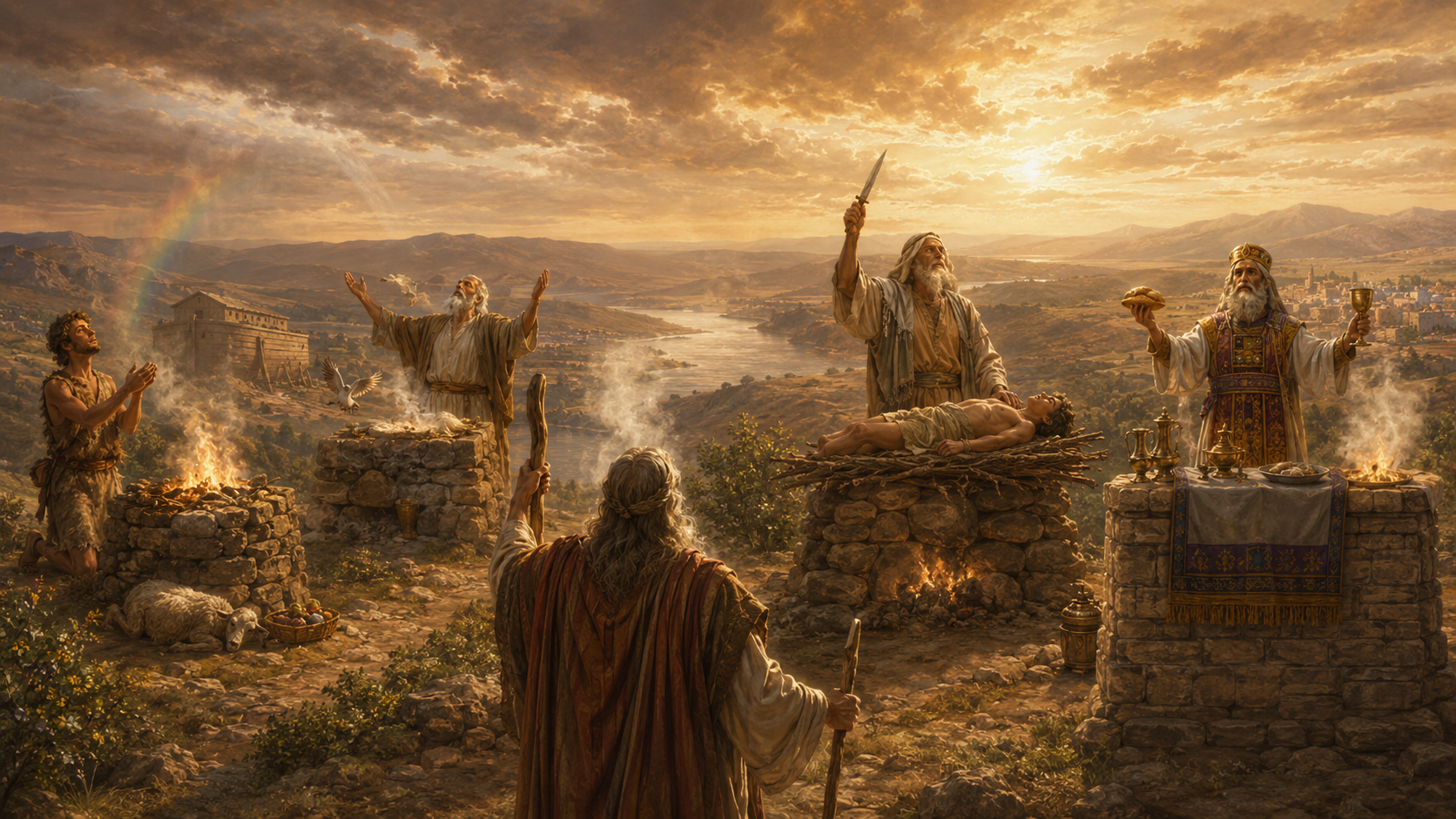
Abel, Noah, Abraham and Melchizedek reveal sacrifice, blessing, bread and wine before the Mosaic Temple. Their worship is simple, but not formless: it is offered to God, marked by gift, thanksgiving, obedience and covenantal blessing.

II

Passover and Exodus

The people are freed through blood, meal, covenant and pilgrimage. Christian liturgy reads this not as a closed memory of Israel alone, but as figure and preparation for the saving acts by which God redeems His people.

III

Temple and Psalms

Priesthood, altar, incense, sacred song and hours of prayer shape the vocabulary of Catholic worship. The Psalms teach the Church how to lament, praise, repent, ascend and bless in the presence of God.

IV

Prophets

Isaias, Ezechiel and Daniel join purification, throne, sacrifice, Son of Man and eschatological worship. They show that worship is not merely earthly order, but a participation in a divine mystery revealed from above.

V

Christ

At the Last Supper and on Calvary, Christ is Priest, Victim, Altar and Mediator. The figures do not disappear into abstraction; they are gathered into the person and saving work of the Incarnate Word.

VI

Heaven

The Apocalypse shows altar, Lamb, incense, elders, angels and ceaseless praise. Earthly liturgy is ordered toward this consummation: the worship of God in the communion of angels and saints.

III. Before Moses

The patriarchal altars: sacrifice before the Temple

Before the Law of Moses gives Israel a detailed public order, Scripture already presents worship through concrete acts. The patriarchal sacrifices show that worship is not a late invention. Man offers because he has received life from God; he gives because everything is first given; he builds an altar because worship is directed upward; he sacrifices because sin, gratitude, covenant and blessing are not abstractions.

Abel: the first accepted offering Genesis 4:3-5; Hebrews 11:4

Abel offers from the firstlings of his flock. Scripture contrasts his sacrifice with Cain's offering and states that the Lord had regard for Abel and his gifts. The point is not only that something was brought to God, but that the offering revealed the heart of the worshipper. True cult joins exterior gift and interior righteousness. It is possible to perform a religious act and still fail in reverence; it is also possible for a simple offering to become pleasing to God when faith and justice stand behind it.

Abel therefore stands at the beginning of the biblical line of sacrifice. His worship is personal and domestic, not yet public Temple service, yet it already contains essential elements: selection of a worthy gift, orientation toward God, the seriousness of sin, and the mystery that innocent blood will mark the history of redemption. Christian tradition naturally sees in Abel the first just man whose sacrifice points beyond itself.

Patriarchal altars
Patriarchal altarsAbel, Noah, Abraham and Melchizedek form the first biblical school of sacrifice.

Noah: altar after judgement and mercy Genesis 8:20-22

After the flood, Noah builds an altar and offers clean animals. The sacrifice rises after judgement, deliverance and a new beginning. Worship appears here as thanksgiving for preservation and as recognition that the world itself remains under God. Noah does not simply resume ordinary life; he begins with an altar. The first act after deliverance is cult.

This passage teaches that worship is tied to creation and covenant. God receives the offering and promises the stability of seedtime and harvest, cold and heat, summer and winter, day and night. The altar is thus not separated from the world. It gathers the restored creation into thanksgiving and places human history under divine mercy.

Abraham: altar, obedience and covenant Genesis 12:7-8; 15:9-18; 22:1-18

Abraham builds altars as he follows the call of God. His worship is inseparable from faith, pilgrimage and promise. The altar marks the places where God appears, speaks and binds His servant to a covenant. The patriarchal altar therefore teaches that worship is not escape from history; it is the way history is received under promise.

The sacrifice of Isaac brings the line to a terrible height. Abraham is commanded to offer the beloved son, yet God Himself provides the victim. The scene reveals obedience, substitution, mount, wood, victim and blessing. It does not yet disclose the full mystery of redemption, but it gives the biblical imagination its deepest grammar: the son, the sacrifice, the mountain and the divine provision. Later worship cannot be understood apart from this school of obedience.

Melchizedek: priest, blessing, bread and wine Genesis 14:18-20; Psalm 109/110:4

Melchizedek appears as priest of the Most High God and king of Salem. He brings forth bread and wine and blesses Abraham. His figure is brief, but immensely important. Before the Levitical priesthood, Scripture shows a priest-king whose blessing is connected with bread and wine and whose priesthood is later recalled in the royal psalm: “Thou art a priest for ever according to the order of Melchizedek.”

In this figure, cult is joined to blessing, kingship and priesthood. Melchizedek does not replace the later Mosaic order; he stands before it as a mysterious sign that priesthood is deeper than genealogy alone. He helps the reader understand why the biblical path to Christ cannot be reduced to Temple sacrifice alone. Bread, wine, blessing, kingship and priesthood already stand on the horizon.

IV. Moses

From single sacrifice to organised public cult

With Moses, the worship of God's people becomes a full public order. The earlier altars are not denied, but they are now surrounded by divine commands: appointed feasts, priestly service, purification, vesture, sacred objects, sacrifices, blessings, processions and the Tabernacle. The people do not gather around a religious idea alone. They are formed by a cult commanded by God.

Passover: blood, meal and deliverance Exodus 12

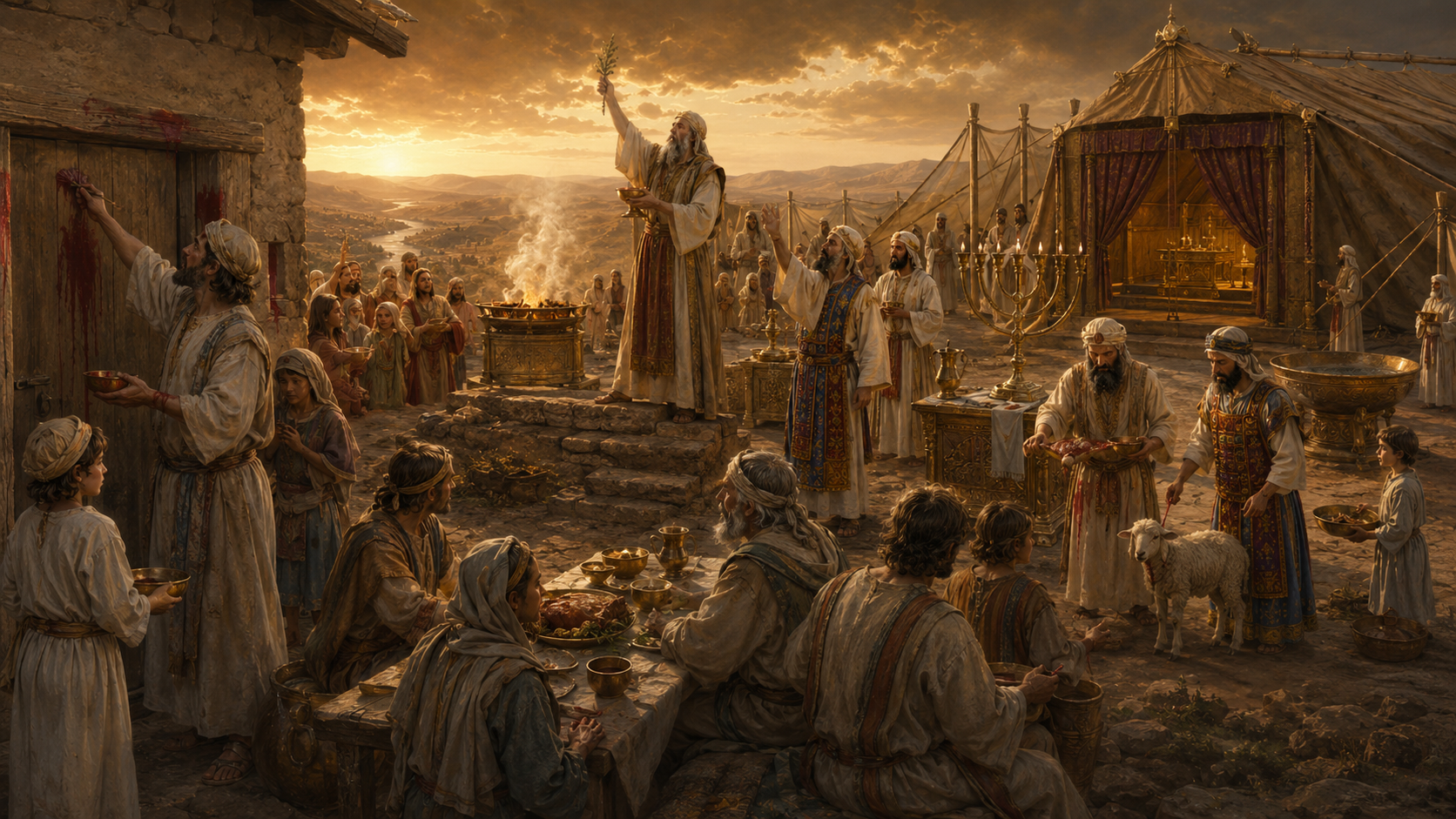
The Passover is not a mere story remembered by words. It is an act commanded in detail: lamb, blood, unleavened bread, household meal, haste, night, judgement and deliverance. Israel is freed through a sign placed upon the house and through a meal eaten in obedience. Worship here is already historical, sacrificial, communal and pedagogical. It teaches the people who they are because it teaches them what God has done.

This is the first great passage from domestic cult to the worship of a redeemed people. The family remains present, but the whole nation is now marked by the same command and the same memory. Sacred time begins to shape identity. The calendar becomes theology written into the year.

Passover and Exodus
Passover and ExodusBlood, meal and covenant prepare the redemption that culminates in Christ.

Sinai: covenant and blood Exodus 24:3-11

At Sinai the covenant is sealed with blood. Moses builds an altar, young men offer sacrifice, the blood is sprinkled, the words of the covenant are read, and the people answer. Doctrine, sacrifice and obedience stand together. The people are not asked to invent worship; they receive the words, the altar and the blood within the covenant God gives.

Here the reader sees why biblical worship is never merely interior. The covenant is heard, accepted and ritually sealed. Word and sacrifice are not enemies. The spoken command and the visible rite belong together because man is body and soul, memory and action, hearing and offering.

Tabernacle: sacred space and divine pattern Exodus 25-40

The Tabernacle gives Israel a sacred geography. There is court, altar, laver, holy place, lampstand, table, incense altar and the Holy of Holies. Access is ordered. Purification precedes approach. Sacred objects are made according to command. The worship of Israel is therefore not spontaneous assembly around a general religious feeling; it is the ordered dwelling of God among His people.

The repeated biblical insistence that Moses makes the sanctuary according to the pattern shown by God is decisive. Liturgy is received pattern before it is human expression. It is not an empty shell, but a school of reverence: the people learn that God is near, yet holy; merciful, yet not common; present, yet approached through purification and priestly service.

Levitical service: sacrifice made orderly Leviticus 1-7; 16; Numbers 28-29

Leviticus and Numbers may appear difficult to the modern reader because they are full of prescriptions. Yet this is precisely their importance. Worship is not left to improvisation. Different sacrifices teach different aspects of man's relation to God: holocaust, peace offering, sin offering, guilt offering, daily offering, feast offering and the solemn rites of atonement.

The prescriptions are not a denial of the spirit. They protect worship from arbitrariness and teach that holiness orders time, place, body, gesture, priesthood and people. Israel's public cult is now a complete liturgical world. It surrounds the offering with commanded signs so that the people may learn reverence not as an idea, but as a way of standing before God.

V. Temple and Psalms

The height of Israel's public worship

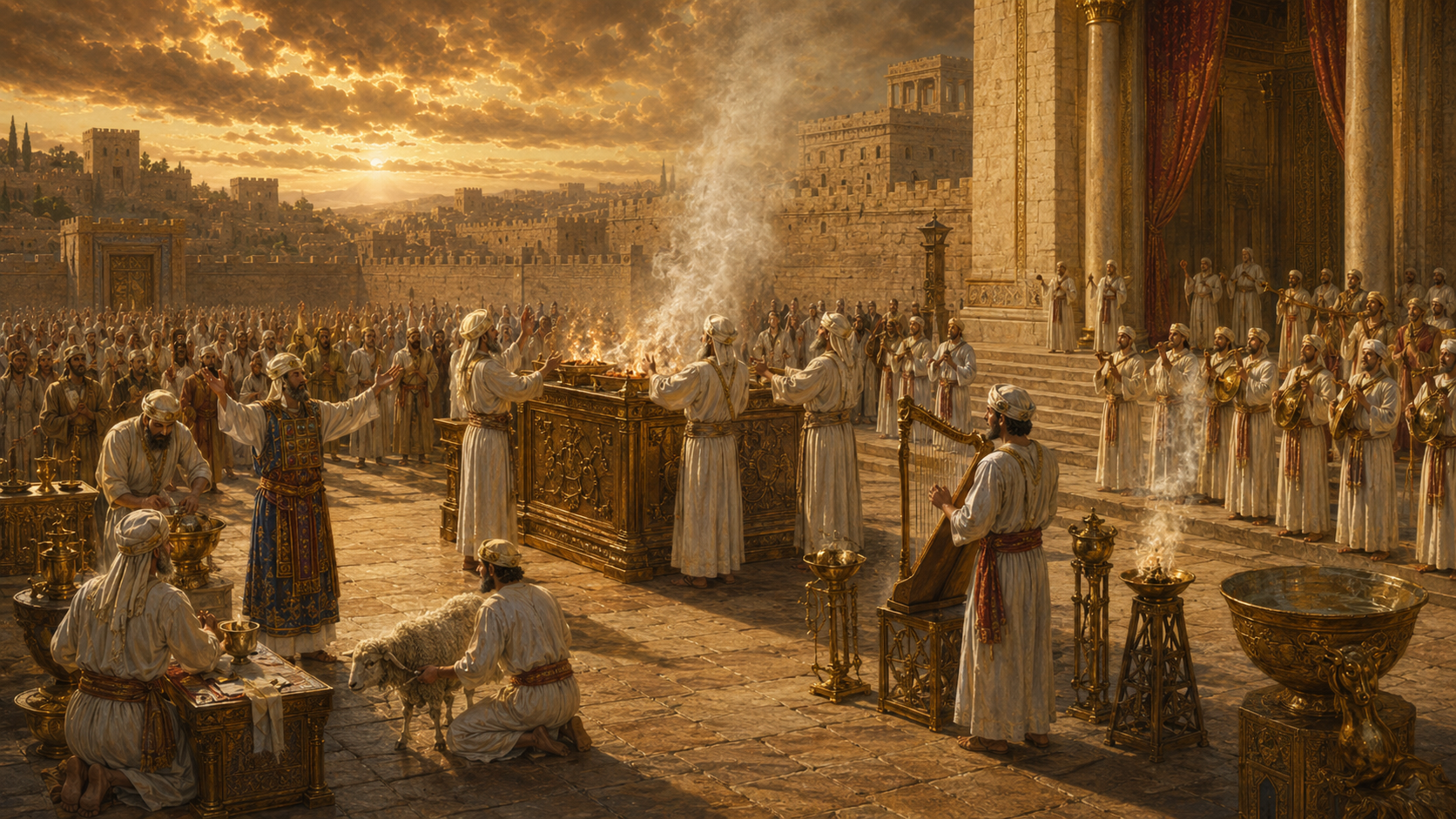
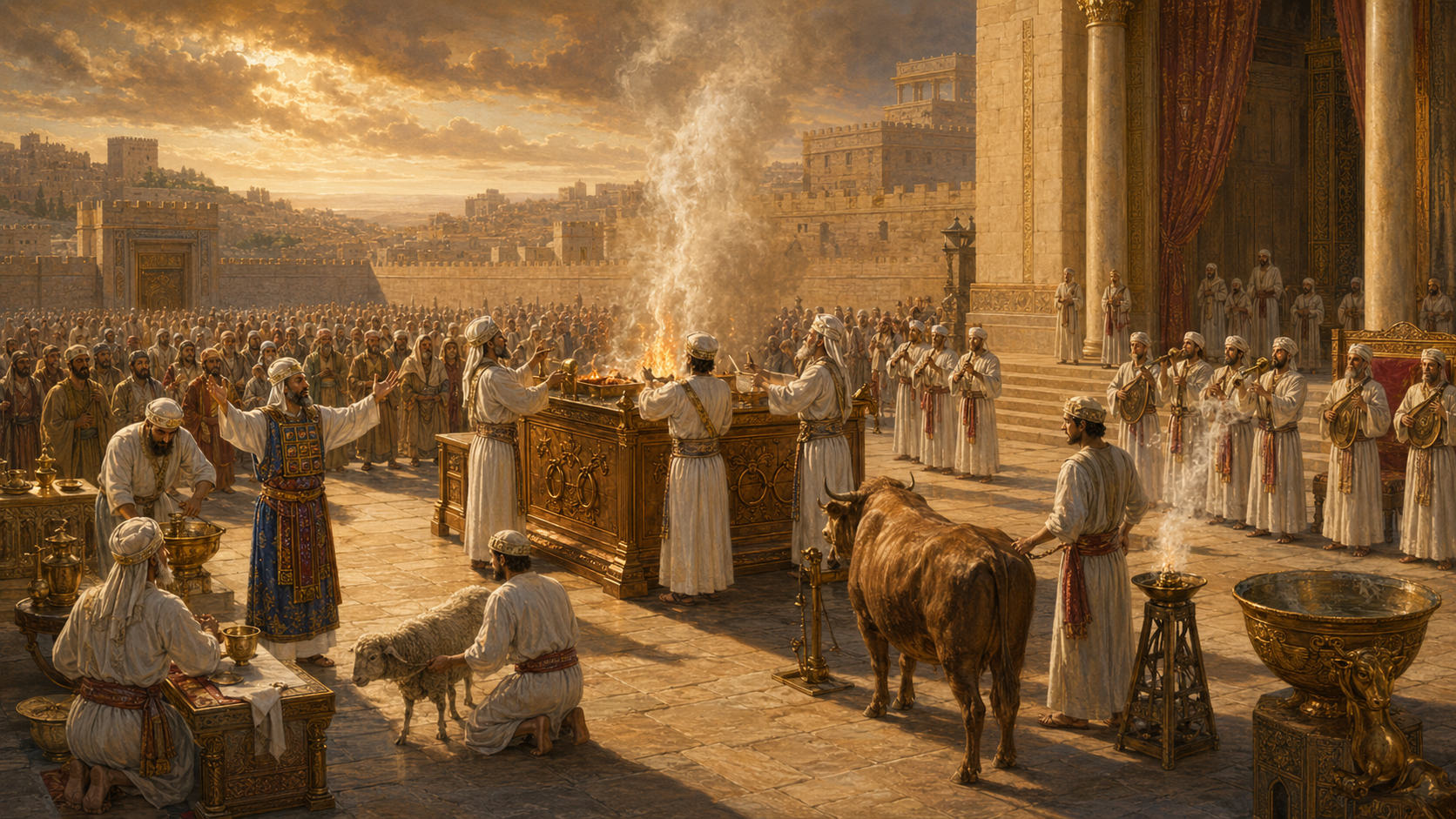
The Tabernacle is portable; the Temple gives Israel a fixed sacred centre. In Jerusalem the lines of altar, priesthood, incense, song, calendar, pilgrimage and royal memory meet. The Temple is not simply a building. It is the visible sign that worship has a place, a throne, an altar, a priestly order and a people called to ascend to God.

The altar and the sanctuary

The altar stands at the centre of Temple worship because Israel's cult is sacrificial. Yet the sanctuary shows that sacrifice is not isolated slaughter. It belongs to a holy order: purification, approach, priestly service, incense, prayer and blessing. The sacred place teaches distance and nearness at the same time.

Temple and Psalms
Temple and PsalmsPublic cult, priesthood, incense and sacred song shape the language of worship.

The priesthood and the people

The priests serve by appointment; the people worship as a people. This difference is not contempt for the people, but order for the sake of the people. Biblical priesthood teaches that public worship needs mediation, office, blessing, purification and continuity. The people are gathered, not abandoned to individual invention.

The Psalms as liturgical soul

The Psalms teach Israel to pray in every state: joy, fear, guilt, exile, ascent, thanksgiving, kingship, lament and praise. They give public worship a language deep enough for the whole human condition. The Church later receives them not as archaeological memory, but as living prayer fulfilled in Christ.

Hours, incense and sacred rhythm

Temple worship forms time. Morning and evening sacrifice, incense, feast days and pilgrimage teach that time itself belongs to God. Worship is not an occasional interruption of ordinary life; it is the sanctification of life by recurring remembrance, offering and praise. This rhythm prepares the later Christian sense that the day, week and year can be ordered to divine worship.

Jerusalem and ascent

The pilgrim psalms teach ascent: the people go up to the holy city, not merely to attend an event, but to appear before God. This ascent is outward and inward. Feet climb the road; the heart is purified; the people move from scattered life to gathered worship. The geography of Israel becomes a pedagogy of the soul.

VI. Prophecy

Worship purified and opened toward fulfilment

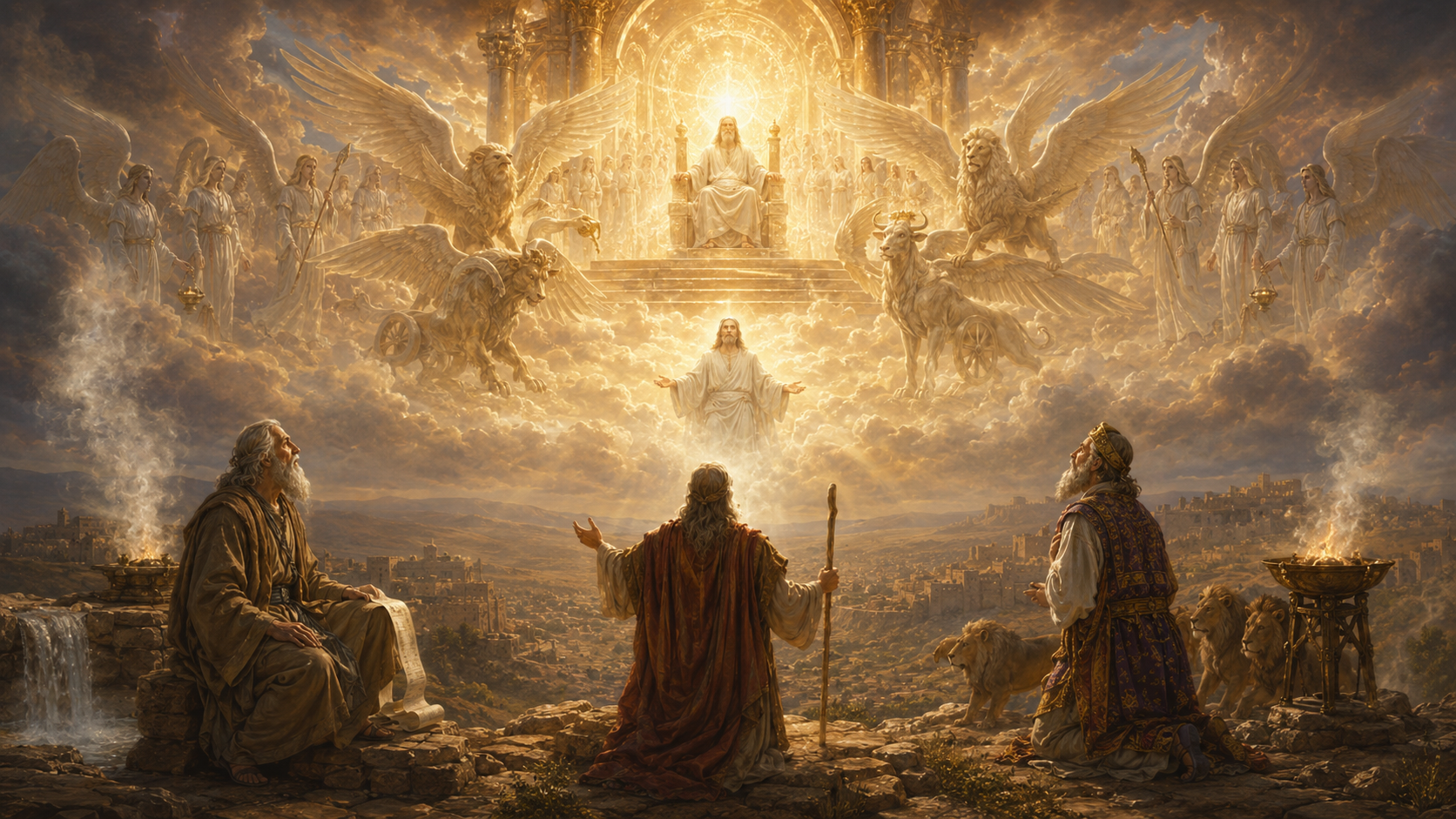
The prophets do not abolish cult. They condemn false worship: sacrifice without conversion, feasts without justice, lips near God while the heart is far away. At the same time, they reveal that the visible worship of Israel points beyond itself. The throne, the altar, the purified lips, the suffering servant, the renewed Temple and the Son of Man open the Old Covenant toward a mystery not yet fully manifest.

Isaias: holiness, altar and servant Isaias 6; 53; 56; 66

Isaias sees the Lord enthroned and the seraphim crying holy. His lips are purified by fire from the altar. Worship begins with adoration and purification; mission follows worship, not the reverse. The same prophet later speaks of the suffering servant and of all nations coming to worship. Sacrifice, purification and universal worship are drawn into a larger promise.

Prophets
ProphetsThe prophets open earthly worship toward heavenly mystery and fulfilment.

Ezechiel: glory and restored order Ezechiel 1; 10; 40-48

Ezechiel sees the glory of God depart and return. His Temple vision is full of measurements, gates, waters, priestly order and sacred boundaries. This is not dry architecture. It teaches that restoration is liturgical as well as moral: when God restores His people, worship is purified, space is ordered, and life flows from the sanctuary.

Daniel: Son of Man and kingdom Daniel 7

Daniel lifts worship toward the final kingdom. The Son of Man receives dominion; the saints are vindicated; earthly empires pass away. The public cult of Israel is thus not a closed national possession. It is part of a history moving toward universal kingship and everlasting worship.

VII. Toward Christ

The Old Covenant is ordered toward a person, not an abstraction

The whole biblical preparation would remain incomplete if it ended with altar, priesthood, Temple and prophecy as separate themes. Scripture gathers them toward Christ. He is not merely another teacher about worship. He is the fulfilment toward which sacrifice, priesthood, covenant, Passover, Temple, Psalm and prophecy are ordered.

Priest, victim, altar and mediator

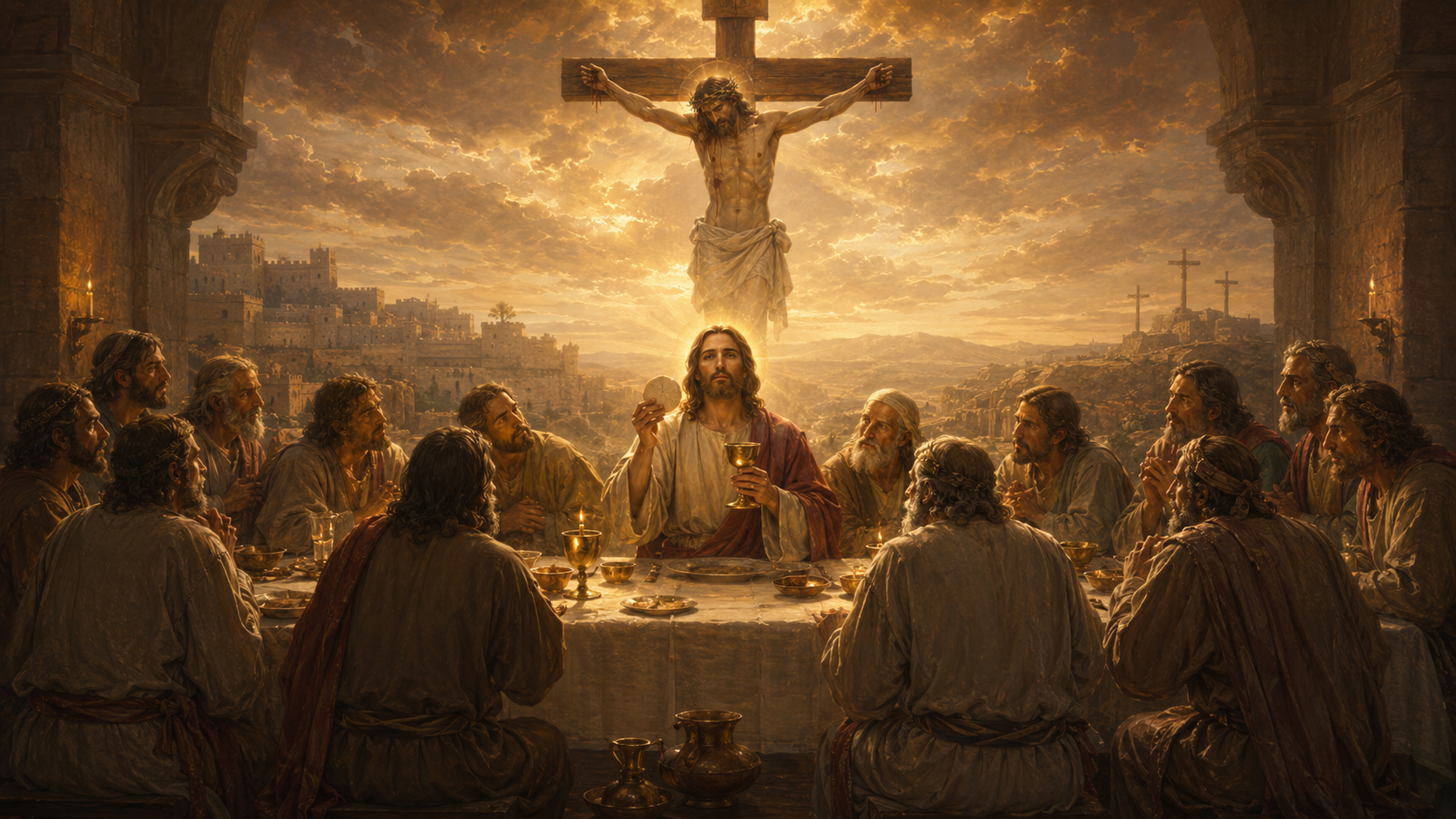
The Old Covenant gives many elements: a priest who serves, a victim offered, an altar of sacrifice, blood of covenant, bread and wine, incense of prayer, psalms of praise and a sanctuary of divine presence. In Christ these lines do not disappear; they become intelligible. He stands at the centre because He unites what was formerly distributed among signs, persons and places.

This page stops at the threshold. It prepares the reader to understand why Christian worship cannot be reduced to instruction, fellowship or memory alone. The next step is the Holy Mass, where the fulfilment of sacrifice, priesthood, covenant and heavenly worship must be treated directly.

Christ
ChristAt the Supper and on Calvary Christ gathers the figures into His saving work.

Continuity and fulfilment

Fulfilment does not mean that the Old Covenant was meaningless until replaced. It means that its figures were real preparations. Abel, Noah, Abraham, Melchizedek, Moses, Aaron, David, Solomon, Isaias, Ezechiel and Daniel each contribute a line of meaning. The Christian reader should therefore not rush past Israel's worship. Without the Old Testament, the language of sacrifice, priesthood, altar, covenant and heavenly worship becomes thin and easily misunderstood.

To study Catholic liturgy well is to move patiently through this order: cultus, altar, sacrifice, covenant, public worship, Temple, prophecy, Christ, heavenly consummation.

VIII. Heaven

The worship of earth points beyond earth

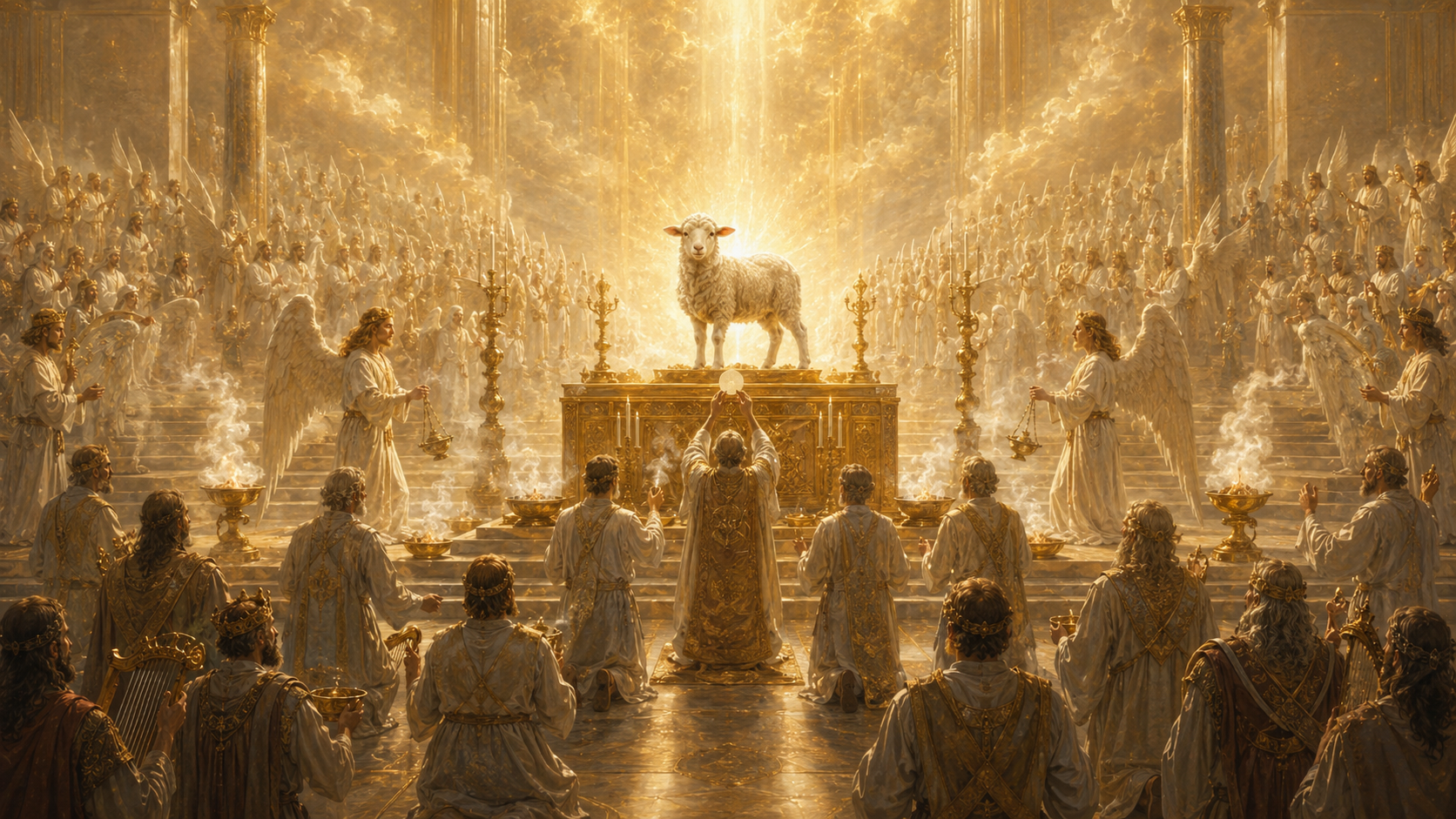
The Apocalypse shows worship in its final horizon: throne, Lamb, altar, incense, elders, angels, hymns and ceaseless praise. The end of worship is not religious self-expression, but the glory of God. Earthly liturgy is sacred because it is ordered beyond itself. It prepares man for the worship of heaven, where truth, holiness, sacrifice and praise are no longer seen through figures, but in the unveiled triumph of God.

Altar and Lamb

The Apocalypse does not present heaven as empty abstraction. It shows altar and Lamb, sacrifice and victory, adoration and song. The language of worship remains concrete because redemption is concrete.

Heaven
HeavenThe Apocalypse shows the altar, the Lamb, angels and ceaseless heavenly praise.

Incense and prayer

The prayers of the saints are shown under the sign of incense. What the Temple foreshadowed is not discarded; it is lifted into its heavenly meaning.

Angels and saints

Heavenly worship is not solitary. It is communion: angels, elders, saints and the redeemed gathered before God. Public worship on earth is ordered toward this final communion.

Study path

Where to continue

This overview has not yet attempted to explain the Holy Mass in detail. It has prepared the biblical ground: cultus, sacrifice, public order, priesthood, Temple, Psalms, prophecy, Christ and heavenly worship. Continue now to the pages that unfold each part more specifically.

Holy Mass

Continue from the biblical preparation to the central act of Catholic worship.

Continue

Roman Rite

Study the received Roman order: silence, canon, chant, calendar, sanctuary and stational memory.

Open

Symbols of the Mass

Learn the sacred gestures and visible actions by which worship forms the body and teaches the soul.

Open

24 Catholic Churches

See how the one Catholic faith is expressed through Latin, Byzantine, Alexandrian, Syriac, Armenian and East Syriac inheritances.

Open