
Sancta Missa · Sacrificium · Eucharistia
The Holy Mass
The page on sacred liturgy prepared the way by following cultus from the first altars, through Moses, the Passover, the priesthood, the Temple, the Psalms and the prophets. This page now asks what the Holy Mass is. It does not begin with a bare definition, as if the Mass were an isolated ceremony. It begins with the long biblical preparation: God taught His people by altar, sacrifice, priesthood, bread, blood, covenant and sacred presence before Christ fulfilled all these figures.
The Holy Mass is the sacramental presence and unbloody offering of the one sacrifice of Christ. The old sacrifices found their end in the sacrifice of Calvary; yet worship did not disappear from the New Testament. Christ did not redeem man in order to leave him without cult, altar, priesthood, offering and communion. He fulfilled the old order and gave His Church the new cult of the New Testament: His own sacrifice, made present without a new death, received in Holy Communion, and joined to His living intercession before the Father.
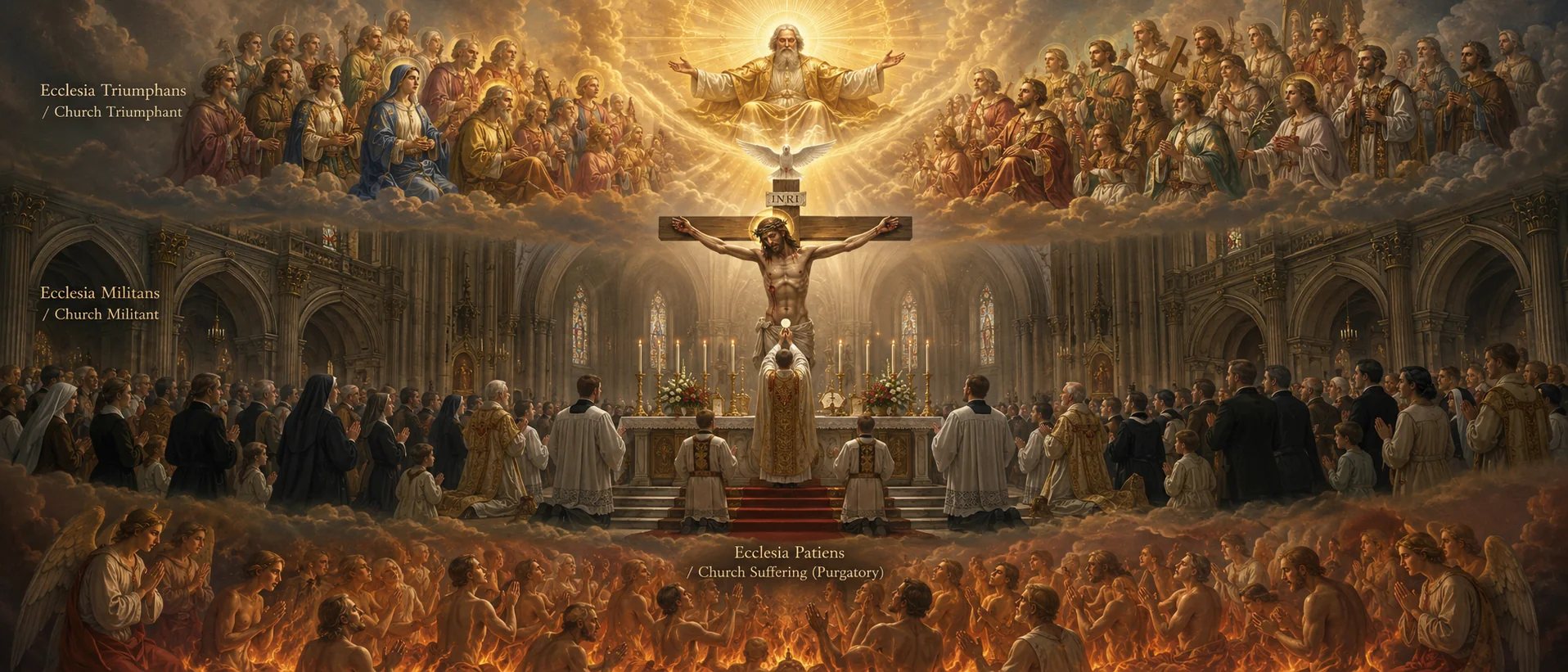
What the Mass is
The Mass is not understood rightly if it is separated from the whole economy of worship. Before the Mass can be described as a rite of the Church, the reader must see the road that leads to it. Abel offers from the firstlings of his flock; Noah builds an altar after the Flood; Abraham raises altars and is tested on Moria; Melchizedek appears as priest of the Most High God with bread and wine; Israel is delivered by the blood of the lamb and the meal of Passover; Moses receives the pattern of tabernacle, altar, priesthood and sacrifice; the Temple gathers the worship of the people into solemn public cult; the prophets announce purification, a suffering servant, a pure offering among the nations and the coming of the Son of Man.
All this is not a loose collection of symbols. It is divine pedagogy. God teaches man that worship is not self-invented, that sin requires atonement, that covenant is sealed by blood, that sacred bread signifies presence, that priesthood mediates public worship, that sacrifice is the highest act of cultus, and that the people of God are gathered not only by doctrine but by worship. The Old Covenant forms the vocabulary by which the sacrifice of Christ can be recognised when it appears.
For this reason the Mass must be approached from fulfilment, not from abstraction. It is not first a meeting, lesson, hymn service or religious memorial. It is the sacramental offering of Christ to the Father, under the signs He Himself established, so that the one sacrifice of Calvary may be present to the Church in time. It is also the sacrament in which Christ gives Himself as food: the same Lord who offers Himself is received by the faithful under the appearances of bread and wine.
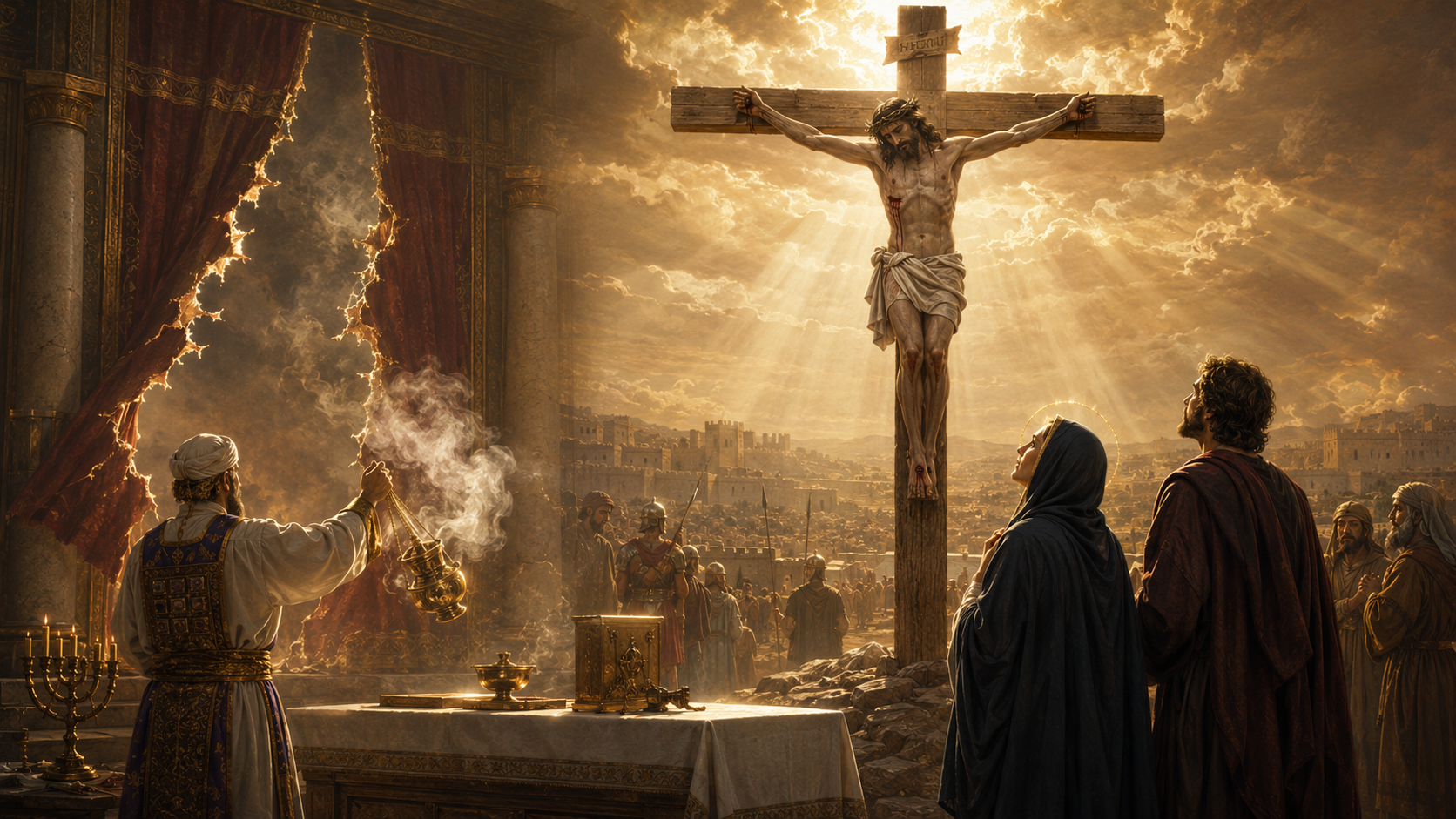
Calvary and the torn veil
The sacrifices of the Old Covenant reached their fulfilment at the Cross. Christ is not merely another victim beside the lambs of the Temple, nor merely another priest beside Aaron's sons. He is the Incarnate Word, the innocent Lamb, the eternal High Priest, the true Temple and the Mediator of the New Testament. On Calvary He offers Himself to the Father in obedience and love. The sacrifice is bloody, visible, historical and complete. Nothing can be added to the merit of that Passion.
The tearing of the veil in the Temple must be read in this light. The veil had marked the holy place and the separation of man from the innermost sanctuary. When Christ dies, access is opened by His Blood. The old sacrificial order is judged, fulfilled and surpassed; the many offerings of the Temple have reached the one offering toward which they pointed. The end of the old sacrifice is not the end of worship, but the end of figure before fulfilment.
This point is decisive. Some imagine that because Christ completed sacrifice on the Cross, the New Testament must contain no cult and no sacrifice. Catholic doctrine answers otherwise. Christ did not abolish worship by fulfilling it. He abolished the insufficiency of the old order. He did not leave His disciples with bare memory, private sentiment or instruction alone. He gave them a sacramental participation in His one sacrifice, so that the fruits of Calvary might be applied to souls through time.
The old sacrifices end
They end not because they were meaningless, but because the reality has come. The many victims, repeated priests and veiled sanctuary give way to Christ: one Victim, one eternal Priest, one opened way to the Father.
The sacrifice of Christ remains
Christ dies no more; yet His sacrifice is not locked in the past as a dead event. The risen High Priest lives forever to intercede, and His one oblation remains the source from which grace is applied.
The Church receives a cult
The New Testament people are not without public worship. They receive prayer, baptism, Eucharist, priesthood, altar, Communion and the command to do what Christ instituted in memory of Him.
The cult of the New Testament
Christ does not take sacrifice away from His followers in the sense of making Christian life effortless or worship empty. He commands the disciple to take up the cross daily and follow Him. This daily carrying of the cross is not a rival sacrifice beside His own, but participation in it. The Christian is drawn into the obedience, charity, penance and self-offering of the Lord. In the Mass this participation receives its centre: the Church offers through Christ, with Christ and in Christ, because Christ is the principal priest and victim.
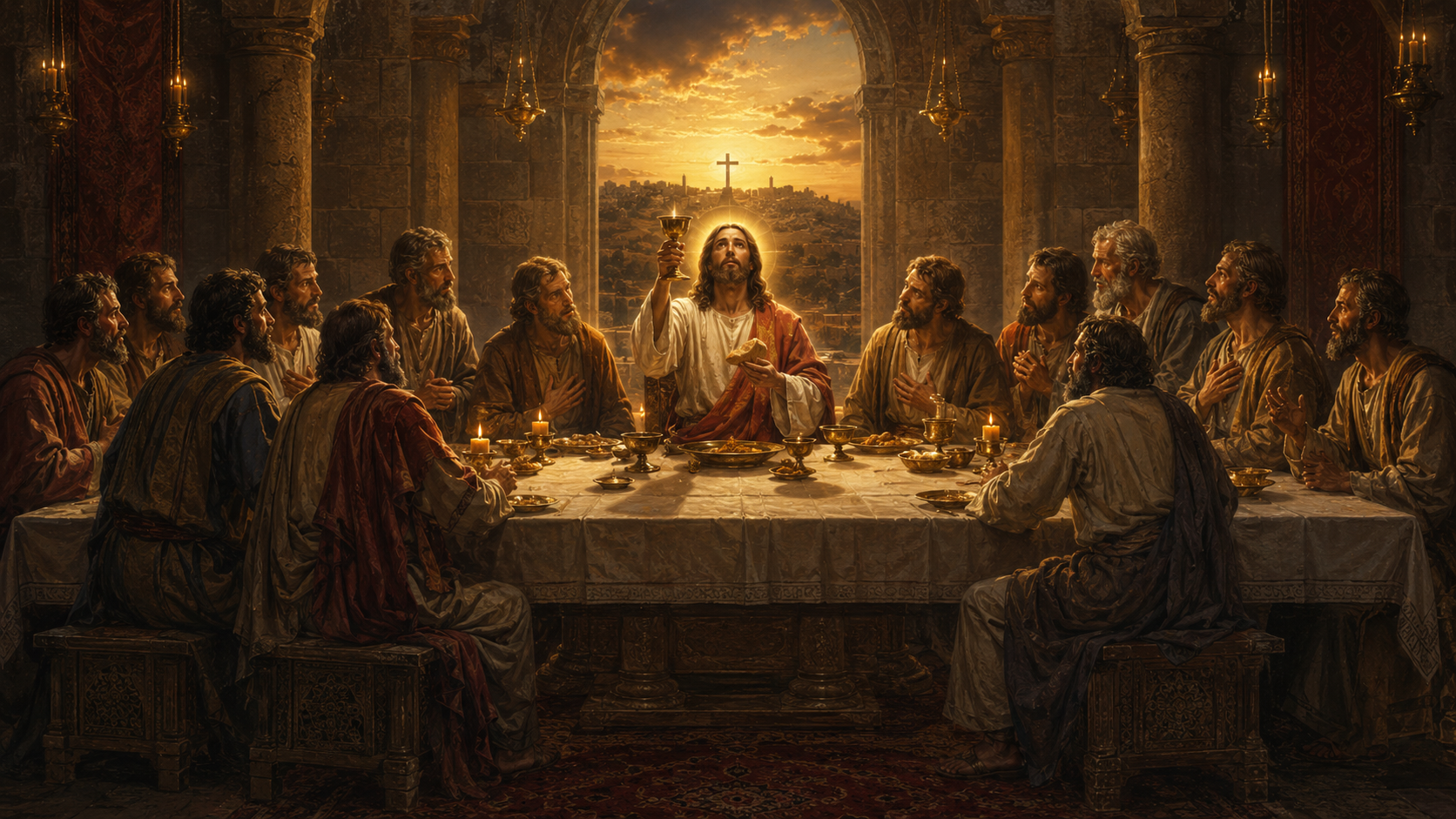
At the Last Supper, Christ prepares and institutes the cult of the New Testament. He takes bread and wine, gives thanks, speaks over them the words of His Body and Blood, and commands the Apostles to do this in remembrance of Him. The words are not only words of fellowship; they are sacrificial covenant words. “This is my body, which is given for you”; “This cup is the new testament in my blood.” The Supper is ordered to the Passion, and the Passion gives the Supper its sacrificial truth.
Thus Holy Thursday and Good Friday are inseparable. At the Supper Christ sacramentally anticipates what He will offer in blood on Calvary. On the Cross He accomplishes what the Supper signified and made present under sacramental signs. In the Mass, after the Resurrection and Ascension, the Church does not produce a new Calvary. She receives the abiding sacramental form by which the one Calvary is made present without a new shedding of blood.
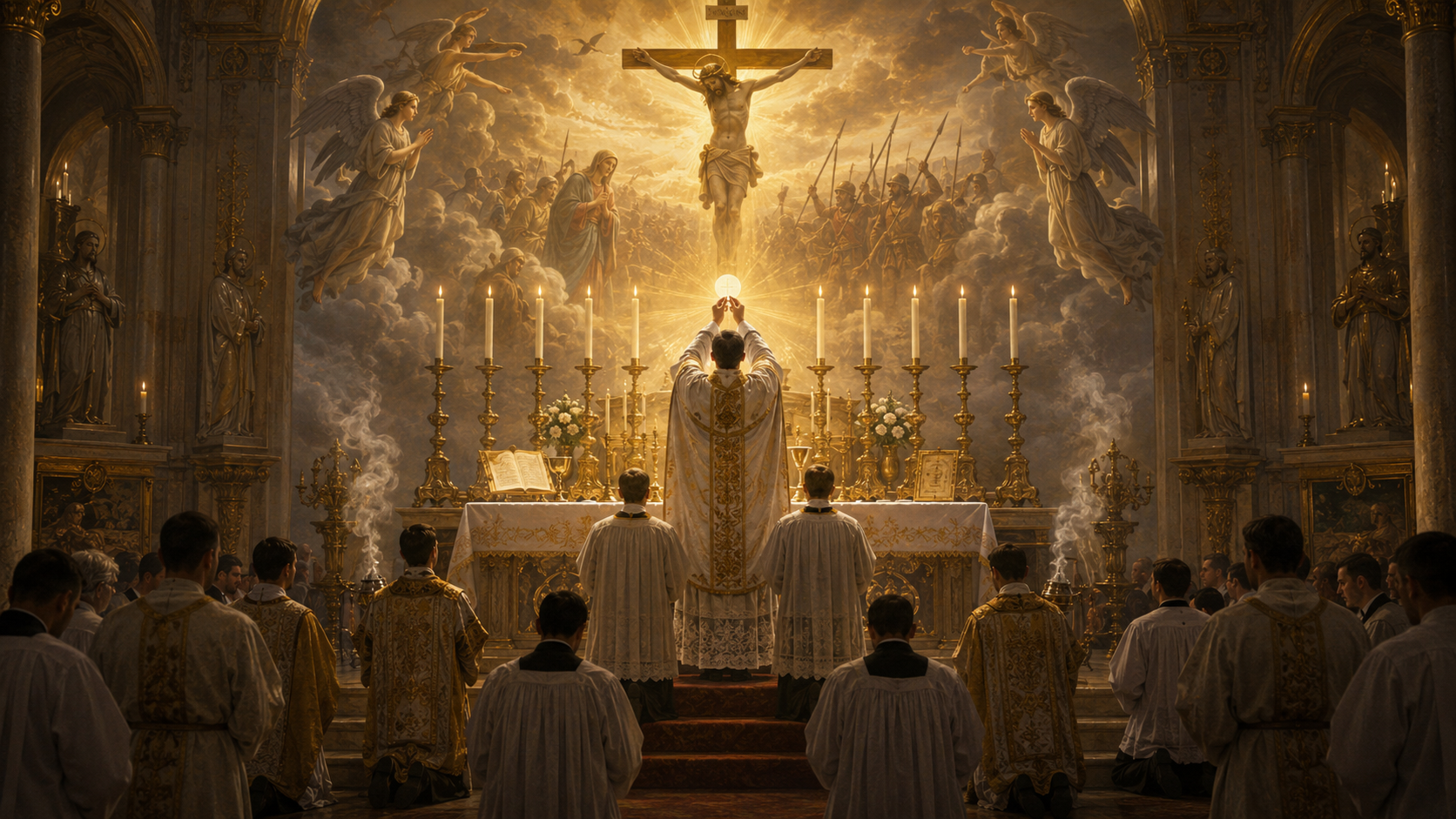
The Mass is therefore a true cult, not a bare remembrance. It is public, ordered, sacrificial and priestly. The visible priest acts ministerially; Christ remains the principal priest. The bread and wine do not remain ordinary gifts; by consecration they become the Body and Blood of Christ. The Church does not replace the sacrifice of Christ; she is admitted into it, so that she may adore the Father, give thanks, obtain mercy and receive the sacrificial Victim as heavenly food.
From showbread to the tabernacle
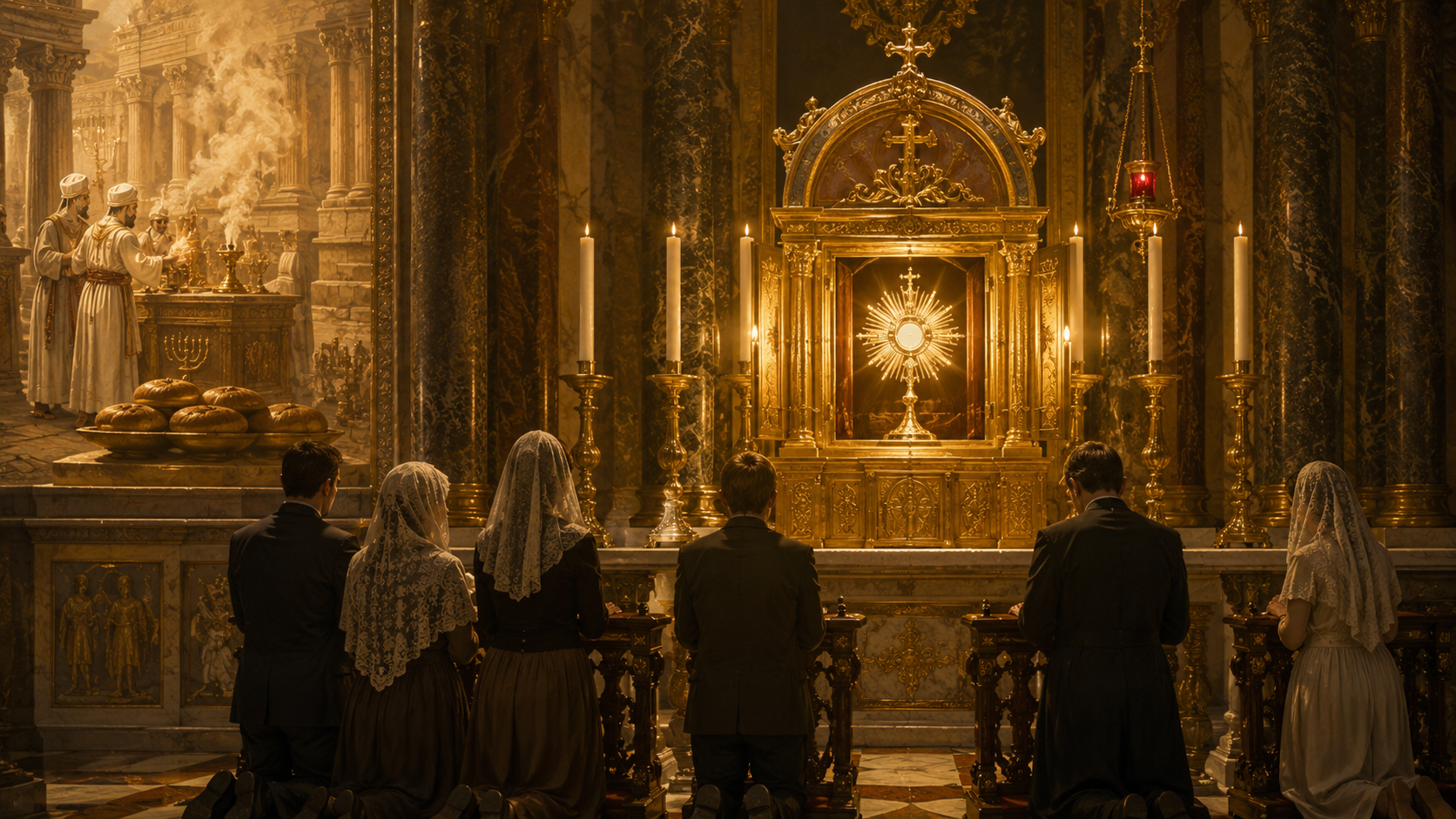
The Old Covenant already taught Israel to think of sacred presence through sacred bread. The loaves of proposition, or showbread, were set before the Lord in the holy place. They were not the Eucharist, but they formed part of the biblical preparation. Bread was placed in relation to covenant, priesthood and sanctuary. It stood before God as a sign within the ordered worship of Israel.
In the New Testament, the figure gives way to fulfilment. Christ does not leave His Church with bread that merely reminds her of divine favour. He gives Himself. In the Eucharist, under the appearances of bread and wine, He is truly, really and substantially present: Body, Blood, Soul and Divinity. The tabernacle is therefore not a decorative remnant of ancient religion. It is the dwelling of the Eucharistic Lord among His people. The old bread of presence was a figure; the Eucharistic presence is the fulfilled reality.
This gives the Mass its full movement. Christ is offered to the Father, and Christ gives Himself to the faithful. Sacrifice and Communion are not enemies. The sacrificial Victim becomes food. The altar leads to the tabernacle, and the tabernacle sends the faithful back to adoration. Christ promised to remain with His own; in the Eucharist this promise is given with a nearness that demands faith, reverence and love.
Definitions guarded by the older catechisms
Only after this biblical path is clear can the concise definitions be heard correctly. The older catechisms do not invent a theory apart from Scripture; they guard the meaning of Scripture and the received worship of the Church. They protect two truths at once: the Cross is perfect and cannot be repeated as though incomplete; the Mass is a true sacrifice and not a mere symbolic reminder.
Council of Trent
The Mass is a true and proper sacrifice. In this divine sacrifice the same Christ is contained and offered in an unbloody manner who once offered Himself in a bloody manner on the altar of the Cross. It is not another victim and not another principal priest, but the same Christ offered under a different mode.
Catechism of Pius X
The sacrifice of the Mass is substantially the same as that of the Cross. Jesus Christ, who offered Himself on the Cross, offers Himself by the hands of His priests on the altar; the manner differs because on the Cross He shed His Blood, while in the Mass He is offered without bloodshed and applies the fruits of His Passion.
Baltimore Catechism
The Holy Eucharist is both sacrament and sacrifice. Under the appearances of bread and wine, Christ is contained, offered and received. The Mass is the same sacrifice as the Cross because the victim is the same and the principal priest is the same: Jesus Christ.
These definitions are brief because they are meant to be exact. The Mass is not a second redemption; it is the sacramental application of the one redemption. It is not a stage play of Calvary; it is the true sacramental presence of the sacrifice of Calvary. It is not only meal; it is sacrifice received as Communion. It is not only the action of the visible priest; it is the action of Christ the High Priest through His minister.
The scriptural line gathered into the Mass
The Holy Mass gathers the biblical line without flattening it. Abel teaches acceptable sacrifice; Melchizedek joins priesthood, blessing, bread and wine; the Passover joins lamb, blood, meal and deliverance; the manna and showbread teach heavenly bread and sacred presence; Isaias teaches purification from the altar and the Sanctus of heavenly worship; the suffering servant reveals vicarious offering; Malachi announces a pure offering among the nations; the Epistle to the Hebrews reveals Christ as the eternal High Priest who enters the sanctuary with His own Blood.
The Mass does not merely quote these passages. It stands at their fulfilment. The altar is not simply a memory of patriarchal stones; it is the place of sacramental sacrifice. The priesthood is not merely the continuation of Aaron; it is ministry under Christ the eternal High Priest. The sacred bread is not merely a sign before the Lord; it is the Lord Himself under sacramental appearances. The Sanctus is not only a beautiful acclamation; it is the Church joining the angelic worship of God.
Because the Mass gathers the whole economy of worship, it must be approached with a formed mind. One cannot reduce it to one element without damaging the whole. It is sacrifice, but not without Communion. It is Communion, but not without sacrifice. It is presence, but not without offering. It is public worship, but not without interior conversion. It is earthly rite, but not without heavenly orientation.
The New Testament priesthood
The sacrifice of the New Testament is not entrusted to a formless religious crowd. Christ is the one eternal High Priest, and no priest in the Church can stand beside Him as another source of redemption. Yet Christ chose to make men His ministers. He called the Apostles, gave them the Eucharistic command, breathed upon them for the forgiveness of sins, and sent them as the Father had sent Him. The ordained priest therefore does not invent the sacrifice and does not own it. He receives a sacred office inside the priesthood of Christ.
The Epistle to the Hebrews gives the key: Christ is priest forever according to the order of Melchizedek. Melchizedek appears before the Law with blessing, priesthood, bread and wine; Christ fulfils that figure infinitely. In the Mass the priest does not return to the imperfect priesthood of Aaron as if Calvary had not happened. He ministers under the eternal priesthood of Christ. He stands at the altar as a sacramental instrument, a visible minister, and a real representative by participation in the one Mediator.
This is why the priestly office is not merely leadership, teaching or ceremonial presidency. The priest is ordained for the altar, for sacrifice, for absolution, for blessing, for the sanctification of souls. He is set apart for God. His hands are consecrated for holy things; his life must be marked by purity, obedience, prayer and custody of the sacred mysteries. In the Latin Church, celibacy expresses this undivided consecration to God and the altar; it does not despise marriage, but witnesses that the priest belongs in a singular way to Christ and to the service of His Church.
At the consecration the priest speaks the words of Christ in persona Christi: not as a narrator reporting a past event, but as the minister through whom Christ acts sacramentally. “This is my Body”; “This is the chalice of my Blood.” The power of these words is not the personal holiness of the priest, but Christ who instituted the sacrament and acts through the ordained ministry. For this reason the Mass is the summit of the priest's office. From the Cross, made present in the Mass, the graces of the sacraments flow into the Church; and the priest who baptises, absolves, anoints and blesses does so as a minister of the same saving priesthood.
The order of the Mass as sacrificial movement
The order of the Mass teaches by movement. The faithful do not begin at Communion as if the sacrament were ordinary food distributed without ascent. They are led toward the altar. The prayers of preparation confess unworthiness and ask purification. The readings and chants place the action within revelation. The offering of bread and wine sets apart the matter that will be consecrated. The Canon surrounds the consecration with praise, petition, remembrance of saints and intercession for the living and the dead.
This order is not a late invention without roots in the apostolic Church. The New Testament already shows the essential line: the faithful continue in the doctrine of the Apostles, fellowship, breaking of bread and prayers; on the first day they gather for the breaking of bread; Saint Paul transmits the words of institution and warns that the Body of the Lord must be discerned. The external shape will grow in solemnity, language and ceremonial richness, but the inner structure is already visible: apostolic teaching, prayer, Eucharistic offering, sacramental Communion and ecclesial discipline.
The early witnesses confirm the same direction. The Didache speaks of the Lord's Day assembly, confession before worship, the breaking of bread, thanksgiving and a pure sacrifice. Saint Justin Martyr describes readings, exhortation, common prayers, the kiss of peace, bread with wine and water brought to the presider, thanksgiving, the Amen of the people, Communion and distribution by deacons. These testimonies do not give every later rubric, but they show that Christian worship from the beginning was ordered, sacramental, Eucharistic, priestly and communal.
At the consecration, the words of Christ are spoken over the gifts. What was bread and wine becomes the Body and Blood of Christ. By the separate consecration of Body and Blood, the sacrifice of Calvary is represented sacramentally. The Church adores because Christ is present. She offers because the Victim is present. She receives because the sacrificial Lord gives Himself as food. The movement of the Mass therefore does not descend from ordinary gathering to ordinary food; it ascends from preparation and revelation to the altar, the Canon, the sacramental sacrifice and Communion.
Approach
The soul comes before holy things in humility, not as an owner but as one summoned by mercy.
Word
Scripture prepares the mind to recognise the mystery and places the sacrifice inside the whole economy of revelation.
Offertory
Bread and wine are set apart for sacred use and ordered toward the consecration.
Canon
The Church enters solemn prayer: praise, intercession, remembrance and offering are gathered around the sacrifice.
Consecration
By the words of Christ, spoken through the ordained minister, the sacred species become His Body and Blood.
Communion
The Victim offered to the Father is given to the faithful as the Bread of Life.
Holy Communion: the sacrifice received
Holy Communion must be understood from the sacrifice. The faithful do not receive an isolated sacred object; they receive the Christ who has made Himself present in the sacrificial action. Communion is therefore the sacrament of union, but it is not casual intimacy. It is the reception of the Lord who gives Himself under the appearances of bread and wine. Faith must confess what the senses cannot see; reverence must answer the presence of the Holy One; charity must conform the communicant to the sacrifice received.
This is why the Church has always treated preparation, fasting, confession of grave sin, thanksgiving and adoration as serious matters. The Eucharist is gift, but not common food. It is mercy, but not without conversion. It nourishes the soul because it gives Christ Himself. The Christian who receives the sacrificial Lord is called to become sacrificial in life: patient, obedient, penitent, charitable and united to the Cross.
The Mass and the worship of heaven
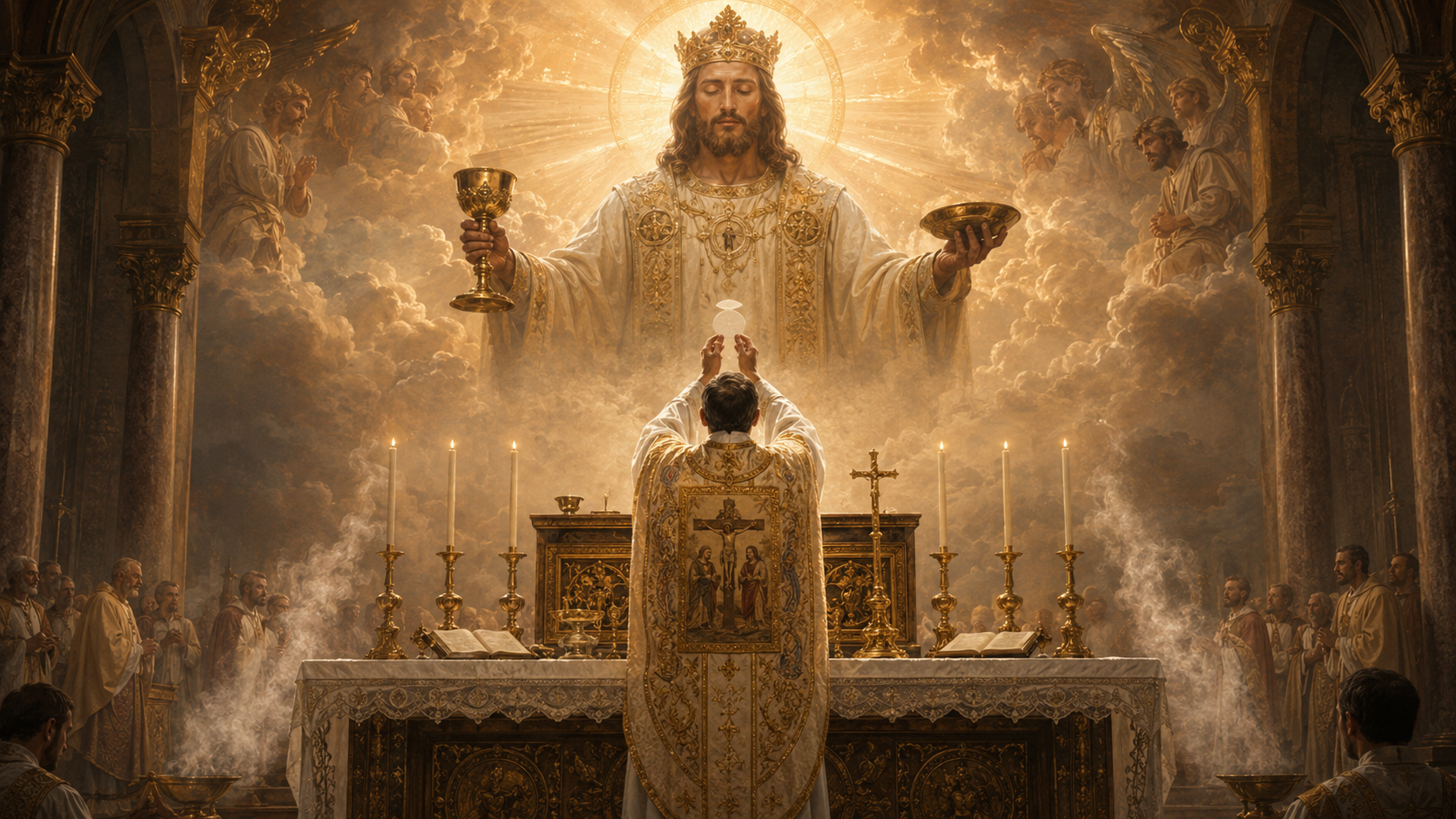
The Mass also opens the Church's worship toward heaven. Isaias hears the Sanctus before the throne. Saint John sees the Lamb, the altar, incense, elders, angels and ceaseless praise. These are not decorative images added after the doctrine has been explained. They reveal the final horizon of all worship: the adoration of God by angels and saints, with the Lamb at the centre.
At the altar, the Church on earth is not closed inside the visible congregation. The Church Militant worships with the Church Triumphant and prays for the Church Suffering. The Mass widens the soul beyond the present moment. It joins sacrifice, intercession, communion and hope. The faithful stand before the altar on earth, but the action is ordered toward the heavenly liturgy in which Christ, the Lamb once slain, lives and reigns forever.
Ecclesia Militans
The faithful on earth receive strength to carry the cross daily and to live from the sacrifice they adore.
Ecclesia Patiens
The dead in need of purification are remembered because the charity of the altar reaches beyond visible life.
Ecclesia Triumphans
The saints in glory are not absent from worship; the Church venerates their fellowship and asks to share their company in Christ.